

ModelMetaConfirmed
Story 1 of 8 in the Monday 12 October editionMeta launches Muse Wonder and Muse Wonder Full for AI agents
Meta calls them its most capable models. Muse Wonder is on the Meta Model API and in Muse Code; Muse Wonder Full comes only with a Muse Code subscription.

 Edited by Ashutosh Shrivastava
13 Oct 2026, 14:01 IST · 2 min read
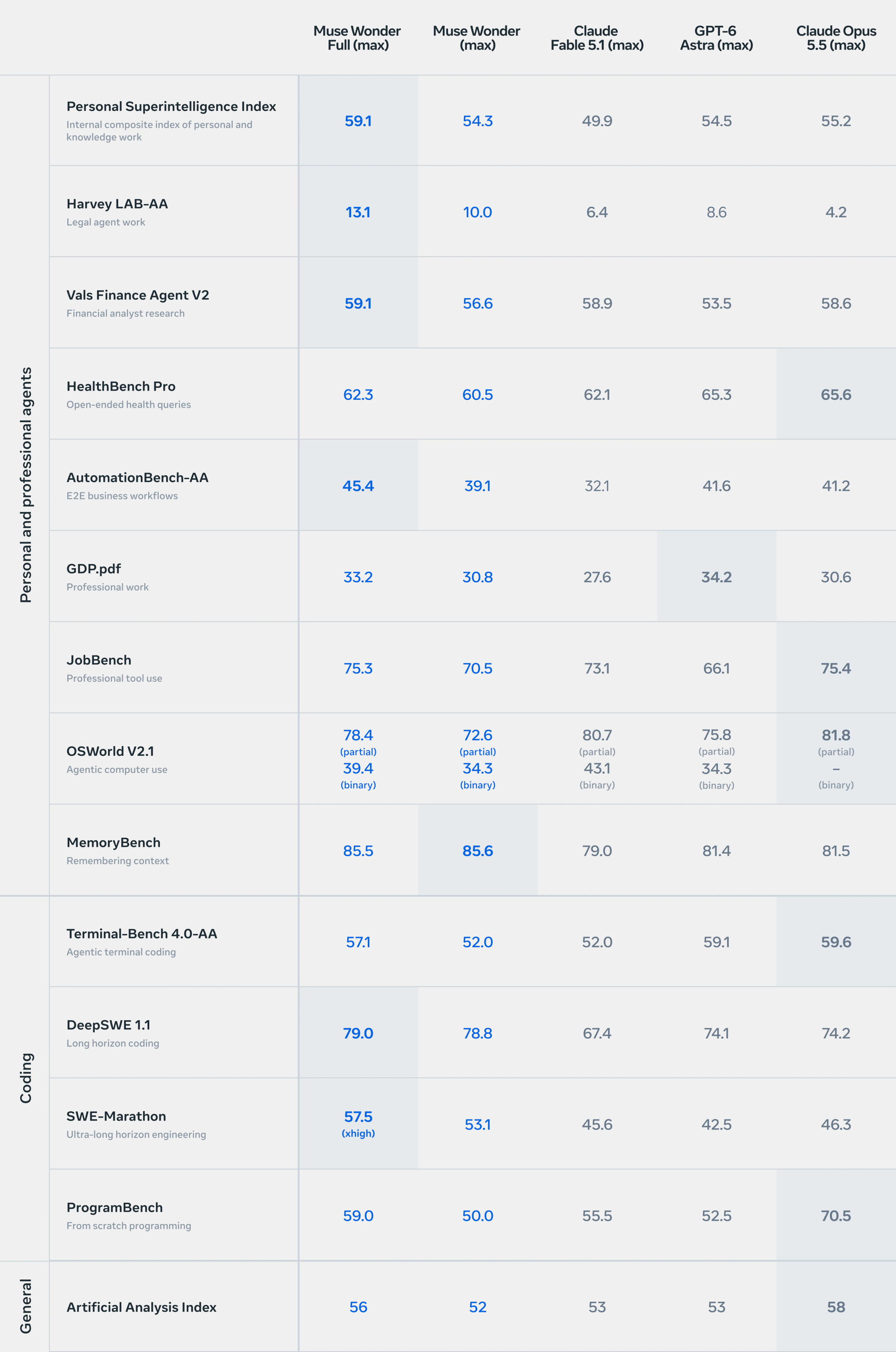
Meta announced both on 12 October and says they are state of the art on agent tasks in personal and professional settings. The model card says both take text, images, video and audio as input, produce text and are not intended for people under 18.
Meta trained both at Prometheus, its gigawatt-scale data centre, and highlights two behaviours: Active Memory, which carries what matters about a person from one conversation to the next, and Active Focus, which keeps the model on difficult goals and has it check with the user before important steps.
Price and access
On the Meta Model API, Muse Wonder (muse-wonder-1.0) costs $4.00 per million input tokens and $20.00 per million output tokens. Artificial Analysis notes that Muse Spark 1.3 was priced at $1.25 and $4.25.
Both models have a 1M-token context window. Muse Wonder Full (muse-wonder-full-1.0) has no per-token price: it comes with Muse Code, Meta’s multi-agent coding tool for the terminal, on the Power Usage plan at $50 a month or the Maximum Usage plan at $200 a month.
Key numbers
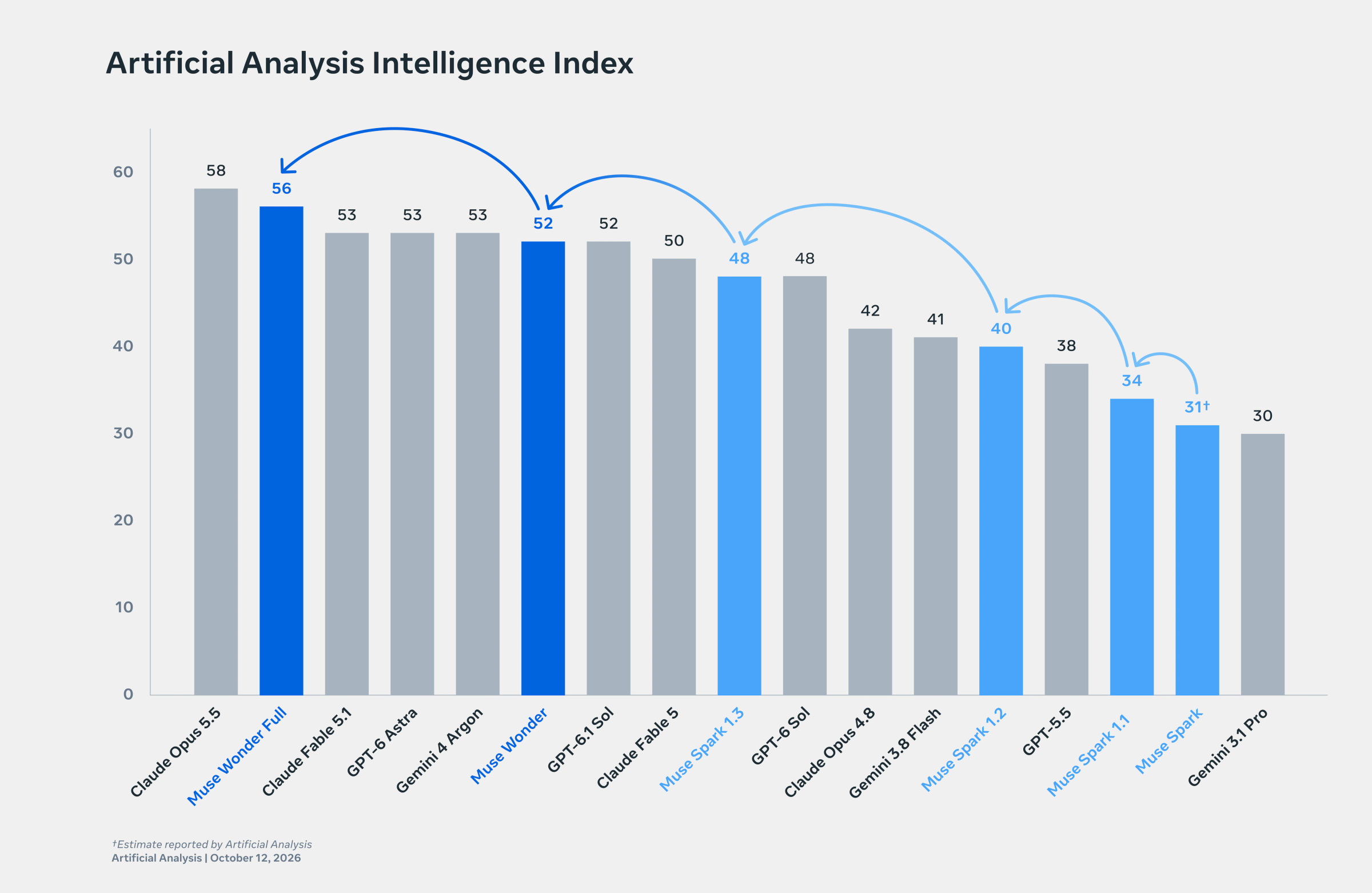
- Terminal-Bench 4.0, in Artificial Analysis’s own tests for its Intelligence Index v4.3, at maximum effort: 52% for Muse Wonder and 57% for Muse Wonder Full, up from 33% for Muse Spark 1.3
- Muse Wonder Full narrowly ranks first on CritPt and GDP.pdf, at 33% each, and is in the top three on six of the index’s ten evaluations
- $4.52 per task in the index for Muse Wonder, against $1.60 for Muse Spark 1.3, because of higher prices and heavy input use
Safety
Meta calls Muse Wonder its most aligned model and says it carries Meta’s strongest safeguards against chemical, biological, radiological, nuclear and cyber misuse. Its model card says Meta cannot rule out that the model, without those safeguards, would reach Meta’s high risk threshold for chemical and biological threats; with them, Meta rates it “moderate or lower” in every domain. Meta hasn’t published the full safety report its announcement mentions.
Sources
- PrimaryMuse Wonder: A Frontier Model For Personal & Professional AI Agentsresearch.meta.ai · Meta’s announcement, 12 October 2026
- OfficialMuse Wonder models and pricing on Meta’s developer sitedev.meta.ai · Prices, context and Muse Code plans
- OfficialMuse Wonder model cardresearch.meta.ai · Modalities, intended use and risk ratings
- PressMuse Wonder and Muse Wonder Full: a material jump in intelligence over previous Meta modelsartificialanalysis.ai · Artificial Analysis, independent benchmarks
- On X@AIatMeta on X: the launch postx.com
- On X@finkd (Mark Zuckerberg) on X: introducing Muse Wonderx.com
- On X@alexandr_wang on X: introducing Muse Wonderx.com
The rest of the day
Read the whole day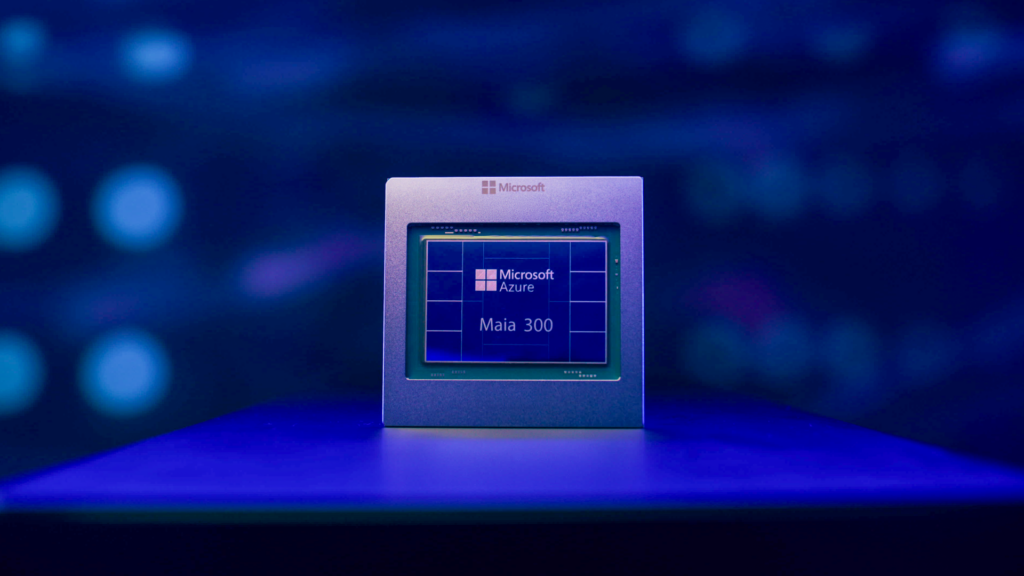
02InfraMicrosoft
Microsoft unveils Maia 300 and plans multi-gigawatt Maia deployments from 2027
Microsoft expects its third-generation Azure Maia chip, built for inference, to deliver 40% more tokens per megawatt than leading GPU systems.
03ProductSpaceXSI
SpaceXSI bundles Grok, Cursor and X Premium into The X Subscription
Five tiers run from free to $200 a month, with one pool of Grok model usage shared across the Grok apps, the Grok tab on X and Cursor.

04ResearchAnthropic
Anthropic says distillers now get 90 to 99 percent less data out of Claude
Distillers copy a model’s abilities without its maker’s permission.

05ModelOpenAI
OpenAI raises GPT-6.1 Sol’s default context to 500k in Codex and Work
Thibault Sottiaux, who leads Codex at OpenAI, announced the change on X.
Spotted an error? Email aiforsuccess.in+compass@gmail.com or tag @ai_for_success on X