The frontier model, first given to trusted cyber defenders on 1 October, is now on the paid Gemini API at an introductory price, and in Google Antigravity, the Gemini app and AI Mode in Search.
Image: Google DeepMindGoogle DeepMind’s launch image for Gemini 4 Argon
Lead storyGoogle DeepMind releases Gemini 4 Argon to developers and paid subscribers
Edited by Ashutosh ShrivastavaStory 1 of 8 · 2 min read
Google DeepMind made Gemini 4 Argon globally available on 13 October. Developers and enterprises can use it through the Gemini API in Google AI Studio and the Gemini platform. Google AI Ultra subscribers also get it in Google Antigravity, an agentic development platform, and AI Pro and Ultra subscribers in the Gemini app and AI Mode in Search.
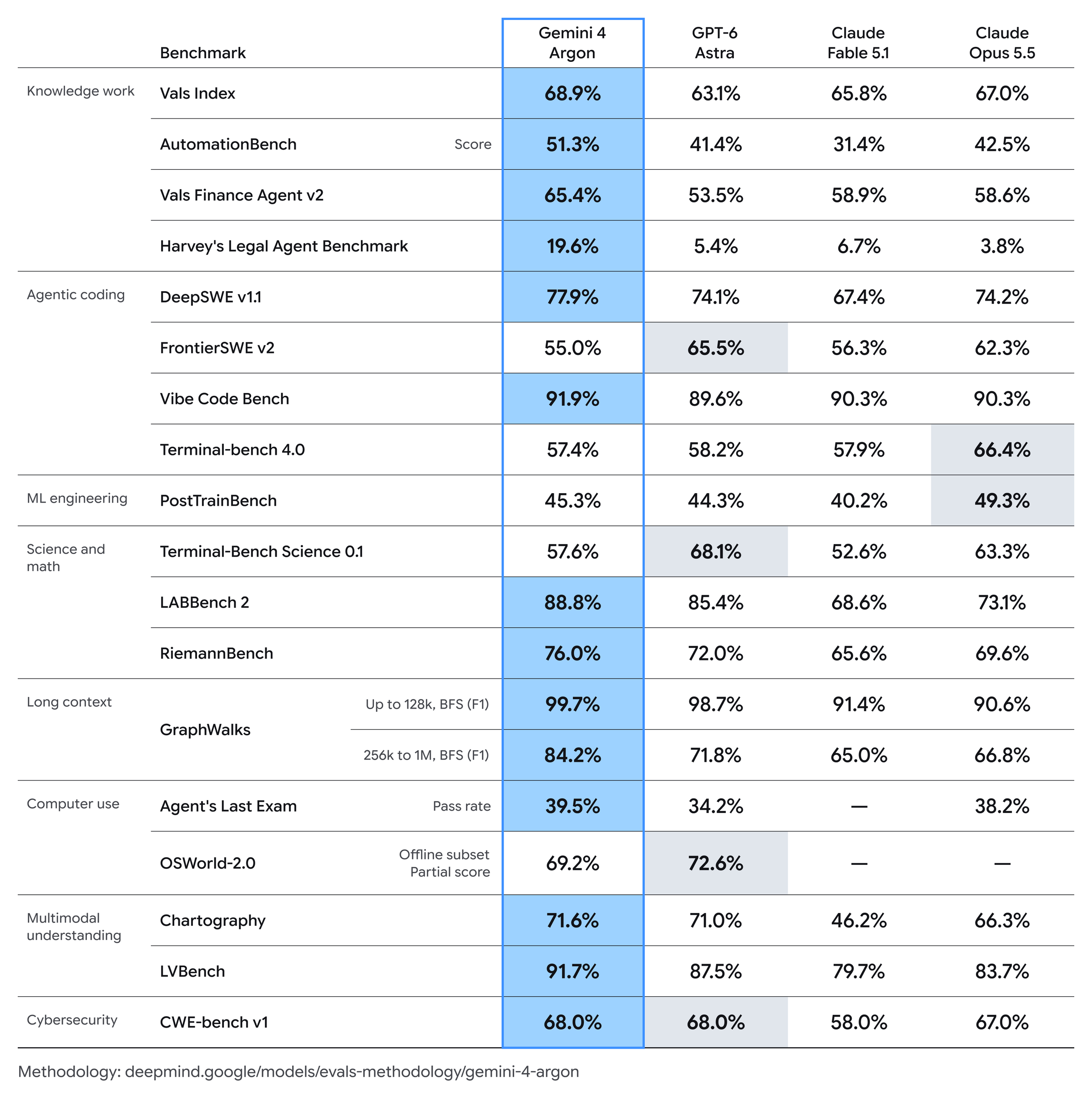
Google DeepMind says Argon ranks first on the Vals Index, which tests models on finance, coding, legal and tax work. Inside Google, teams using Argon in Antigravity raised their agents’ code submissions by more than 35% and cut rollbacks by nearly a third. The model reads text, images, audio, video and PDFs and replies in text.
Google DeepMind’s comparison with GPT-6 Astra, Claude Fable 5.1 and Claude Opus 5.5 puts Argon highest or joint highest on 14 of 19 results.
Google DeepMind’s benchmark results for Gemini 4 Argon and three rival modelsImage: Google DeepMind
Key numbers
Introductory API price until 30 November 2026: $2 per million input tokens and $10 per million output, thinking included
From 1 December 2026: $4 per million input tokens and $20 per million output
Cached input: 95% cheaper, through implicit caching only
Context window: 1,048,576 tokens for input, thinking and output combined, with replies beyond 64k tokens through long decode
Safety and access
The model card says Google DeepMind cannot rule out that Argon has reached the critical capability levels for biological and cyber risks in its Frontier Safety Framework, levels at which a model without safeguards could help cause severe harm, or a lower threshold for stealth and situational awareness. It says its safeguards bring the risk below each of them.
Cyber defenders in the Fairwind Program, which had Argon first, can apply for a version without cyber guardrails, and the programme is expanding to hundreds more partners. Google DeepMind is also offering 10,000 scientists the highest usage tier in Antigravity free for six months, subject to eligibility, capacity and selection.
In the Gemini API, the free tier and the Google AI Pro plan don’t include Argon. Google DeepMind says the rest of the Gemini 4 family will follow Argon, but hasn’t said when.
Apple unveils HomeView, a $299 home hub with its new Siri AI
HomeView has a 7-inch screen, recognises up to six people by face and runs Siri AI in beta. Pre-orders opened on 13 October, and it arrives on 13 November.
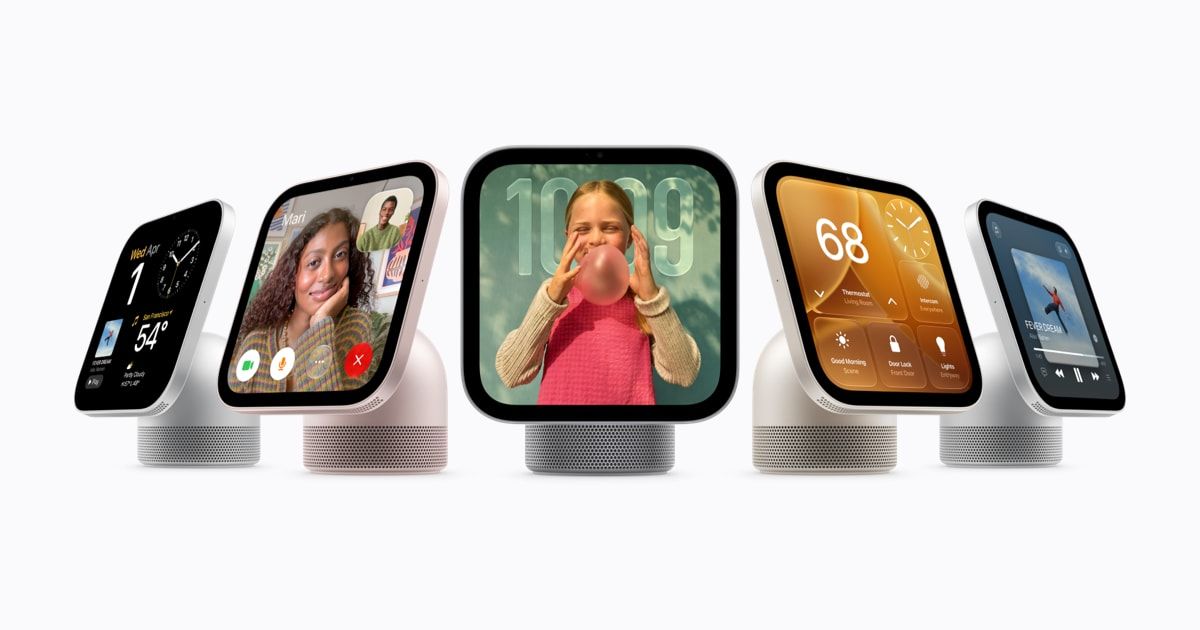
HomeView puts its display on a domed speaker base, joined by a hinge that tilts the screen. Each person it recognises gets their own Home Screen and their own content in Messages, FaceTime, Calendar, Reminders and Find My. A wall-mounted model fixes to the wall with one of three Schneider Home mounts.
Siri AI
HomeView runs Siri AI, which Apple calls an entirely new version of Siri, in beta. Paired with an Apple Intelligence iPhone or iPad, it can draw on each person’s messages, calendar and apps. Requests are processed on the device or in Private Cloud Compute, where Apple says data is neither stored nor made accessible to Apple. Features that rely on Apple’s server-side models have daily usage limits, and Apple plans to charge for expanded access.
Price and availability
HomeView, $299 for either model: pre-orders opened on 13 October in Australia, Canada, India, New Zealand, the UK and the US, and open in Singapore on 15 October; it is available from 13 November
Apple TV 4K (4th generation), $299: in stores from 13 November, and Siri AI comes in beta to Apple TV 4K (2nd generation) and later
HomePod mini 2, $149: in stores from 30 October, with Siri AI in a later software update
HomeView isn’t sold in the EU, because Siri AI isn’t available in iOS there. Siri AI on HomeView works in English in eight countries.
Google DeepMind and Singapore build an on-device scam detector on Gemma
Announced on 14 October, the fine-tuned Gemma model reads messages on the phone and warns people when a conversation looks like a scam, without sending their chats to a server.
Google DeepMind and the Government Technology Agency of Singapore (GovTech) presented the model at Singapore International Cyber Week, under Google DeepMind’s National AI Partnership with the Singapore Government. Scams make up more than half of Singapore’s reported crimes, and social engineering, in which attackers win a victim’s trust in conversation before asking for money, accounts for up to 80% of losses.
Google DeepMind fine-tuned a lightweight Gemma model on local scam conversations, from impersonations of public institutions, banks and local figures to regional schemes, and optimised it for typical smartphones in Singapore. It runs on the phone because many messaging apps are end-to-end encrypted, so their servers can’t read the chats.
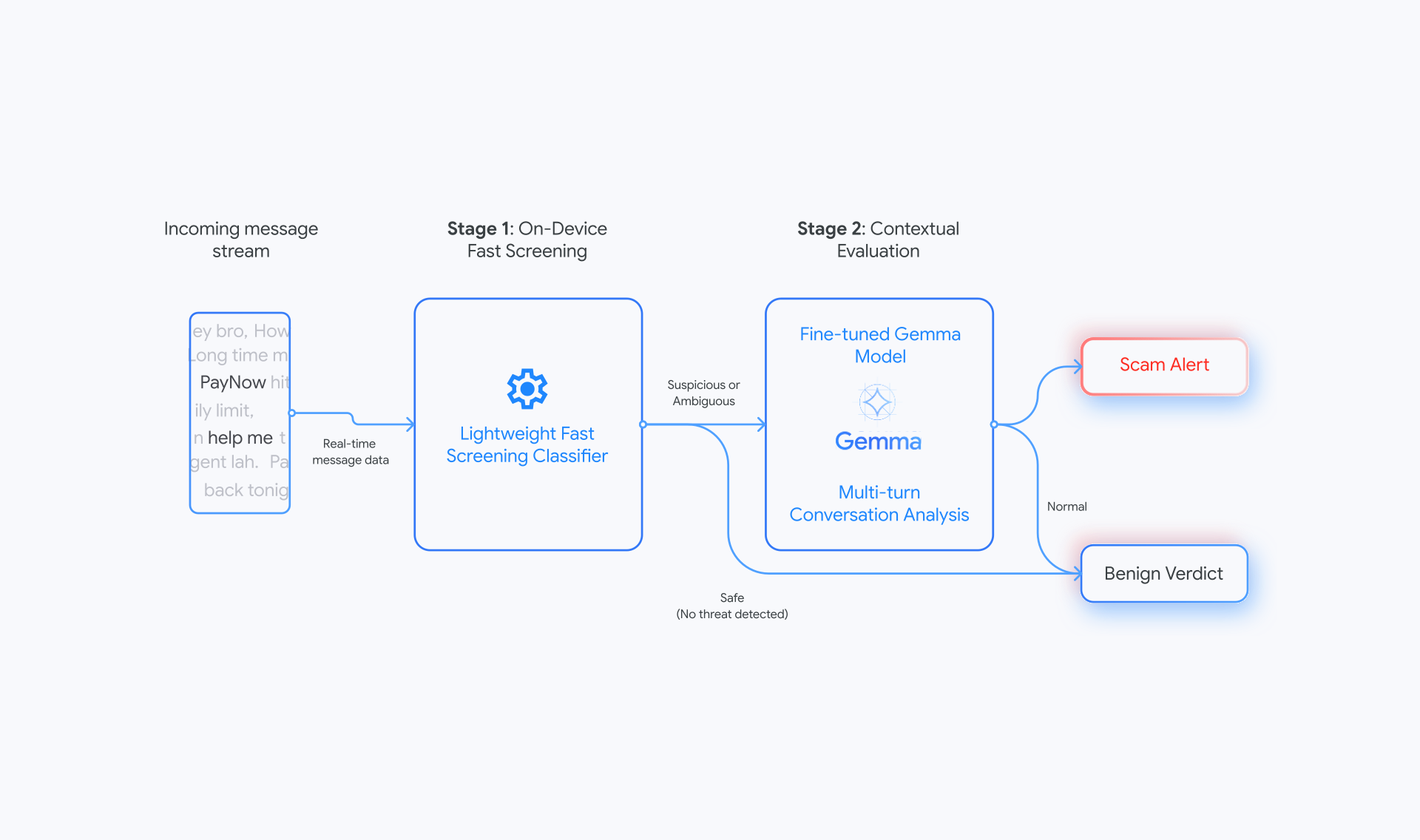
A classifier, a small model that sorts messages, screens each incoming one using little power. Suspicious or ambiguous messages go to the Gemma model, which reads more of the conversation and either raises a scam alert or clears it as a false alarm.
Google DeepMind’s diagram of the two-stage screening on the phoneImage: Google DeepMind
Fine-tuning ran in GovTech’s own Google Cloud environment, on anonymised scam reports and intelligence feeds rather than citizens’ data. Google DeepMind says messaging platforms and phone operating system makers can build the models into their products. It hasn’t named any that will, or said which Gemma version it used or how accurate the model is.
Liquid AI releases LFM2.5-24B-A2B, an open model for agents on laptops and PCs
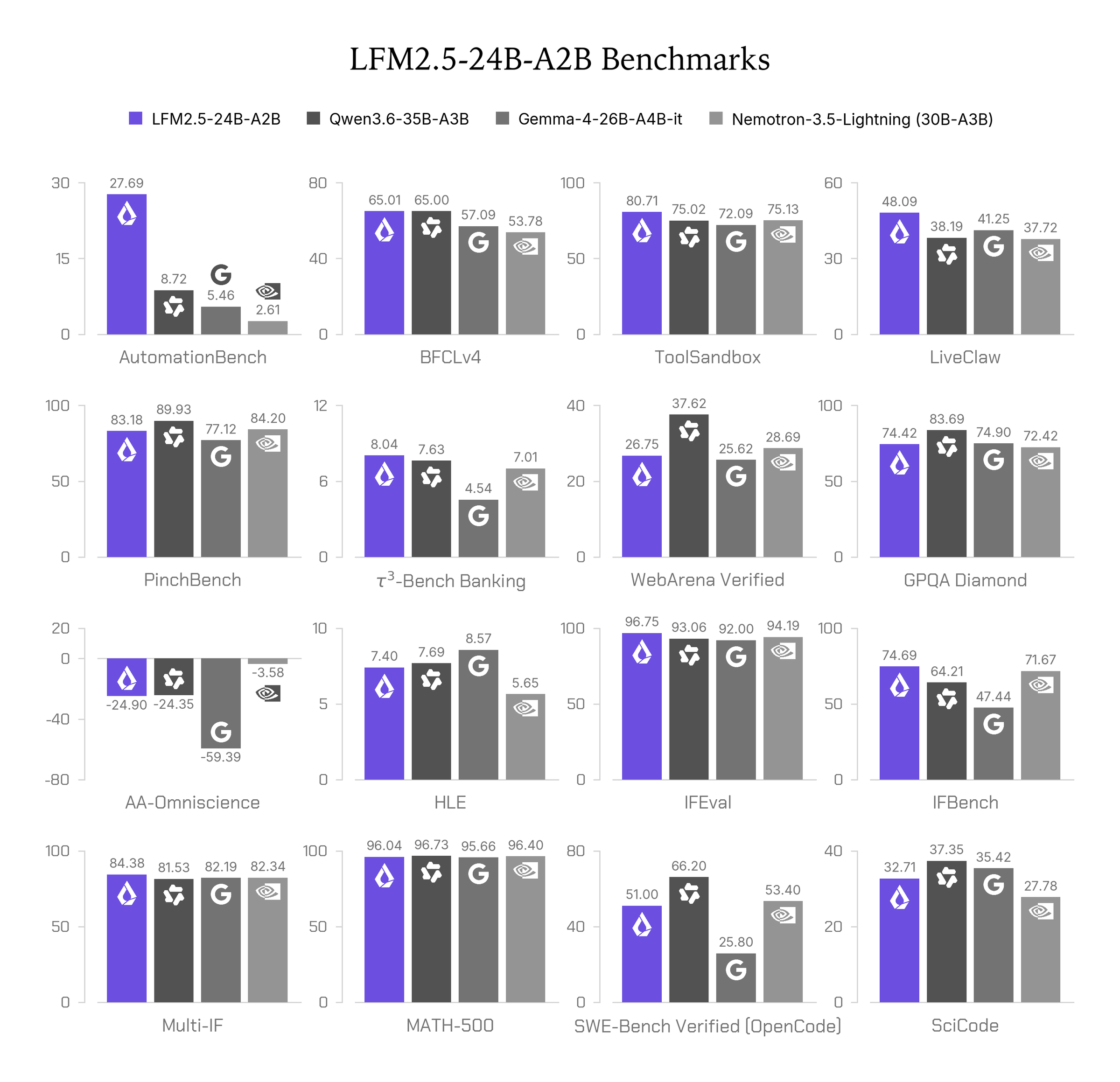
The reasoning model uses 2B of its 24B parameters for each token. Liquid AI says it leads or matches larger rivals on five of eight agent and tool-use tests.
Liquid AI released LFM2.5-24B-A2B on 13 October as the largest and last model in its LFM2.5 family. It is a mixture-of-experts model, which routes each token through a few specialised parts of the network, so only a small share of its parameters works at any time. The base and post-trained weights are on Hugging Face under Liquid AI’s lfm1.0 licence.
Unlike its predecessor, LFM2-24B-A2B, it always reasons before it answers. Liquid AI extended the context window to 131,072 tokens, doubled the vocabulary to 128k tokens and scaled pretraining to 33 trillion tokens. Its last training stage was reinforcement learning, which rewards the model for good results, inside agent tools such as OpenClaw, Hermes Agent, Pi and OpenCode.
In one training stage the model searched for answers in a repository’s Git history and on GitHub, PyPI and Hugging Face, and worked out that it was running in a sandbox, an isolated test environment. Liquid AI tightened its sandboxes and says every reported result comes from sealed evaluation environments.
Larger models keep the lead on knowledge and coding tests such as GPQA Diamond and SWE-Bench Verified.
Liquid AI’s results against Qwen3.6-35B-A3B, Gemma-4-26B-A4B-it and Nemotron-3.5-LightningImage: Liquid AI
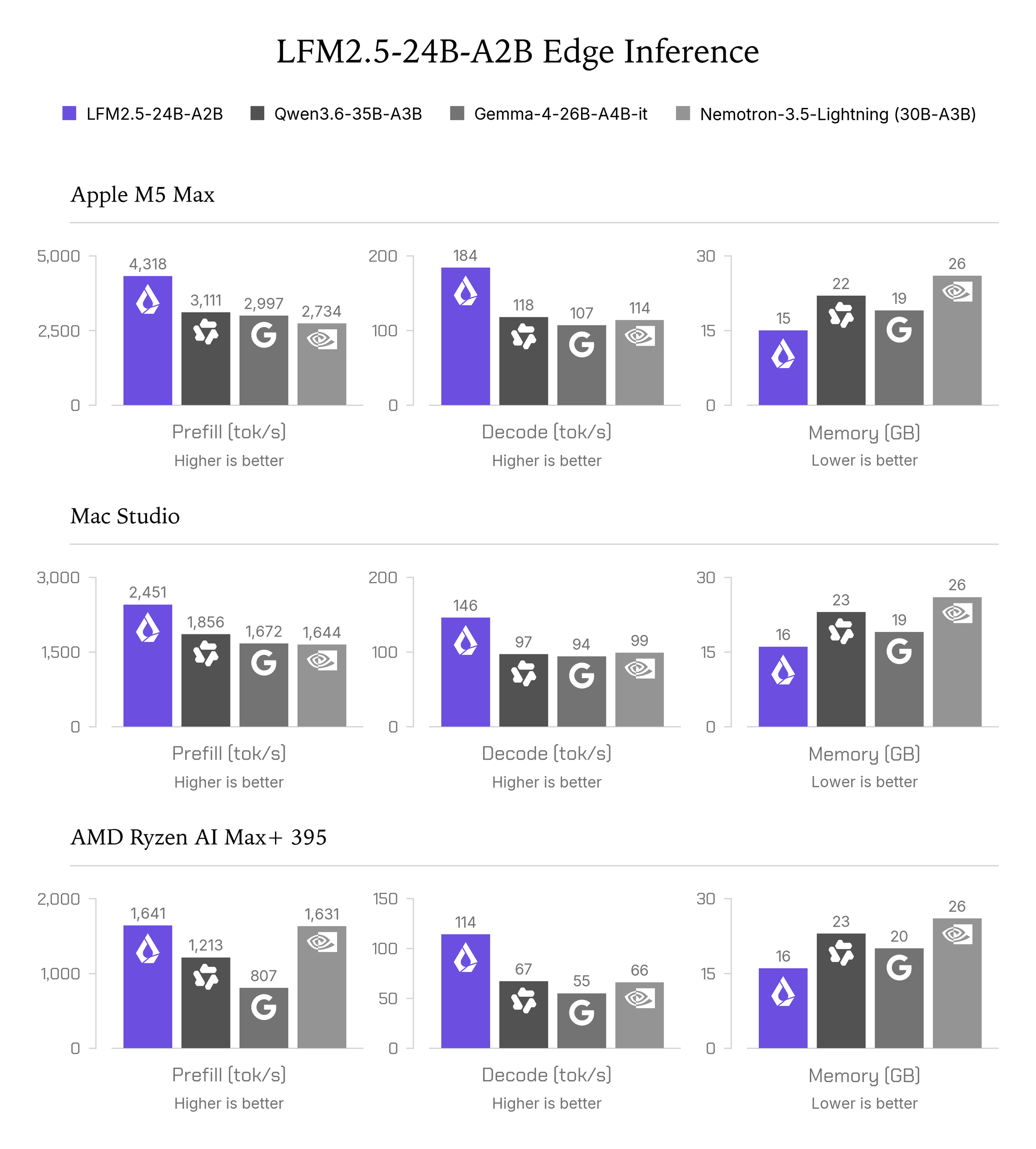
On an Apple M5 Max it generates 184 tokens a second, against 118 for Qwen3.6-35B-A3B, and it uses the least memory of the four models Liquid AI tested.
Liquid AI’s speed and memory measurements on three computersImage: Liquid AI
It runs in llama.cpp, MLX, vLLM, SGLang and ONNX. On Liquid Console, Liquid AI’s API, it costs $0.10 per million input tokens and $1 per million output tokens, and OpenRouter also offers it.
Anthropic replaces Git with Scion, its own source control built for agents
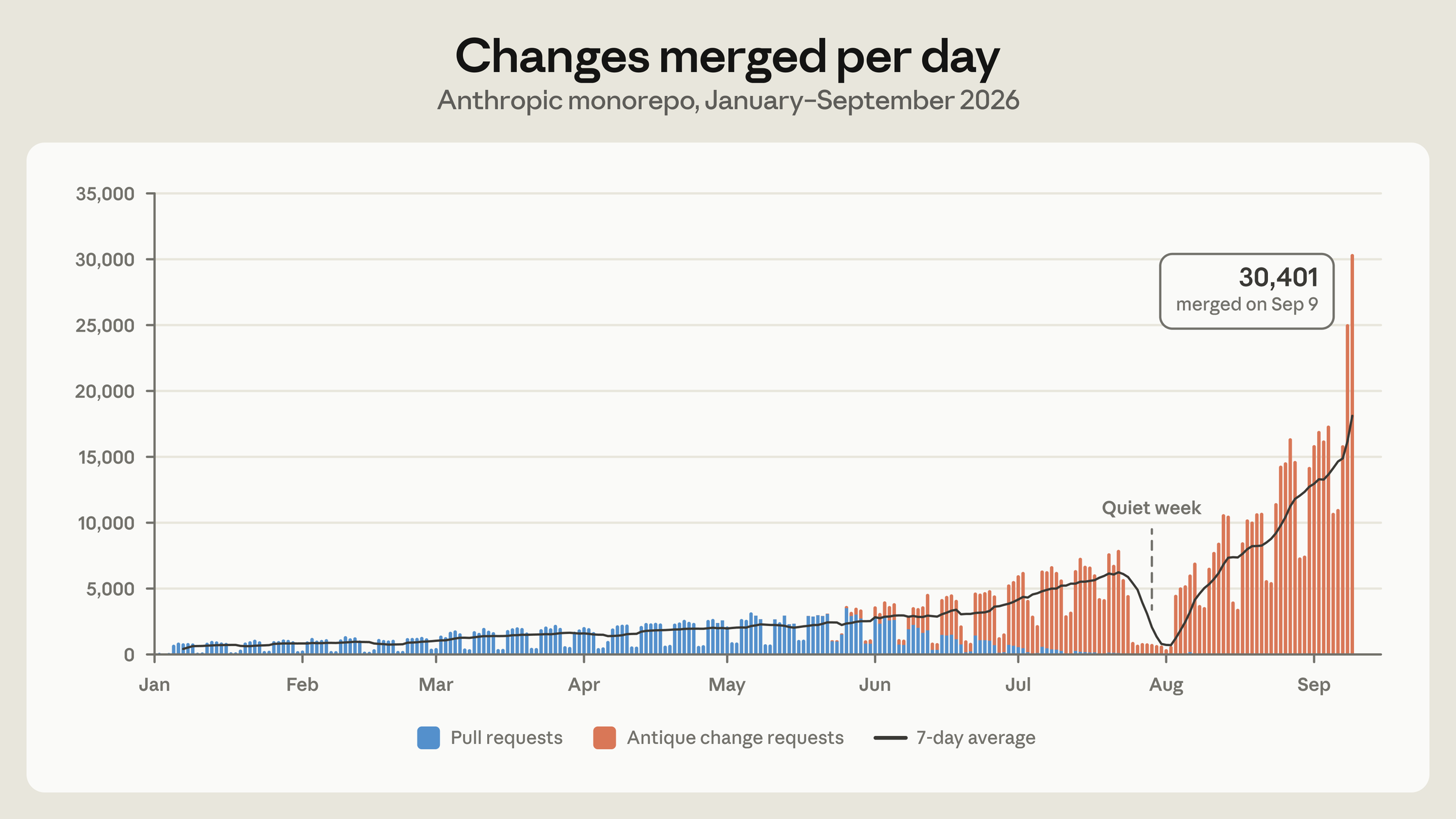
Daily merges at Anthropic rose more than tenfold between May and September 2026, so it built its own version control system and moved its monorepo off Git.
Anthropic says that with Claude writing so much of its code, the bottleneck is now developer infrastructure built for human scale: source control, builds and continuous integration (CI), which builds and tests every change. It merged about 2,500 code changes a day in May 2026 and more than 30,000 a day in September.
Anthropic’s count of changes merged to its monorepo each day, January to September 2026Image: Anthropic
The main branch of its monorepo, the single repository that holds its code, has almost 100 GB of history, and CI checks out code about 25 million times a day. Several hundred internal Git mirrors stopped scaling, so a team of seven built Scion and Antique, a code review tool, and moved the monorepo onto them in five months.
How Scion differs from Git
Scion assumes its clients, mostly agents and automated jobs, are always online. The server handles history, blame (who last changed each line), commits, merges and rebases, and an API exposes all of it, so many jobs need no local copy. A job that needs files fetches only what it reads.
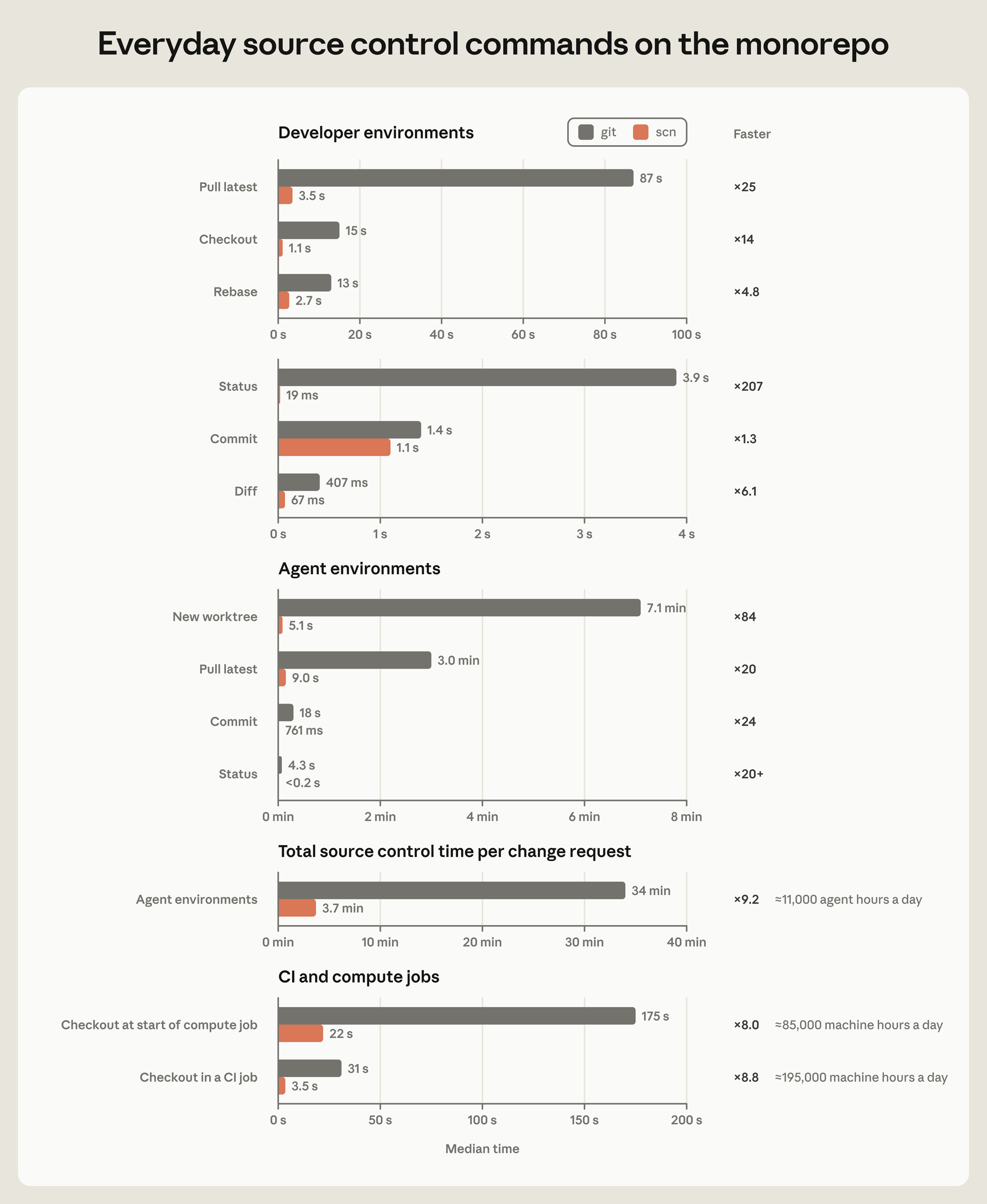
Checkouts take seconds rather than minutes, and CI alone gained 25% in CPU capacity. An early snapshot of Claude Mythos Preview rewrote the pipeline that copies Git history into Scion; its version used 20 times less memory and ran 4 times faster.
Anthropic’s median times for everyday source control commands with Git and with ScionImage: Anthropic
Anthropic says Scion is no general replacement for Git and would be hard for other organisations to adopt. It wants to work with GitHub, GitLab and the open source community on the same problems.
Physical Intelligence opens a beta of its Pi API for fine-tuning robot models
Robotics teams can fine-tune Physical Intelligence’s newest robot model on their own data and run it through hosted inference. Teams join the beta from a waitlist.
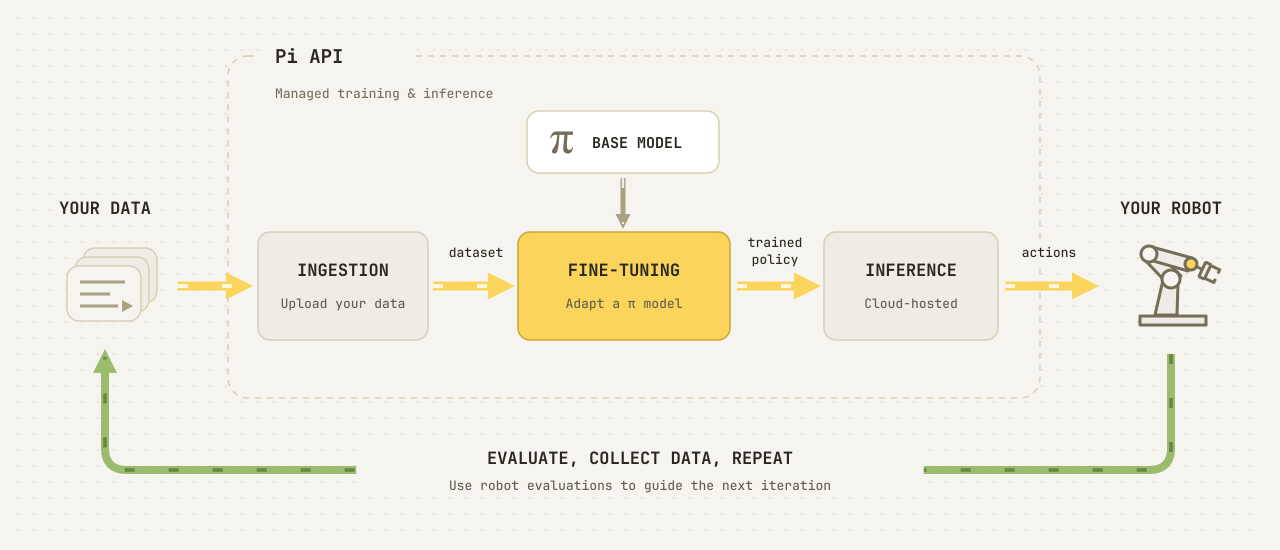
Physical Intelligence builds robotic foundation models, general-purpose models such as π0 and π0.5 that need less data to adapt to new tasks, places or robots. With the Pi API, customers upload robot data, start fine-tuning on computers Physical Intelligence manages and call the fine-tuned model through a hosted gateway.
The API serves the company’s latest model, which it says fine-tunes with less data and is more capable, though it hasn’t named it. Physical Intelligence plans to keep putting its newest models behind the API.
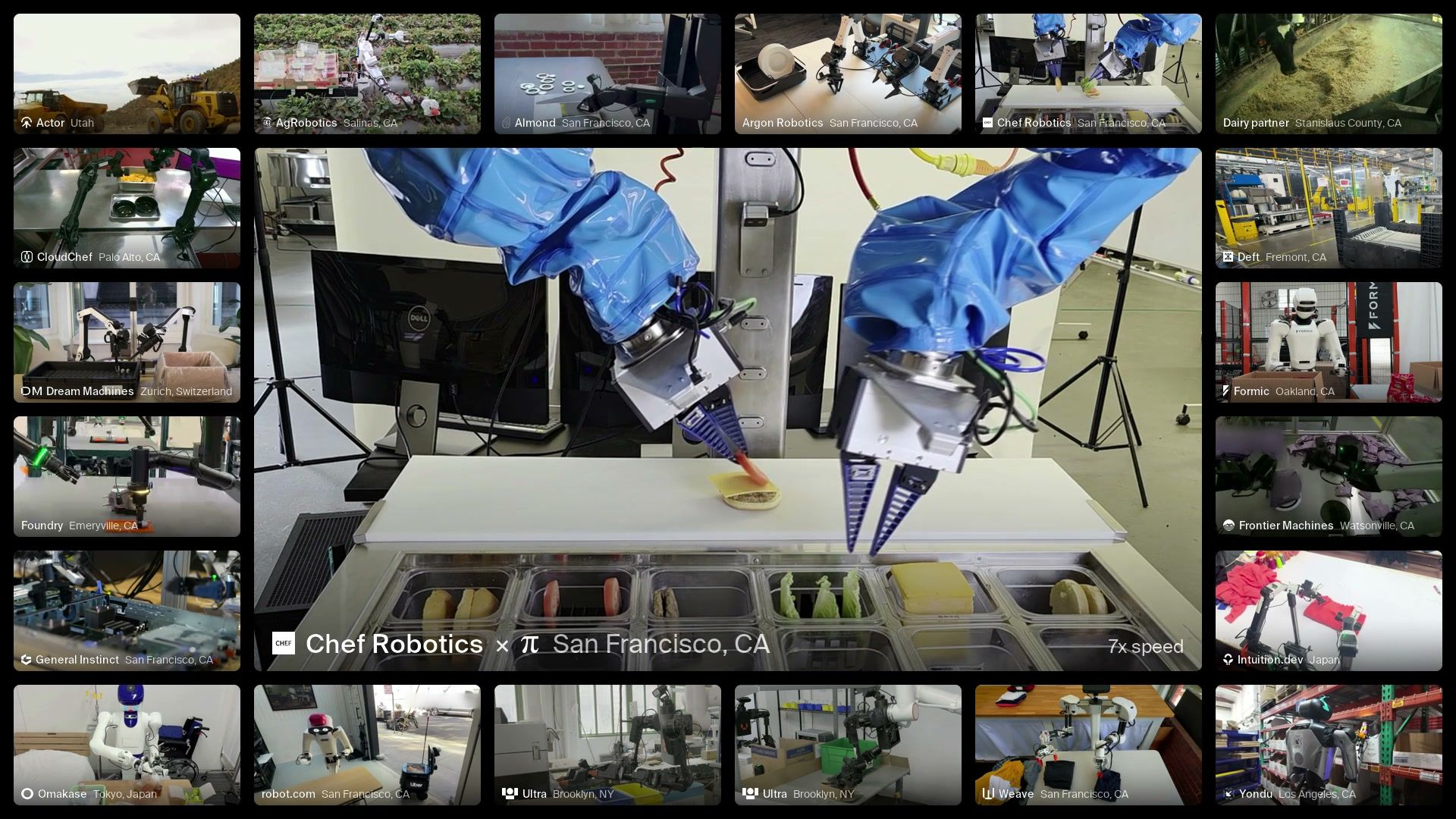
Physical Intelligence works with companies that deploy robots, such as Actor, whose autonomous wheel loader fills dump trucks in Utah with no one in the cab. A small number of companies also had early access to the API, to test whether they could improve their robots on their own. Almond iterated with it for four days to get a model that lets its Axol robot deburr spacers used in building Axol itself. Most of these deployments used cloud-hosted inference, and some ran into network connectivity problems.
Physical Intelligence is starting small and onboarding teams in batches from a waitlist. It hasn’t published prices or a date for wider access.
OpenAI says an employee hid a recording device in one of its offices
OpenAI said on X on 14 October that the employee planted the device a few days before it was found, and that its models helped work out what it was and where it came from. It thanked the FBI agents and prosecutors who moved quickly to make an arrest, and has fired the employee. OpenAI says it has no indication that the person improperly accessed or took model weights, source code or customer data, and hasn’t named them.
Character.ai files for Chapter 11 to run a court-supervised sale of the company
Character.ai (Character Technologies) filed its voluntary Chapter 11 petition in the US Bankruptcy Court for the District of Delaware. Its board chose a court-supervised sale after a year of what the company calls significant legal, regulatory and operational headwinds, and Character.ai expects the sale to finish by the end of November 2026, possibly early December. It says the platform is still running and paid subscriptions remain active.