

ResearchMetaConfirmed
Story 3 of 7 in the Wednesday 14 October editionMeta shares ten health studies that researchers wrote with its Muse models
Medical researchers went from first prompt to manuscript in under two weeks, and their report lists the errors that only clinicians caught.

 Edited by Ashutosh Shrivastava
15 Oct 2026, 10:10 IST · 2 min read

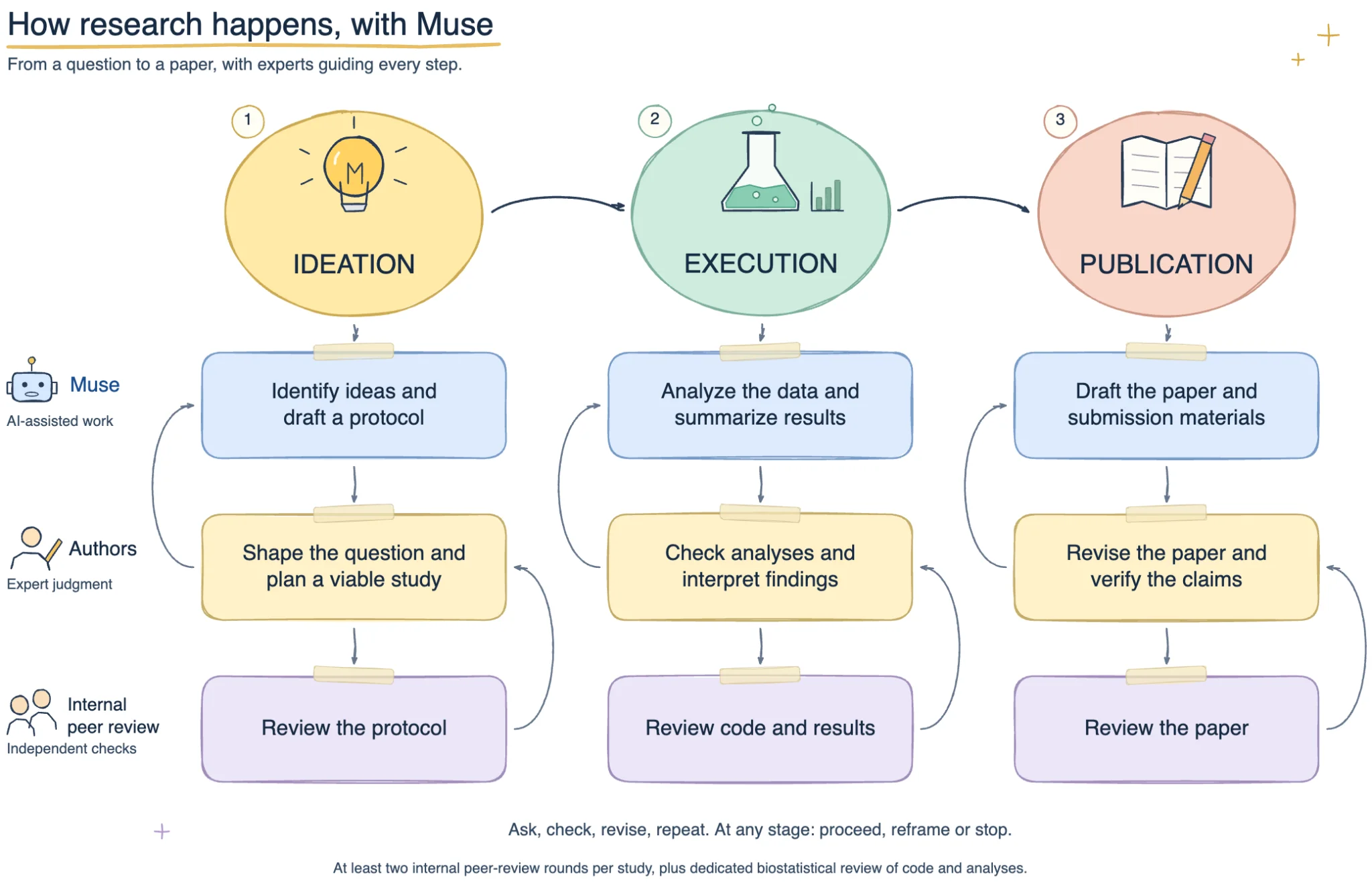
Meta built an internal coding scaffold, a tool that writes and runs analysis code, on Muse Spark 1.3 and Muse Wonder, the model it introduced on 12 October. Medical researchers in fields such as cardiology and infectious disease used it for four weeks to brainstorm hypotheses, write and run all the code and draft manuscripts, keeping every scientific decision for themselves. It could reach public data and a licensed database of five million de-identified electronic health records.
The ten manuscripts range from sports medicine to oncology. One, a case series on the fungus Cladophialophora bantiana, found 21 patients with it in brain or lung samples. Each paper had feedback from peers, a biostatistician’s review and summaries from independent experts Meta contracted. Participants reported up to ten times their usual productivity in the best cases.
What the researchers found
In a report Meta hosts, the researchers call the system fast but unevenly reliable. At times it was confidently wrong with nothing to warn a reviewer, and more than once it said data was missing when it was in the dataset. It put mortality from Staphylococcus aureus bacteremia, a bloodstream infection, at 1%; an infectious disease doctor knew published studies report closer to 30%, which led to an audit of how deaths were recorded.
The studies are retrospective, using existing records only. Meta says future work on larger datasets could produce hypotheses to test in prospective trials. It hasn’t said whether researchers outside the project will get the tool.
Sources
- PrimaryAccelerating Scientific Research in Health Data Science With Muse Modelsresearch.meta.ai · Meta research blog, dated 14 October 2026
- OfficialObservational research with Muse models: what models accelerate and where expertise still mattersresearch.meta.ai · The researchers’ report, hosted by Meta
- OfficialCladophialophora bantiana: a US clinical case series assisted by artificial intelligenceai.meta.com · One of the ten manuscripts
- OfficialHuman-Guided Agentic AI for End-to-End EHR Research: Sequential Antibody-Drug Conjugate Pathways in Breast Cancerai.meta.com · One of the ten manuscripts
- OfficialMuse Wonder: A Frontier Model For Personal & Professional AI Agentsresearch.meta.ai · Meta research blog, 12 October 2026
- On X@AIatMeta on X: how AI can accelerate health science researchx.com
The rest of the day
Read the whole day
01ModelSpaceXSI
SpaceXSI’s Grok Voice 3.0 tops Artificial Analysis’s speech-to-speech index
The new voice model is in SpaceXSI’s Voice Agent API at the same per-minute price as Grok Voice 2.0, and already runs in Tesla cars and Starlink’s call centres.

02Coding agentAnthropic
Anthropic reworks the Claude Code desktop app for running many sessions at once
Anthropic announced the update in a post and video from its developer account on X, without release notes.

04InfraAnthropic
Anthropic adds OpenTelemetry tracing to the Claude Platform in public beta
Teams can follow each model call and tool use of their Claude agents in the monitoring tools they already use.

05InfraOpenAI
OpenAI will shut down GPT-4o and GPT-4.1 in its API on 14 January 2027
Five snapshots get three months’ notice, and OpenAI recommends gpt-6-luna as the replacement for each, fine-tuned versions included.
Spotted an error? Email aiforsuccess.in+compass@gmail.com or tag @ai_for_success on X