

ResearchAnthropicConfirmed
Story 1 of 10 in the Friday 16 October editionAnthropic’s Claude Mythos 5 improves on the best published quantum circuits
Given plain-language specifications and an automated evaluator, the model found designs for eight circuits from chemistry, optimisation, physics simulation and number theory that improve on the best published ones.

 Edited by Ashutosh Shrivastava
17 Oct 2026, 10:30 IST · 2 min read
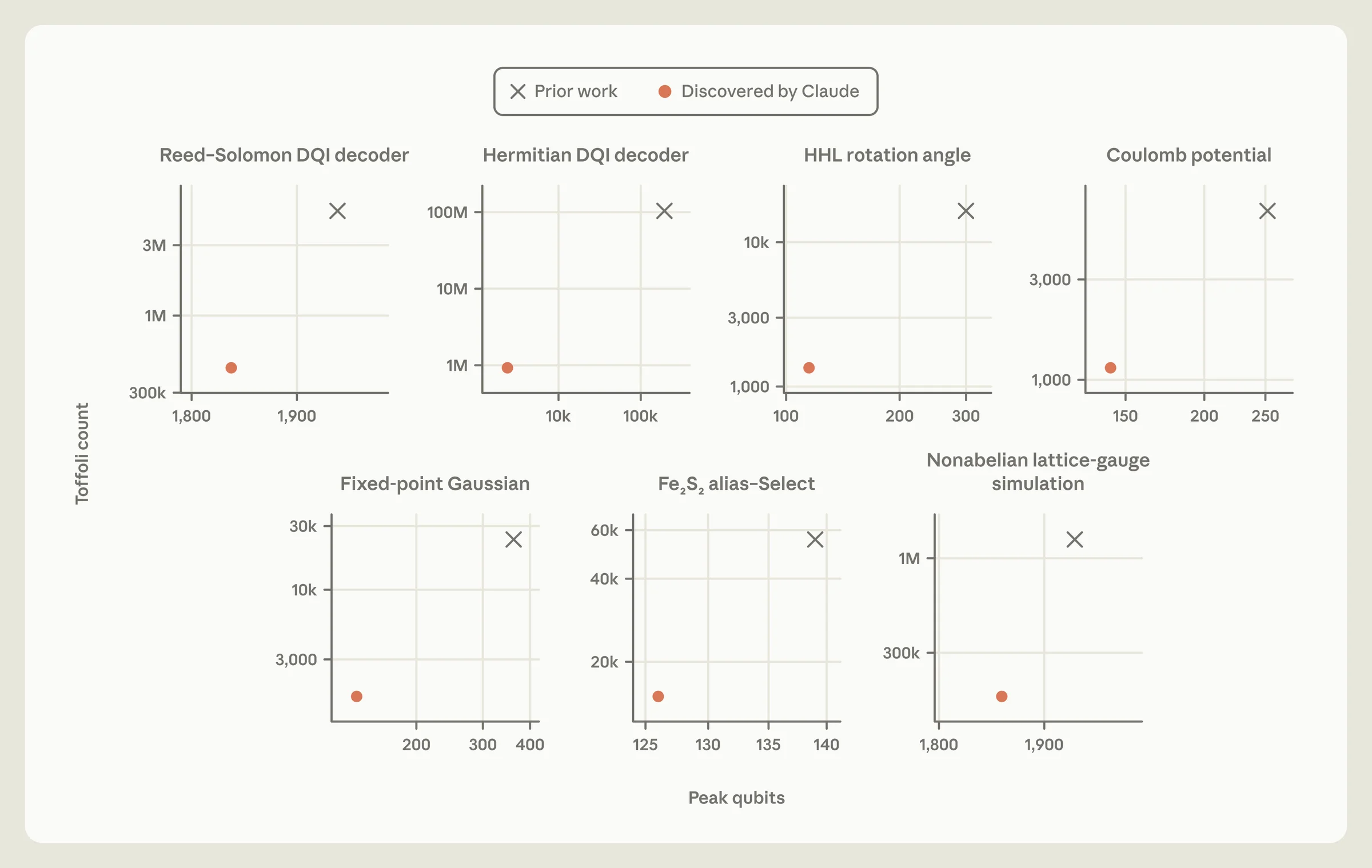
Anthropic published the work on 16 October 2026 with an arXiv paper. Andi Gu led it in Anthropic’s STEM Fellows Program, with Anthropic and Harvard University researchers. Claude Mythos 5 worked in a closed loop: it wrote each circuit as a Python program, an automated evaluator checked and scored it, and the model used that feedback for its next attempt, with no human input between rounds.
Quantum computers built by October 2026 have hundreds to thousands of qubits, too few for many of the algorithms expected to beat ordinary computers. Designs using fewer qubits and fewer gates, the basic operations a circuit applies, bring those algorithms closer to real hardware. The score was peak qubits times Toffoli gates, which are among the costliest gates to run and are counted to estimate runtime.
The paper reports that on seven of the eight tasks the new circuits use both fewer Toffoli gates and fewer qubits than the best published designs. Anthropic says the gains came from new structural and mathematical insights, not from fine-tuning existing designs.
Two results
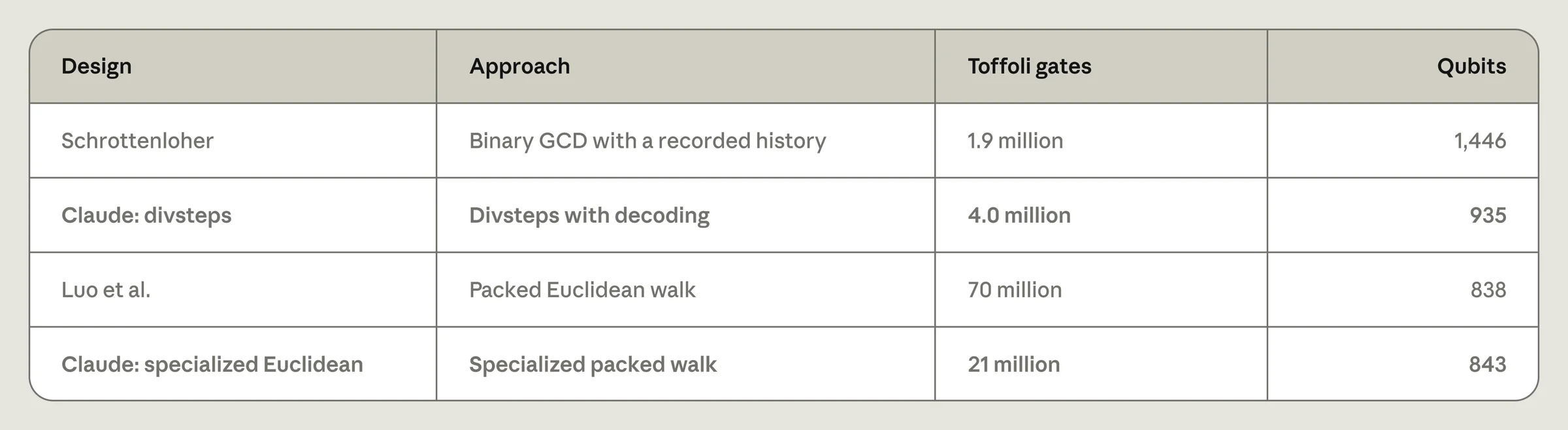
The remaining task, point addition on elliptic curves, is the core step of quantum algorithms for the elliptic-curve discrete logarithm problem, which is beyond ordinary computers for large curves. Its costliest part is modular inversion, the wraparound version of division. In one 53-hour run, Claude produced the first version of divsteps, a classical inversion method, that runs reversibly, as quantum circuits must, without storing a record of its steps. It checked the design in large simulations and in Lean, a proof assistant. One circuit in the resulting family uses 12% more qubits than the smallest previous design but 17 times fewer gates.
In decoded quantum interferometry, a candidate quantum algorithm for optimisation problems, Claude’s decoder for the costliest step uses 12 times fewer gates than Google’s previous construction.
Anthropic says Claude tended to favour well-known approaches, so the setup had it develop several in parallel, with occasional prompts to search more broadly. Circuit design is one part of a useful quantum computer, which must also catch and fix its own errors as it runs.
Sources
- PrimaryDesigning more efficient quantum circuits with Claudeanthropic.com · Anthropic research post, 16 October 2026
- OfficialarXiv:2610.22367, Discovering state-of-the-art quantum circuits with large language modelsarxiv.org · The paper, submitted 15 October 2026
- On X@AnthropicAI on X: designing more efficient quantum circuits with Claudex.com · Anthropic’s launch post
- On X@AndrewCurran_ on X: quoting the post on optimising quantum algorithmsx.com
The rest of the day
Read the whole day
02Open sourceReflection
Reflection releases Beam, a 501B open-weight coding model, under Apache 2.0
Reflection’s first open model, built for coding, reasoning and long agent tasks, is free to download, fine-tune and build on, and launched with more than 40 partners.

03ProductOpenAI
OpenAI gives GPT-6 Astra Pro in ChatGPT parallel agents and faster replies
Pro subscribers can now have several agents work on different parts of one task at once, and follow each one’s progress in the conversation.

04Coding agentAnthropic
Anthropic speeds up Claude Code by compressing the conversation sent each turn
Claude Code’s 14 October 2026 release shrinks large requests to the model, and cloud sessions now start up as soon as the user begins typing.

05ProductNVIDIA
NVIDIA RTX Spark laptops go on sale from $2,599 with up to 128GB of memory
The Windows laptops from six makers put an NVIDIA GPU and CPU on one chip, built to run AI models and agents locally as well as creative apps and games.
Spotted an error? Email aiforsuccess.in+compass@gmail.com or tag @ai_for_success on X