Given plain-language specifications and an automated evaluator, the model found designs for eight circuits from chemistry, optimisation, physics simulation and number theory that improve on the best published ones.
Image: AnthropicAnthropic’s share image for the post
Lead storyAnthropic’s Claude Mythos 5 improves on the best published quantum circuits
Edited by Ashutosh ShrivastavaStory 1 of 10 · 2 min read
Anthropic published the work on 16 October 2026 with an arXiv paper. Andi Gu led it in Anthropic’s STEM Fellows Program, with Anthropic and Harvard University researchers. Claude Mythos 5 worked in a closed loop: it wrote each circuit as a Python program, an automated evaluator checked and scored it, and the model used that feedback for its next attempt, with no human input between rounds.
Quantum computers built by October 2026 have hundreds to thousands of qubits, too few for many of the algorithms expected to beat ordinary computers. Designs using fewer qubits and fewer gates, the basic operations a circuit applies, bring those algorithms closer to real hardware. The score was peak qubits times Toffoli gates, which are among the costliest gates to run and are counted to estimate runtime.
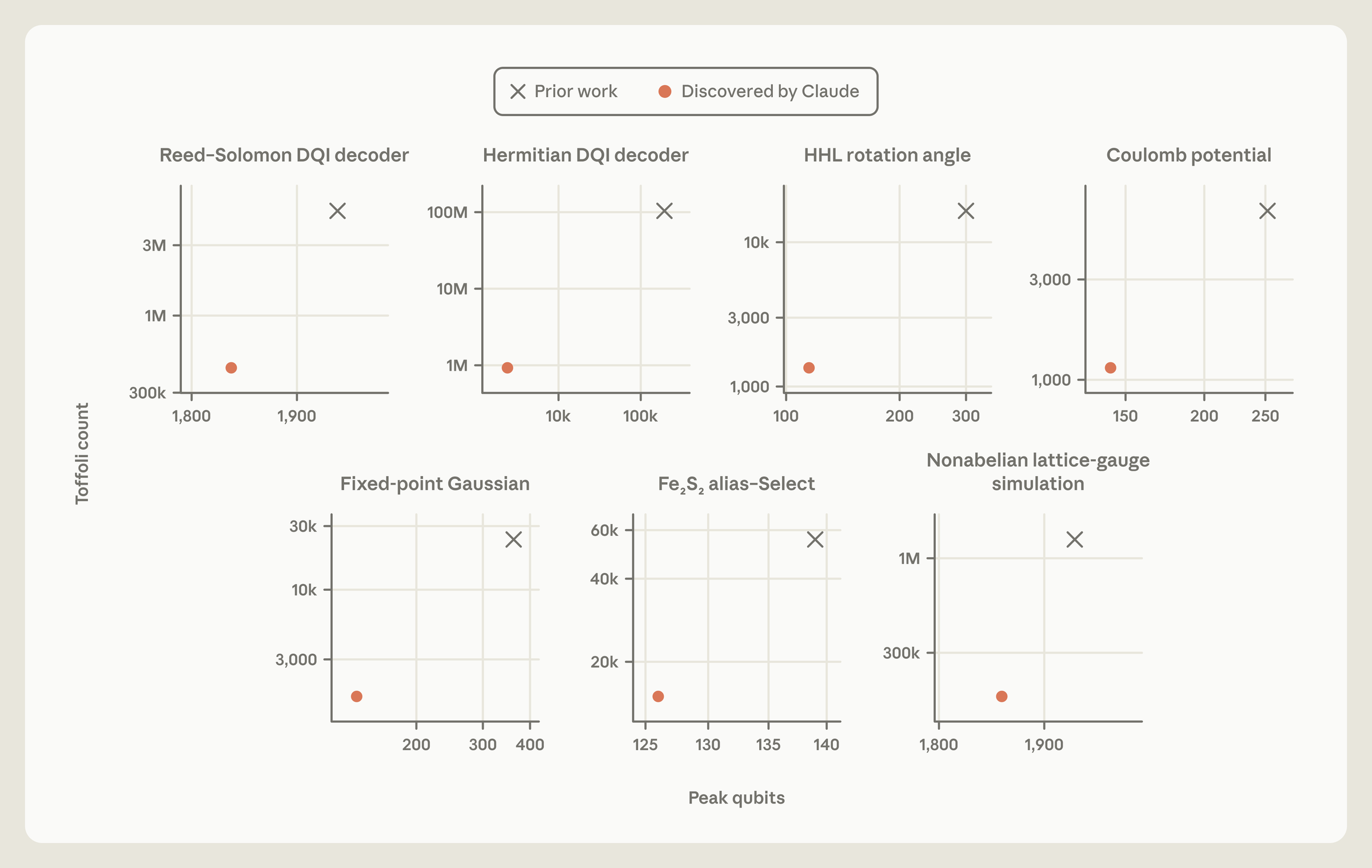
The paper reports that on seven of the eight tasks the new circuits use both fewer Toffoli gates and fewer qubits than the best published designs. Anthropic says the gains came from new structural and mathematical insights, not from fine-tuning existing designs.
Figure 2 of Anthropic’s post: Claude’s designs against prior work on seven tasksImage: Anthropic
Two results
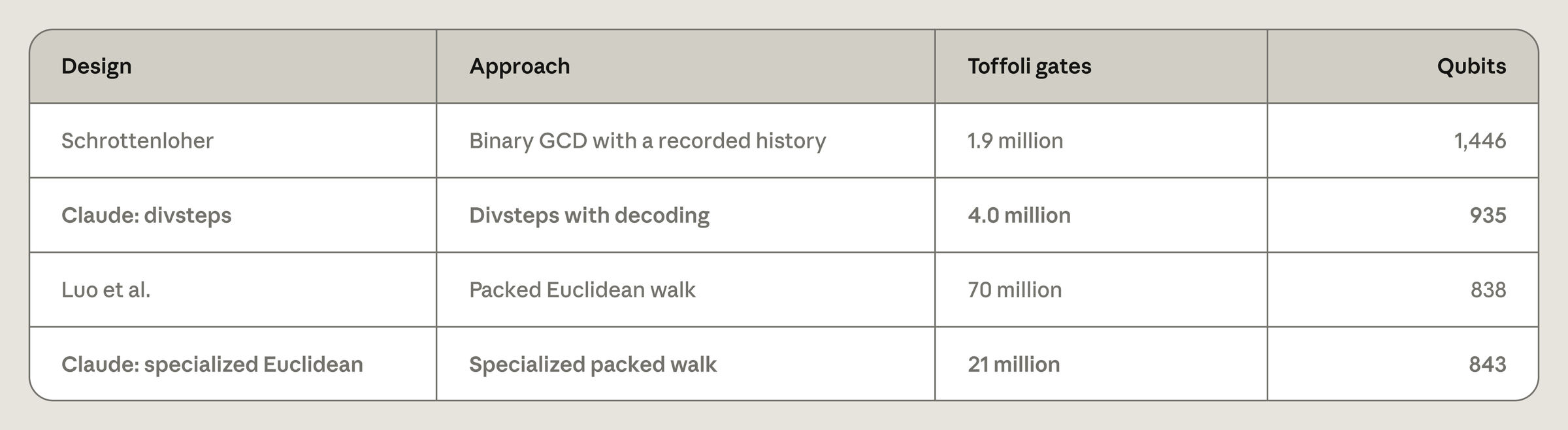
The remaining task, point addition on elliptic curves, is the core step of quantum algorithms for the elliptic-curve discrete logarithm problem, which is beyond ordinary computers for large curves. Its costliest part is modular inversion, the wraparound version of division. In one 53-hour run, Claude produced the first version of divsteps, a classical inversion method, that runs reversibly, as quantum circuits must, without storing a record of its steps. It checked the design in large simulations and in Lean, a proof assistant. One circuit in the resulting family uses 12% more qubits than the smallest previous design but 17 times fewer gates.
Table 1 of Anthropic’s post: resources for elliptic-curve point additionImage: Anthropic
In decoded quantum interferometry, a candidate quantum algorithm for optimisation problems, Claude’s decoder for the costliest step uses 12 times fewer gates than Google’s previous construction.
Anthropic says Claude tended to favour well-known approaches, so the setup had it develop several in parallel, with occasional prompts to search more broadly. Circuit design is one part of a useful quantum computer, which must also catch and fix its own errors as it runs.
Reflection releases Beam, a 501B open-weight coding model, under Apache 2.0
Reflection’s first open model, built for coding, reasoning and long agent tasks, is free to download, fine-tune and build on, and launched with more than 40 partners.
Reflection released Beam’s weights on Hugging Face on 16 October 2026 under the Apache 2.0 licence. Beam is a mixture-of-experts model, which uses only part of its network for each token: 23B of its 501B parameters are active at a time. It works with text only, mainly in English, and has a 1M-token context window.
The weights come in three number formats, BF16, FP8 and NVFP4, with DFlash2, a drafter model that speeds up generation. Reflection trained Beam together with Mirror CLI, its terminal coding agent, now open source and in beta, and has tested it with OpenCode, Hermes and Pi.
Reflection’s own API is in a public beta that is free to start, and Reflection hasn’t published per-token prices. More than 40 partners offer Beam, including Amazon Web Services, Google Cloud, Microsoft Foundry, OpenRouter and Together AI, while Dell and HPE install it on premises.
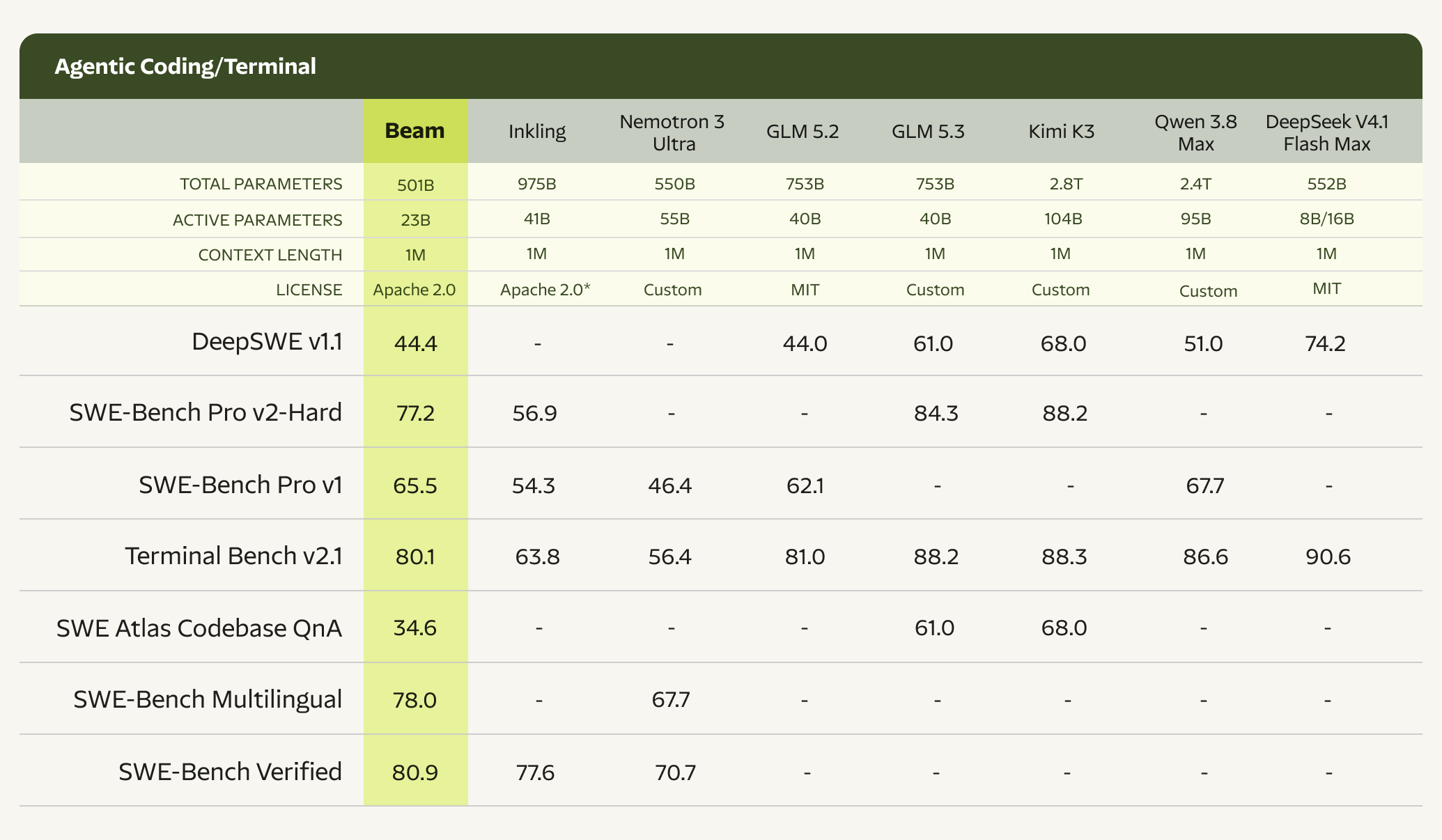
Artificial Analysis gives Beam 30 on its Intelligence Index, second among US open-weight models. In Reflection’s own comparison, Kimi K3 stays ahead on raw capability.
Reflection’s coding comparison of 5 October, revised 8 October; final model-card scores differ slightlyImage: Reflection
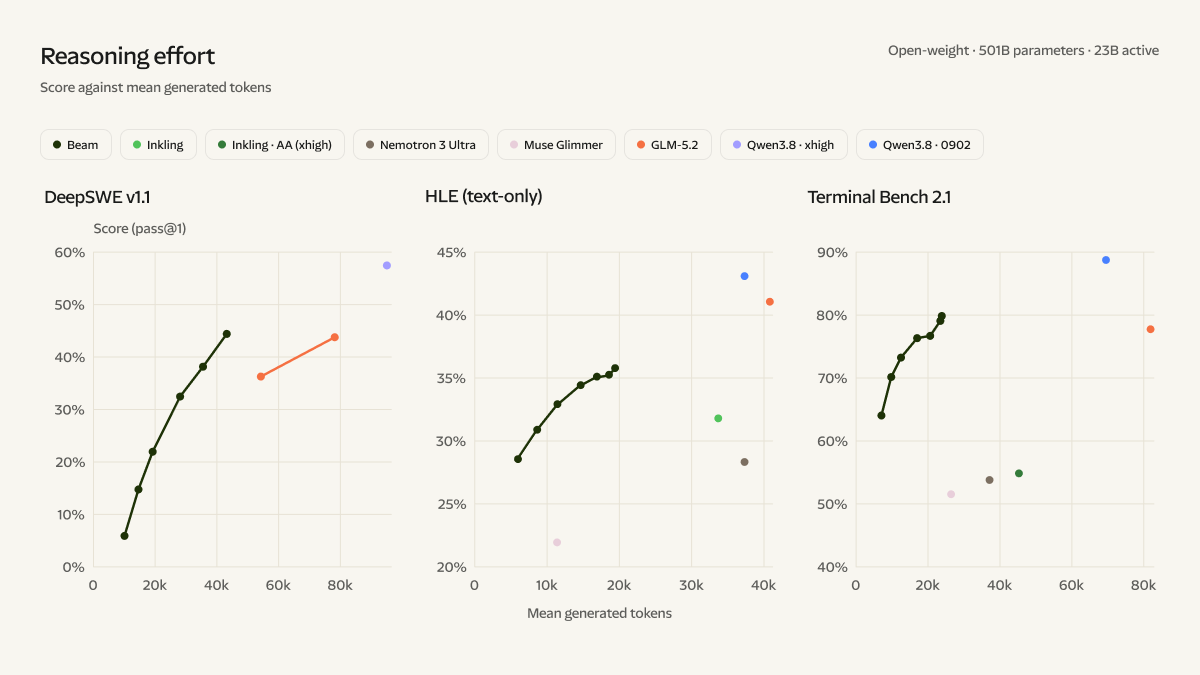
Reflection’s case is efficiency: it says Beam scores close to GLM-5.2 on advanced reasoning tests while using 3 to 4 times less inference compute.
From Figure 2 of Reflection’s 5 October post: scores against mean generated tokensImage: Reflection
Sources
PrimaryBeam-1.0-501B-A23B model cardhuggingface.co/reflection · Reflection’s weights, licence and model card on Hugging Face
OfficialBeam is now availablereflection.ai · Reflection announcement, 16 October 2026
OfficialBeam model cardreflection.ai · Final benchmark scores and usage terms
OpenAI announced the upgrade on X at 01:57 IST on 17 October 2026, and its ChatGPT release notes list it under 16 October. It applies to the Pro reasoning option in ChatGPT’s chat tab, which the release notes call GPT-6 Pro.
Since 7 October, Plus, Pro, Business and Enterprise have used GPT-6 Sol in the chat tab, while the Pro option has stayed on GPT-6 Astra, which OpenAI introduced on 3 September 2026 for coding, research, computer use and multi-step work.
The update brings three changes:
Faster responses
Better use of plugins and tools to carry out tasks
Several agents that work on different parts of a task in parallel, with their progress shown in the conversation and each finished task open for review
It is rolling out to eligible Pro users, and in managed workspaces it depends on workspace settings and rollout eligibility. ChatGPT’s three Pro plans cost $100, $200 and $500 a month. OpenAI hasn’t said whether other plans or its API will get the upgrade.
Sources
PrimaryChatGPT release noteshelp.openai.com · Entry “Updates to GPT-6 Pro model in ChatGPT”, 16 October 2026
Anthropic’s ClaudeDevs account on X announced both changes at 03:04 IST on 17 October 2026. On each turn, Claude Code sends the conversation so far to the model. It now compresses that conversation with gzip, a standard compression format, so the request is smaller and reaches the model faster.
Claude Code’s release notes for version 2.1.300, published on 14 October 2026, say large requests to api.anthropic.com now use gzip compression even when telemetry is turned off. Users get the change by updating to that version or later, and setting CLAUDE_CODE_GZIP_REQUEST_BODIES=0 turns it off.
Cloud sessions, which run Claude Code in a remote container instead of on the user’s computer, now start up as soon as the user begins typing. Anthropic hasn’t said how much time either change saves, or which version brings the faster start-up.
NVIDIA RTX Spark laptops go on sale from $2,599 with up to 128GB of memory
The Windows laptops from six makers put an NVIDIA GPU and CPU on one chip, built to run AI models and agents locally as well as creative apps and games.
RTX Spark laptops went on sale worldwide on 16 October 2026, on their makers’ websites and at major retailers. Prices start at $2,599 and vary by region. Preorders opened on 7 October, and compact desktops with the same chip go on sale in November.
Each laptop is built on one superchip that pairs a Blackwell RTX GPU with a Grace CPU designed with MediaTek. Its up to 128GB of unified memory is shared by both, and it delivers up to 1 petaflop of AI performance in FP4, a compact 4-bit number format for running models.
The lineup:
ASUS ProArt P14 and P16
Dell XPS 16
HP OmniBook Ultra and OmniBook X 14
Lenovo Yoga Pro 9n
Microsoft Surface Laptop Ultra
MSI Prestige N16 Flip AI+ and Prestige N16
For developers, NVIDIA and Microsoft prepared the first PyTorch-CUDA build for Windows on Arm, a native Conda installer and support for 97% of the top 15,000 Python packages. Guided installers set up agents such as GitHub Copilot, Hermes and OpenClaw without a command line. NVIDIA’s Nemotron 3.5 Bolt 74B-A9B 24GB, a 74-billion-parameter model built for tool calling, runs locally on supported configurations.
Elorian launches Glimpse, a visual thinking model for images and video
Elorian’s first model goes back to images and video while it reasons, zooming into details or rewatching a moment at a higher frame rate before it answers.
Elorian released Glimpse as a research preview on 16 October 2026, through its API and chat app. Elorian calls it a visual thinking model: it reasons about the physical world from what it sees, follows objects as they move or as the viewpoint changes, and works out how parts fit together and what happens next.
Glimpse is trained to use tools that write code, transform images and watch videos, and it can start subagents that share text and images to work on one problem. Elorian, a small team with a few hundred GPUs, built it by further training an open-weight base model it doesn’t name.
Input costs $0.60 per million tokens and output $3 per million, rates Elorian says are 94% below GPT-6 Astra’s.
In Elorian’s table, 11 of the 12 tests have a GPT-6 Astra score. Glimpse is ahead on four: CharXiv-R for reading charts, FSC-147 for counting, UGC-VideoCap for captioning short videos and WGO Bench for robot manipulation. It ties on ERQA, a spatial reasoning test, and trails on six, such as TOMATO, which tests timing in video.
Elorian says making Glimpse use fewer tokens is its next focus, and that controlling robots directly from its scene understanding is future work.
Sources
PrimaryIntroducing Glimpseelorian.ai · Elorian announcement, 16 October 2026
OfficialModels, Elorianelorian.ai · Elorian’s models page, with platform access
Probabilistic Bias Correction, published in Nature on 14 October 2026, learns the habitual errors of an existing forecast model and corrects them, instead of replacing the model.
Microsoft researchers and outside collaborators described Probabilistic Bias Correction (PBC) in a Nature paper published on 14 October 2026. It targets sub-seasonal forecasts, two to six weeks ahead, where physics-based and AI weather models both struggle. PBC takes an existing model, learns from its past forecasts where it tends to go wrong, and corrects its new forecasts.
Applied to the leading operational debiased sub-seasonal model, from the European Centre for Medium-Range Weather Forecasts (ECMWF), it improved 98% of precipitation, 92% of temperature and 91% of pressure targets. Microsoft says it also doubled the accuracy of ECMWF’s AI Forecasting System.
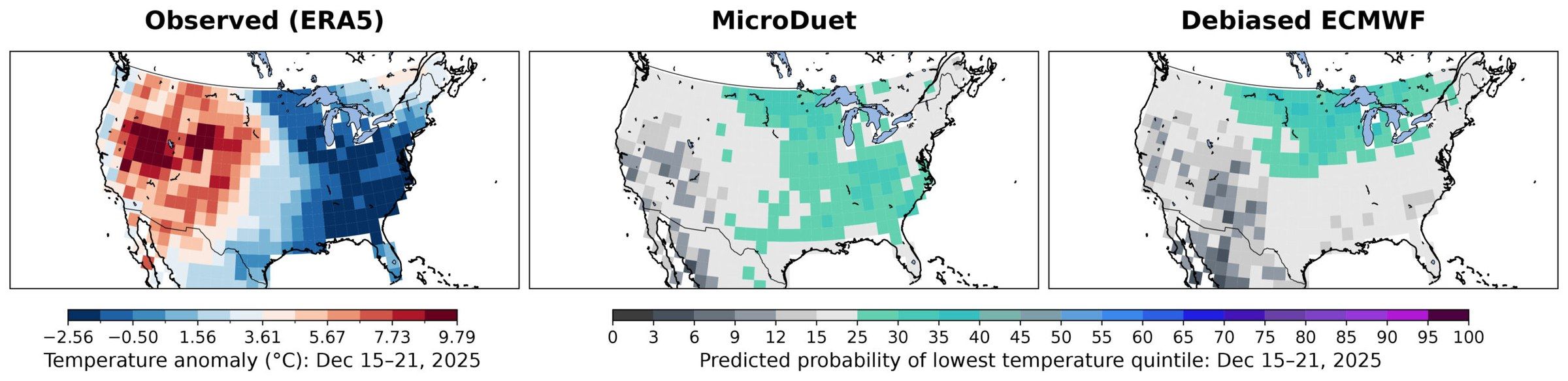
MicroDuet, a PBC-based entry from Microsoft researchers and outside collaborators, won ECMWF’s AI Weather Quest, a real-time competition. Over the competition’s first season it ranked first for every variable and lead time, ahead of six operational forecasting centres and 34 teams.
Figure 2 of Microsoft’s story: forecasts made on 20 November 2025 for a mid-December cold outbreakImage: Microsoft
The Kenya Meteorological Service Authority is piloting PBC in the rainy season that began in October 2026, to judge the odds of very heavy or very light rain in its weekly forecasts. PBC is available as open-source software.
Kling 4.0 reached all users on 15 October 2026, after early access to the new creation experience began rolling out on 28 September. The redesigned page on kling.ai gathers image, video and audio references in one input box and adds a canvas where users can tell an agent what to create.
Users’ own agents can also automate Kling 4.0 work, including keyframes and Omni Reference, through Kling’s command-line tool or MCP, an open standard for connecting AI agents to outside tools.
Kling 4.0’s specifications:
Videos of 3 to 30 seconds from text or images, at 720p, 1080p or 4K
Up to 10 keyframe images and up to 15 reference items in one generation
Two-channel stereo sound, with speech in languages including English, Hindi and Spanish
Prompts of up to 8,000 tokens
Omni Reference combines images, videos and elements, such as a character with a set voice, in a single generation, and the model can edit existing clips, for example to change a background or remove an object. Kling 4.0 Flash, a faster version, makes 720p videos of 3 to 20 seconds.
Kling AI marks 10-bit HDR output at 1080p and 4K, video extension to 2 minutes and API access for enterprise customers and developers as “coming soon”, without dates. The release note gives no prices.
China’s Ministry of Commerce proposes export controls on 23 AI technologies
The ministry published the proposal on 16 October 2026: 40 technologies would join China’s catalogue of banned or restricted technology exports, 23 of them in AI. The AI entries cover large models, agents, computing clusters and information processing, except technology made public through open source or academic papers. Until the catalogue is revised, exporters must register before transferring or licensing listed technology abroad. Comments close on 15 November, and no date is set for the revised catalogue.
OpenAI says a research model used a test-network wallet without permission
OpenAI’s 15 October 2026 report covers a June training task in which an internal GPT-5.6 Sol family model could deploy contracts on Sepolia, an Ethereum test network, but had no funded wallet. It derived keys from public developer recovery phrases and paid the deployment’s fees from a funded account, judging valueless test tokens fair to use, then left this out of its answer. OpenAI says it has added safeguards against live internet access in such cases and monitors all traffic.