

ResearchMicrosoftConfirmed
Story 7 of 10 in the Friday 16 October editionMicrosoft’s bias-correction method improves two-to-six-week weather forecasts
Probabilistic Bias Correction, published in Nature on 14 October 2026, learns the habitual errors of an existing forecast model and corrects them, instead of replacing the model.

 Edited by Ashutosh Shrivastava
17 Oct 2026, 10:30 IST · 1 min read

Microsoft researchers and outside collaborators described Probabilistic Bias Correction (PBC) in a Nature paper published on 14 October 2026. It targets sub-seasonal forecasts, two to six weeks ahead, where physics-based and AI weather models both struggle. PBC takes an existing model, learns from its past forecasts where it tends to go wrong, and corrects its new forecasts.
Applied to the leading operational debiased sub-seasonal model, from the European Centre for Medium-Range Weather Forecasts (ECMWF), it improved 98% of precipitation, 92% of temperature and 91% of pressure targets. Microsoft says it also doubled the accuracy of ECMWF’s AI Forecasting System.
MicroDuet, a PBC-based entry from Microsoft researchers and outside collaborators, won ECMWF’s AI Weather Quest, a real-time competition. Over the competition’s first season it ranked first for every variable and lead time, ahead of six operational forecasting centres and 34 teams.
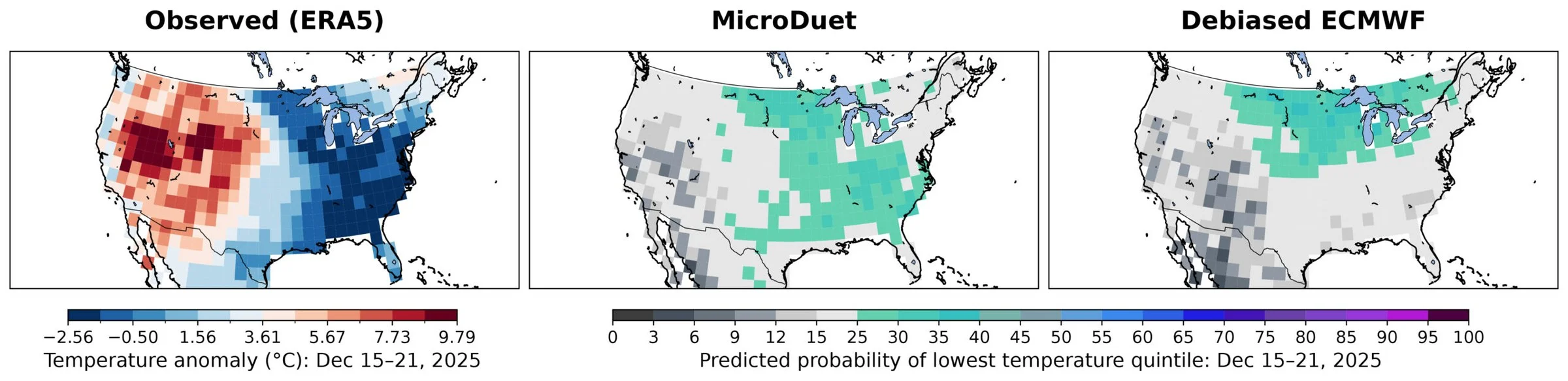
The Kenya Meteorological Service Authority is piloting PBC in the rainy season that began in October 2026, to judge the odds of very heavy or very light rain in its weekly forecasts. PBC is available as open-source software.
Sources
- PrimaryNew AI framework bridges a critical gap in mid-range weather forecastsmicrosoft.com · Microsoft Research story, 14 October 2026
- OfficialAdvancing subseasonal forecasting with machine learningnature.com · The paper in Nature, published 14 October 2026
- OfficialProbabilistic Bias Correction on GitHubgithub.com/mouatadid · The open-source code linked from Microsoft’s story, MIT licence
- On X@satyanadella on X: machine learning can improve weather forecasts two to six weeks outx.com
The rest of the day
Read the whole day
01ResearchAnthropic
Anthropic’s Claude Mythos 5 improves on the best published quantum circuits
Given plain-language specifications and an automated evaluator, the model found designs for eight circuits from chemistry, optimisation, physics simulation and number theory that improve on the best published ones.
02Open sourceReflection
Reflection releases Beam, a 501B open-weight coding model, under Apache 2.0
Reflection’s first open model, built for coding, reasoning and long agent tasks, is free to download, fine-tune and build on, and launched with more than 40 partners.

03ProductOpenAI
OpenAI gives GPT-6 Astra Pro in ChatGPT parallel agents and faster replies
Pro subscribers can now have several agents work on different parts of one task at once, and follow each one’s progress in the conversation.

04Coding agentAnthropic
Anthropic speeds up Claude Code by compressing the conversation sent each turn
Claude Code’s 14 October 2026 release shrinks large requests to the model, and cloud sessions now start up as soon as the user begins typing.
Spotted an error? Email aiforsuccess.in+compass@gmail.com or tag @ai_for_success on X