

InfraGoogleConfirmed
Story 1 of 12 in the Friday 30 October editionGoogle receives first Gemma 4 inference response from orbital TPU on Project Suncatcher
Google Research completed its orbital “Hello World” milestone on 30 October 2026, uplinking a prompt to an onboard Gemma 4 model running on a data-centre-class TPU aboard its Project Suncatcher prototype satellite and receiving a downlinked haiku over Svalbard, Norway.

 Edited by Ashutosh Shrivastava
31 Oct 2026, 11:45 IST · 2 min read
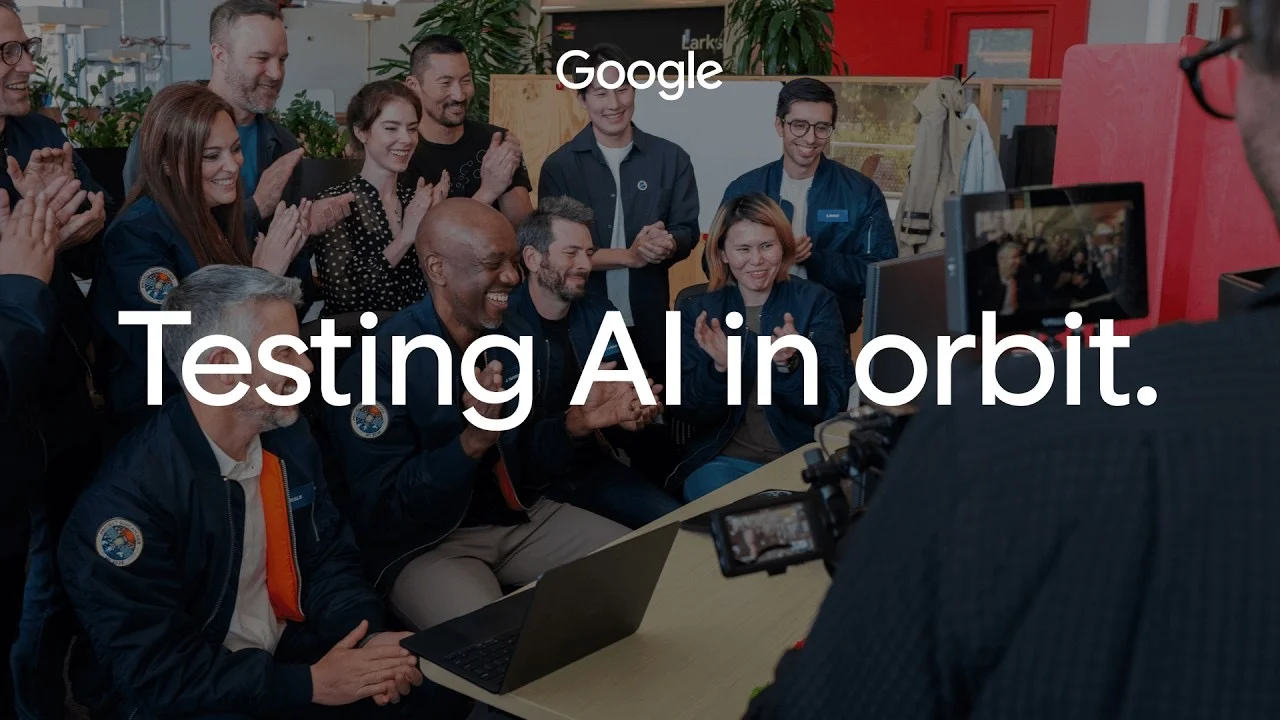
Built in partnership with Planet, Google’s Project Suncatcher prototype satellite launched into low-Earth orbit on 1 October 2026 aboard SpaceX’s Transporter-18 rideshare mission alongside a peer-reviewed design study in Joule. Over the following four weeks, Google Research engineers worked through an orbital commissioning checklist that powered up the satellite host bus and custom TPU trays and verified baseline machine learning execution in vacuum.
Orbital inference test
On 30 October 2026, Senior Director Travis Beals and CEO Sundar Pichai reported the mission’s first end-to-end language model response from space. During a ground-station pass, engineers uplinked a prompt asking the onboard Gemma 4 open model to write a haiku from the perspective of an orbiting TPU watching Earth spin below. As the spacecraft crossed over Svalbard, Norway, it downlinked the completed verse: “Blue marble below / Data streams in silent grace / Starlight feeds my core.”
Engineers followed the initial pass with space-themed limericks and structured telemetry prompts that queried the technical health of the payload systems. Google Research will continue evaluating how data-centre-class TPUs behave under sustained thermal cycling and orbital radiation exposure ahead of its next hardware milestone: launching twin interconnected satellites in 2027 to test high-bandwidth optical links in space. Google has not published orbital power figures, radiation error rates, or commercial deployment dates.
Sources
- PrimaryWe’ve received our first response from the Project Suncatcher prototype satelliteblog.google · Google Research post by Travis Beals
- OfficialOur Project Suncatcher prototype satellite is in orbitblog.google · 1 October 2026 launch overview
- On XSundar Pichai (@sundarpichai) on Xx.com · Ground-station terminal clip and announcement
The rest of the day
Read the whole day
02ProductOpenAI
OpenAI launches Private Intelligence security architecture for enterprise AI
OpenAI introduced Private Intelligence on 30 October 2026, unifying zero-retention API options, confidential-computing Private Inference in preview, and granular workspace action policies across ChatGPT, Codex, and the OpenAI API.
03ProductAnthropic
Anthropic renames Claude Max 20x to Ultra and removes five-hour session caps
Anthropic renamed its $100 monthly Claude Max 5x tier to Max and its $200 monthly Max 20x tier to Ultra on 30 October 2026, eliminating five-hour rolling session limits on verified Ultra accounts.

04CreativeThe Biological Computing Co.
The Biological Computing Co. ships neuron-derived TBC mischief 1 video model
San Francisco startup The Biological Computing Co.

05Open sourcePika
Pika open-sources six-step Pika H3 Flex video-and-audio model
Released on 29 October 2026, Pika H3 Flex post-trains MiniMax H3 down from 50 denoising steps to six, generating 15-second 768p stereo-audio video clips in seven seconds of transformer compute alongside open weights on Hugging Face.
Spotted an error? Email aiforsuccess.in+compass@gmail.com or tag @ai_for_success on X