

ResearchOpenAIConfirmed
Story 3 of 9 in the Monday 2 November editionOpenAI introduces LifeVal to test AI agents on everyday household and civic tasks
Grounded in government time-use diaries and a survey of 3,995 people, the evaluation published on 2 November 2026 measures browser use, computer use and connectors across seven personal-life domains.

 Edited by Ashutosh Shrivastava
3 Nov 2026, 09:45 IST · 1 min read
OpenAI introduced LifeVal on 2 November 2026 to measure how AI assistants handle practical household and personal administration rather than coding or academic exams. To construct the suite, OpenAI paired data from the American Time Use Survey and the Multinational Time Use Study with a demographically representative survey of 3,995 respondents asking where unpaid personal tasks consume the most time and effort.
The resulting multi-step scenarios span seven categories: caregiving, health, education, household administration, personal finances, shopping and government services. Completing a task requires an agent to combine web browsing, desktop computer use and external connectors while respecting constraints such as municipal deadlines, school catchment rules, dietary restrictions or county property portals.
In walkthrough examples drawn from what OpenAI calls its current models without naming a specific checkpoint, scores reached 100% on a Luzerne County home search and deed-record lookup, 98.0% on flood-volunteer coordination, 96.3% on setting up a remote sports watch for an elderly relative, 93.1% on shortlisting local kindergartens and 90.4% on assembling a diabetes care and meal plan. OpenAI uses LifeVal internally alongside GDPval and has not released the task dataset or a public leaderboard repository.
Sources
- PrimaryIntroducing LifeVal on the OpenAI blogopenai.com
- On XOpenAI LifeVal announcement on Xx.com
The rest of the day
Read the whole day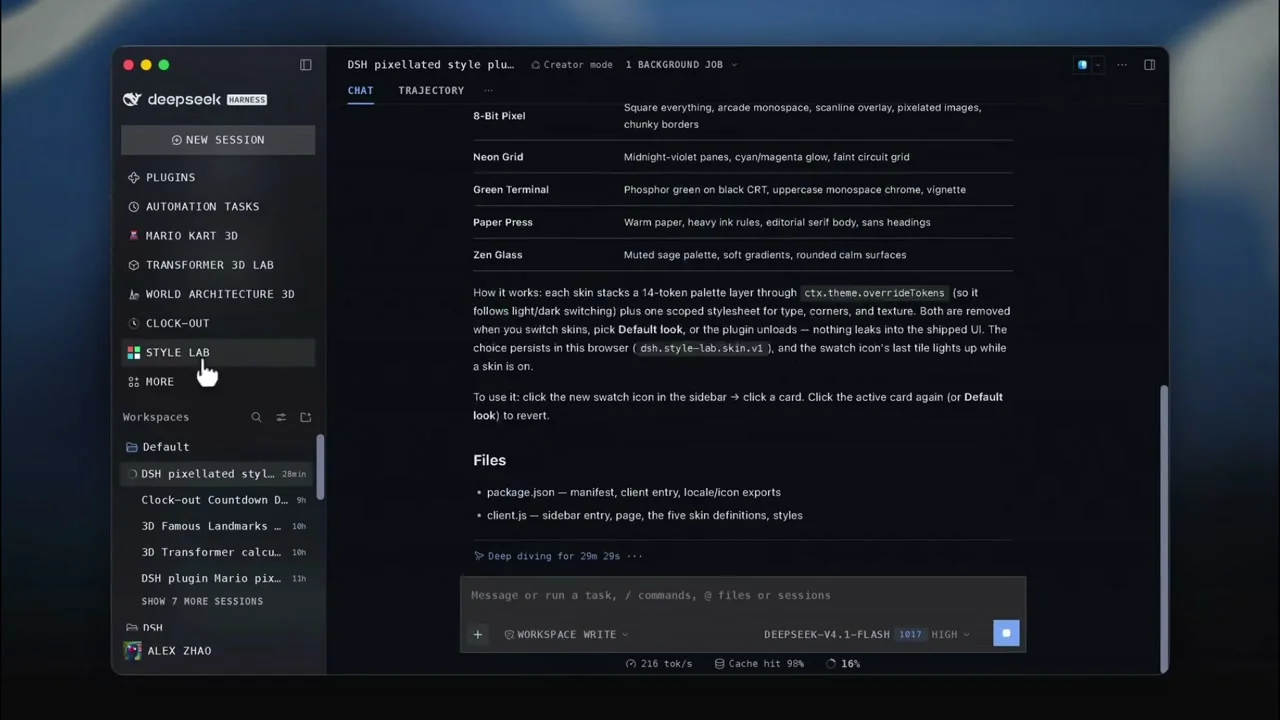
01Coding agentDeepSeek
DeepSeek Harness adds Creator Mode for building live UI plugins in chat
Announced on 2 November 2026, the fourth session mode in DeepSeek’s MIT-licensed desktop and local web agent harness generates, lints, themes and hot-installs custom interface plugins inside an active workspace.

02Open sourceDeep Principle
Deep Principle releases Hydrogen-1.0 open-weight model for chemistry and materials
Built on Z.ai’s GLM-5.3 and released under the MIT licence on 2 November 2026, Hydrogen-1.0 pairs laboratory notebook trajectories with reinforcement learning across molecular, materials and life-science workflows.

04ModelMeituan
Meituan launches LongCat-2.5 with 1.6T parameters and discrete visual tokens
Detailed in a 1 November 2026 technical report and opened on the LongCat API on 2 November 2026, the Mixture-of-Experts model activates roughly 48B parameters per token across text and native-resolution images.

05InfraAnthropic
Anthropic adds server-side message threads to cut long-context Claude API latency
Launched in public beta on 2 November 2026, message threads keep conversation state in encrypted server memory for five minutes so subsequent turns transmit only new messages and cut median time to first token by roughly 35%.
Spotted an error? Email aiforsuccess.in+compass@gmail.com or tag @ai_for_success on X