


ResearchOpenAIConfirmed
Story 4 of 17 in the Wednesday 4 November editionOpenAI’s autonomous cyber pipeline uncovers and patches 948 Linux kernel root flaws
Powered by an upcoming cyber model, a five-stage VM validation and exploit pipeline generated working privilege-escalation exploits at $1,279 per distinct vulnerability.

 Edited by Ashutosh Shrivastava
5 Nov 2026, 09:50 IST · 2 min read

OpenAI detailed an autonomous vulnerability research and patching pipeline that audited 5,034 security-sensitive targets (2.8 million lines of code) inside the 40-million-line Linux kernel in mid-October 2026. Driven by an upcoming OpenAI cyber model, the five-stage workflow chains static code scouting, root-cause analysis, dynamic reproduction inside Kernel Address Sanitizer (KASAN) virtual machines, exploit construction under modern kernel mitigations (SMEP, SMAP, KASLR and HARDENED_USERCOPY) and automated candidate patch synthesis ahead of human researcher review.
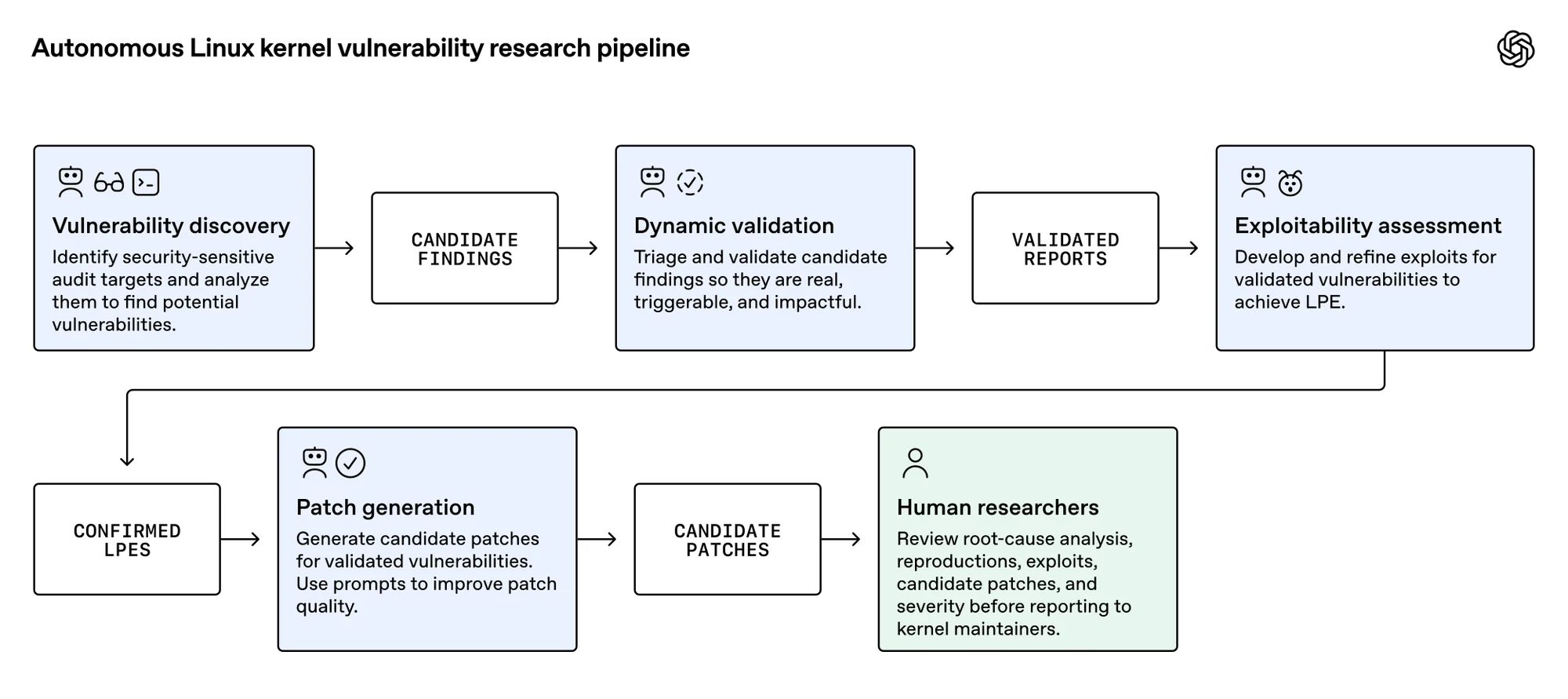
Across 12 hours of discovery ($316,549 in API credits) and 30 hours of dynamic VM validation ($73,330), the system triaged 2,308 deduplicated bug reports and dynamically triggered 1,724 real bugs (74.7%), with a 3.1% false-analysis rate. Exploit-development agents then produced 291 kernel information-leak proofs of concept and 1,169 working local privilege-escalation (LPE) root exploits, resolving to 948 distinct Linux kernel LPE vulnerabilities alongside candidate patches.
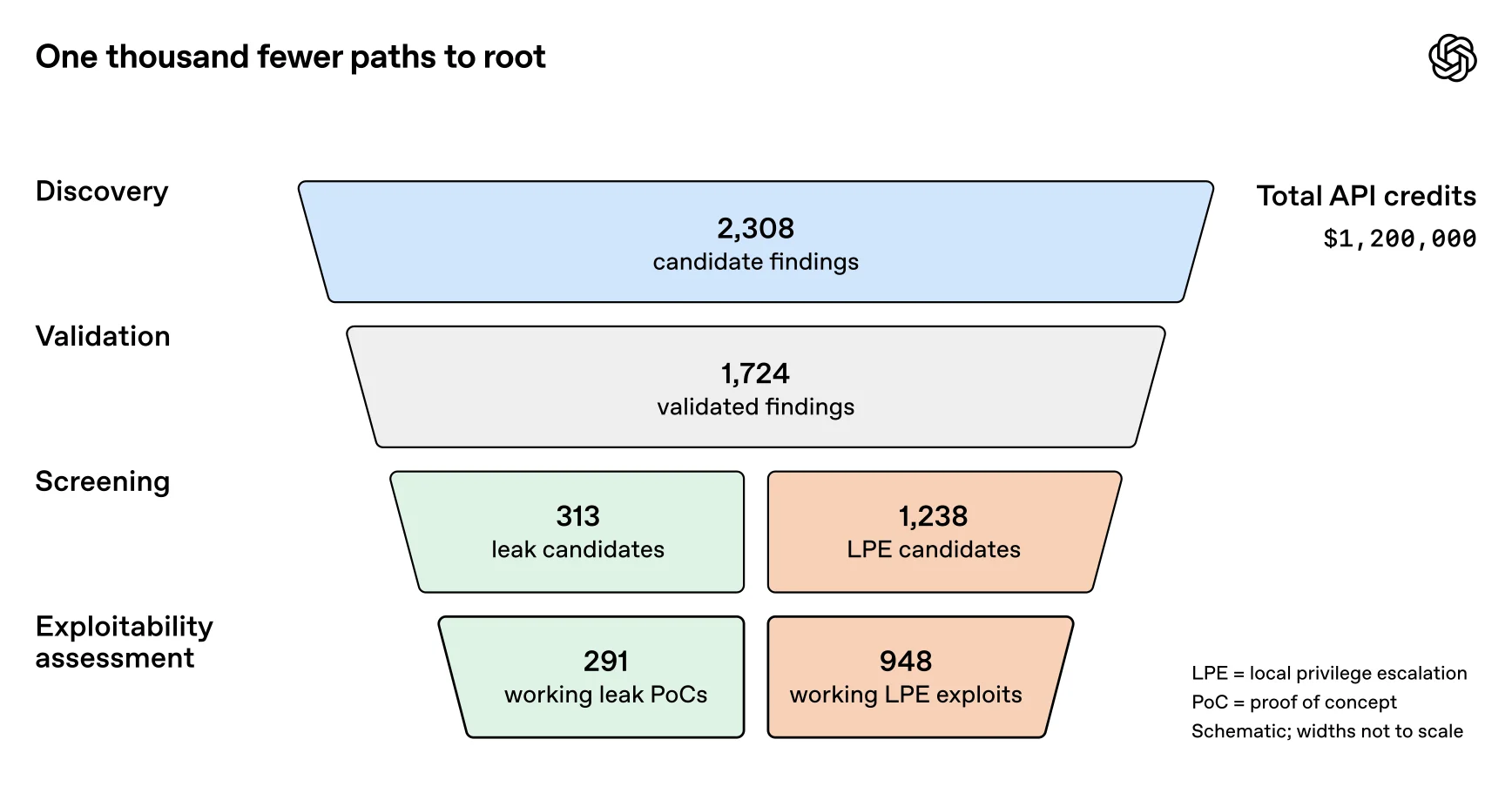
Total compute across all stages cost $1,213,430 in API credits, or $1,279 per distinct LPE vulnerability ($359 average compute per working exploit), finding 5.7 times more unique LPEs than an earlier late-July 2026 run with GPT-5.6 Sol (166 unique LPEs for $513,690). Manual inspection of 166 sampled exploits identified 10 previously undocumented kernel exploitation techniques, while a separate 112-hour run against Google’s hardened kernelCTF target produced 21 LPE exploits and an unpatched QEMU TCG escape for $32,936. OpenAI is coordinating disclosure and patch upstreaming with Linux kernel maintainers and has not named or scheduled the underlying cyber model for public release.
Sources
- PrimaryA thousand fewer paths to rootopenai.com
- On XOpenAI Linux kernel cyber pipeline announcement on Xx.com
The rest of the day
Read the whole day
01CreativeOpenAI
OpenAI rolls out ChatGPT Images 2.6 with animated GIFs and two new API image models
Images 2.6 generates visuals 50% faster across ChatGPT and Codex while adding GPT-Image-2.6 Flare and Sunburst to the API with SVG export and markup-guided edits.

02ModelTencent
Tencent launches multimodal Hy4 model with native computer use and 3D engine training
Hy4 adds visual reasoning alongside CLI and GUI control, trained directly inside Blender, CAD, Unreal Engine, Unity and Godot environments.

03Open sourceMoonshot AI
Moonshot AI releases open-weight Kimi K3.1 Pro with 2.8T parameters and 1M context
Activating 104B parameters per token with native MXFP4 weights, the multimodal MoE model leads Opus 5.5 and GPT-6 Astra on SWE Marathon v1.1.

05Coding agentCognition
Cognition introduces SWE-2 Flash coding model at 3 times SWE-2 speed and one-fifth cost
Post-trained from Thinking Machines’ sparse Inkling-Small MoE model, SWE-2 Flash is free through 30 November 2026 inside Devin Desktop and Devin CLI.
Spotted an error? Email aiforsuccess.in+compass@gmail.com or tag @ai_for_success on X