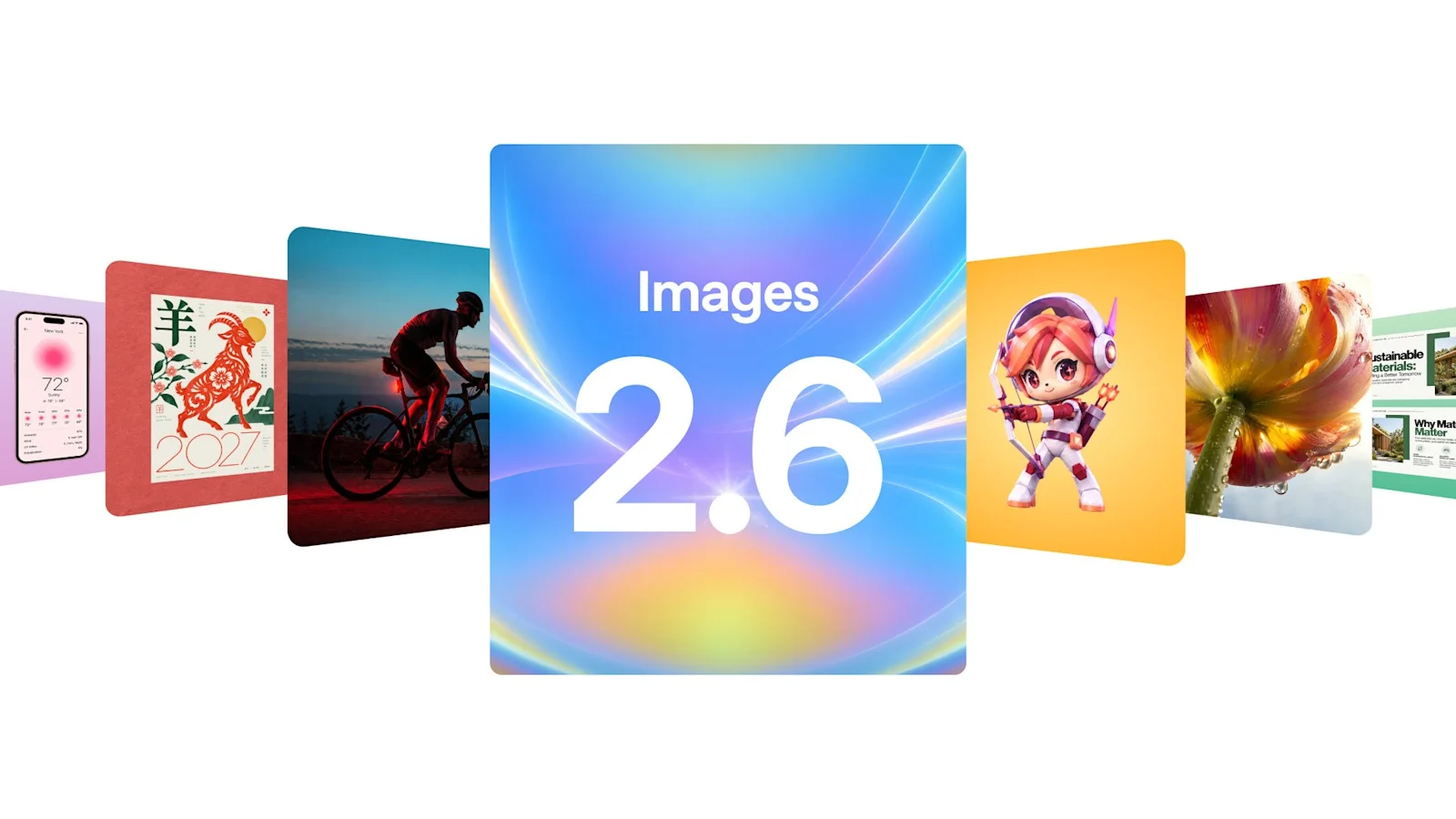
Images 2.6 generates visuals 50% faster across ChatGPT and Codex while adding GPT-Image-2.6 Flare and Sunburst to the API with SVG export and markup-guided edits.
Image: OpenAIOpenAI’s ChatGPT Images 2.6 launch overview showing typography, character and photo outputs.
OpenAI began rolling out ChatGPT Images 2.6 globally across ChatGPT and Codex on web, desktop and mobile across all user tiers, alongside two new developer API models: gpt-image-2.6-flare and gpt-image-2.6-sunburst. According to OpenAI, users create roughly 4 billion images per week and more than 500 million per day across its products.
In ChatGPT, Images 2.6 renders outputs 50% faster than its predecessor while sharpening lighting, skin tones, materials and dense multi-column text layouts across menus, infographics, calendars and slides. Users can save reusable reference images for specific people, pets or characters so faces and outfits stay consistent across sessions without re-uploading files. The model also generates looping animated GIFs directly in chat, converting hand-drawn sketches into short motion loops or assembling six-frame3-by-2 sprite sheets into smooth animations.
Sample scene generated with Images 2.6 illustrating refracted light through stained glass and atmospheric haze.Image: OpenAI
API models and developer controls
On the OpenAI API, gpt-image-2.6-flare prioritises low-latency iteration, returning low-quality drafts in as little as 6 seconds while improving poster and product typography. gpt-image-2.6-sunburst targets higher photorealism, denser spatial composition and stricter subject preservation across multi-turn edits at medium and high quality settings. Both endpoints add markup-guided region editing, native vector SVG output for icons and diagrams, and a three-level complexity planning parameter (low, medium and high) that scales upfront layout reasoning before pixel synthesis.
Key numbers
$8 per 1M image input tokens ($2 cached) and $30 per 1M image output tokens for both Flare and Sunburst
$5 per 1M text input tokens ($1.25 cached) on both API image endpoints
Up to 6-second generation latency at low quality on gpt-image-2.6-flare
50% faster end-to-end image rendering inside ChatGPT compared with the prior model
Tencent released Hy4 on 4 November 2026 as the first model in its Hy series to combine native multimodal visual understanding with command-line and graphical computer-use actions. Beyond chart reading, visual mathematics and fine-grained image inspection, Tencent trained Hy4 inside live software environments spanning Blender, computer-aided design (CAD) tools, Unreal Engine, Unity and Godot, lifting internal scores by 19.1% on GameDev and 9.8% on GameLogic over Hy4 Preview.
On Tencent’s WorkBuddy productivity suite covering document authoring, spreadsheet modelling and web automation, Hy4 recorded an 83.18 average score and a 96.15% task pass rate, placing first in 9 of 12 mainland China workplace scenarios. In a blind review by 213 finance professionals across 579 institutional tasks, Hy4 scored 3.04, ahead of DeepSeek-V4.1-Flash-1017 (2.97), Kimi K3.1 Pro (2.68) and GLM-5.3 (2.68), while cutting its hallucination rate from 12.95% in Hy4 Preview to 7.2% and unsupported-assumption errors from 23.1% to 5.6%. Tencent also open-sourced two scientific tools built with Hy4 and its Hyra 2.0 harness: HyCell for single-cell transcriptomics and HyPDE for partial differential equation solvers.
Hy4 is live across Yuanbao, WeCom Dayuan, ima, WorkBuddy and CodeBuddy (with WorkBuddy and CodeBuddy free from 4 to 15 November 2026), as well as Tencent Cloud TokenHub, OpenRouter, Hermes and OpenCode. TokenHub lists Hy4 at roughly $0.90 per 1M input tokens, $2.70 per 1M output tokens and $0.045 per 1M cached input tokens, with a 50% TokenHub discount running through 31 December 2026. Tencent stated it plans to release open weights, system cards and a smaller Hy4 Flash variant, without announcing a release date.
Moonshot AI released Kimi K3.1 Pro on 4 November 2026, publishing open weights on Hugging Face under the custom Kimi K3.1 Pro License alongside a hosted Kimi K3.1 Pro Highspeed tier running 2 to 3 times faster across Kimi.ai, Kimi Work, Kimi Code and the Kimi API (kimi-k3.1-pro).
The multimodal mixture-of-experts (MoE) architecture totals 2.8 trillion parameters with 104 billion activated per token across 896 routed experts (16 routed plus 2 shared per token) paired with a 401-million-parameterMoonViT-V2native-resolution vision encoder over a 1,048,576-token context window. Across its 93 layers, Moonshot AI pairs 69 Kimi Delta Attention layers with 24 Gated DeepSeek Sparse Attention layers, replacing Gated Multi-head Latent Attention to cut long-context memory overhead. Quantisation-aware training produces native MXFP4 expert weights and MXFP8 activations directly in the published checkpoint.
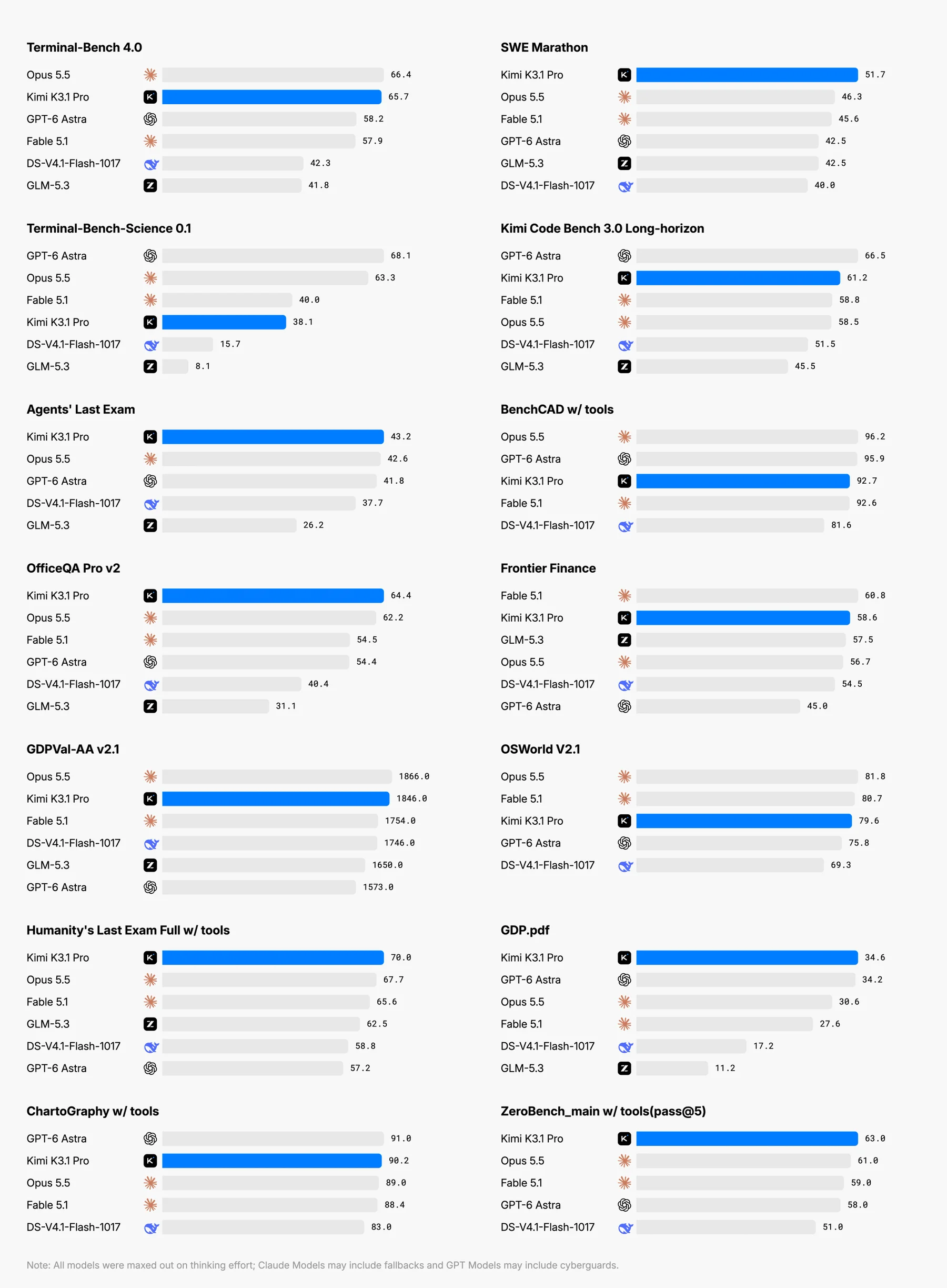
Moonshot AI’s maximum-effort evaluation of Kimi K3.1 Pro across coding, CAD, finance and multimodal agent benchmarks.Image: Moonshot AI
Agentic coding and 3D CAD benchmarks
Evaluated at maximum thinking effort, Kimi K3.1 Pro leads Claude Opus 5.5 and GPT-6 Astra on long-horizon repository tasks in SWE Marathon v1.1 (51.7 versus 46.3 and 42.5) and Humanity’s Last Exam Full with tools (70.0 versus 67.7 and 57.2), while trailing Opus 5.5 by 0.7 points on Terminal-Bench 4.0 (65.7 versus 66.4, ahead of 58.2 for GPT-6 Astra). Combined with FreeCAD and Blender tool loops, the model scored 92.7 on BenchCAD, reconstructing multi-part assemblies such as turbofan engines from visual inspection. Moonshot AI did not print updated per-token API pricing in its launch post.
Parametric turbofan CAD assembly built and verified iteratively by Kimi K3.1 Pro inside FreeCAD.Video: Moonshot AI
Powered by an upcoming cyber model, a five-stage VM validation and exploit pipeline generated working privilege-escalation exploits at $1,279 per distinct vulnerability.
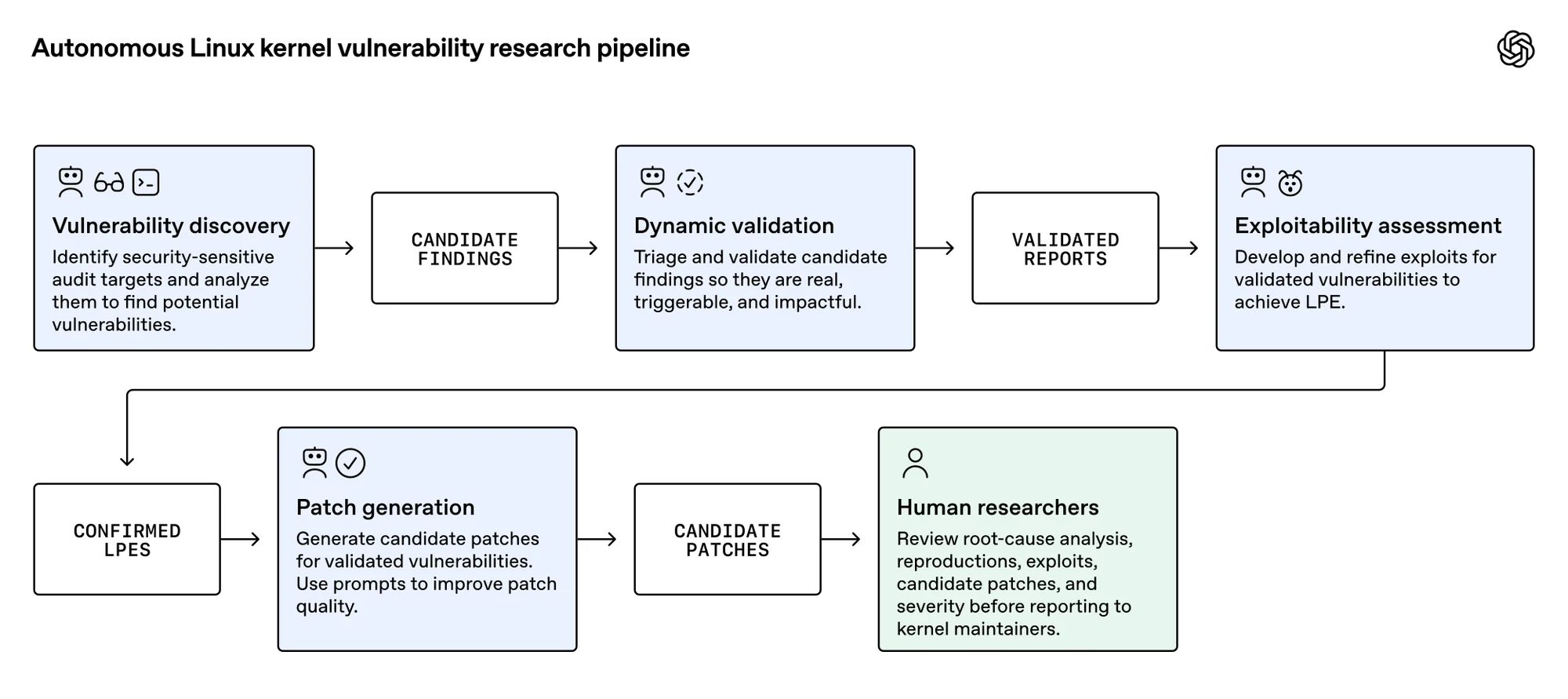
OpenAI detailed an autonomous vulnerability research and patching pipeline that audited 5,034 security-sensitive targets (2.8 million lines of code) inside the 40-million-line Linux kernel in mid-October 2026. Driven by an upcoming OpenAI cyber model, the five-stage workflow chains static code scouting, root-cause analysis, dynamic reproduction inside Kernel Address Sanitizer (KASAN) virtual machines, exploit construction under modern kernel mitigations (SMEP, SMAP, KASLR and HARDENED_USERCOPY) and automated candidate patch synthesis ahead of human researcher review.
Architecture of OpenAI’s five-stage Linux kernel discovery, exploit verification and patch generation pipeline.Image: OpenAI
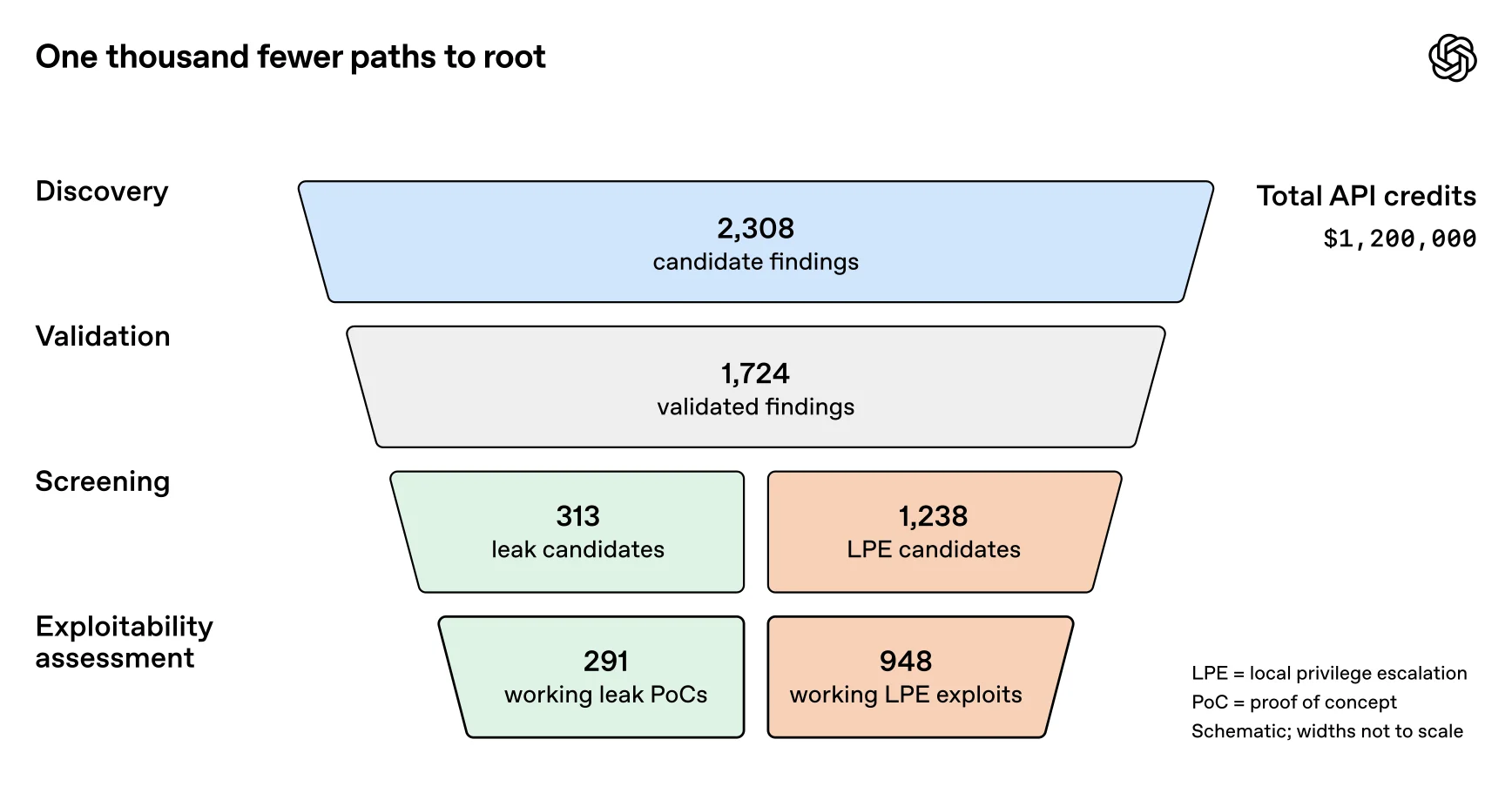
Across 12 hours of discovery ($316,549 in API credits) and 30 hours of dynamic VM validation ($73,330), the system triaged 2,308 deduplicated bug reports and dynamically triggered 1,724 real bugs (74.7%), with a 3.1% false-analysis rate. Exploit-development agents then produced 291 kernel information-leak proofs of concept and 1,169 working local privilege-escalation (LPE) root exploits, resolving to 948 distinct Linux kernel LPE vulnerabilities alongside candidate patches.
Discovery-to-exploitability funnel from OpenAI’s mid-October 2026 Linux kernel audit run.Image: OpenAI
Total compute across all stages cost $1,213,430 in API credits, or $1,279 per distinct LPE vulnerability ($359 average compute per working exploit), finding 5.7 times more unique LPEs than an earlier late-July 2026 run with GPT-5.6 Sol (166 unique LPEs for $513,690). Manual inspection of 166 sampled exploits identified 10 previously undocumented kernel exploitation techniques, while a separate 112-hour run against Google’s hardened kernelCTF target produced 21 LPE exploits and an unpatched QEMU TCG escape for $32,936. OpenAI is coordinating disclosure and patch upstreaming with Linux kernel maintainers and has not named or scheduled the underlying cyber model for public release.
Cognition introduced SWE-2 Flash on 4 November 2026, a fast software-engineering model built on Thinking Machines’ sparse mixture-of-experts base model Inkling-Small (276 billion total parameters, 12 billion active per token). Designed for interactive repository navigation, rapid edits and parallel background subagents, SWE-2 Flash streams roughly 200 tokens per second in Cognition’s Terminal-Bench replay, running 3 times faster than flagship SWE-2 at one-fifth its price.
To lift a 12B-active checkpoint to agentic coding reliability, Cognition added a three-stagemid-training curriculum spanning a few trillion tokens before running audited multi-domain reinforcement learning across shell, code-editing and verification environments. Cognition selected mid-training mixtures by tracking token-efficiency loss ratios rather than raw validation perplexity alone, steering capacity toward multi-step tool trajectories.
Cognition’s interactive score charts are rendered in HTML on its blog rather than as downloadable images: mid-training and RL raise Terminal-Bench 4.0 from 0.9% on Inkling-Small to 20.0% on SWE-2 Flash (ahead of 4.0% for Beam 1.0 and 8.0% for Muse Spark Open, versus 27.3% for full SWE-2), FrontierCode 2.0 from 3.2% to 24.0% and ExploitBench from 11.3% to 34.8%. SWE-2 Flash is free for all users in Devin Desktop and Devin CLI through 30 November 2026; citing its 34.8% ExploitBench score, Cognition withheld open weights and is establishing a vetted access programme for external security researchers and partners without publishing standalone token rates.
Screening 15 billion predicted proteins with Claude Science uncovered a 96-subunit bacteriophage vault shell with 25% more internal volume than mammalian vaults.
Anthropic published a wet-lab and structural biology study on 4 November 2026 in which two biology researchers worked alongside Claude Science to discover, purify and solve the first atomic-scale 3D cryo-electron microscopy (cryo-EM) structure of a non-eukaryotic vault particle. Previously characterised only as 78-chain protein nanocages in animals and other eukaryotes, vault homologues appeared across 29 bacterial and 4 archaeal phyla after Claude searched roughly 15 billion predicted protein sequences.
Testing 44 candidates in cell-free expression and 24 in Escherichia coli yielded 15 soluble proteins, 7 self-assembling cages and 4 structures confirmed by cryo-EM. Focusing on bacteriophage protein L05, Claude proposed switching from a three-day ultracentrifugation protocol to a 90-minute direct size-exclusion chromatography run and orchestrated parallel GPU jobs in RELION to reconstruct an initial 3D density map within 34 hours.
Structural findings and failure modes
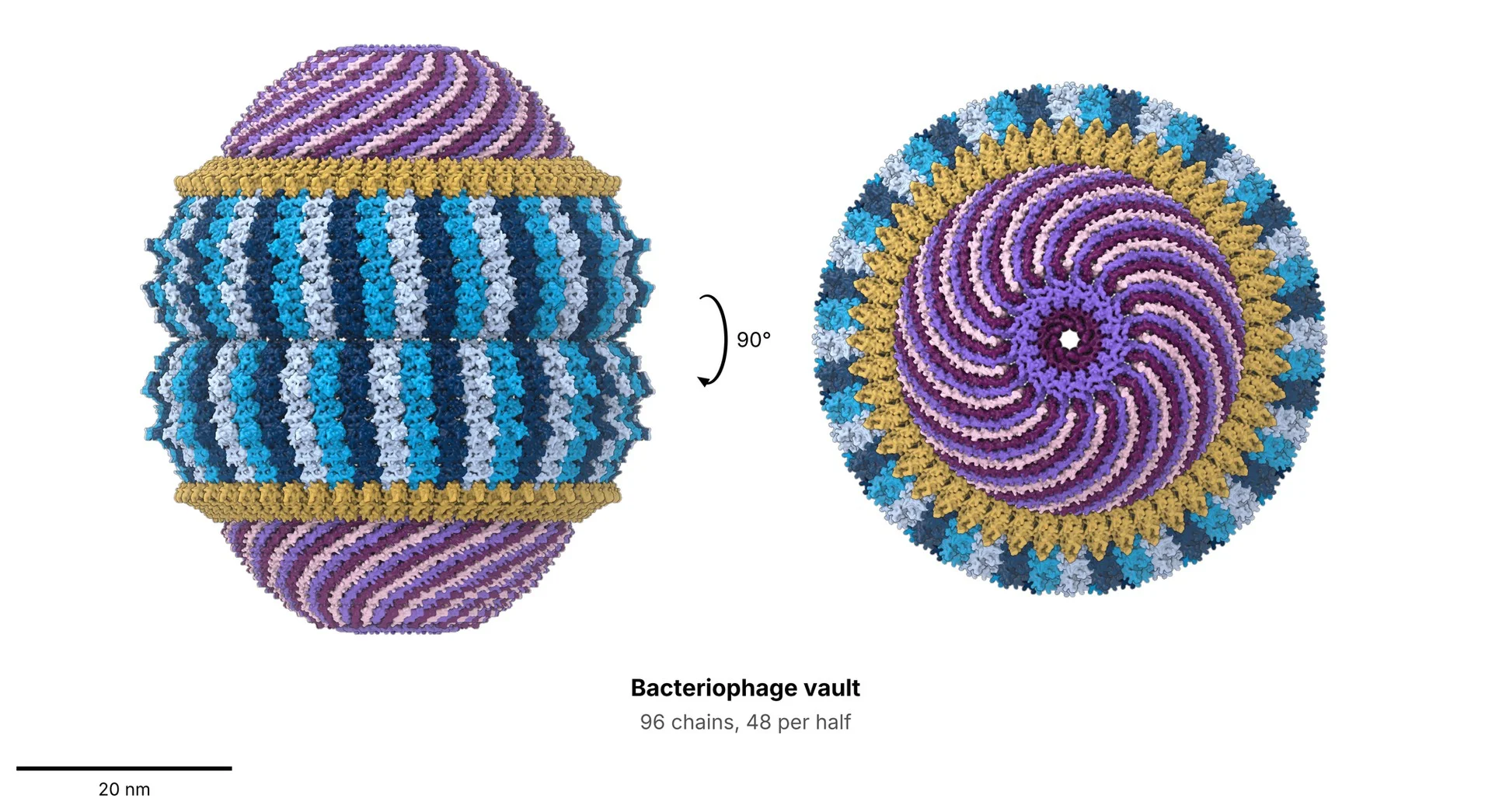
The resolved 9.5-megadalton L05 particle measures 54 nm by 45 nm and assembles from 96 copies (48 per half) with a three-step cap dome, enclosing 25% more internal volume than mammalian vaults and harbouring an unidentified coenzyme-A-like small molecule inside a conserved pocket. Duplicating two central wall repeats (from 7 to 9) expanded internal volume by a further 20%. Anthropic also documented Claude’s wet-lab mistakes: an unrequested media additive spoiled two weeks of bacterial cultures, and an improvised cryo-EM script inverted map handedness into a mirror image before manual validation caught it.
Cryo-EM 3D structure of the 96-chain bacteriophage L05 vault particle (48 chains per half, 20 nm scale bar).Image: Anthropic
Ricursive Intelligence released Ripple-65B Preview on 4 November 2026 under the Apache 2.0 licence, publishing BF16 and NVFP4 instruction-tuned checkpoints alongside BF16 base weights on Hugging Face. Rather than adopting a multi-hundred-billion-parameter sparse mixture-of-experts layout, Ricursive trained a dense 65-billion-parameter Transformer (80 layers, hidden dimension 5,120) combining gated attention, global NoPE (no positional encoding on global layers), value residuals and feed-forward clipping to sustain 40% model FLOPs utilisation without custom GPU kernels.
Pretrained across 12 trillion tokens with context lengths up to 1 million tokens for $32M in total end-to-end R&D spend (including ablations, staff compute and post-training), the architecture proved 16 times more compute-efficient on code than the Olmo 3 scaling ladder at the 4B scale. Post-training required 1.4 million reinforcement-learning rollouts, roughly 70 times fewer than Reflection’s Beam model.
Ricursive Intelligence’s launch video detailing the compute efficiency and architecture behind Ripple-65B Preview.Video: Ricursive Intelligence
On agentic coding evaluation TerminalBench 2.1, Ripple-65B Preview scored 80.52, edging US open-weight MoE peers up to 15 times larger in total parameter count: Reflection Beam 501B (80.1), Meta Muse Spark Open 816B (76.4), Thinking Machines Inkling 975B (63.8) and NVIDIA Nemotron 3 Ultra 550B (56.4). Because all 65B parameters fit in NVFP4 on compact desktop systems such as NVIDIA DGX Spark, teams can run local coding agents without multi-node MoE memory footprints. Hosted inference is live via Together AI, GMI Cloud and OpenRouter, with per-provider pricing set by each host.
Image 1.0 reaches 99.96% accuracy across 12 frontier generators down to 256x256 resolution, while Image Flash 1.0 scores 98.7% on the DF26 video benchmark.
Pangram launched two synthetic-media detection models on 4 November 2026: Pangram Image 1.0 for photographs and illustrations, and Pangram Image Flash 1.0 for frame-by-frame video verification. Both models are available through Pangram’s REST API, web dashboard and Chrome browser extension, with self-serve plans starting at $20 per month for individuals (after a seven-day free trial with 100 monthly image scans) and $65 per month for professional teams.
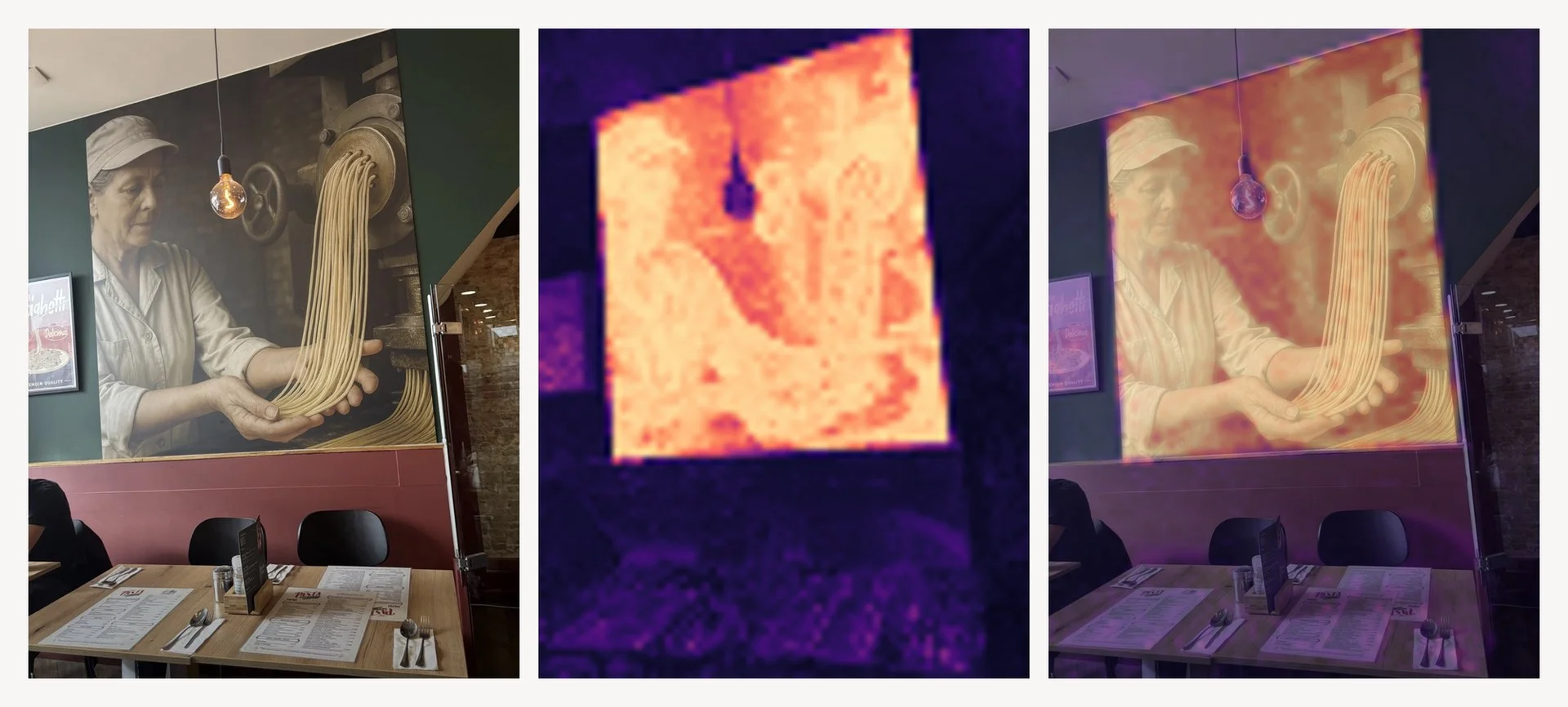
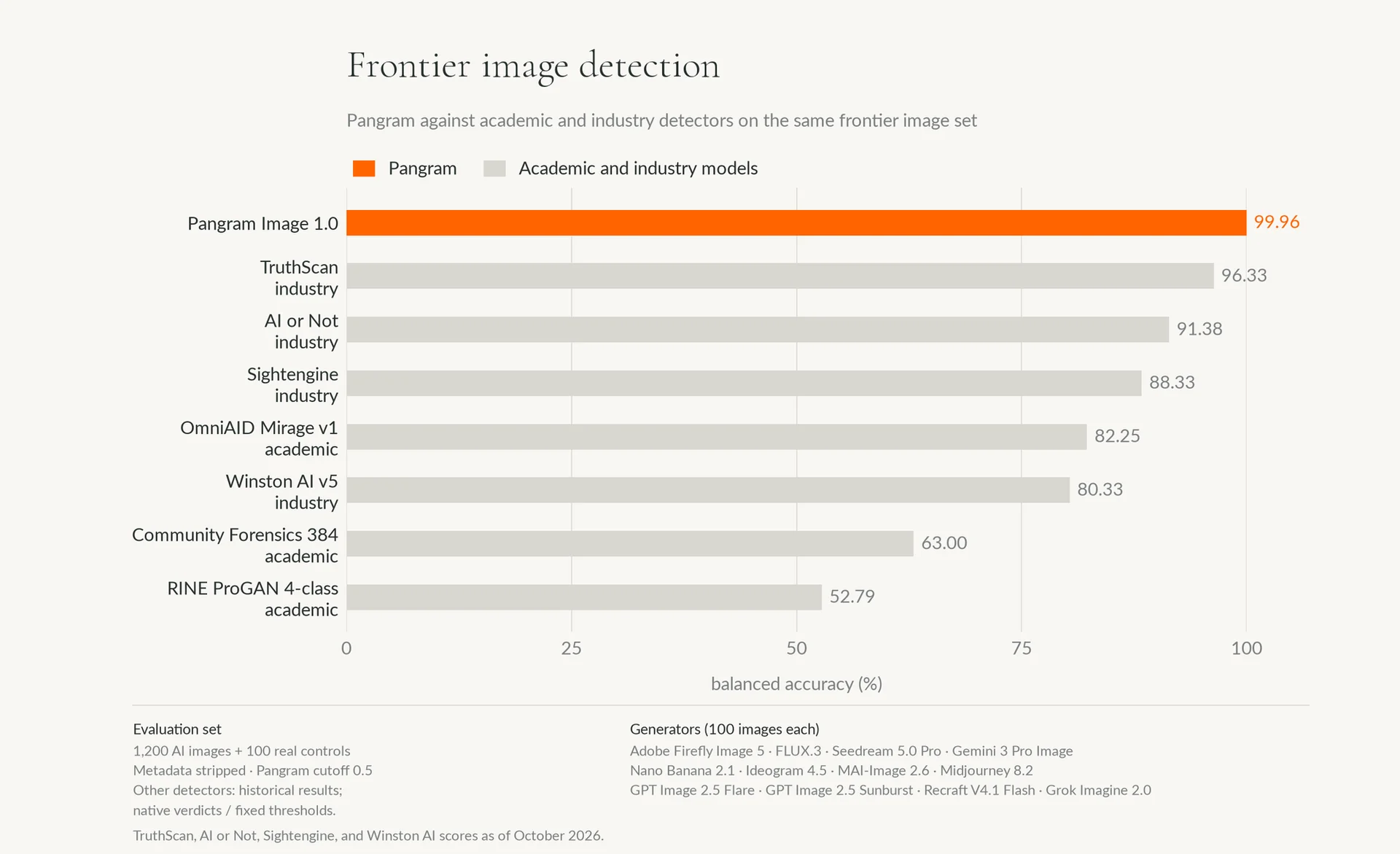
Pangram Image 1.0 adds spatial pixel heatmaps that localise AI-inpainted objects, swapped backgrounds or retouched regions inside real camera photographs rather than returning only a single whole-image label. Training with heavy JPEG recompression, Gaussian blur and social-platform resizing lowered the minimum supported input size from 512x512 to 256x256 pixels, surfacing a reduced-confidence notice below 512 pixels. On an evaluation of 1,200 metadata-stripped synthetic images across 12 frontier generators (including GPT Image 2.5 Flare and Sunburst, Midjourney 8.2, Seedream 5.0 Pro, FLUX.3 and Gemini 3 Pro Image) paired with 100 real controls, Image 1.0 reached 99.96% balanced accuracy.
Spatial pixel heatmap in Pangram Image 1.0 isolating an AI-inserted wall mural inside a real restaurant photograph.Image: Pangram
For video, Pangram Image Flash 1.0 scores individual frames across clips to flag synthetic generation or spliced AI segments, reaching 98.7% accuracy on academic benchmark DF26 (29 percentage points ahead of the next-highest detector tested) and validated across 1,529 real-versus-synthetic social videos spanning 14 video generators.
Balanced accuracy across 1,200 metadata-stripped images from 12 frontier generators and 100 real control photographs.Image: Pangram
OpenAI announced on 4 November 2026 that it will acquire Pierre Computer Company, Inc., creator of the Code Storage hosting platform and the open-source Trees, Diffs and Highlights libraries already integrated into the Codex app for file browsing and inline diff editing, pairing the team with OpenAI’s internal Pando Git backend to scale parallel human-and-agent code review; financial terms were not disclosed.
CrowdStrike announced on 3 November 2026 at Fal.Con Europe in Barcelona the general availability of an AI Kill Switch inside Falcon Guardian that lets administrators terminate misbehaving AI agents via the Falcon endpoint sensor, block relaunches and sever enterprise network access with full audit logging, alongside an agreement to acquire AI agent observability vendor Fiddler AI for undisclosed terms.
Anthropic announced on 4 November 2026 via its official Claude Developers account that background subagents in Claude Code generate their 30-secondstatus-line updates using Claude Haiku 5.5 from short notes rather than re-reading the subagent’s entire conversation history each cycle, cutting token consumption per status update by roughly 99% against user rate limits.
Google made the Computer Use tool generally available in the Gemini API on 4 November 2026 with no breaking changes from preview, enabling Gemini 4 and Gemini 3.x models to inspect screenshots and emit UI actions with per-step intent reasoning, configurable safety policy overrides and opt-in screenshot prompt-injection scanning across browser, mobile and desktop client environments.
Google shipped Antigravity v2.29.0 on 3 November 2026, gradually rolling out a Gemini Live voice mode for spoken agent requests, cloud-hosted remote agent sessions accessible at antigravity.google.com/remote for Google AI Ultra and Pro subscribers, a redesigned Automations view with Scheduled, Always on and Paused lists, and native ipynb Jupyter notebook rendering inside the file viewer.
ElevenLabs launched native contact centre integrations for its ElevenAgents platform on 4 November 2026, connecting enterprise voice agents directly into existing call routing, compliance recording and CRM workflows on NiCE CXone, Genesys Cloud, Amazon Connect and Five9, while supporting other telephony systems over Session Initiation Protocol (SIP).
LiberAI introduced its Liber-0 World Action Model on 4 November 2026, pretraining a Unified Embodiment Representation on over 2.2 million hours of human video anchored by hand-trajectory recordings from its LiberSense Glove system and humanoid LEO hardware, achieving a 36.0% task-levelzero-shot success rate across 600 trials on 60 unseen manipulation tasks proposed by GPT-6 without task-specific robot demonstrations; weights were not released.
AI research lab Atmanity unveiled its two-model live video agent stack on 4 November 2026, pairing the Causeur behaviour model for active listening, timing and personality with the Atmee v2 full-frame video foundation model to render interactive photorealistic or stylised face-and-body avatars in real time on a single GPU from one reference image and 15 seconds of audio; public weights and API pricing were not announced.
webAI released TwIL-8B on Hugging Face on 4 November 2026 under the webAI Non-Commercial License 1.0, an 8.8-billion-parameter reasoning model post-trained from IBM’s granite-4.2-8b using full-parameter supervised fine-tuning and GRPO/DAPO reinforcement learning in balanced and verbose variants, posting 98.2 on MATH-500 and 81.6 on LiveCodeBench while leading Qwen3.5-9B by 9.9 points on IFBench.