


ResearchAnthropicConfirmed
Story 5 of 11 in the Friday 6 November editionAnthropic details Claude agent memory architecture and offline dreaming
An Engineering Blog post explains how background consolidation reviews transcripts, extracts corrections, and injects a compact memory layer into new sessions.

 Edited by Ashutosh Shrivastava
7 Nov 2026, 09:30 IST · 1 min read
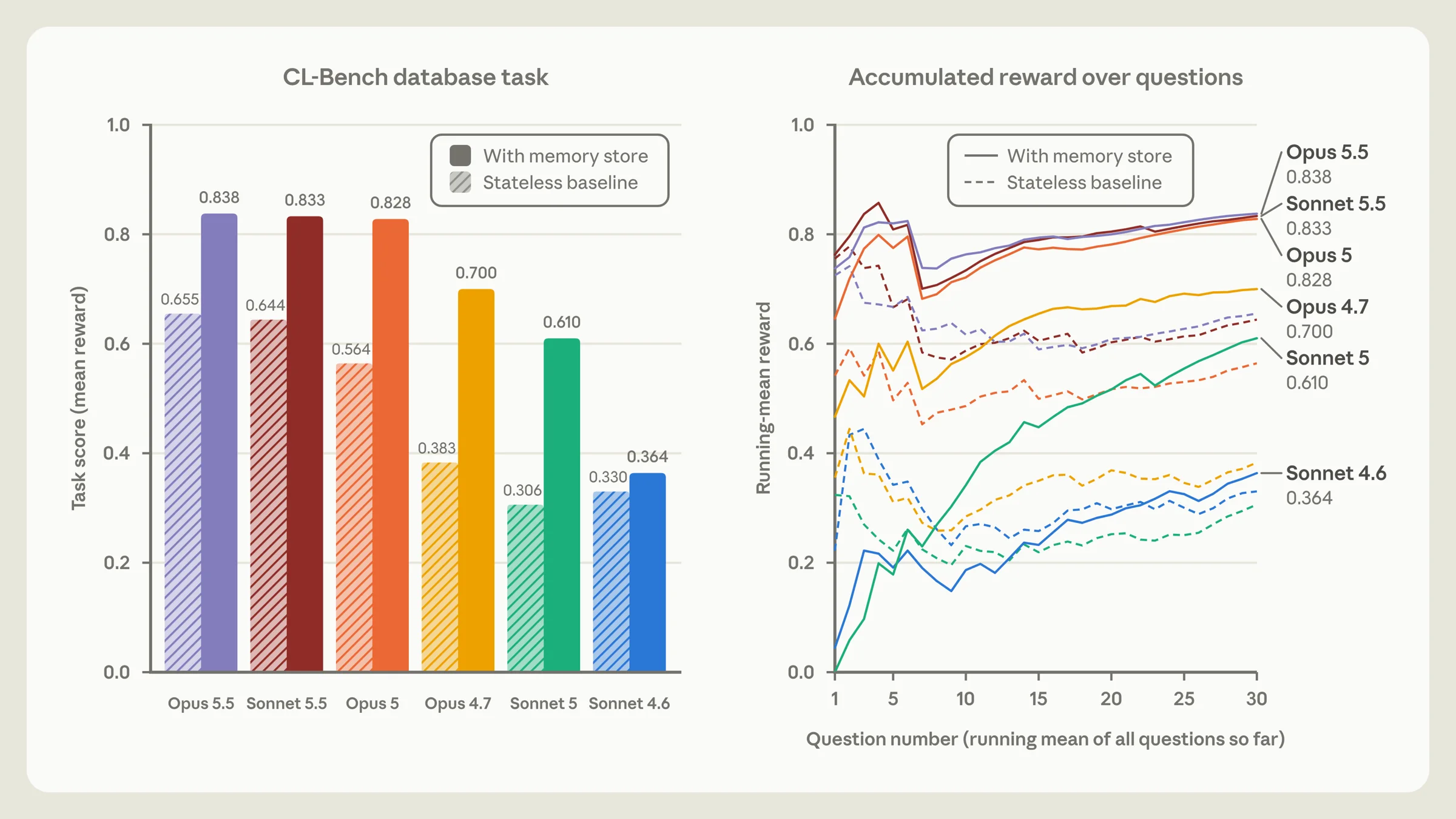
Anthropic published an Engineering Blog post on 6 November 2026 detailing how it designs and evaluates persistent memory for Claude agents. Drawing an analogy to hippocampal memory consolidation during sleep, Anthropic separates live session logging from offline consolidation, a background step the team calls “dreaming”.
During offline consolidation, Claude reviews raw session transcripts, filters out transient noise, resolves contradictions when earlier assumptions failed, and organises durable facts into structured wiki-style notes with an index layer injected into the start of future sessions. On the CL-Bench database evaluation across 30 sequential questions, adding the memory store lifted Claude Opus 5.5 from a 0.655 stateless baseline to 0.838 mean reward, and Claude Sonnet 5.5 from 0.644 to 0.833.
Sources
- PrimaryThe components of agent memoryanthropic.com · Anthropic Engineering Blog
- On XAnthropic on agent memory componentsx.com · Official X post
The rest of the day
Read the whole day
01ProductMeta
Meta launches Spaces in Muse for custom interactive tools built from chat
Users can describe an idea to build persistent planners, trackers, and games inside the Muse app, pin them to navigation, and keep them updated through connected apps.
02ModelMeta
Meta rolls out specialized Muse and Meta AI models with Active Memory
Trained using Muse Wonder, the upgraded models bring Active Memory and Active Focus to consumer Muse and Meta AI interfaces with 2.4 times lower critical forgetting.

03InfraOpenRouter
OpenRouter launches next-generation Auto Router and Auto Code for coding agents
The new routers pick a model and reasoning effort per request within workspace guardrails, matching Claude Opus 5.5 on coding benchmarks at 74% lower cost.
04ResearchOpenAI
OpenAI and Ligo introduce BioBasicsBench for everyday wet-lab biology
The 100-task benchmark tests whether AI agents can interpret raw gels, flow cytometry plots, plates, and microscopy images, with GPT-6 Astra scoring 66.7%.
Spotted an error? Email aiforsuccess.in+compass@gmail.com or tag @ai_for_success on X