Users can describe an idea to build persistent planners, trackers, and games inside the Muse app, pin them to navigation, and keep them updated through connected apps.
Meta launched Spaces in the Muse application on 6 November 2026, introducing an interactive way for users to build custom experiences by describing an idea in plain language. Rather than keeping recurring projects inside scrolling chat threads, a space turns a prompt into a persistent surface inside Muse, such as a holiday gift tracker, a daily word game, a freelance client hub, or a trip itinerary.
Custom layout and scheduling
Once Muse generates an initial space from a user’s prompt, the user can keep refining its layout, visual styling, and behaviour through conversation. Users choose where each space sits in the interface: spaces can be pinned to the sidebar, promoted into the main navigation tabs, hidden when inactive, or scheduled to appear on specific days, such as showing a work planner on weekdays and a weekend tracker on Saturdays.
Pinned spaces live in the Muse sidebar and update automatically from connected apps.Video: Meta
Live background updates
Spaces connect to external applications that the user links to Muse, updating automatically in the background as new emails, calendar events, price changes, or marketplace messages arrive. Users can check off tasks, add notes, and edit entries directly inside the space. Spaces are available everywhere Muse operates as individual workspaces, while multi-user collaborative sharing remains in exploration.
Trained using Muse Wonder, the upgraded models bring Active Memory and Active Focus to consumer Muse and Meta AI interfaces with 2.4 times lower critical forgetting.
Meta AI Research began rolling out specialized versions of its existing models to Muse and Meta AI users on 6 November 2026. Trained using Meta’s frontier Muse Wonder series, the updated models bring two core capabilities, Active Memory and Active Focus, to standard consumer conversations without requiring direct Muse Wonder access.
Active Memory trains the model to distinguish temporary details from permanent user preferences, reason across time, and recognise when context from earlier sessions becomes relevant again. Active Focus keeps the model aligned with multi-step user goals when constraints shift mid-task, deciding when to ask clarifying questions and when to adapt autonomously. The evaluation charts on Meta’s research blog are rendered in HTML rather than as downloadable image files, comparing the new specialized Muse model against the previous Muse model across three internal benchmarks.
Key numbers
47% vs 38%: Score on Meta’s Personal Superintelligence Index for the current versus previous Muse model
90% vs 76%: Tasks correctly using critical context on the Active Memory evaluation (a 2.4 times reduction in forgetting)
68% vs 53%: Multi-step task completion on the Active Focus evaluation (a 67% improvement in recovering when stuck)
The new routers pick a model and reasoning effort per request within workspace guardrails, matching Claude Opus 5.5 on coding benchmarks at 74% lower cost.
OpenRouter launched its next-generation Auto Router (openrouter/auto) alongside a dedicated coding router, Auto Code (openrouter/auto-code), on 6 November 2026. Processing more than 2.5T tokens per month, the updated routing engine evaluates each incoming prompt to select both the target model and the reasoning effort level from the pool permitted by the caller’s zero data retention (ZDR), provider, and bring-your-own-key policies.
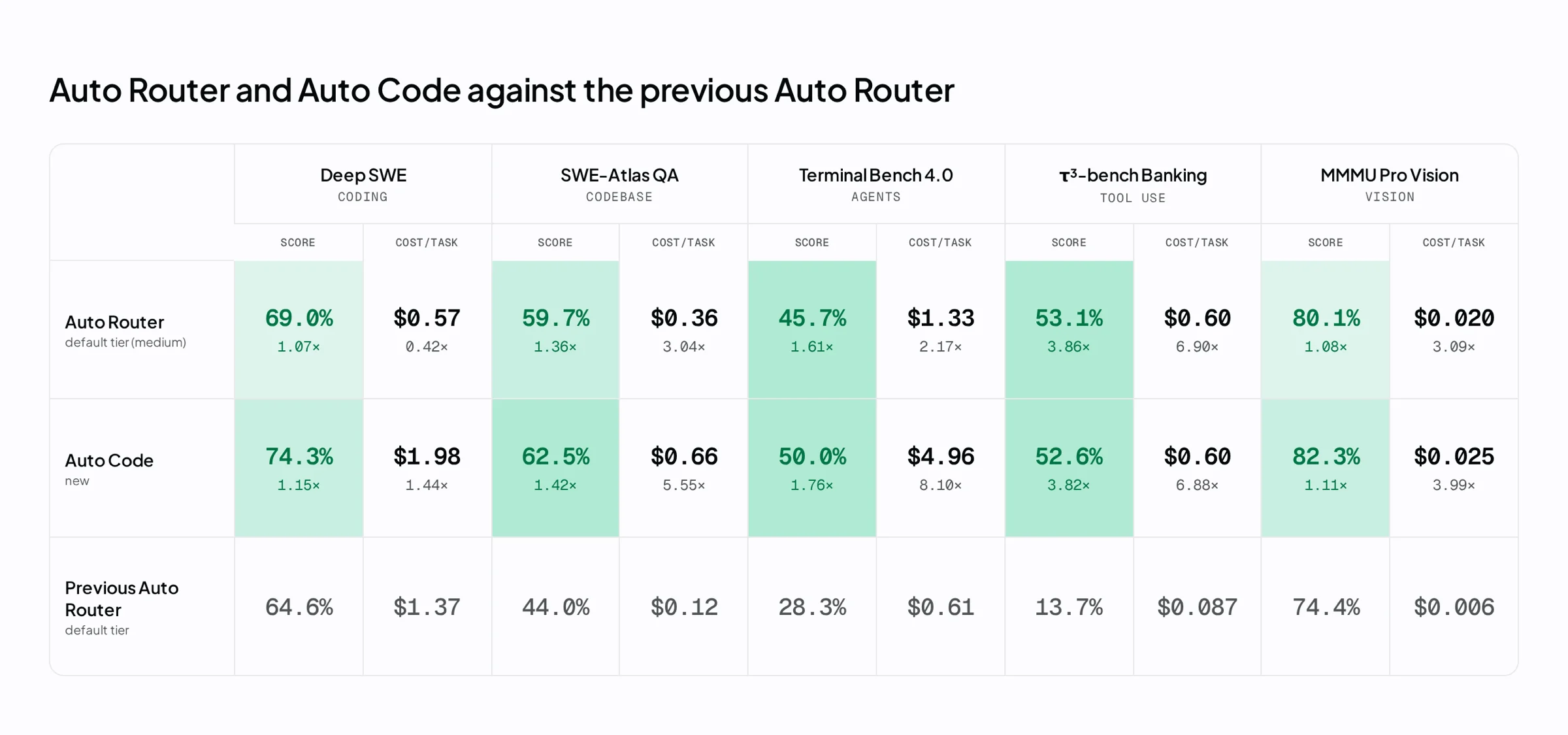
Auto Router and Auto Code accuracy and cost per task compared with the previous Auto Router.Image: OpenRouter
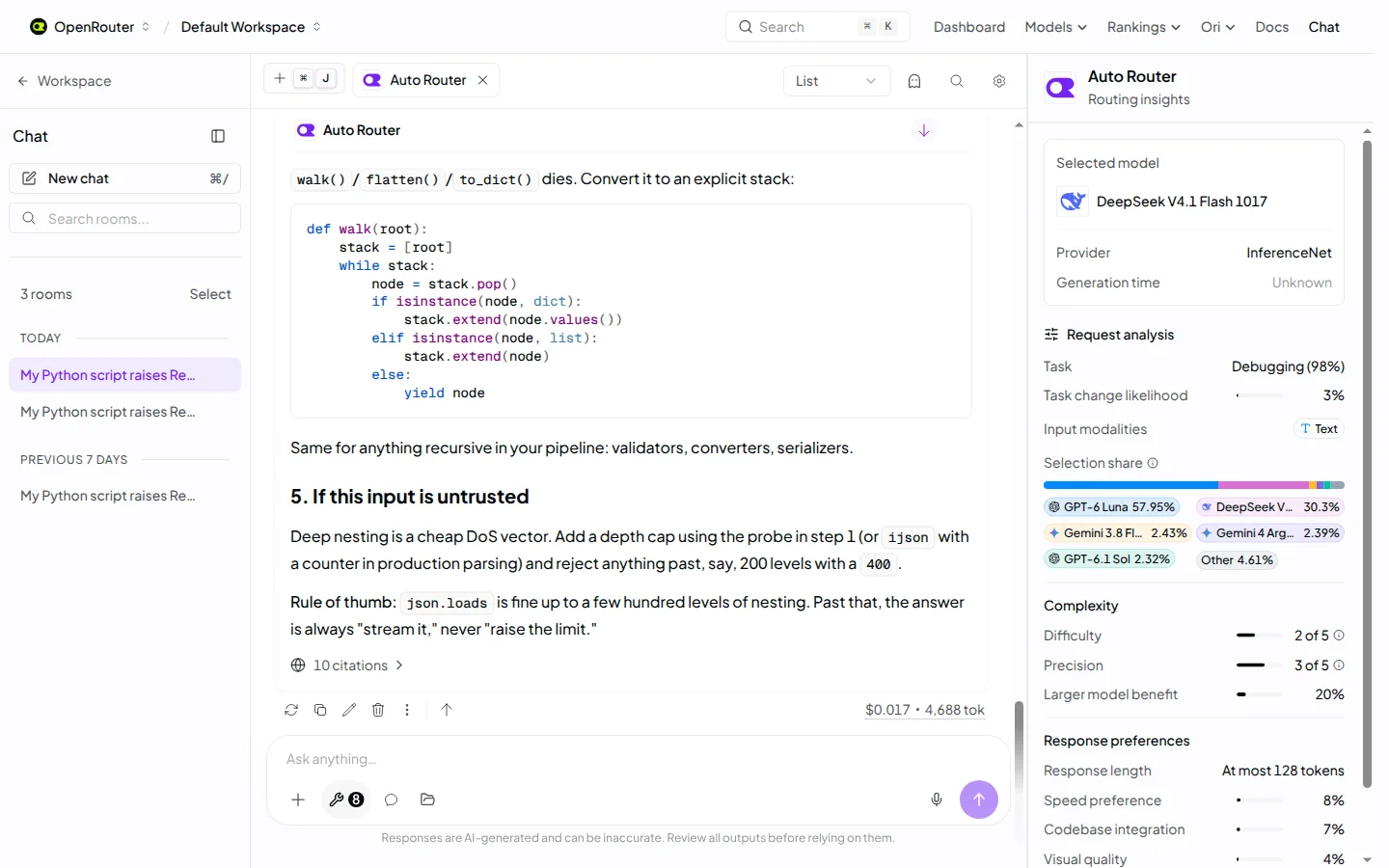
Auto Code is tuned specifically for multi-turn software engineering and agentic tool use, achieving 74.3% on Deep SWE at $1.98 per task and cutting cost per task by roughly 74% compared with single frontier model calls at comparable accuracy. Both routers operate with a p90 routing decision latency of 0.65 seconds and expose per-request routing rationale and candidate model selection shares in the OpenRouter chat interface.
Per-request routing insights display the chosen model, task classification, and candidate selection breakdown.Image: OpenRouter
The 100-task benchmark tests whether AI agents can interpret raw gels, flow cytometry plots, plates, and microscopy images, with GPT-6 Astra scoring 66.7%.
OpenAI and biological research laboratory Ligo introduced BioBasicsBench on 6 November 2026, a 100-task benchmark built from real wet-lab experiments to evaluate how AI agents handle routine experimental analysis. Rather than testing literature recall, each task supplies raw laboratory artifacts including agarose and polyacrylamide gels, multi-well assay plates, microscopy time-lapses, flow cytometry plots, and instrument readouts.
Agents must inspect the visual and tabular evidence, identify experimental controls or pipetting errors, and recognise when flawed or incomplete data cannot support a scientific conclusion. Graded on rubric-based mean reward at xhigh reasoning effort, GPT-6 Astra scored 66.7% across the 100 tasks, up from 43.8% for GPT-5.6 Sol. OpenAI uses the benchmark both to track scientific research assistance and to inform biological safety evaluations.
An Engineering Blog post explains how background consolidation reviews transcripts, extracts corrections, and injects a compact memory layer into new sessions.
Anthropic published an Engineering Blog post on 6 November 2026 detailing how it designs and evaluates persistent memory for Claude agents. Drawing an analogy to hippocampal memory consolidation during sleep, Anthropic separates live session logging from offline consolidation, a background step the team calls “dreaming”.
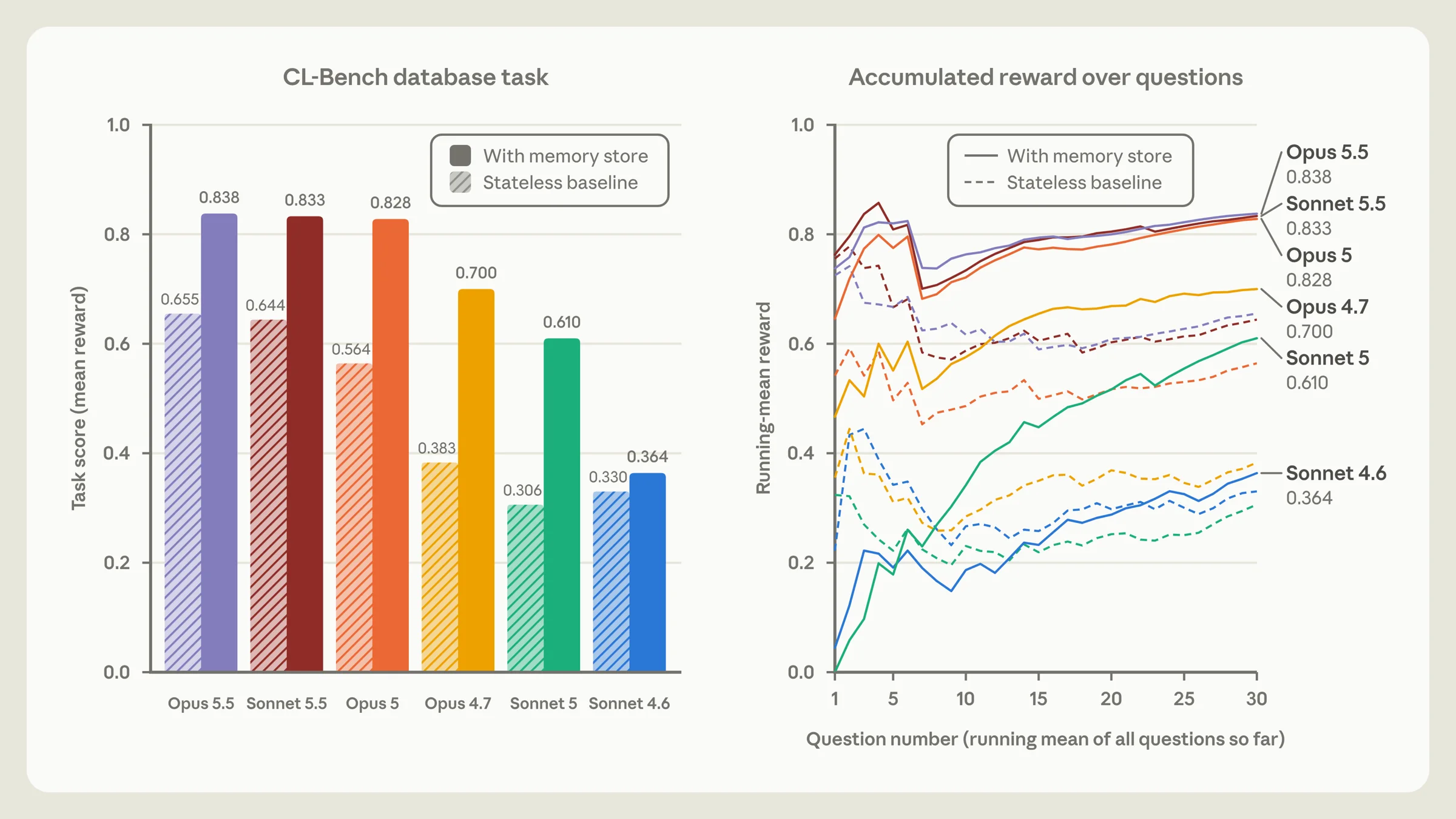
During offline consolidation, Claude reviews raw session transcripts, filters out transient noise, resolves contradictions when earlier assumptions failed, and organises durable facts into structured wiki-style notes with an index layer injected into the start of future sessions. On the CL-Bench database evaluation across 30 sequential questions, adding the memory store lifted Claude Opus 5.5 from a 0.655 stateless baseline to 0.838 mean reward, and Claude Sonnet 5.5 from 0.644 to 0.833.
CL-Bench database task mean reward and accumulated reward over 30 sequential questions with and without a memory store.Image: Anthropic
Written in Rust and Slang with Vulkan and Metal backends, vork lets agents write 3D scenes as code through a 2,500-token API and render a million-bird flock in 97 seconds.
Voyager released vork on 6 November 2026, a source-available headless 3D rendering and visual effects engine built for autonomous coding and multimodal agents. Instead of driving a human viewport editor, an agent writes a scene in Rust and Slang shader code, renders frames on the GPU through Vulkan or Metal, inspects the rendered output, and revises the code.
The core vork API fits in roughly 2,500 tokens, including a complete starter scene, so an agent can hold the full specification in context without documentation retrieval. In Voyager’s benchmark demonstrations on a single GPU, vork simulated and rendered a self-steering flock of one million birds in 97 seconds and composited 3D light-emitting geometry onto tracked live-action footage. The engine is free to use during its research preview.
A million self-steering birds simulated and rendered in 97 seconds on a single GPU in vork.Video: Voyager
Part of Microsoft Pro Badge, the opt-in credential continuously evaluates how developers apply GitHub Copilot across five core workflows without an exam.
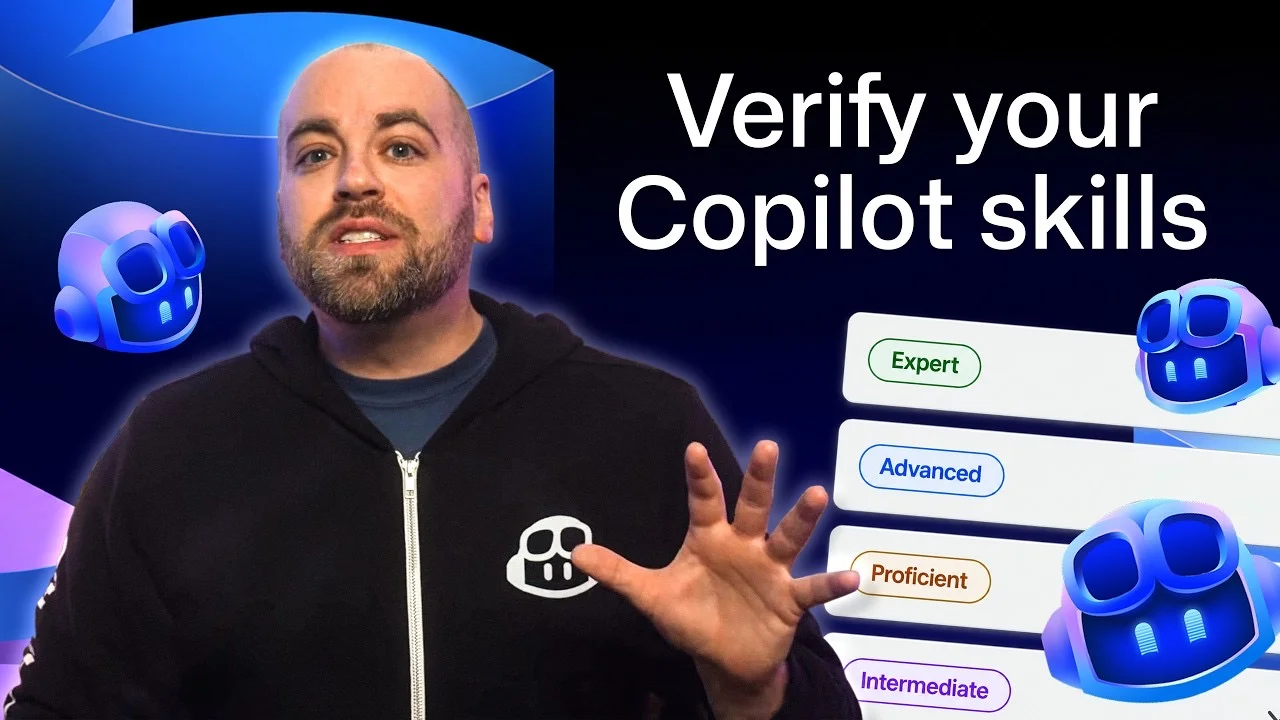
GitHub launched Copilot Verified Proficiency on 6 November 2026, introducing an opt-in credential under the Microsoft Pro Badge programme that measures how developers use GitHub Copilot in their daily work rather than in a proctored test. The system evaluates real workflow telemetry across five Copilot skill areas, weighing breadth across task types, depth on complex engineering work, and consistency over time.
Results are private to the individual developer by default and can be shared on professional profiles once calculated, typically after a few days of regular Copilot usage. At launch, GitHub scores three tiers, Beginner, Intermediate, and Proficient, with Advanced and Expert levels planned. Earning the Proficient tier grants a Pro Badge valid for six months while active usage continues.
Developed with OpenAI, Anthropic, Google DeepMind, and Microsoft on 5 November 2026, the rubric scores cyber jailbreaks across capability gain, scope, deployment, and discovery.
The Frontier Model Forum (FMF), the industry body backed by OpenAI, Anthropic, Google DeepMind, and Microsoft, published Version 1.0 of the FMF Jailbreak Rating Framework for Frontier Cyber Threats on 5 November 2026. The framework provides a common severity scale for evaluating when an adversarial bypass of model safeguards could enable material cybersecurity harm.
Rather than treating all safeguard bypasses equally, the rubric rates each jailbreak across four dimensions: capability gain (the uplift over baseline tools), capability scope (how broadly the enabled behaviour applies across cyber operations), ease of deployment (the effort needed to weaponise the bypass), and ease of discovery. Member labs have invited external security researchers to submit feedback on Version 1.0 through 21 December 2026.
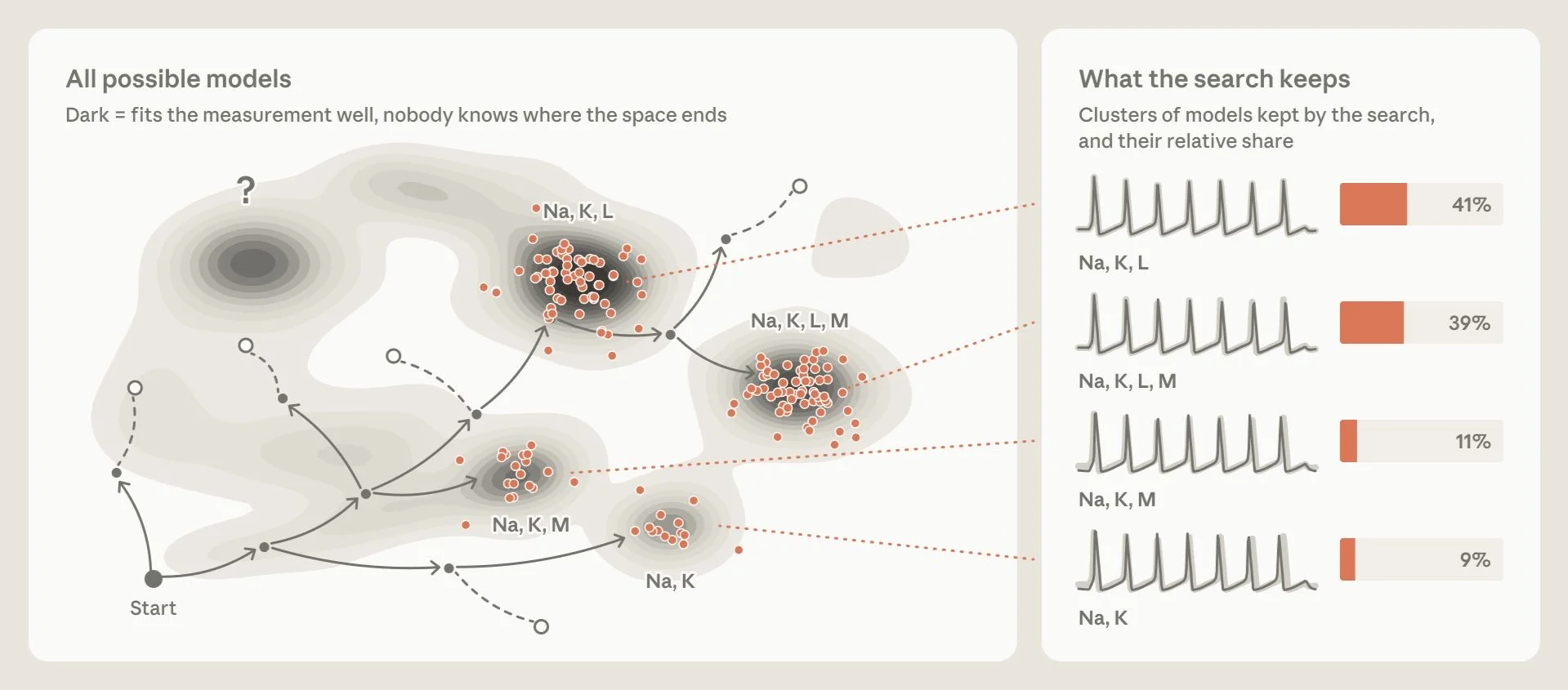
Researchers from the ELLIS Institute Tübingen and the University of Tübingen outline how simulation-based inference and code-writing agents explore candidate scientific models.
Anthropic published a Science Blog post on 6 November 2026 by AI for Science grantees Jakob Macke, Daniel Gedon, and Stefan Wahl of the ELLIS Institute Tübingen and the University of Tübingen. Tracing scientific modelling from the 1951 Hodgkin-Huxley squid axon equations to modern computational neuroscience, the authors break the discipline into three recurring steps: proposing model equations, constraining parameters against experimental data, and interpreting what the equations imply about physical mechanisms.
Where classical Bayesian fitting struggles on complex simulators, simulation-based inference (SBI) runs a simulator 100,000 to millions of times with varied parameters and trains a neural network to return full posterior probability distributions in seconds. Pairing SBI with language models that write, run, and revise simulator code lets researchers search across families of candidate models rather than settling on a single manual curve fit.
Searching across candidate scientific model structures groups plausible ion-channel configurations by posterior share.Image: Anthropic
OpenAI began rolling out Remix to ChatGPT Business and Enterprise accounts on 6 November 2026. The feature lets workspace members create their own copy of a teammate’s ChatGPT site by describing what they want to change in chat, then continue editing the forked version without modifying the original.
OpenAI added a Showcase tab of starter applications to the OpenAI Developers plugin on 6 November 2026 and highlighted that eligible ChatGPT Pro and Business subscribers can claim between $100 and $500 in monthly API credits in billing settings to cover their app’s API usage.