


ModelZ.aiConfirmed
Story 1 of 18 in the Monday 23 November editionZ.ai launches 750B GLM-5.4 Loop Transformer for visual coding
Live in Z.ai Chat, ZCode and the GLM Coding Plan across a 1M-token multimodal window, looping 28 shared GLM-5 middle layers twice at up to 200 tokens per second.

 Edited by Ashutosh Shrivastava
24 Nov 2026, 10:15 IST · 3 min read
Z.ai (Zhipu) introduced GLM-5.4 on 23 November 2026, its first flagship model built on a Loop Transformer architecture and aimed at Generalized Coding across software, video, games, GLSL shaders and FreeCAD mechanical design. Rather than pretraining a looped model from scratch, Z.ai adapted its 750B-scale GLM-5 sparse-attention base checkpoint through continued training so 28 weight-shared middle layers run across two sequential passes per forward step while accepting vision inputs alongside text.
Gated progressive updates, hybrid 1M KV cache and sparse index reuse
Scaling multi-pass depth across 1B, 4B, 30B and 750B ablations required three architectural changes to prevent activation blow-up and KV memory multiplication across a 1M-token context window. Independent per-token gates scale residual writes on each pass, writing conservatively on the first global-context iteration and opening wider on the second refinement pass, while allocating larger first-pass step sizes to harder tokens.
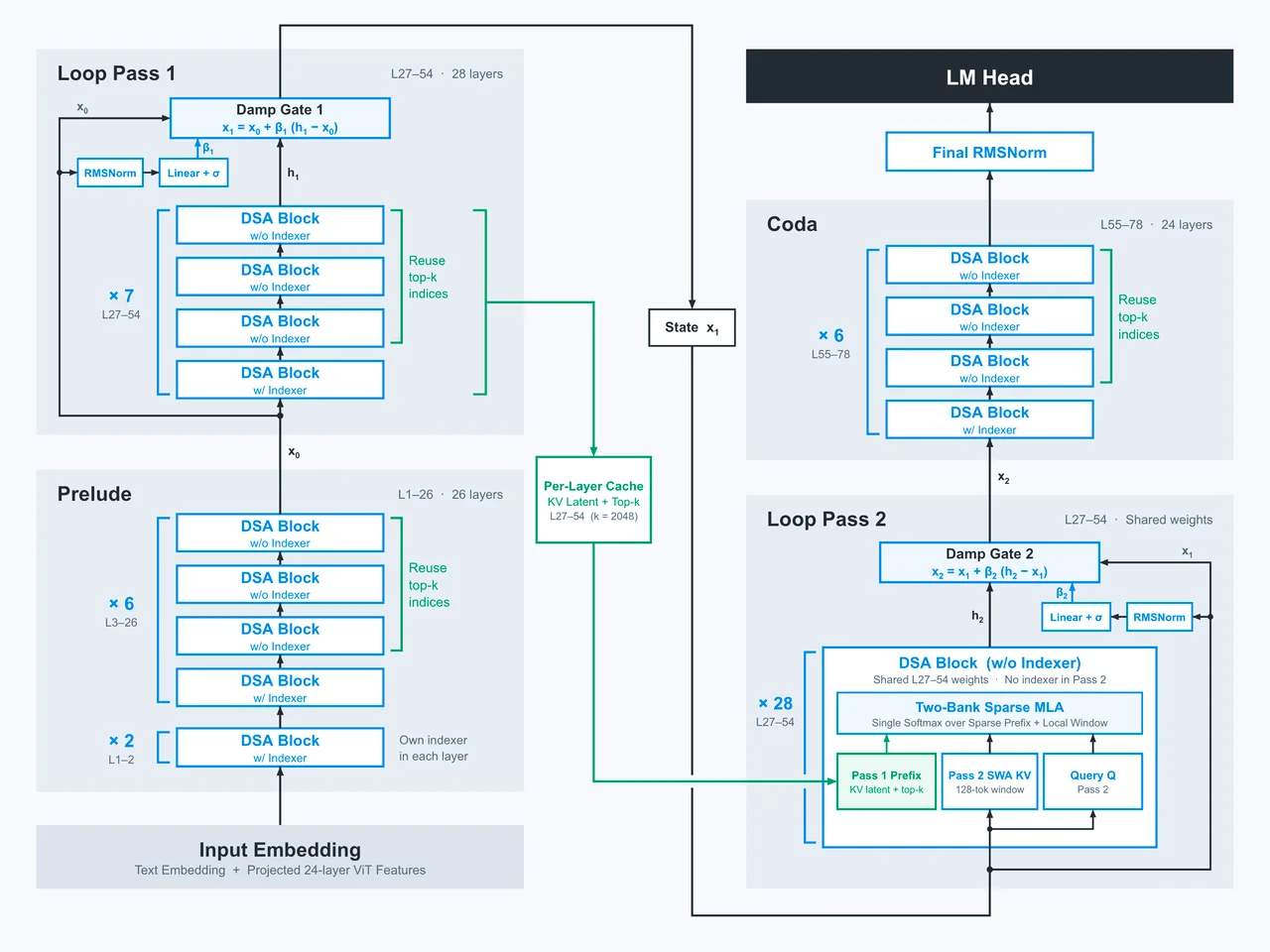
A hybrid KV cache pairs cross-loop sparse KV sharing from Pass 1 with an independent local sliding window on Pass 2 instead of duplicating the full context cache, and Pass 2 reuses Pass 1 sparse attention indices at zero extra indexing cost. Fused inference kernels sustain 70 to 80 tokens per second at peak load and up to 200 tokens per second off-peak. GLM-5.4 is available in Z.ai Chat, ZCode and the GLM Coding Plan; Z.ai has not announced API pricing or a release date for its planned open weights, stating both will follow safety evaluations.
Technical details
- Layer topology and vision input
- 26-layer Prelude (L1-26), 28-layer two-pass loop (L27-54), 24-layer Coda (L55-78) plus 24-layer ViT projector
- Pass 2 attention cache design
- Two-Bank Sparse MLA over Pass 1 top-2,048 KV latent prefix plus a 128-token Pass 2 sliding window
- Serving throughput
- Up to 200 tokens/s during off-peak windows and 70 to 80 tokens/s under peak cluster load
- Current access surfaces
- Live on Z.ai Chat, ZCode and GLM Coding Plan; hosted Model API and open weights pending safety hardening
Release details & context
Prelude-Loop-Coda stack, marathon thinking trade-offs and looped peers
Across GLM-5.4’s 78-layer backbone, only the first two Prelude layers run independent sparse indexers, while subsequent blocks reuse top-2,048 indices and Pass 2 combines single-softmax attention over the cached Pass 1 prefix and its 128-token local window via RMSNorm-gated Damp Gate residuals. Z.ai notes one remaining failure mode where difficult prompts trigger prolonged marathon thinking reflection cycles, though extended self-correction still improves final task accuracy.
The 750B adaptation arrives three days after Thinking Machines Lab’s Apache 2.0 Inkling 2 Mini looped MoE, showing both laptop-scale and frontier-scale labs adopting recurrent middle-layer depth.
Common questions
Are GLM-5.4 API endpoints and open model weights available on 23 November 2026?
No, Z.ai launched GLM-5.4 inside Z.ai Chat, ZCode and its GLM Coding Plan first and stated that Model API access and open-weight checkpoints will be released after safety evaluations conclude.
How does GLM-5.4 avoid doubling KV-cache memory across two loop iterations at 1M context?
Pass 2 reuses the top-2,048 sparse KV latent prefix cached during Pass 1 and allocates new KV entries only inside a 128-token local sliding window.
Sources
Z.ai release timeline (2 launches tracked)
- Z.ai introduces GLM-Legal, a model for legal work built on GLM-5.3-Flash
Z.ai’s GLM-Legal ranks seventh of 79 models on Harvey’s legal agent benchmark in Vals’s tests.