Live in Z.ai Chat, ZCode and the GLM Coding Plan across a 1M-token multimodal window, looping 28 shared GLM-5 middle layers twice at up to 200 tokens per second.
Z.ai (Zhipu) introduced GLM-5.4 on 23 November 2026, its first flagship model built on a Loop Transformer architecture and aimed at Generalized Coding across software, video, games, GLSL shaders and FreeCAD mechanical design. Rather than pretraining a looped model from scratch, Z.ai adapted its 750B-scaleGLM-5sparse-attention base checkpoint through continued training so 28 weight-shared middle layers run across two sequential passes per forward step while accepting vision inputs alongside text.
Gated progressive updates, hybrid 1M KV cache and sparse index reuse
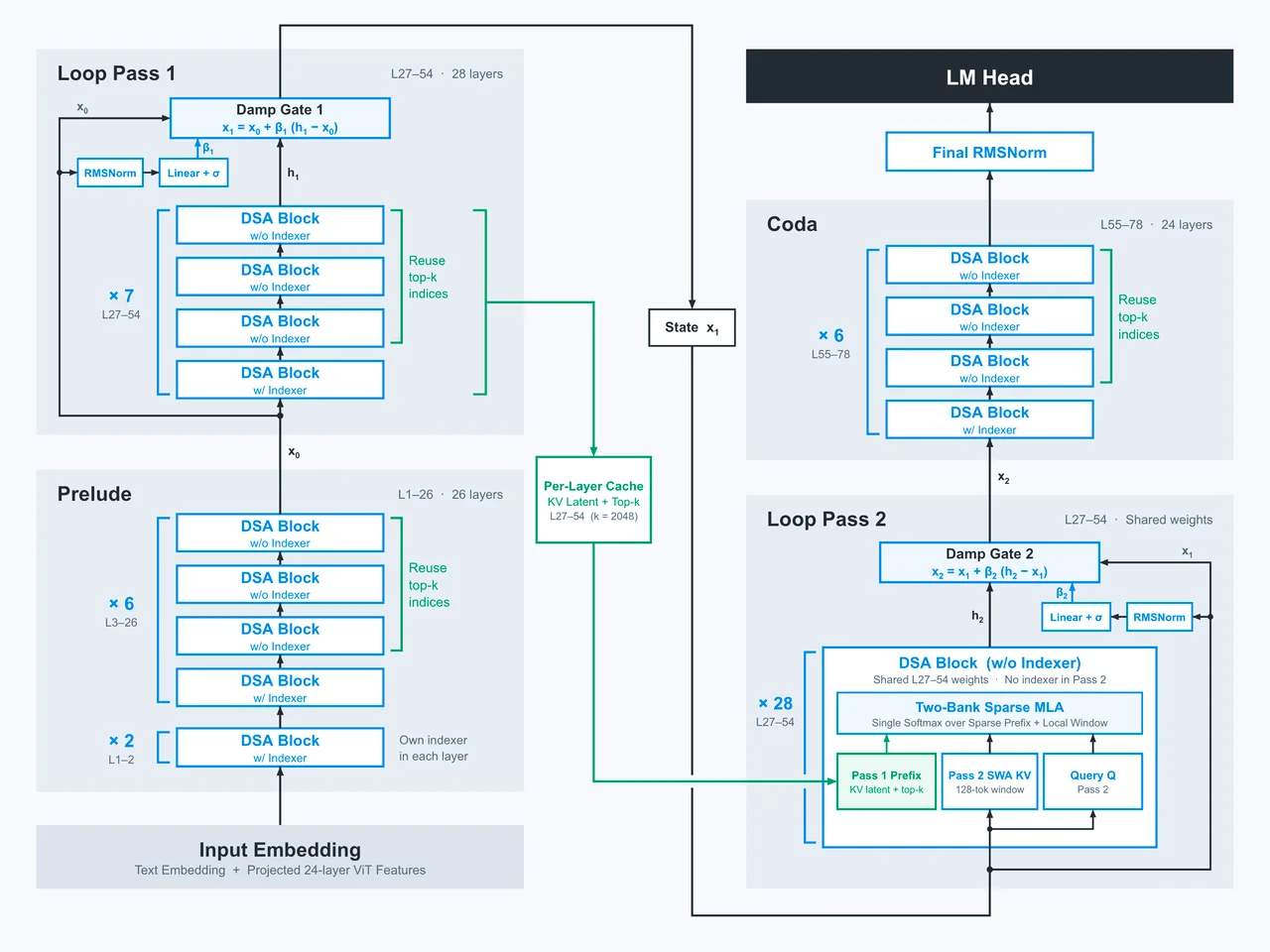
Scaling multi-pass depth across 1B, 4B, 30B and 750B ablations required three architectural changes to prevent activation blow-up and KV memory multiplication across a 1M-token context window. Independent per-token gates scale residual writes on each pass, writing conservatively on the first global-context iteration and opening wider on the second refinement pass, while allocating larger first-pass step sizes to harder tokens.
GLM-5.4 runs layers 27 to 54 twice with Damp Gates, shared top-2,048 sparse KV prefix cache and a 128-token Pass 2 sliding window.Image: Z.ai
A hybrid KV cache pairs cross-loop sparse KV sharing from Pass 1 with an independent local sliding window on Pass 2 instead of duplicating the full context cache, and Pass 2 reuses Pass 1 sparse attention indices at zero extra indexing cost. Fused inference kernels sustain 70 to 80 tokens per second at peak load and up to 200 tokens per second off-peak.GLM-5.4 is available in Z.ai Chat, ZCode and the GLM Coding Plan; Z.ai has not announced API pricing or a release date for its planned open weights, stating both will follow safety evaluations.
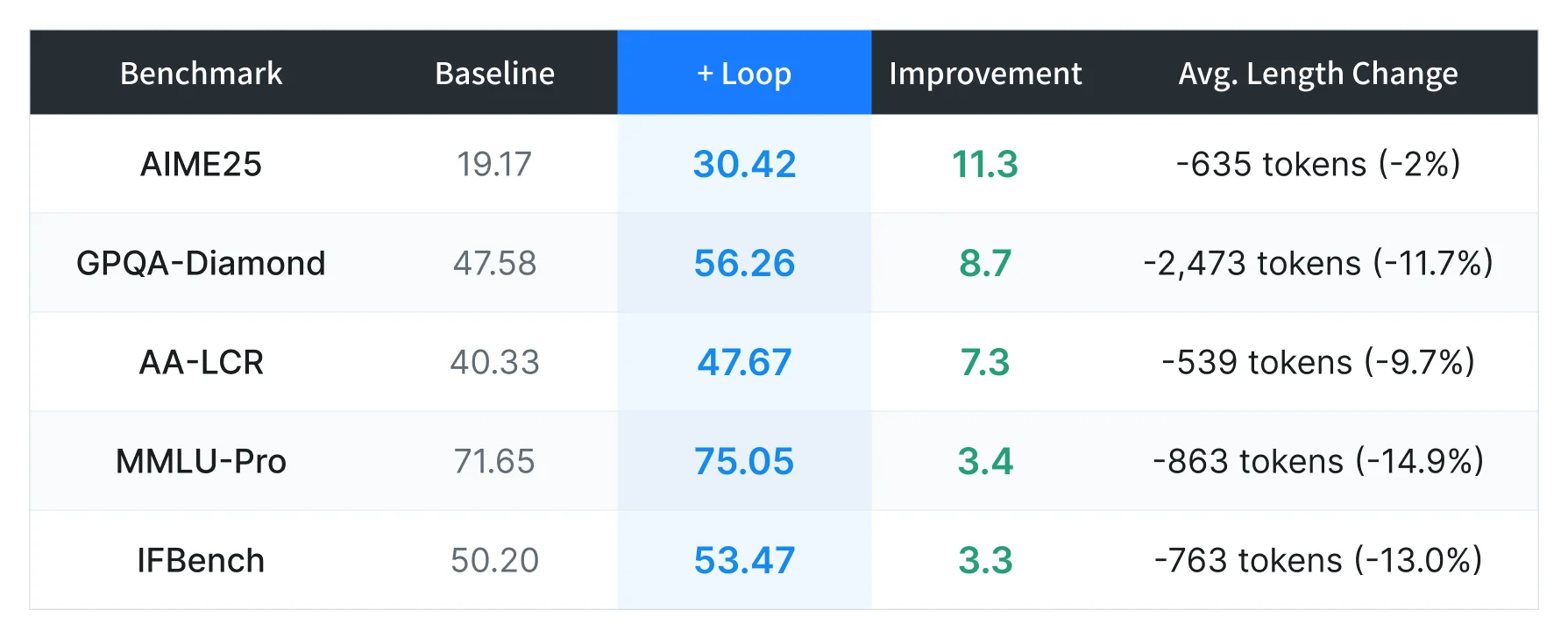
At equal 30B parameter count and roughly 10% extra training compute, looping raises accuracy while cutting reasoning length up to 14.9%.Image: Z.ai
Anthropic launched Claude Ship in beta on 23 November 2026, introducing three repository-level GitHub pull request agents alongside the /ship and /steward slash commands in Claude Code v2.1.330 and newer, extending Claude Code’s JavaScript Code Mode into post-commit review and continuous-integration maintenance. Running /ship on a local change commits, pushes and opens a GitHub pull request, runs /code-review and starts a session watch, while /steward attaches a watch directly to an existing pull request.
Code Review, PR Steward and policy-checked Claude Approvals
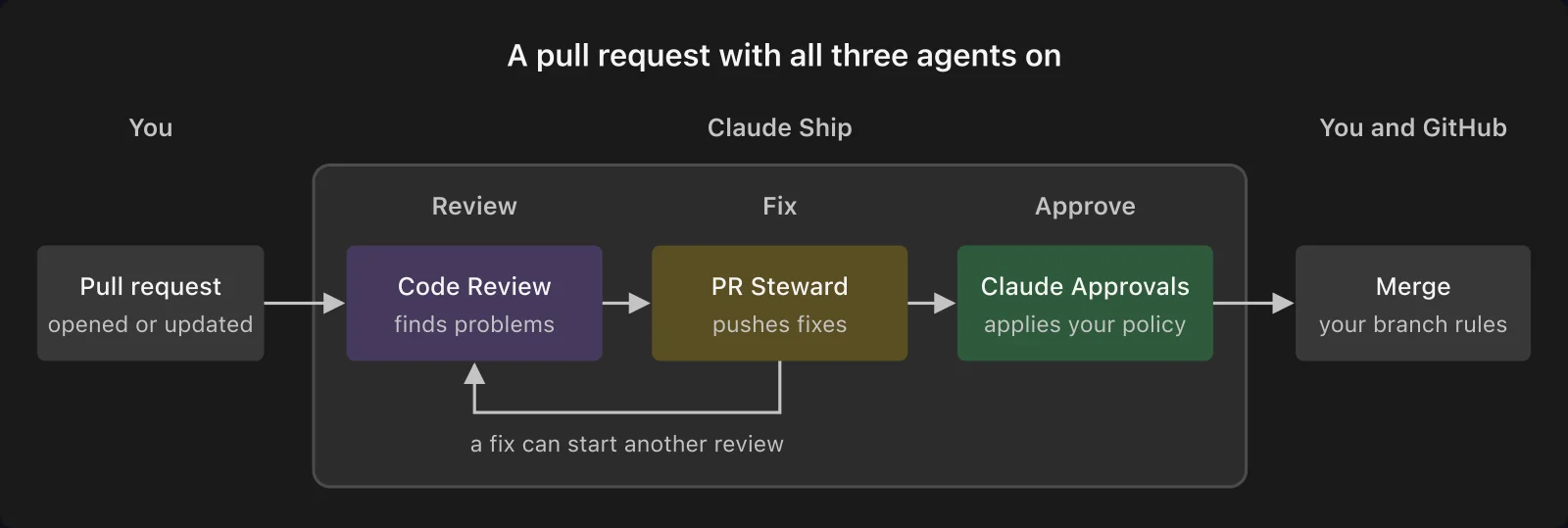
Across GitHub repositories, Claude Ship divides pull request automation across three agents. Code Review inspects diffs for logic defects, security vulnerabilities and unhandled edge cases. PR Steward monitors reviewer comments, merge conflicts and failing CI checks, pushing remediation commits under manual @claude steward triggers or automated rules with configurable spend caps.
Claude Ship chains Code Review, PR Steward fix commits and policy-based Claude Approvals ahead of GitHub branch merge rules.Image: Anthropic
Claude Approvals evaluates pull requests against a versioned approval policy stored inside the repository. Organisations can deploy Claude Approvals in a billed observe mode first so status checks report what the policy would decide before enabling live pull request approvals, while keeping the final branch merge step with repository maintainers or GitHub branch rules. Anthropic has not published per-run dollar rates on its public overview page.
Effective immediately on 23 November 2026 after US government input, while Colette Kress remains CFO and NVIDIA forms a board national-security committee.
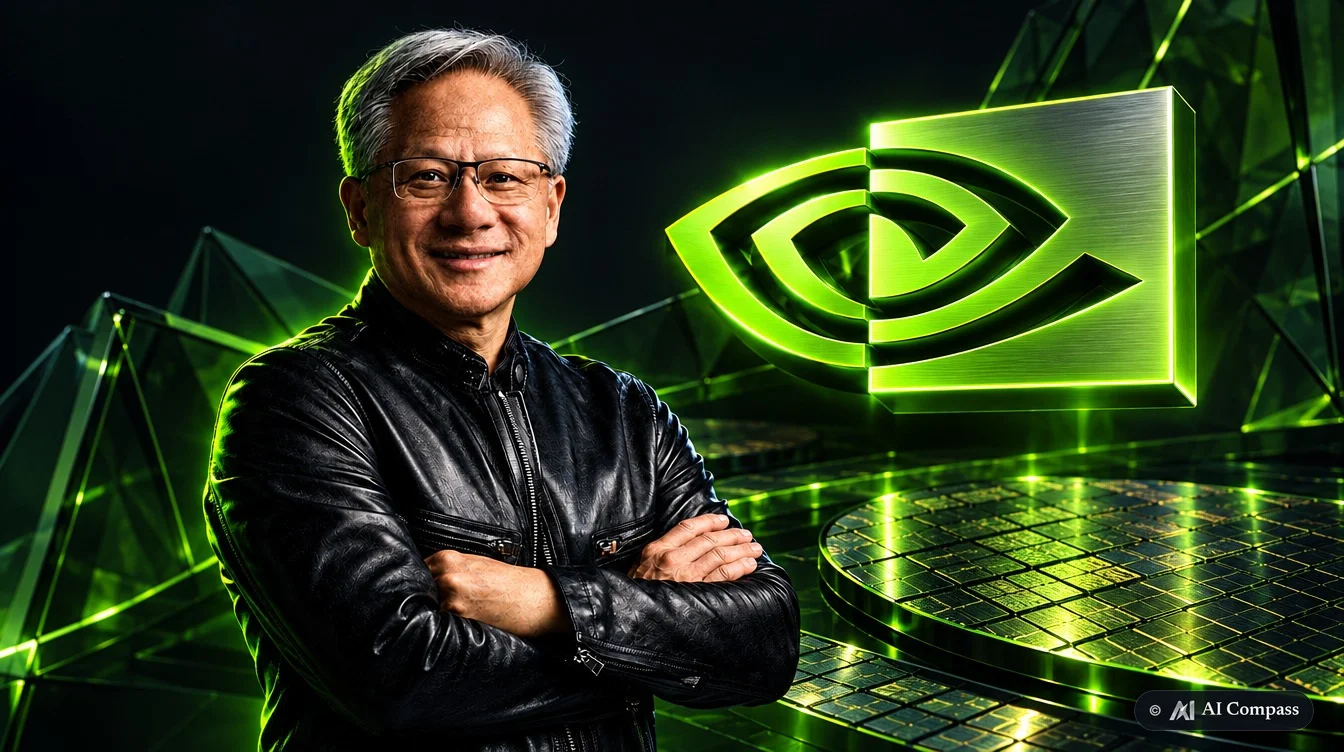
NVIDIA (NASDAQ: NVDA) announced on 23 November 2026 that its Board of Directors voted unanimously to reinstate founder Jensen Huang as President, Chief Executive Officer and member of the Board, effective immediately. Huang resumes leadership 11 days after NVIDIA named Chief Financial Officer Colette Kress interim CEO on 12 November amid reports that he had been targeted by a foreign intelligence effort. Kress continues as NVIDIA’s CFO, and Harvey C. Jones remains Chair of the Board.
US government clearance, ongoing independent inquiry and compliance oversight
The board stated that it reached the unanimous vote following multiple meetings with Huang that satisfied directors regarding his candour and ability to lead, alongside input from senior levels of the United States government confirming his reinstatement poses no national security risk. The independent directors’ committee and its outside counsel will continue their investigation through to completion with Huang’s full cooperation.
Alongside the leadership announcement, NVIDIA established a permanent National Security and Export Control Committee composed solely of independent directors and backed by specialist national-security counsel and advisers. NVIDIA also began recruiting for a newly created Chief Compliance Officer role reporting directly to the Nominating and Corporate Governance Committee.
OpenAI began rolling out a conversation-optimised version of GPT-6.2 Sol inside the ChatGPT Chat tab on 23 November 2026 for Plus, Pro, Business and Enterprise subscribers. Arriving six days after GPT-6.2 Astra and GPT-6.2 Sol launched across the OpenAI API, Codex and ChatGPT Work, the deployment brings the 6.2 model family into ChatGPT’s default everyday consumer and workspace chat view.
Fine-detail visual reading, filtered web comparisons and proactive prompts
OpenAI tuned the Chat-tab variant of GPT-6.2 Sol around multi-constraint instruction following and live online research. In multimodal chats, the model extracts smaller visual details from uploaded photographs, including fine text on product labels and symbols on street signs, and narrows online shopping or local service options around user priorities such as budget and location.
Conversational turn-taking also adjusts when ChatGPT suggests follow-up actions, such as offering a price-drop alert while comparing items, alongside companion 3D Blender scene-generation workflows shared by OpenAI Developers. OpenAI has not announced a timeline for bringing GPT-6.2 Sol to Free-tier ChatGPT accounts.
Live across Google AI Studio and the Gemini platform for all Gemini 4 models, billing tokens only for targeted PDF pages, spreadsheet cells and media clips.
Google launched server-side file slicing controls alongside native Microsoft Office and OpenDocument file uploads in the Gemini API on 23 November 2026 across Google AI Studio and the Gemini platform. Supported on all Gemini 4 models and complementing zero-fee Tool Retrieval in the Gemini Interactions API, the update lets developers upload PDFs, Word documents, slide decks, spreadsheets, audio and video once via the Files API and pass targeted slices on user turns or inside function_result tool responses while paying tokens only for the inspected ranges.
Page, cell, timestamp and content-layer parameters
Instead of running LibreOffice, PDF renderers and ffmpeg inside per-user client sandboxes, agent harnesses can skim whole files cheaply as text or transcripts first and zoom into high-resolution views on demand: - Documents and slides (PDF, Office and OpenDocument): select start_page and end_page, low, medium or high resolution, and page_text or page_image layers. - Spreadsheets (.xlsx, .xls and .ods): select sheet_index, visible_cells range, resolution, and data, formulas or visuals layers. - Video and audio: clip start_offset and end_offset intervals, plus fps, low or high resolution, and transcript, frames or audio layers on video.
Ant Group’s healthcare AI team inclusionAI (Ant Ling) released two open-weight Mixture-of-Experts healthcare models on Hugging Face and ModelScope on 22 November 2026: text-and-tool reasoning flagship inclusionAI/LingSante-3.1-flash and natively multimodal inclusionAI/LingSante-3.1-air-VL, building on inclusionAI’s 560B Ling-3.2-flash model line. LingSante-3.1-flash pairs 63 KDA linear-attention layers with 9 Gated MLA layers (7:1 ratio) for 560B total parameters and 25B active per token across a 1M-token context window.
Clinical reasoning scores, 124B vision-language workflows and SGLang serving
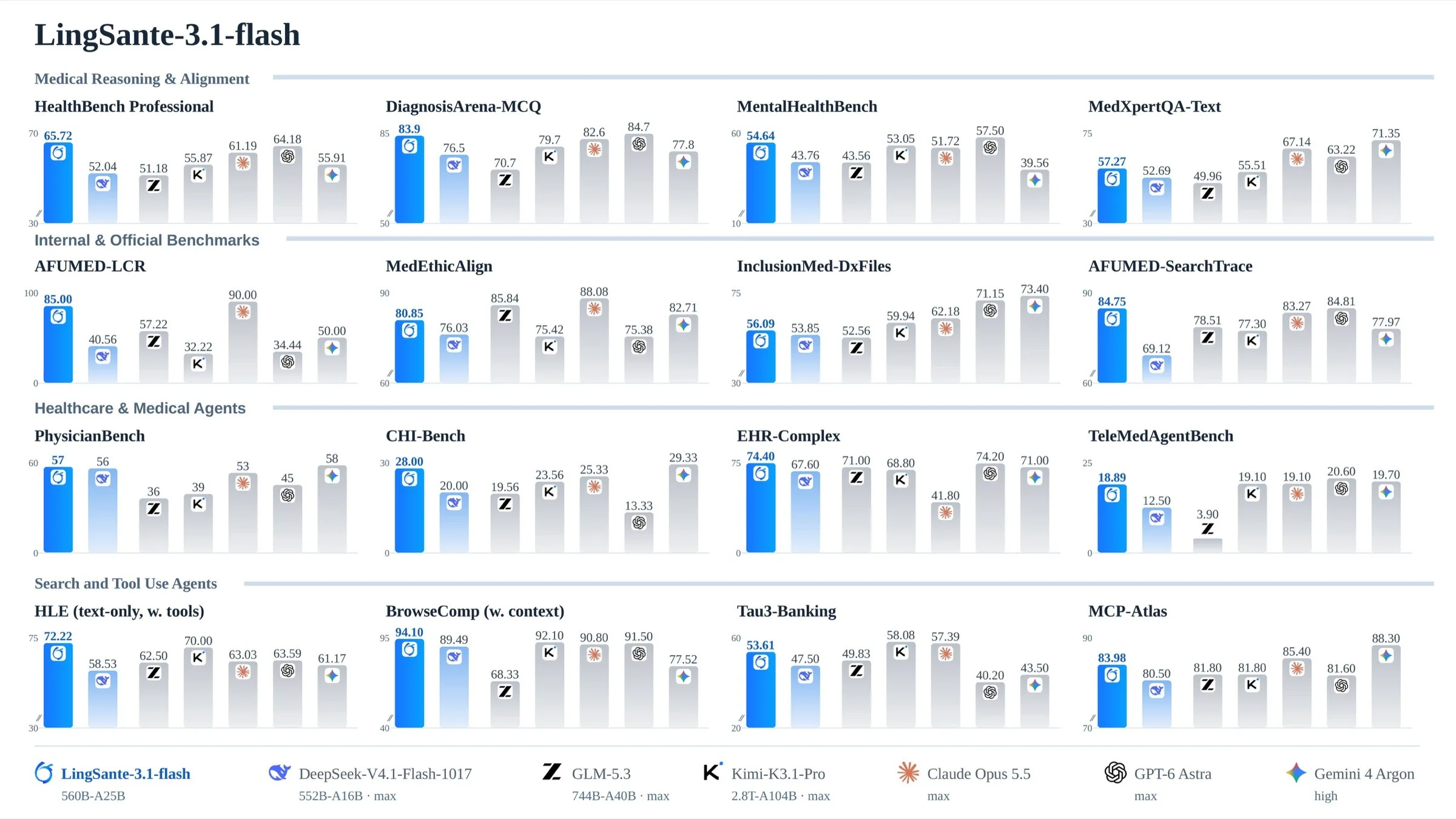
Trained via medical-mixed pretraining, reinforcement learning and multi-teacheron-policy distillation, LingSante-3.1-flash leads GPT-6 Astra, Claude Opus 5.5 and Gemini 4 Argon on HealthBench Professional (65.72), HLE text-only with tools (72.22 single-agent, 74.87 multi-agent) and BrowseComp with context (94.10), while scoring 57 on PhysicianBench and 74.40 on EHR-Complex.
LingSante-3.1-flash leads HealthBench Professional (65.72), DiagnosisArena-MCQ (83.9), EHR-Complex (74.40) and BrowseComp (94.10).Image: inclusionAI
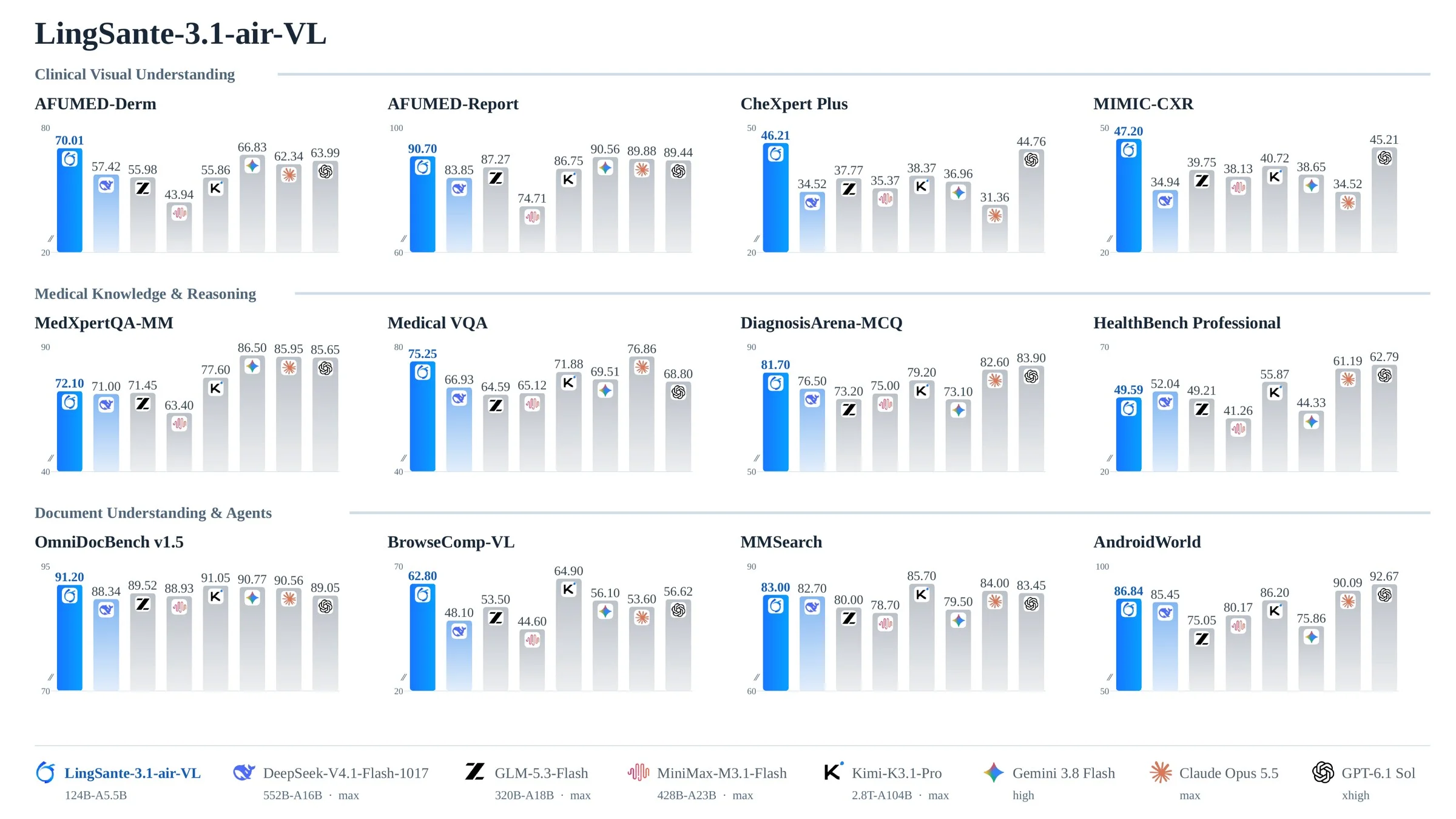
Built on Ling-3.0-flash-VL, LingSante-3.1-air-VL activates 5.5B of its 124B parameters across a 256k YaRN context window with NEXTN speculative decoding on SGLang across four 141GB-class GPUs, targeting chest X-ray findings, 120+ skin diseases, dietary and lab-report analysis, bounding-box evidence search and medical GUI agents. Both checkpoints are restricted to research rather than clinical medical-device use.
LingSante-3.1-air-VL tops CheXpert Plus (46.21), MIMIC-CXR (47.20) and OmniDocBench v1.5 (91.20) at 5.5B active parameters.Image: inclusionAI
Chief Scientist Jakub Pachocki maps internal base-modellog-perplexity milestones from 0.99 to 0.76 to propose cross-lab safety gates, published 22 November 2026.
OpenAI Chief Scientist Jakub Pachocki published Perplexity and Intelligence on 22 November 2026, disclosing internal held-outlog-perplexity milestones across OpenAI’s pretrained base models and proposing shared cross-industry safety limits anchored to next-token compression rather than rapidly saturating downstream benchmarks. The proposal follows OpenAI’s Jagged Frontier research-acceleration study and Sam Altman called it OpenAI’s most important publication in some time.
Internal log-perplexity thresholds and 2027 pretraining risk
On OpenAI’s primary held-out evaluation dataset, Pachocki traces emergent jumps to specific compression levels: - ~0.99 log-perplexity (GPT-3.5): fluent multi-turn conversation underlying the original ChatGPT. - ~0.91 log-perplexity (GPT-4): productive chain-of-thought reasoning that enabled post-trained reasoning models. - Below 0.80 and ~0.76 log-perplexity: major cybersecurity and mathematical shifts, with a ~0.76 internal model resolving open mathematics problems consecutively.
Extrapolating into the 0.68 to 0.70 log-perplexity window, Pachocki projects further unpredicted capabilities alongside degrading chain-of-thought auditability and warned that AI-assisted discoveries in pretraining algorithms could trigger a step-change acceleration as early as 2027, urging frontier labs to gate crossing agreed perplexity thresholds on verified monitoring successors.
Public beta on the Claude Platform routes encrypted Messages API logs to customer-owned cloud buckets and keys while scanning across multi-request patterns.
Anthropic opened Zero Data Retention (ZDR) with Enterprise Frontier Safeguards (EFS) in public beta on 23 November 2026 for eligible business organisations on the Claude Platform. Developed since September 2026 with more than 100 enterprise customers, including a quarter of the Fortune 100 plus Stripe, Cisco, Wells Fargo, Bridgewater and Salesforce, the service pairs strict ZDR data-custody guarantees with multi-turn frontier misuse monitoring alongside Anthropic’s private-betaself-hosted Claude Managed Agents.
Customer-managed encryption keys and cross-request misuse detection
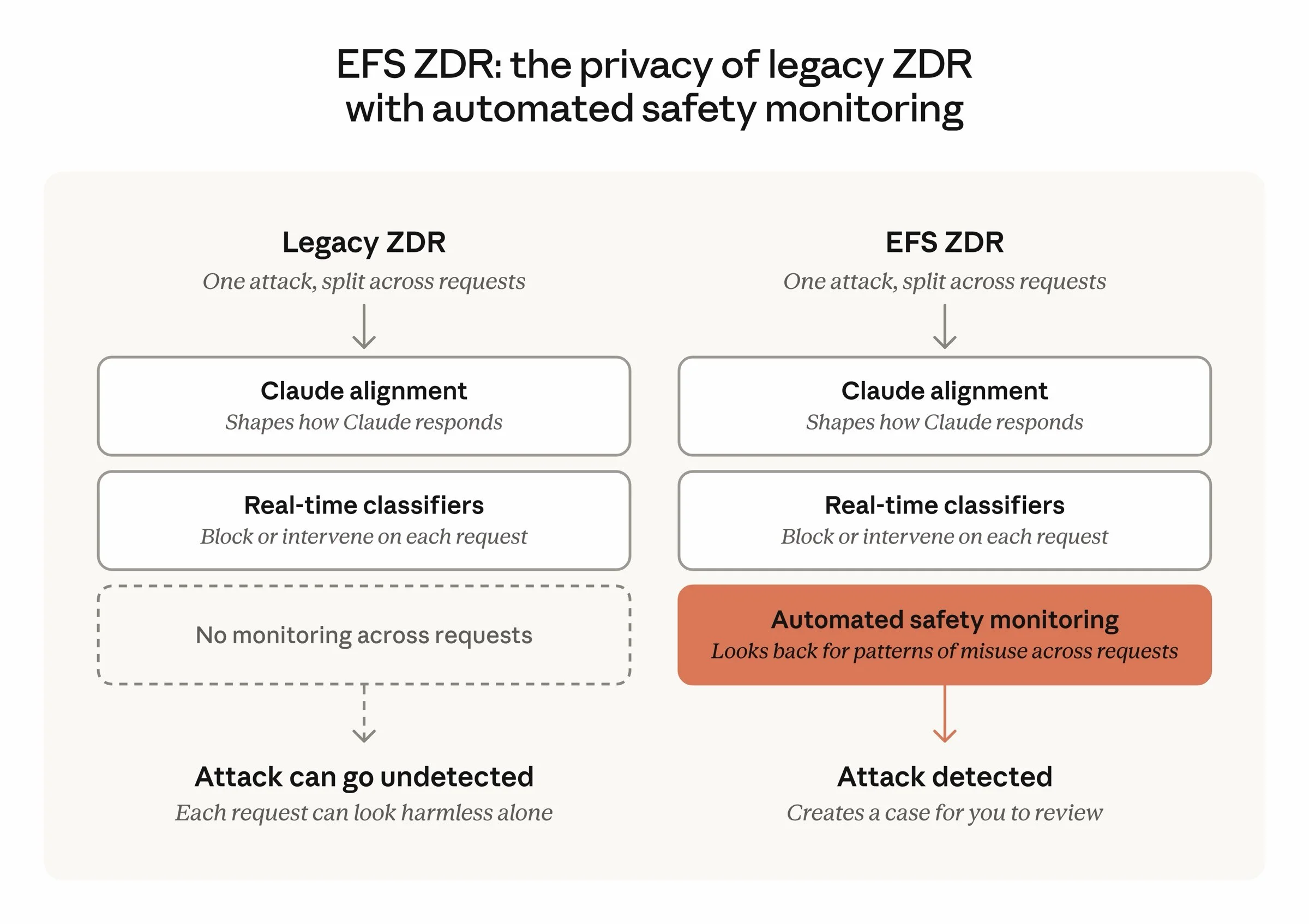
Under legacy ZDR agreements, real-time classifiers inspect each API call in isolation, allowing sophisticated misuse split across many harmless-looking prompts to pass undetected. With EFS enabled, neither Anthropic nor its underlying cloud providers retain prompt or completion logs.
EFS ZDR adds cross-request pattern detection on top of Claude alignment and real-time per-request classifiers.Image: Anthropic
Instead, encrypted copies of an organisation’s Messages API traffic stream directly into storage buckets inside the customer’s own cloud tenancy, such as Stripe’s AWS account or a Wells Fargo-managed environment, protected by customer-managed encryption keys. Automated safety classifiers scan across request sequences and create review cases under the customer’s own security controls. Anthropic has not announced commercial pricing for Enterprise Frontier Safeguards.
Founded by Dreamer creator Danijar Hafner with Khosla Ventures, DST Global and NVIDIA backing to train humanoid motor skills inside video world models.
Robotics AI startup Embo emerged from stealth on 23 November 2026 with a $110 million Seed round led by Andreessen Horowitz (a16z), with participation from Khosla Ventures, DST Global, NVIDIA and strategic angels. Led by Dreamer world-model creator Danijar Hafner alongside contributors to Dreamer, VideoGPT and Diffusion Forcing from Google DeepMind, Meta Superintelligence Labs, NVIDIA Cosmos, UC Berkeley and MIT who previously scaled multimodal training to 70,000 GPUs, Embo is building general-purpose brains for humanoid robots.
Internet-video world models and imagined reinforcement learning
Rather than relying primarily on teleoperated human demonstrations or extending text-first vision-language-action models, Embo pretrains a single unified multimodal architecture from scratch on internet-scale streaming video to model object physics, material interactions and task dynamics.
Fine-tuned on real-world trajectories from Embo’s humanoid robot fleet, the policy then practices high-frequency motor control and failure recovery via reinforcement learning inside imagined world-model rollouts, aiming to handle unfamiliar kitchens, lighting shifts and slipped objects out of the box. Embo has not announced commercial hardware partnerships, weight releases or deployment dates.
Sarvam AI released Sarvam-105B-1711 (sarvamai/sarvam-105b-1711 and sarvamai/sarvam-105b-1711-bf16) on 22 November 2026, an updated open-weight checkpoint of its 105B-parameter Mixture-of-Experts model activating 10.3B parameters per token, following Sarvam AI’s 44 ms Sarvam Prism release. Post-trained on NVIDIA B200 infrastructure and extended to a 160k-token context window over 330B tokens on 512 GPUs, the 65 GB NVFP4 build runs on a single workstation RTX PRO 6000 Blackwell GPU at 99 tokens per second per user and reaches 6,067 tokens per second per B200 across 64 concurrent users.
Conversational agent gains and two-thirds API price reduction
Across eight conversational agent benchmarks covering instruction following, multi-turn tool use and Indian languages, Sarvam-105B-1711 lifts its average from 42.6 on February’s checkpoint to 73.9: - 96.5 on IFEval and 82.5 on IFBench (up from 32.5 in February). - 85.5 on Tau2 customer-service tool use (69.5% four-attempt consistency, ahead of 63.9% for Gemini 3.5 Flash-Lite) and 79.1 on Sarvam’s Indic suite (up from 30.1).
Blackwell serving optimisations cut Sarvam’s blended API rate from $0.44 to $0.15 per million tokens, matching Gemini 3.5 Flash-Lite (74.0 at $0.85) and Gemma 4 31B (73.0 at $0.54).
Microsoft AI published an architectural overview of Rocket on 23 November 2026, detailing the Ray, Kubernetes or Slurm and custom SGLang reinforcement learning framework running multi-week, multi-thousand-GPU Group Relative Policy Optimization runs with sandboxed code and MCP tool rollouts to post-train its three-trillion-parameter MAI Base 2 model without distillation from external labs.
OpenAI announced on 23 November 2026 that it will deprecate GPT-5.6 Sol in ChatGPT Chat alongside both GPT-5.6 Sol and GPT-5.6 Terra across ChatGPT Work and Codex on 23 December 2026, giving workspace and coding-agent users one month to migrate workflows onto the GPT-6.2 model family.
Anthropic unified external tool connectors and reusable procedural skills into single installable Claude plugins on 23 November 2026, opening a browsable directory of more than 10,000 plugins across Free, Pro, Max and Ultra plans at claude.ai/plugins ahead of upcoming Team and Enterprise workspace support.
MemTensor collaborated with NVIDIA to release MemT-1.0-Pro (MemTensor/MemT-1.0-Pro, 554B total and 59B active parameters on NVIDIA-Nemotron-3-Ultra-550B-A55B under OpenMDW-1.1) alongside 36B Nano and 288B Flash on 23 November 2026, embedding constant-size local and hyper memory blocks that reduce storage roughly 66 times versus a 128k full-context KV cache.
Google DeepMind announced on 23 November 2026 that coordinated teams of Gemini 4 agents designed more gate-efficient quantum simulation circuits that cut projected future execution costs by up to 10 times for fusion energy, computational chemistry and drug-discovery algorithms targeting early quantum hardware.
Perplexity expanded its Monitor API with Agent monitors on 23 November 2026, allowing developers to schedule natural-language Agent API tasks in batch mode and receive 0-to-1relevance-scored Markdown updates (up to 1,000 characters) with up to five cited sources whenever the underlying answer changes.
OpenAI launched OpenWorks across 20 US pilot cities on 23 November 2026, recruiting local AI practitioners and small consultancies with monthly stipends of up to $8,000 to host community workshops and build practical workflows at zero cost for independent non-SaaS US small businesses, bundled with three free months of ChatGPT Business.