MiniMax-M3.1-Flash has a 1M-token context and costs $0.15 per million input tokens. Callers set how hard it thinks, and it also takes images and video.
Image: MiniMaxMiniMax’s share image for MiniMax-M3.1-Flash
Lead storyMiniMax releases MiniMax-M3.1-Flash with a 1M-token context window
Edited by Ashutosh ShrivastavaStory 1 of 7 · 2 min read
MiniMax released MiniMax-M3.1-Flash on 19 October 2026, through the MiniMax API, the M Plan subscription and MiniMax Code. It keeps a context window of 1,000,000 tokens, and it accepts text, images and video, so an agent session can carry a long document and look at pictures or clips in the same request.
Thinking depth is a setting MiniMax calls effort: low, medium, high, xhigh or max. A higher setting makes the model think longer before it answers, which uses more output tokens and adds latency. If the request leaves effort unset, the default is max. Thinking stays on, and MiniMax says a request that tries to turn it off is rejected. On the OpenAI-style API the reasoning comes back in a separate field from the answer.
MiniMax says Space Bunny, which processed more than 200 trillion tokens while running without its name attached, was an early version of this model.
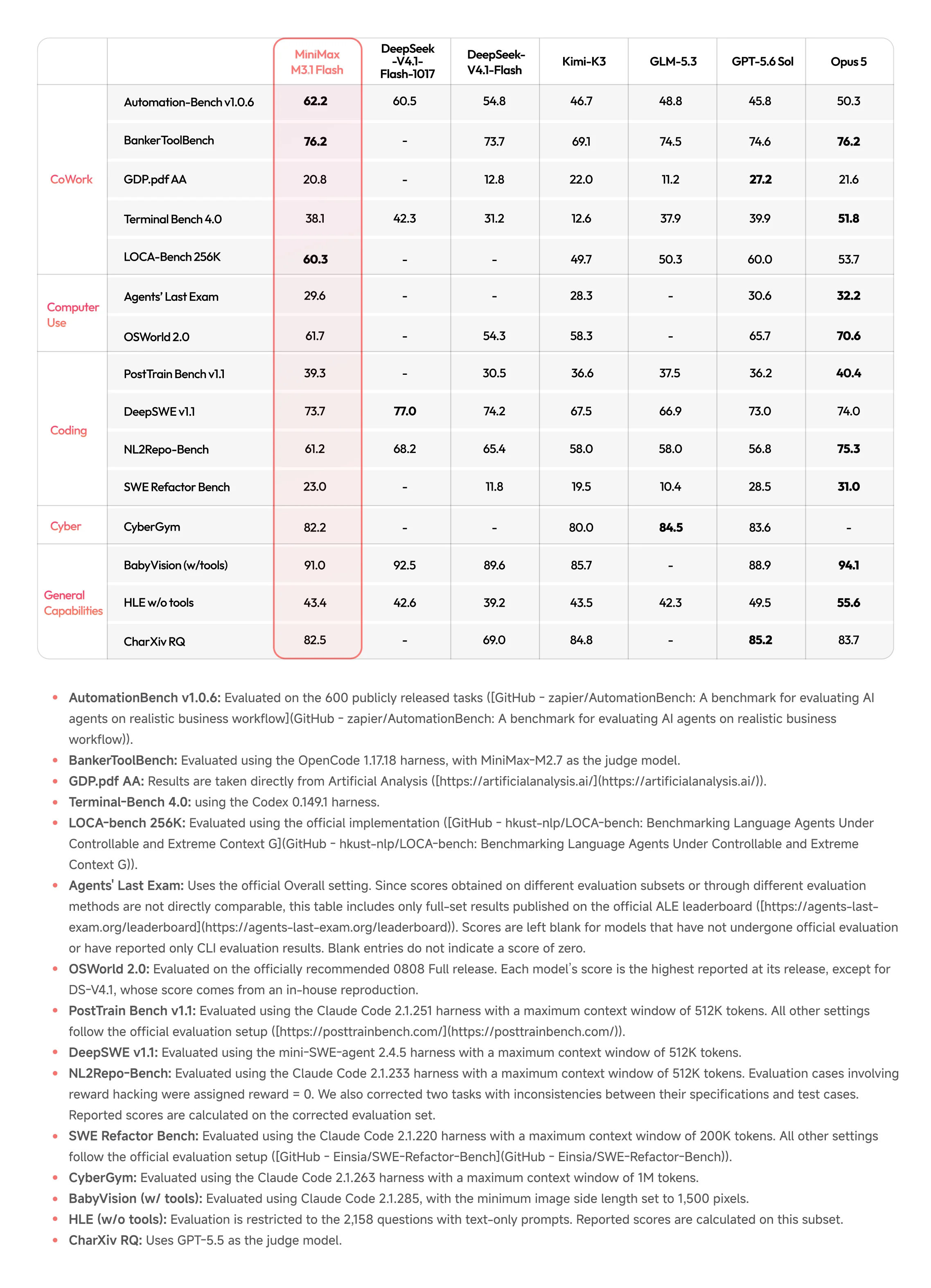
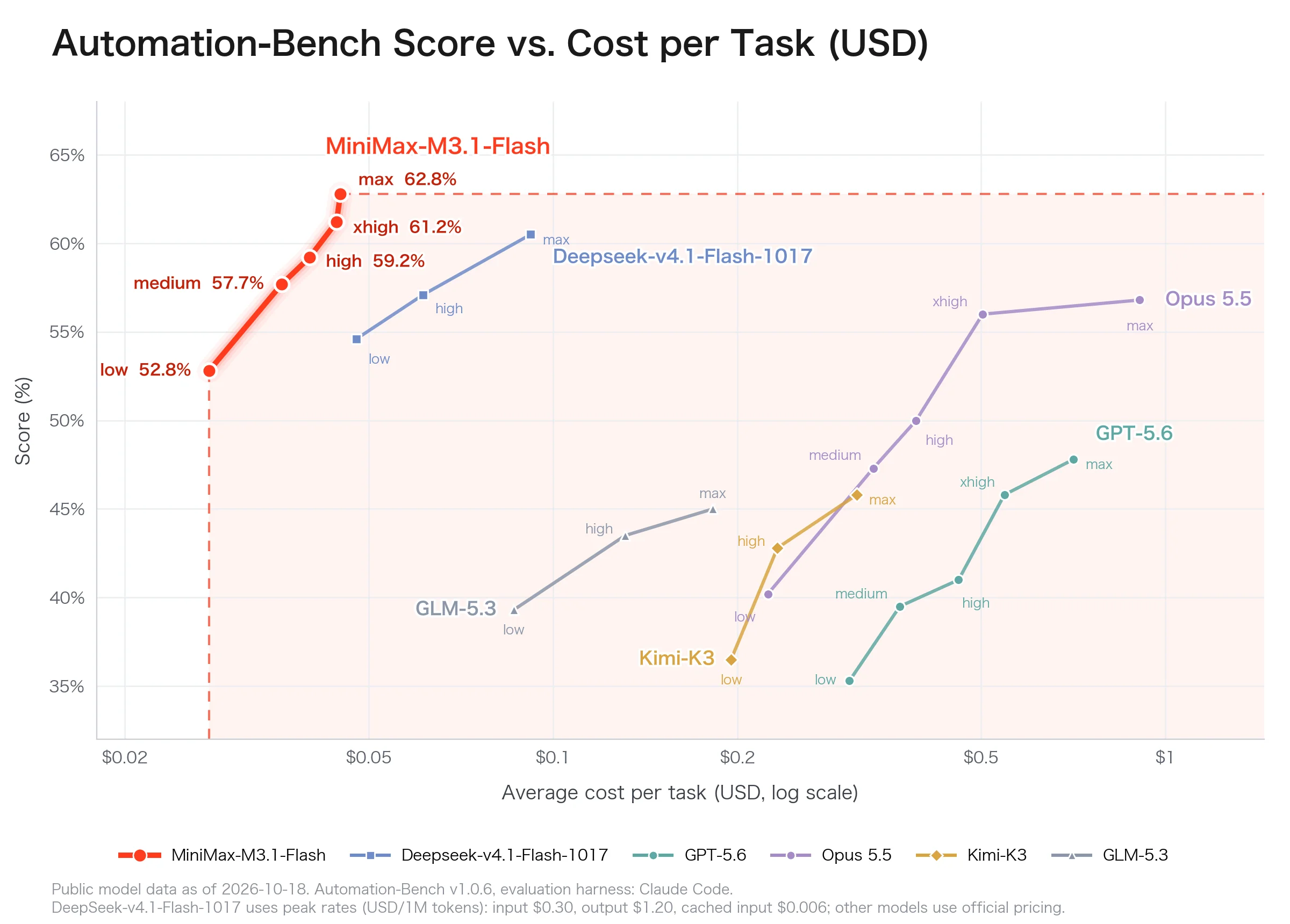
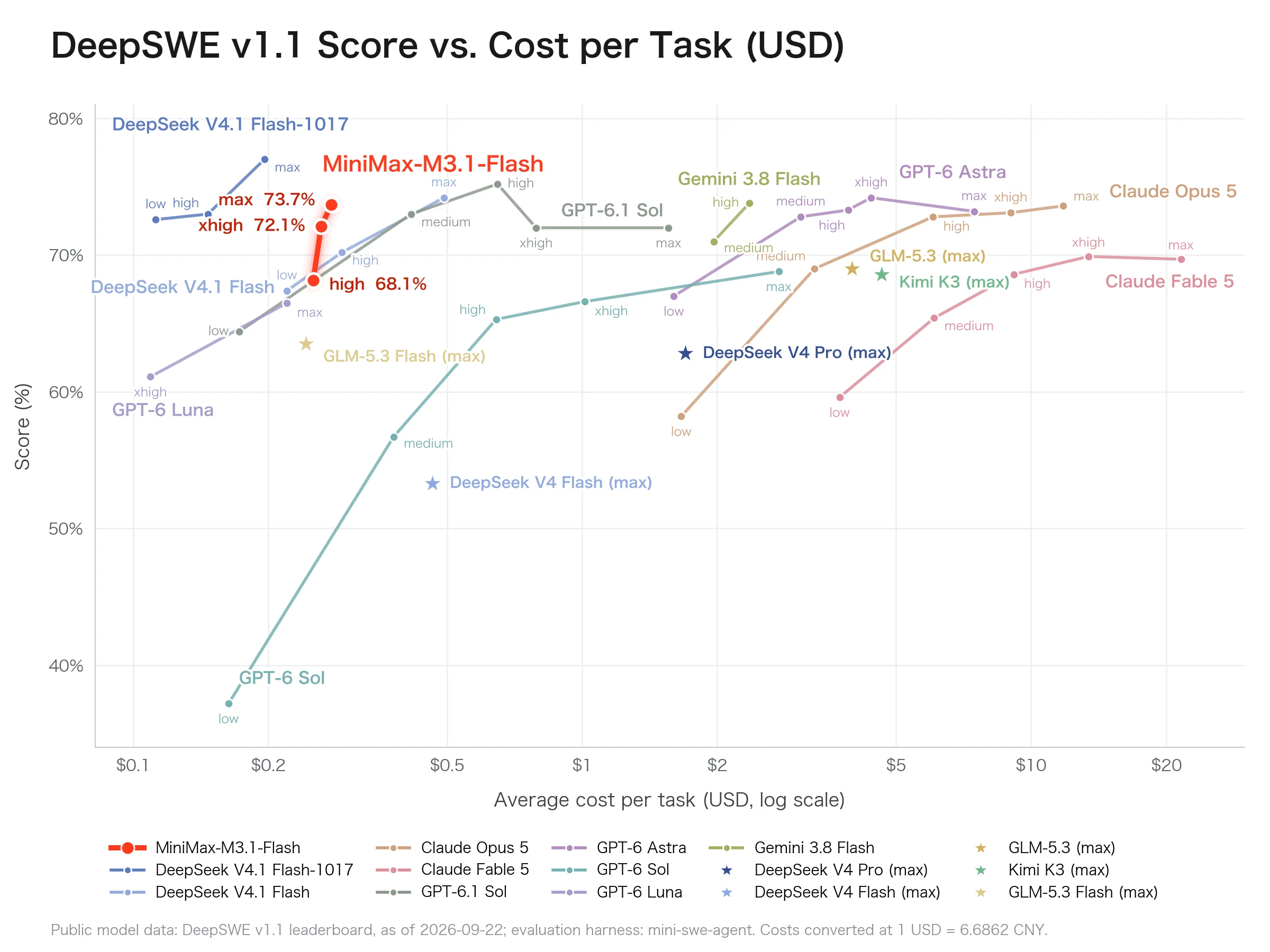
The comparison table and the two cost charts are MiniMax’s. The table prints 62.2 on Automation-Bench v1.0.6 while the Automation-Bench cost chart prints 62.8% at max effort, and the post’s claim of usage cost 70% lower than the predecessor is not the list price: the pricing page sets input at half MiniMax-M3’s standard rate on inputs up to 512k tokens.
MiniMax’s comparison table for MiniMax-M3.1-FlashImage: MiniMax
MiniMax’s Automation-Bench score against cost per taskImage: MiniMax
MiniMax’s DeepSWE v1.1 score against cost per taskImage: MiniMax
Key numbers
Input $0.15, output $0.60 and cached input $0.015, per million tokens, on the pricing page
Context window of 1,000,000 tokens
Thinking depth from low to max, with max as the default
The release notes call it an open-weight model. The research post says the weights will be released later, and does not give a date. MiniMax also says a Pro model will arrive later, again with no date.
Department of Homeland Security publishes a DeepSeek removal order
A notice filed on 19 October 2026 publishes an order dated 24 July 2026 that tells US civilian agencies to drop DeepSeek products, including tools built with them.
The Department of Homeland Security (DHS) filed a notice for public inspection on 19 October 2026, document 2026-21447, scheduled for the Federal Register on 20 October 2026. The notice says the Secretary has ordered two steps under the Federal Acquisition Supply Chain Security Act of 2018.
The first excludes information technology products and services developed by Hangzhou DeepSeek Artificial Intelligence Co., Ltd, including affiliated entities, from federal civilian agency procurements. The second removes DeepSeek and DeepSeek-affiliate products, and third-party products and services developed using DeepSeek implementations, from civilian agency information technology.
The signed order in the appendix is Exclusion and Removal Order #2026-01. Its original release date is 24 July 2026, and it is signed by Secretary Markwayne Mullin. It applies to federal civilian executive branch agencies, except their national security systems and secure compartmented information systems. Those agencies are told to exclude the covered products from procurements, including product lists and similar buying tools, effective immediately after the order was issued, and to remove covered products from agency IT or seek an exception.
Exception requests go to the issuing official in writing within 60 days of the July issuance, so the October notice does not start a new clock. The notice names Hangzhou DeepSeek Artificial Intelligence Co., Ltd, while the signed order names Hangzhou DeepSeek Artificial Intelligence Basic Technology Research Co., Ltd. The order does not, on its own terms, cover the Department of Defense or the intelligence community, except where those departments’ own authorities do not apply.
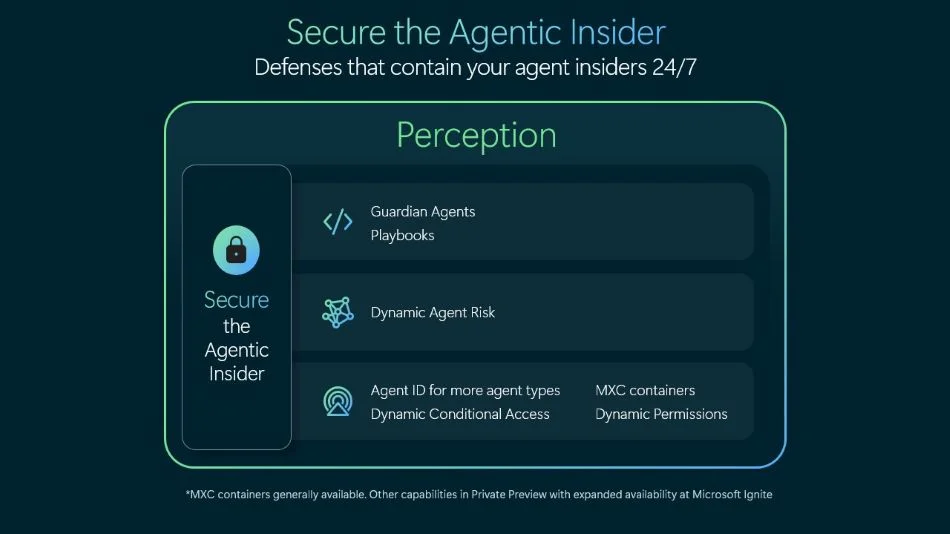
Microsoft published two posts on 19 October 2026. Nadim Abdo’s security blog extends Project Perception so it watches agents inside an organisation. Hayete Gallot’s post on the official Microsoft blog makes the same case: treat the agent as an insider, and keep the controls outside the model.
The mechanism is a loop. Dynamic Agent Risk recomputes a score from identity, data, endpoints and what the agent is doing. Dynamic Permissions give it only the access the current task needs, for a limited time, rather than the user’s standing rights. Dynamic Conditional Access in Microsoft Entra then changes that access: it can leave reads in place and block writes, shrink what the agent can reach, demand a human approval that can be proved, or isolate and stop the agent. Playbooks set the outcome. Guardian Agents carry it out.
Discovery is widening to 35 more local agent types, 60 in total, including Claude Code, OpenAI Codex and GitHub Copilot. New Microsoft Entra Agent ID types cover agents that were not registered before, so a discovered agent can be a policy target of its own.
The security blog introduces the controls without a release stage, while the diagram on the official blog marks only Microsoft Execution Container as generally available and the other capabilities as private preview, with wider availability at Microsoft Ignite. Microsoft Security’s post on X calls the package part of Microsoft 365 E7. Microsoft has not published a price.
Microsoft’s diagram of the Project Perception containment controlsImage: Microsoft
Inception launches Mercury 3, a diffusion language model
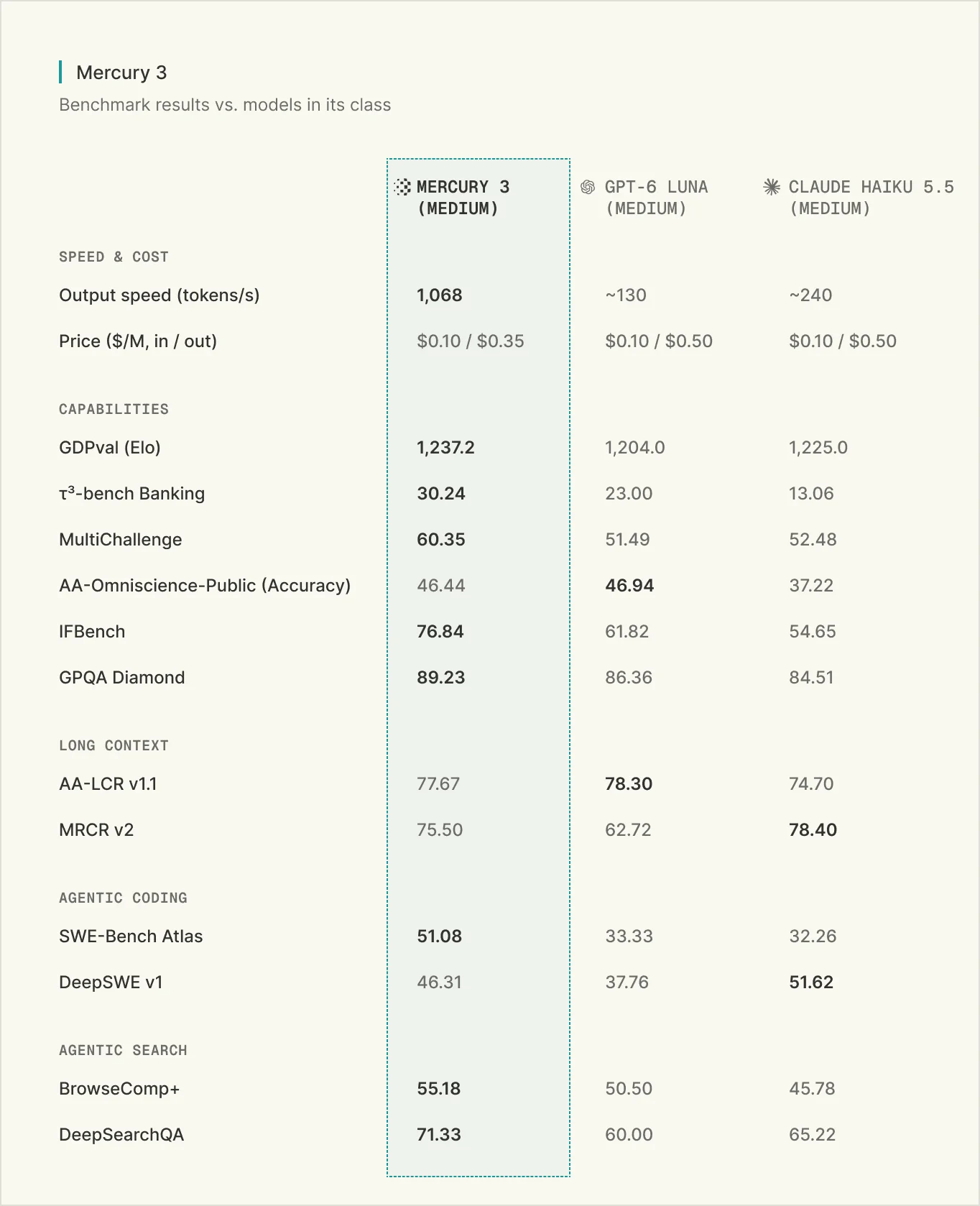
Mercury 3 has a 1M-token context, up from 260k in Mercury 2.5. Inception’s launch price is half the list rate, and the comparisons below are company-reported.
Inception introduced Mercury 3 on 19 October 2026. It is a diffusion language model: Inception says diffusion follows the same scaling pattern as autoregressive models, which is the account it gives for the speed in the table below. Mercury 3 is on the Inception API and, through the same OpenAI-style requests, on OpenRouter, Baseten and Vercel. New API keys include 100 million free tokens.
Inception says Mercury 3 is ahead of GPT-6 Luna and Claude Haiku 5.5 on a range of tests and behind on others, including a lower DeepSWE v1 score than Claude Haiku 5.5. Those comparisons are company-reported. The table is Inception’s.
Inception’s comparison of Mercury 3 with GPT-6 Luna and Claude Haiku 5.5Image: Inception
Key numbers
1M-token context, up from 260k in Mercury 2.5
List price $0.20 per million input tokens and $0.70 output, on the models page
Cached input $0.01 per million tokens at the launch discount
100 million free tokens on a new API key
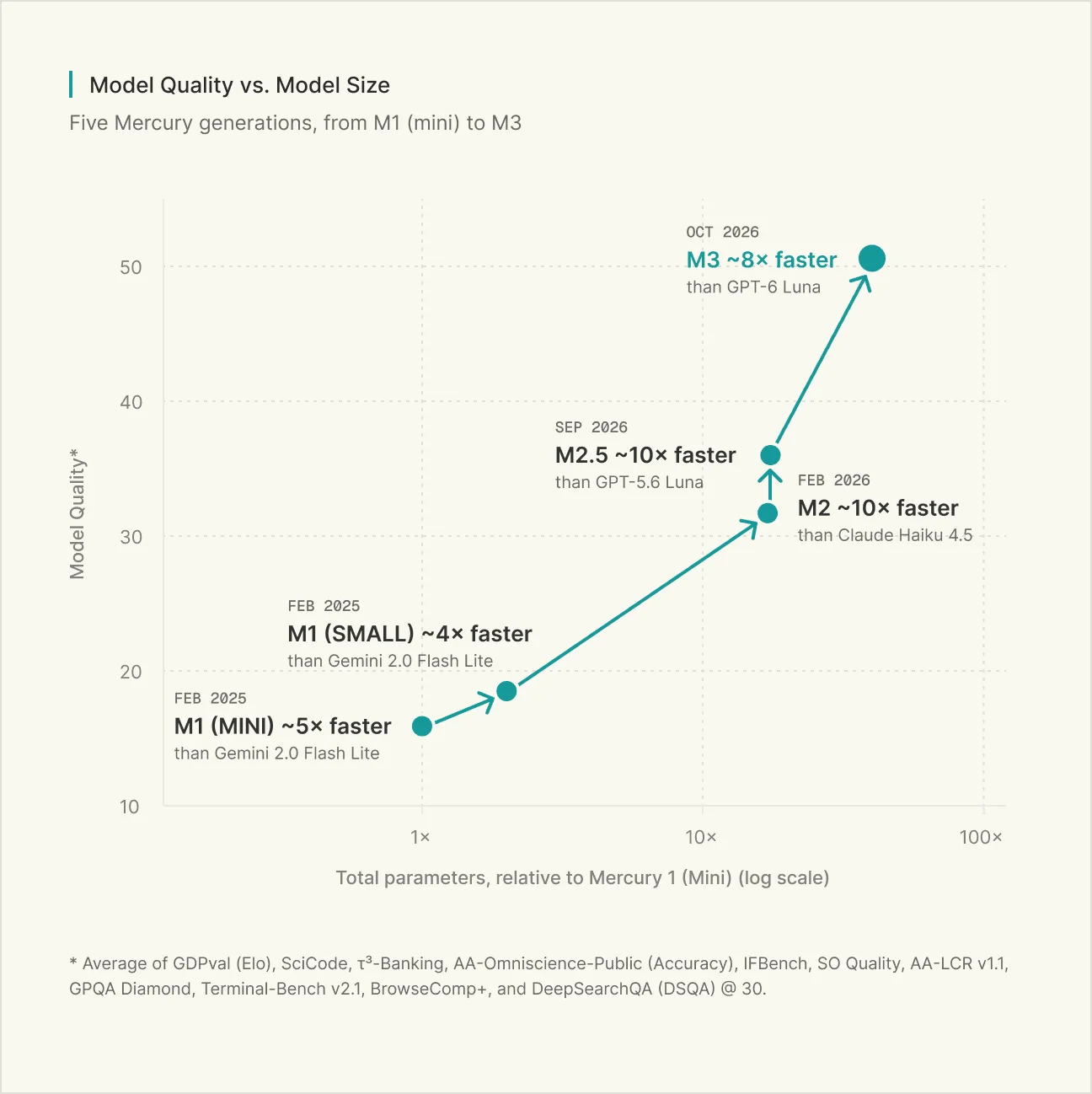
Inception has not said when the launch discount ends. Its models page says Mercury 2 and Mercury 2.5 are closed to new users. Customers who used them before 19 October 2026 keep access until 15 November 2026. Enterprise customers remain on their agreements. The second chart shows Inception’s quality score against size for five Mercury versions, with Mercury 3 at the top.
Inception’s chart of Mercury quality against model size, from Mercury 1 mini to Mercury 3Image: Inception
Meta publishes the technical report for Muse Glimmer 30B
The report is dated 19 October 2026. The model itself came out on 10 August 2026, under the Apache 2.0 licence, and the new paper describes how it was built.
Meta published the technical report for Muse Glimmer 30B on 19 October 2026. The weights, under the Apache 2.0 licence, are on Hugging Face as meta-models/Muse-Glimmer-30B. The report is the new document. The model is the one Meta introduced in August.
Muse Glimmer is a dense model of 30 billion parameters, not a mixture of experts. Meta says it chose a dense network because the model had to fit a memory limit. Distillation trains that smaller model to follow Muse Spark, the teacher the paper calls frontier-class. A perception encoder takes images, alongside text, and the model returns text. The report then quantises the weights to about 4-bit so inference fits one GPU, aimed at machines with 32GB of dedicated memory. Meta says it kept grouped-query attention after a more compressed attention design did worse on long context.
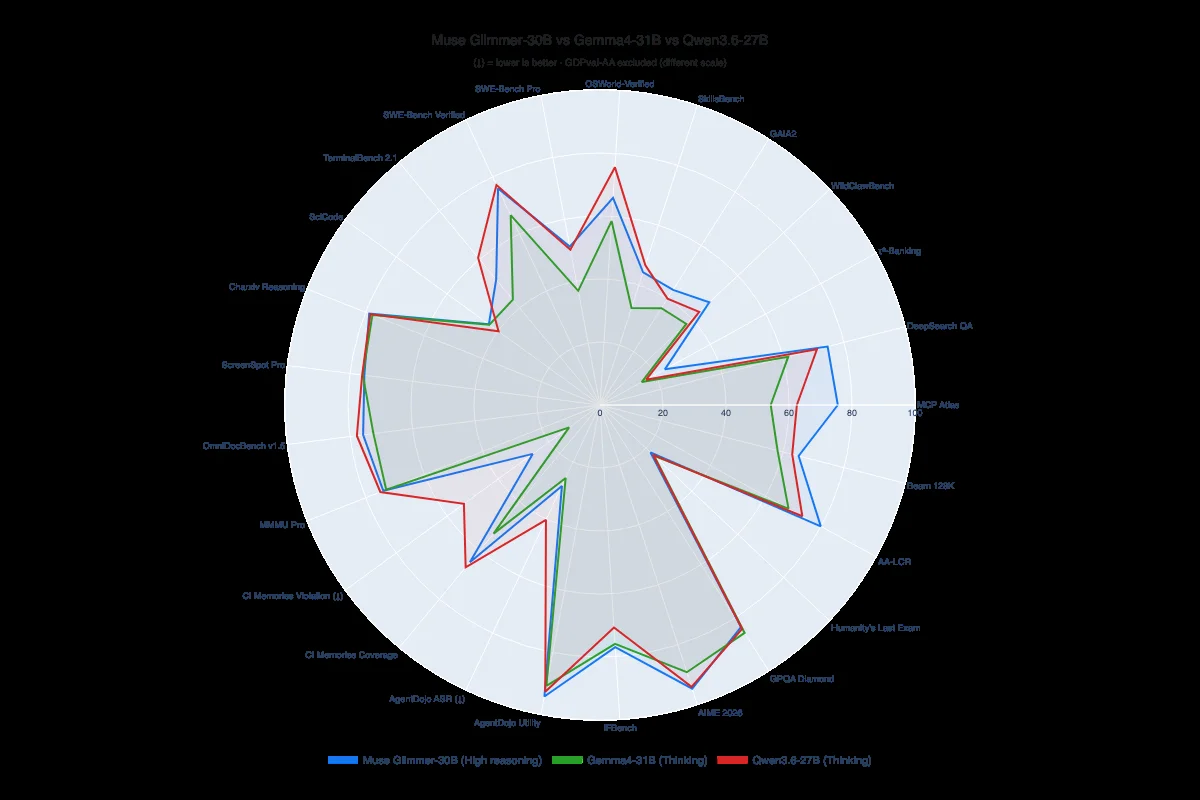
Meta reports a lead over Gemma4-31B and Qwen3.6-27B on tool use, multi-step planning and agentic task completion. Those comparisons are company-reported. The radar chart shows the lead is uneven: Muse Glimmer sits outside the other two on some agent tests and mixed with them on coding tests.
Meta’s radar chart from the Muse Glimmer 30B technical reportImage: Meta
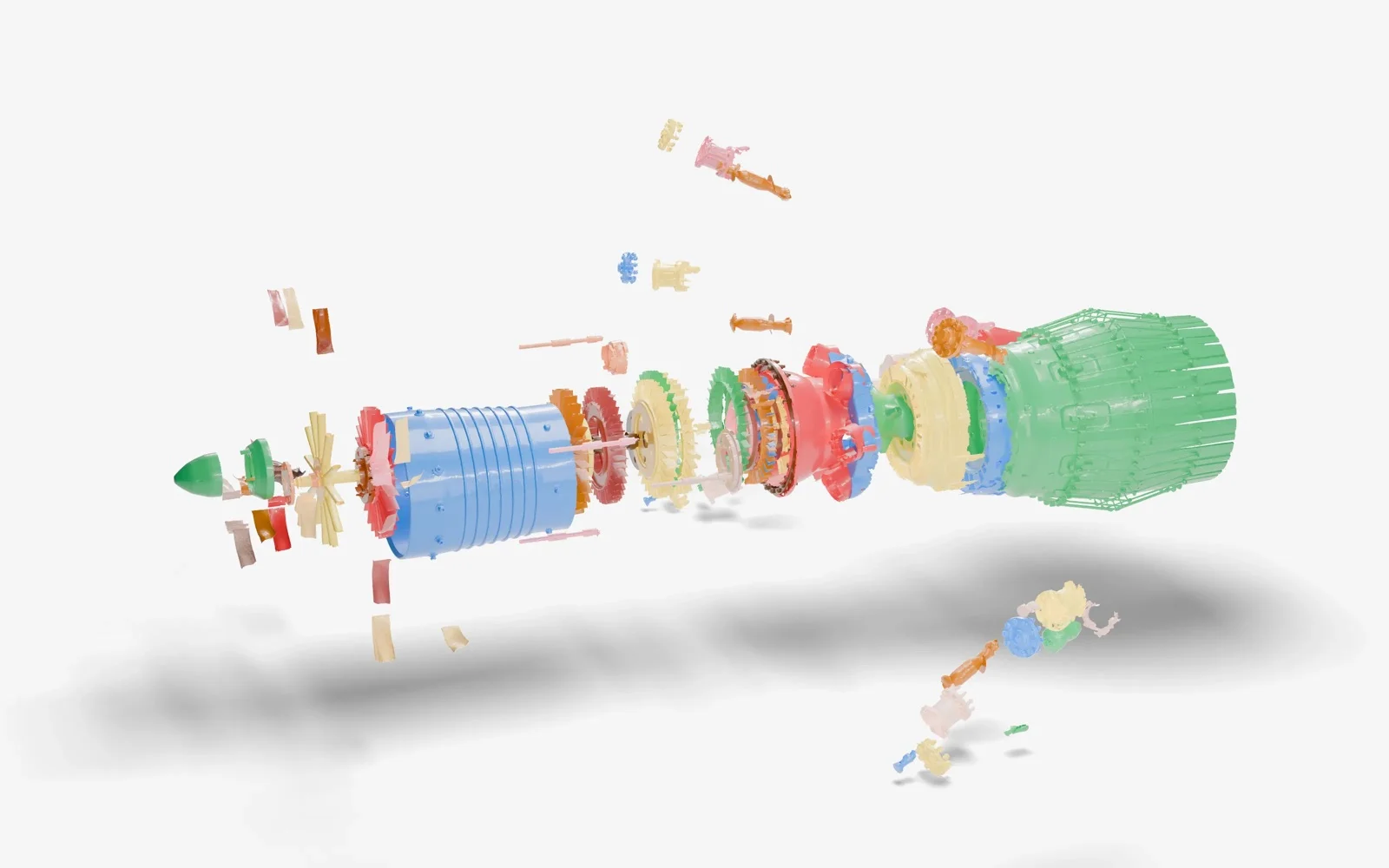
Skyfall AI announced SKY-001 on 19 October 2026 and calls it the first Engineering World Model. On the product page the mechanism has four stages. A text prompt or a 2D image becomes several rough 3D designs at once. A chosen design is split into parts, down to screws. Each part is drawn as 2D sketches and then formed into a solid. The parts are assembled, in order, into a model Skyfall says a standard 3D viewer can open.
Skyfall has not announced general availability. Access is a waitlist. It has not published an API price or a context length.
The comparison charts are drawn in the page and are not image files that can be saved here. On Skyfall’s own numbers, which are company-reported, SKY-001 beats GPT-6 Astra on speed and cost on both sets: 51 times faster and 150 times cheaper on CAD, and 118 times faster and 188 times cheaper on BIM. Skyfall also shows a higher overlap with the reference shape than the other models on those charts, and no completed CAD samples for Grok 4.7.
fal releases FLUX 3 Max for text-to-video and image-to-video
fal Research post-trained FLUX 3 with Black Forest Labs. The page prices 720p video at $0.0425 per second until 7 November 2026, against a $0.17 list price.
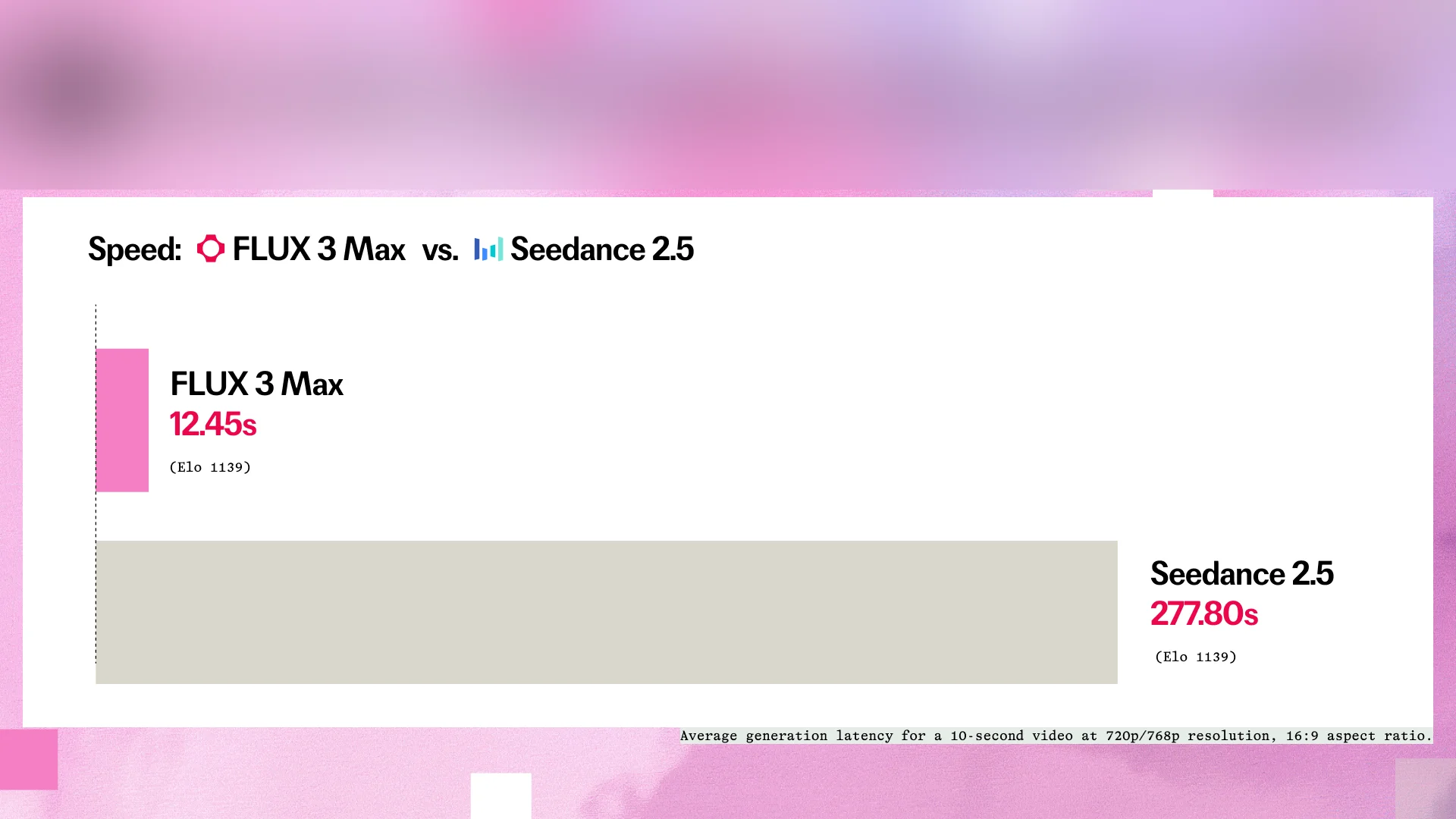
fal released FLUX 3 Max, post-trained by fal Research with Black Forest Labs on FLUX 3. Post-training means fal kept training that model for visual detail, motion and following the prompt, and changed how it runs, rather than training a new one from scratch. Text-to-video and image-to-video are both at 720p. fal says a 10-second clip takes 12.45 seconds, against 126.44 seconds for FLUX 3, about 10 times faster.
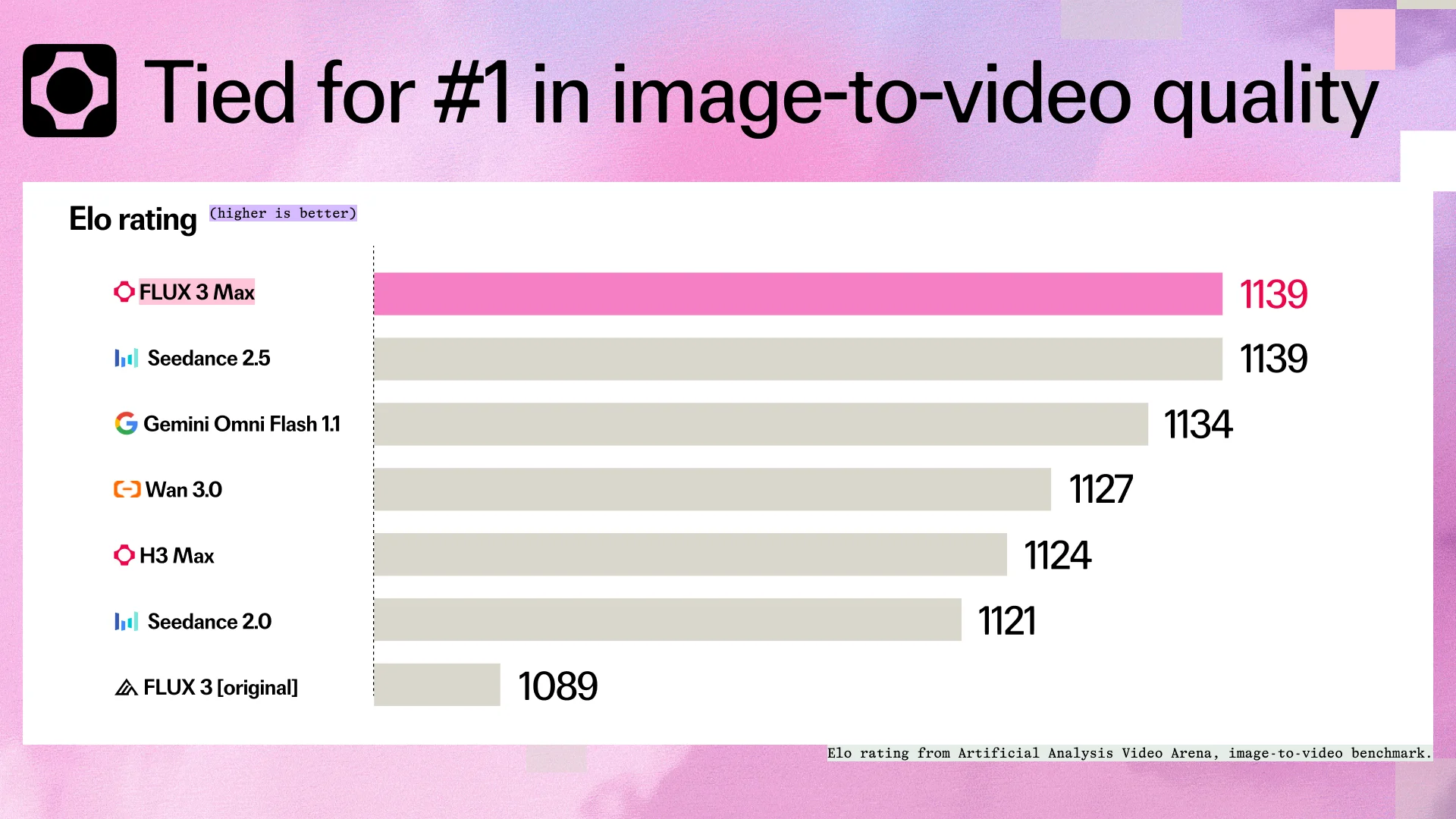
fal says FLUX 3 Max is tied for first on Artificial Analysis’s preliminary image-to-video arena. Its own table lists MiniMax H3 at 1,141, above FLUX 3 Max and Seedance 2.5, and fal says the confidence intervals overlap, which is why it still calls the result a tie.
fal’s image-to-video Elo chart for FLUX 3 MaxImage: fal
The speed chart is a separate cut of generation time against Seedance 2.5, at the Elo fal prints for both.
fal’s generation-time comparison of FLUX 3 Max and Seedance 2.5Image: fal
Key numbers
$0.0425 per second of 720p video until 7 November 2026, on fal’s page
List price $0.17 per second, a 75% discount
Billing is per second of output video, with no subscription. fal has not said it will release the weights. The FAQ on the page dates its endpoint list to 18 October 2026.
Sources
PrimaryFLUX 3 Maxfal.ai · fal’s product page, with the arena table, speed and price