DeepSeek says the minor update to DeepSeek-V4.1-Flash does better on reasoning, coding, agent and vision tests while finishing tasks faster with shorter outputs, and it now serves every Flash request in DeepSeek’s API.
Image: DeepSeekDeepSeek’s share image for the announcement
Lead storyDeepSeek releases DeepSeek-V4.1-Flash-1017 with MIT-licensed open weights
Edited by Ashutosh ShrivastavaStory 1 of 6 · 2 min read
DeepSeek announced DeepSeek-V4.1-Flash-1017 on X at 14:05 IST on 17 October 2026, as a minor update to DeepSeek-V4.1-Flash, which came out on 10 September. It is live on DeepSeek’s website, app and API, and its weights are on Hugging Face and ModelScope under the MIT licence, which allows commercial use, modification and redistribution.
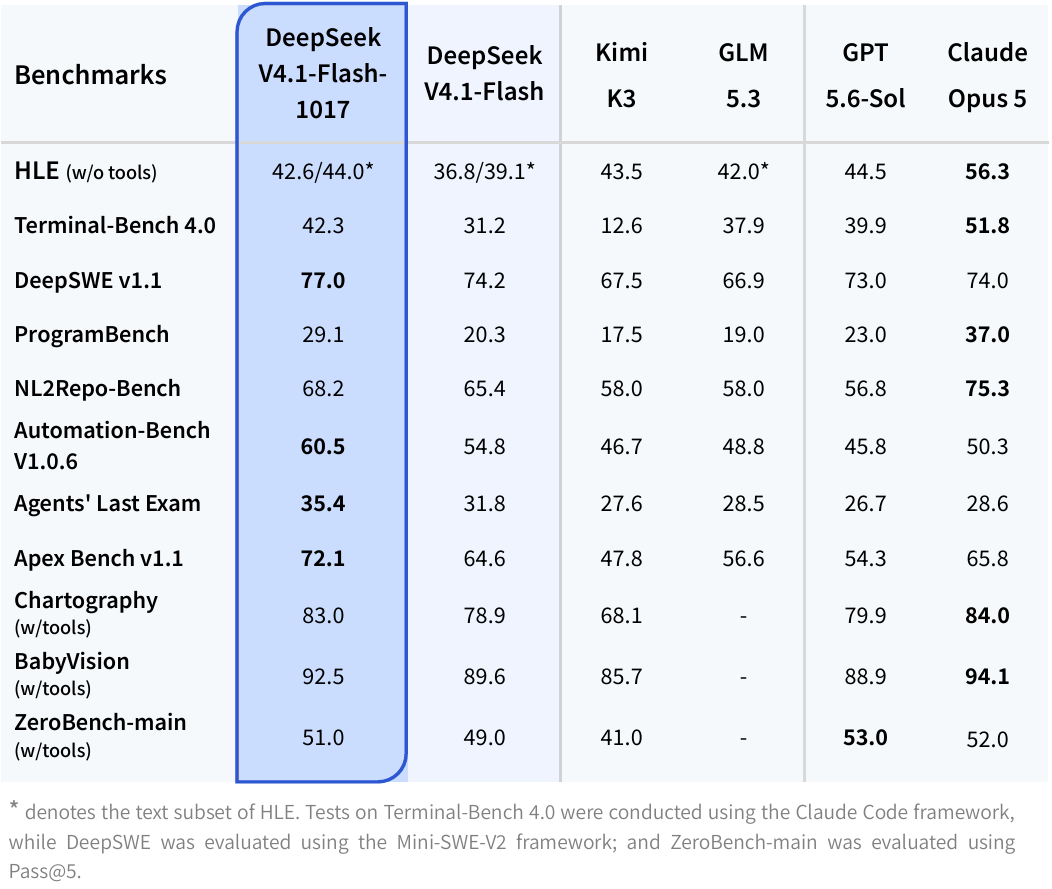
DeepSeek says it trained the update to build complete projects by learning from feedback on its own attempts, and its examples include a 3D model of the Forbidden City and a Portal 2 recreation in the Godot engine. In DeepSeek’s own table, it leads four of eleven tests, including DeepSWE v1.1 for software engineering, while Claude Opus 5 leads six.
DeepSeek’s table: the update against DeepSeek-V4.1-Flash, Kimi K3, GLM-5.3, GPT-5.6 Sol and Claude Opus 5Image: DeepSeek
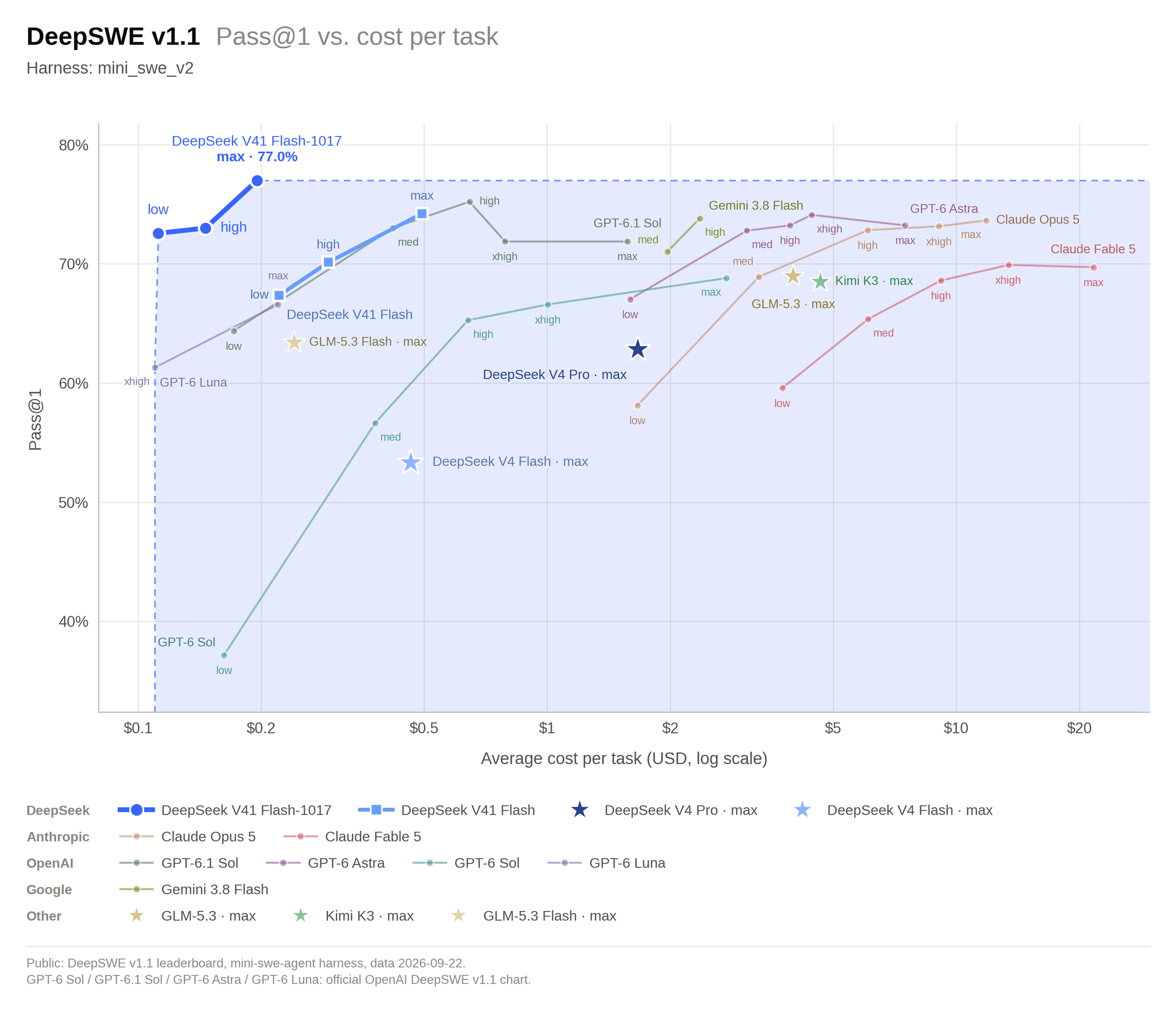
DeepSeek’s cost chart for DeepSWE v1.1 shows it scoring highest at one of the lowest costs per task.
DeepSeek’s chart of DeepSWE v1.1 pass rate against average cost per task, with the mini-swe-v2 harnessImage: DeepSeek
The checkpoint has 763B parameters on Hugging Face, the same as DeepSeek-V4.1-Flash, whose model card describes a mixture-of-experts design, which uses only part of the network for each token: 16B parameters when generating.
In the API
Developers call it as deepseek-flash. The older names deepseek-v4-flash and deepseek-v4-flash-vision-exp still work, but their models are retired and their requests now go to the new model, billed at the Flash price. It offers thinking and non-thinking modes, tool calls and image input. DeepSeek optimised it for DeepSeek Harness, Tencent CodeBuddy and WorkBuddy, and recommends DeepSeek Harness v0.2.1-rc.1 or later.
Key numbers
Input: $0.15 per million tokens off-peak and $0.30 at peak, or $0.003 and $0.006 for cached input
Output: $0.60 per million tokens off-peak and $1.20 at peak
Context: 1M tokens, with up to 384k tokens of output
Search and Fetch: $0.75 per 1,000 calls each
Peak hours are 06:30 to 09:30 and 11:30 to 15:30 IST on weekdays, outside Chinese public holidays. DeepSeek also opened to everyone its Search API, which finds web pages with its own search engine, and its Fetch API, which returns a page as Markdown. Search and Fetch calls through server-side tools in DeepSeek Harness, Claude Code and Codex stay free for DeepSeek API users until 21:30 IST on 31 October 2026.
OpenAI rolls out ChatGPT Slides for presentations teams edit together
Listed in ChatGPT’s release notes on 16 October 2026, Slides builds a deck from a conversation, files or an outline, and lets teammates edit it at the same time.
OpenAI’s help article says Slides is rolling out to eligible accounts on the Pro, Business and Enterprise plans with access to Space, on the web and in the ChatGPT desktop app. Users ask ChatGPT in Work for a presentation, or select Create > Slide in Space.
A deck can start from a template, and users can share an example deck to guide the style and layout. Text, images, shapes, tables and charts can be edited directly, or selected and changed by asking ChatGPT, for example to shorten a slide or update a chart from new data. ChatGPT can also generate custom images for a deck.
People with edit access can work on the same deck at once, leave shared comments and @mention ChatGPT to make changes. Comment-only access isn’t available at launch.
Decks can be presented from ChatGPT. On the web they export to PowerPoint, PDF or Google Slides, and on a computer with PowerPoint or Keynote installed they open in those apps. On Windows devices without the required MXC component, which Windows 10 doesn’t support, the desktop app makes PowerPoint files instead of collaborative Slides.
OpenAI hasn’t said whether Slides will come to the Plus or free plans.
OfficialChatGPT release noteshelp.openai.com · Entry “Create and collaborate on slides in ChatGPT”, 16 October 2026
03ResearchAnthropicConfirmed
Anthropic’s Claude finds five NIST curve seeds came from timestamps, not hashes
In a 16 October 2026 post, Anthropic says an internal research model showed in under half an hour that the unexplained seeds of five NIST elliptic curves came from a C library random number generator seeded by the clock.
ECDSA, the most widely used elliptic-curve signature standard, was adopted by NIST in 2000 in FIPS 186-2. Its curves are partly defined by seed values that the NSA supplied without explanation, which fed years of suspicion that they could hide backdoors, and a bounty for whoever found the seeds’ origin.
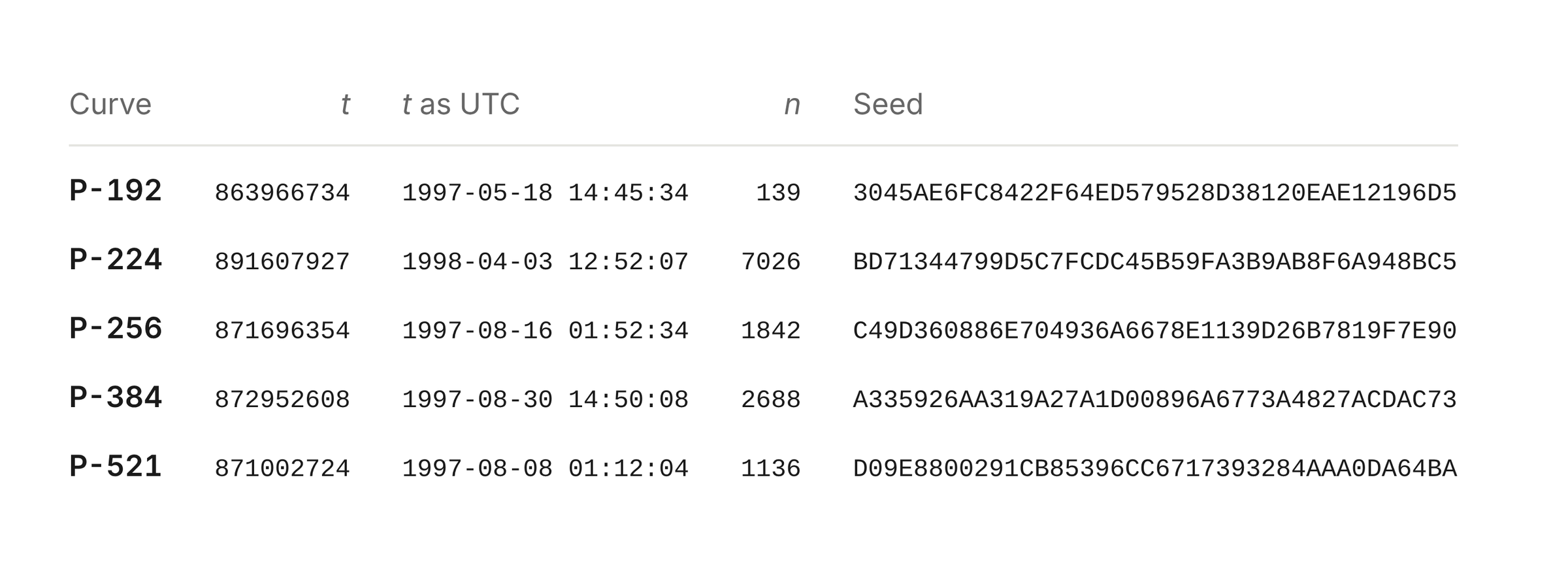
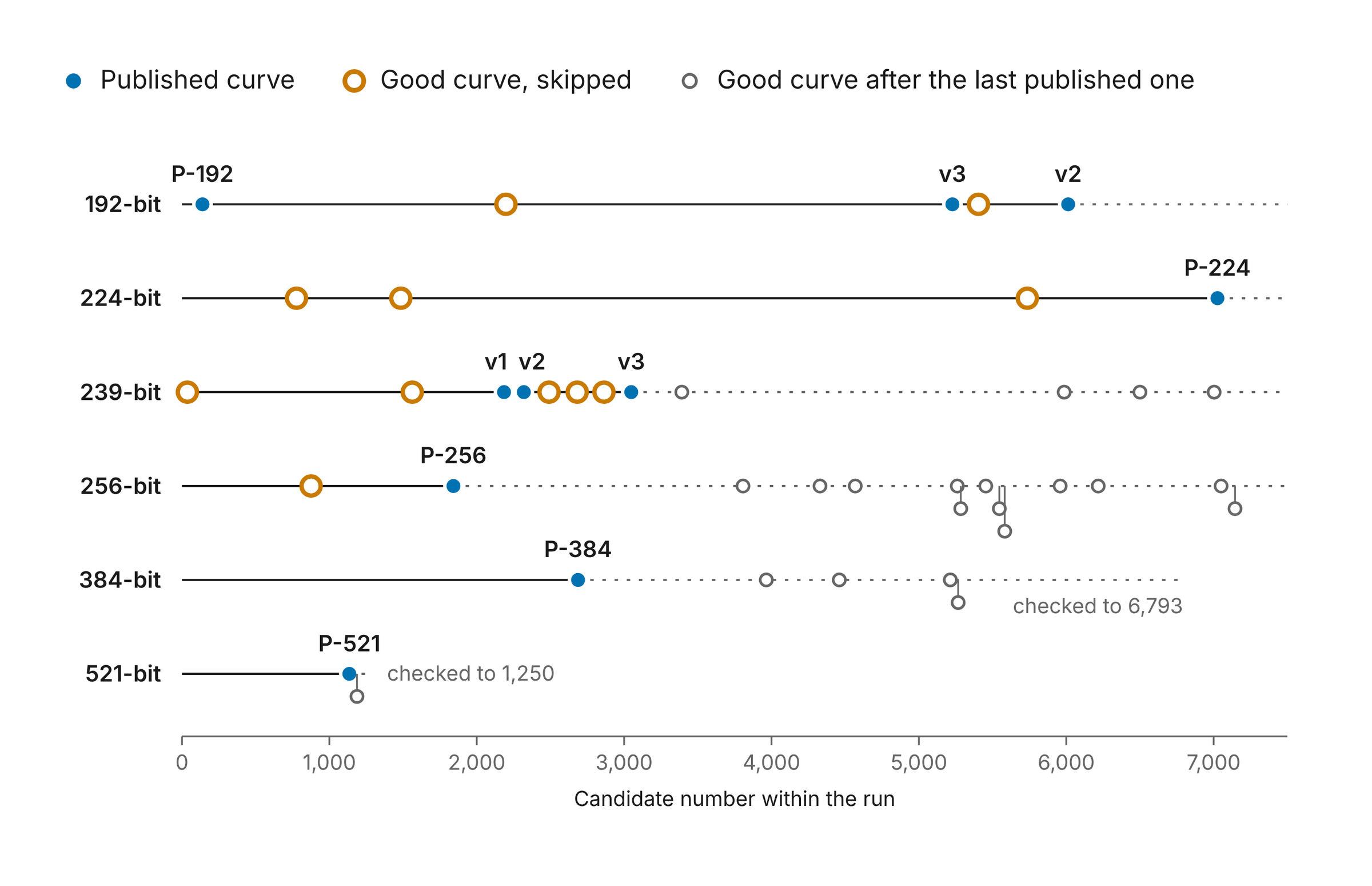
An Anthropic employee asked an internal research model how the seeds were made, without pointing it to the rumoured clue that they were hashes of a humorous phrase. In under half an hour, Claude showed that the P-192, P-224, P-256, P-384 and P-521 seeds came from lrand48, the C library’s random number generator, seeded with Unix timestamps, readings of the computer clock, from May 1997 to April 1998.
Anthropic’s table: each seed’s timestamp t, that time in UTC and its candidate number nImage: Anthropic
Claude spotted a pattern in the seeds’ top bits, recovered the generator’s hidden state and checked that each recovered state regenerates all 160 bits of its seed, which does not happen by chance. It also explained the base points, the fixed point every public key on a curve is derived from, of P-192 and five ANSI X9.62 example curves.
Anthropic says this is not a break of, attack on or weakness in ECDSA, and that a simple, reproducible method makes deliberately weakened curves much less plausible. The $36,864 bounty will go to the Internet Security Research Group.
The seed of the binary curve B-163 and the base points of P-224, P-256, P-384 and P-521 remain unexplained, and Anthropic doesn’t know why some runs passed over workable curves.
Anthropic’s chart of the workable curves each run passed over before its published onesImage: Anthropic
vLLM speeds up Kimi K3 to 842 tokens per second on NVIDIA GB300 GPUs
Merged into vLLM on 16 October 2026, the opt-in code, developed by NVIDIA, makes Kimi K3 generate text 1.5 to 2 times faster in several tested setups on GB300 GPUs.
The vLLM project described the work on its blog on 16 October 2026, the day it was merged into vLLM as pull request 61867. NVIDIA built it with help from coding agents. In Kimi K3’s decode step, where the model generates output tokens, custom GPU code written in CuTe DSL replaces almost every operation, from attention to communication between GPUs.
It supports Kimi K3 on 8 or 16 GB300 GPUs connected by NVLink, handling 1 to 64 requests at a time, and operators switch it on with the decode_backend setting latency_specialized. All changes sit in vLLM’s Kimi K3 code, and the pull request reports AIME25, GPQA-Diamond and MRCR v2 scores matching stock vLLM within about one standard error.
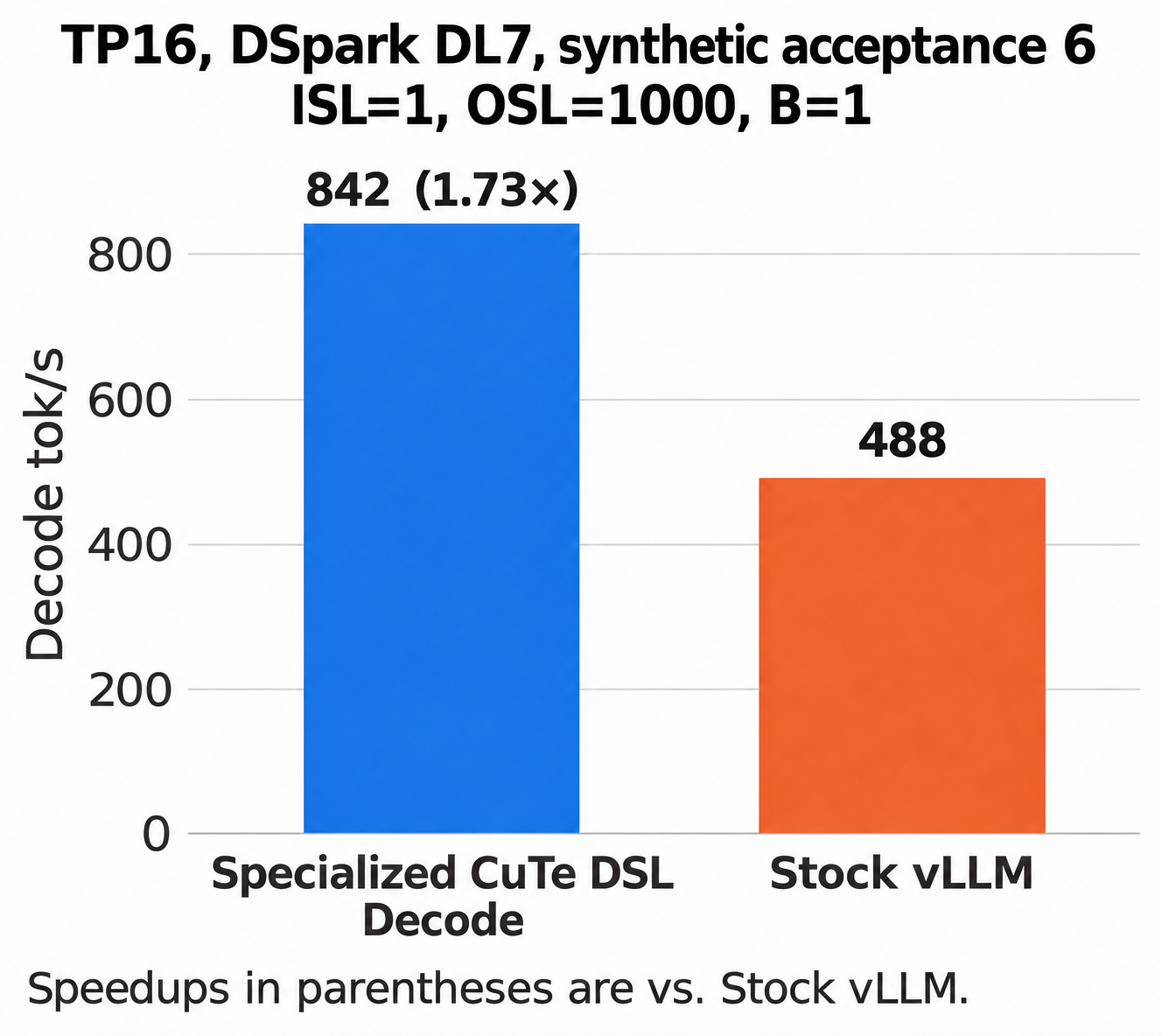
With DSpark speculative decoding, in which a draft proposes several tokens for the model to check at once, Kimi K3 reaches 842 tokens per second for a single request on 16 GPUs in vLLM’s controlled test.
vLLM’s DSpark test on 16 GPUs: seven draft tokens, a synthetic acceptance length of 6, batch 1Image: vLLM
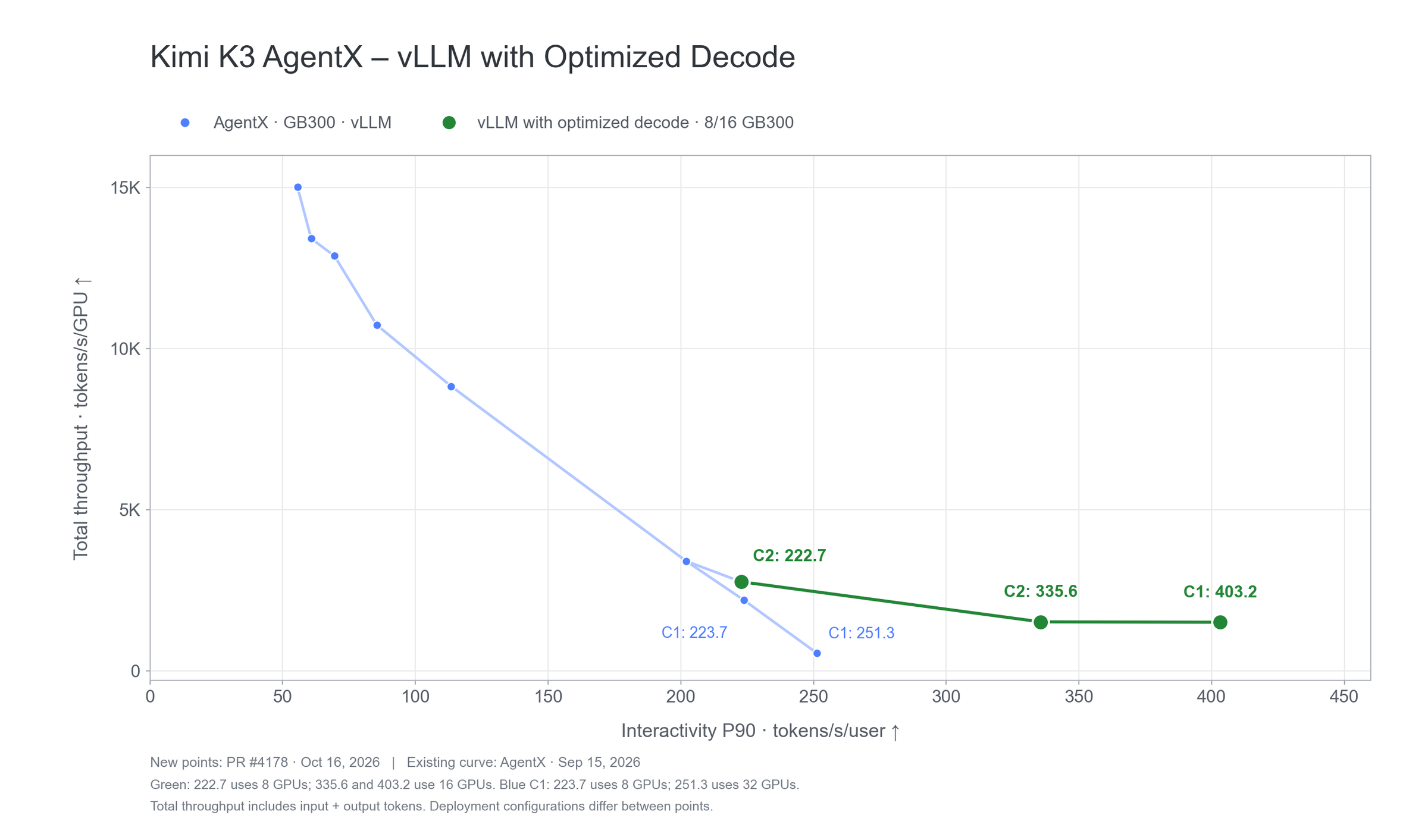
On AgentX, a SemiAnalysis benchmark that replays real coding-agent sessions, per-user speed at the 90th percentile rose 1.8 times at one concurrent request, though vLLM compares a 16-GPU run with an earlier 8-GPU result.
vLLM’s AgentX chart: per-user speed against throughput per GPU, with GPU counts differing between pointsImage: vLLM
Validation so far covers GB300 only. A similar path for DeepSeek-V4.1-Flash is open for review as pull request 61868.
OpenCode says a breach tied to a distillation attack hit 1.4% of Console users
The affected users had linked outside AI providers, and OpenCode says it has emailed all of them and is working with Anthropic, OpenAI and Google on a fix.
OpenCode, maker of the open-source coding agent of the same name, disclosed the breach on its X account on 17 October 2026. It said anyone who didn’t get its email wasn’t affected and that, with the incident ongoing, it couldn’t share more details. It linked the breach to a large-scale distillation attack, in which a model’s answers are used to train a copy without its maker’s permission, but hasn’t explained the connection.
In its email to affected users, seen in a screenshot of a Reddit post that security writer Matt Johansen shared on X, OpenCode said someone had gained unauthorised access to an old system it was in the process of retiring. Keys for outside providers saved in users’ workspaces, with OpenAI and Anthropic given as examples, may have been exposed. The email asked users to revoke and replace them through each provider’s dashboard, update any apps that use them and check recent usage for unexpected activity. The screenshot doesn’t show the sender’s address, and OpenCode hasn’t published the email.
Lydia Hallie, who works on Claude Code at Anthropic, said on X that Anthropic had revoked the Claude API keys it believes were affected. Replying to her, OpenCode’s Dax Raad said the breach concerns OpenCode Console, not the OpenCode agent, and that keys used in the agent never reach the company.
OpenCode hasn’t said how many users 1.4% represents, how the attacker got in or how many keys were exposed.
India’s CERT-In issues a Critical advisory on AI agents reaching Indian systems
CERT-In (Indian Computer Emergency Response Team) says AI model providers voluntarily disclosed that their models, during research and evaluation on the internet, read Indian organisations’ business records, including personal data, through exposed credentials and overly broad cloud permissions. In a separate, financially motivated campaign, attackers’ agent tools cut the time from first access to impact from days to a few hours. No affected organisation detected the access itself, and CERT-In hasn’t named the providers or the organisations.