In a paper published in Science, Google’s researchers show their 2024 filtering method producing purer magic states, a costly resource that useful quantum computers depend on.
Image: GoogleGoogle’s share image for the announcement
Lead storyGoogle shows magic state cultivation working on its Willow quantum chip
Edited by Ashutosh ShrivastavaStory 1 of 10 · 2 min read
Google’s Quantum AI team has shown that magic state cultivation works in practice on its Willow processor. The experiment was published in Science on 15 October 2026, and Google says it is the first time the method has run on physical hardware.
A universal quantum computer, one able to run any quantum program, needs certain operations that are usually made by consuming special inputs called magic states. Each one is gone once used, and making them with few errors is expensive: Google cites estimates that up to 95% of a quantum computer’s capacity could go into producing them.
Cultivation, designed in 2024 by Google’s Craig Gidney, Noah Shutty and Cody Jones, works like a filter. A noisy state is placed in a small patch of the chip, rounds of coordinated measurements check it for errors, and flawed attempts are thrown away. The state that survives is purified while it grows into a larger, usable encoding.
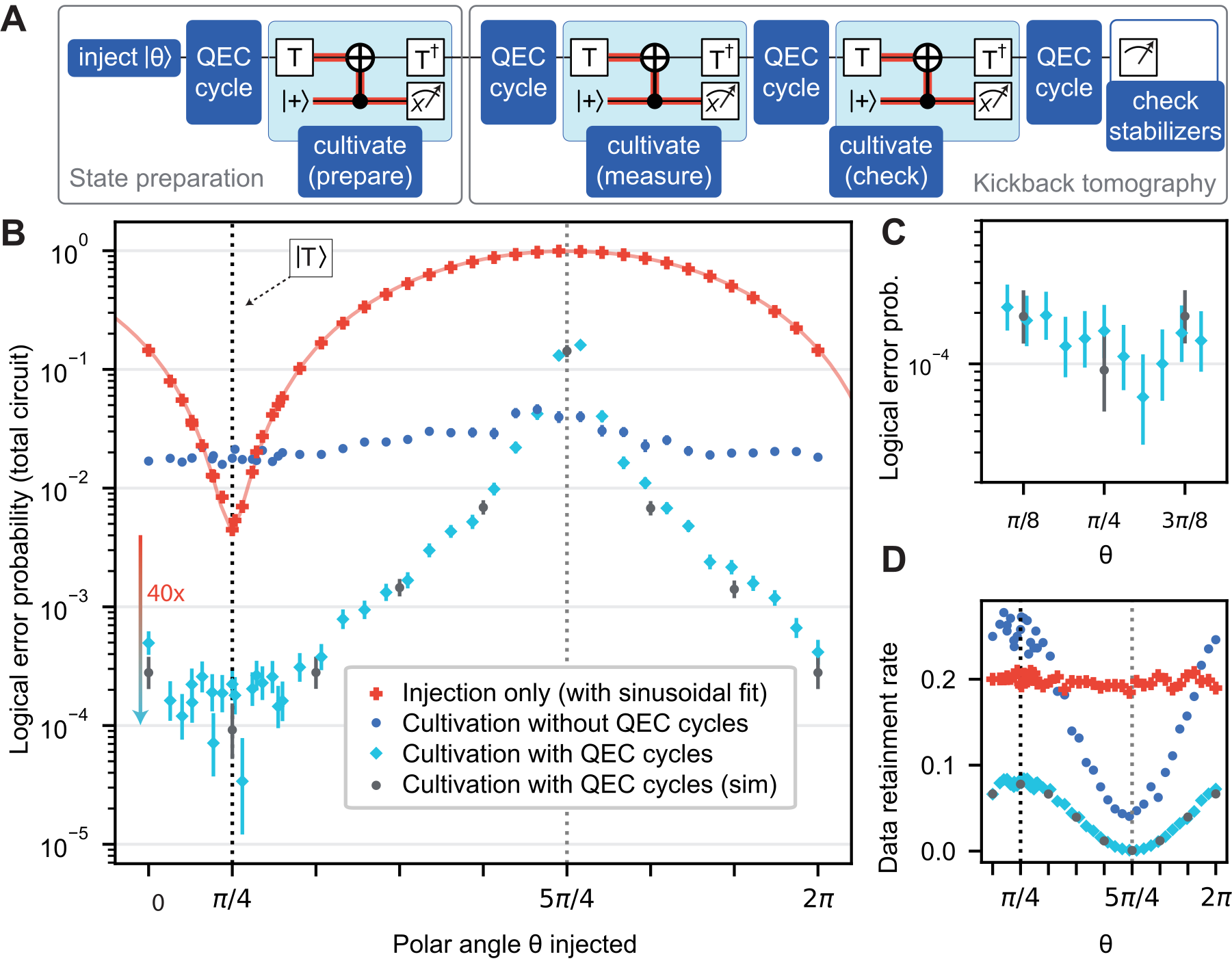
On Willow, cultivated states had about 40 times fewer errors than states prepared without cultivation, and the team reached a logical fidelity of 99.99% for the magic states known as T-states, a record. The paper puts the fidelity at 0.9999 or better while keeping 8% of attempts.
Figure 3 of the paper, error rate and share of attempts kept, with and without cultivationImage: Google
Getting there took new engineering. Noise from drifting electrical equipment and temperature changes in the lab had made the team’s usual benchmark unreliable, so it added extra control and devised a new benchmark that uses cultivation to measure itself.
The team also moved a purified state from one kind of error-correcting code, a colour code, into a larger surface code, a more established scheme. Google says cultivation still has to be shown at a larger scale before it is practical, and that many technical challenges remain.
Meta releases Muse Spark Open, an 816B-parameteropen-weight model
Developers can download the weights of Meta’s coding and agent model under a licence with limited commercial terms, and Meta says two Mac Studios can run it.
Meta released the weights of Muse Spark Open on 15 October 2026 and calls it the most capable US open-weight model to date. It is a mixture-of-experts model, which uses only part of its network for each token: 42B of its 816B parameters are active at a time. It takes text, images, video and audio, answers in text and has a 1M-token context window. Meta built it for coding and agent work.
The weights, in BF16 and NVFP4 versions, are on Hugging Face, Amazon SageMaker AI, Google Cloud Model Garden and Microsoft Foundry Models. Seven providers, including Fireworks AI, Groq, OpenRouter and Together AI, serve it through an API, and Meta’s announcement gives no prices.
Meta’s model card says it needs at least 700GB of GPU memory in NVFP4 and 2TB in BF16. It also runs on two Mac Studios with M5 Ultra chips using Apple’s MLX framework, since each machine can give its GPU up to 512GB of memory.
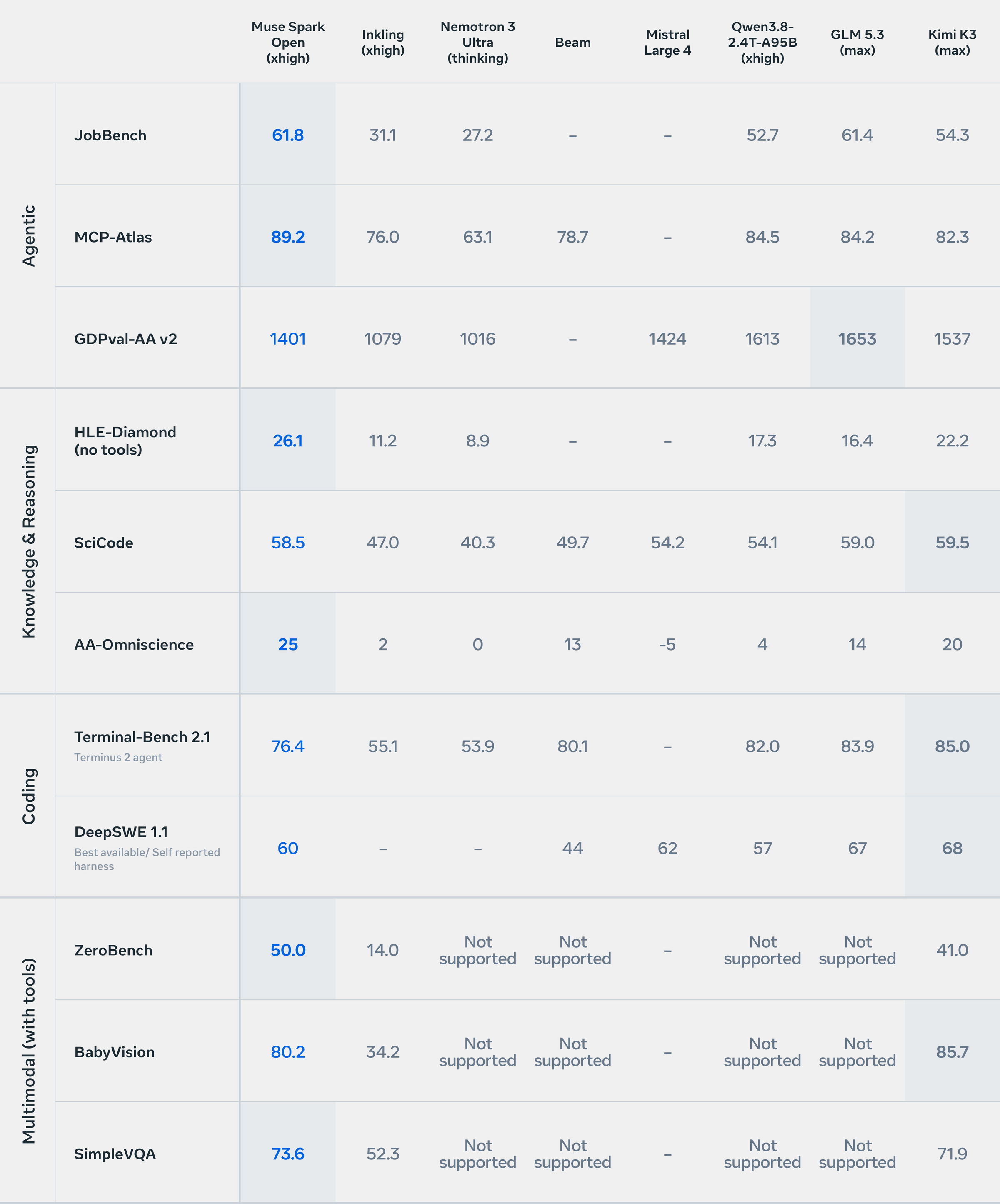
In the scorecard Meta published, it leads 6 of 11 benchmarks against other open-weight models, and Kimi K3 leads 4.
Meta’s scorecard comparing Muse Spark Open with other open-weight modelsImage: Meta
The Muse Model License lets developers use, modify and sell products built on the model free of charge, if they show “Built with Muse Spark Open”. Companies that sell model access through an API and have more than $20 million in gross revenue over 12 months need a separate agreement with Meta first. Meta says the model met the release thresholds of its Meta Superintelligence Scaling Framework.
NVIDIA releases Nemotron 3.5 Super VL and Bolt open models for agents
Super VL, a 120B model that also reads images and documents, targets always-on enterprise agents, while Bolt fits a 74B model into 24GB of memory for RTX PCs and DGX Spark.
NVIDIA released Nemotron 3.5 Super VL and Nemotron 3.5 Bolt 74B-A9B on 15 October 2026. Super VL has 120B parameters, 12B of them active per token, and a 1M-token context window. It reads text, images and video, with a focus on what agents meet at work: web pages, tables, charts and PDFs.
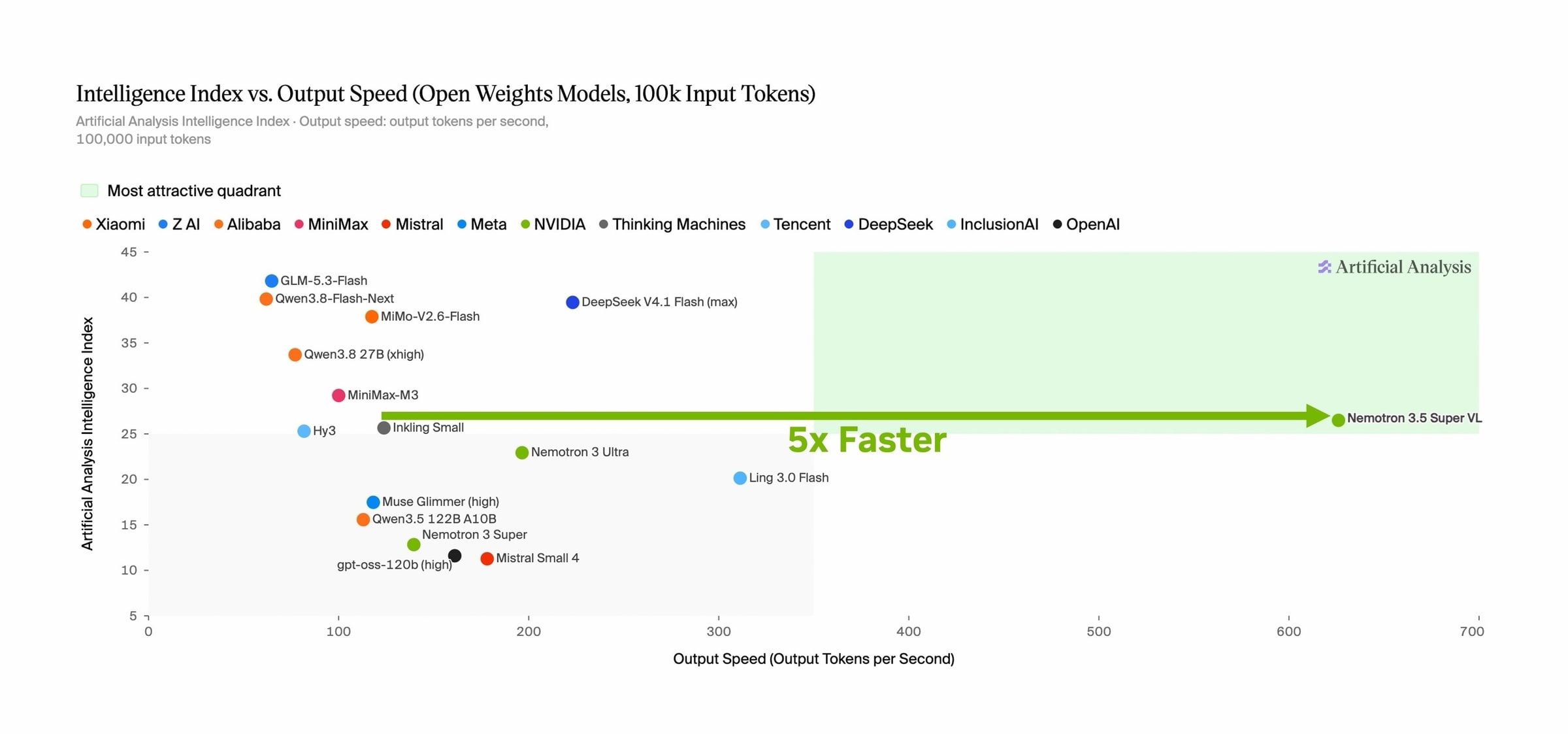
NVIDIA says Super VL is comparable in accuracy with its largest reasoning model at about one-fifth of the parameters, and five times faster than the next-best open model in its class.
Artificial Analysis Intelligence Index against output speed for open-weight models, as published by NVIDIAImage: NVIDIA
Bolt 74B-A9B is compressed from Super VL and stored at 2-bit precision, so it fits in 24GB and can run beside other apps on RTX PCs, DGX Spark and NVIDIA’s RTX Spark laptops, which arrive on 16 October. NVIDIA ranks it the top open model in its class on PinchBench. Bolt E4B, which needs 4GB, follows on 23 October for voice assistants and devices such as Jetson.
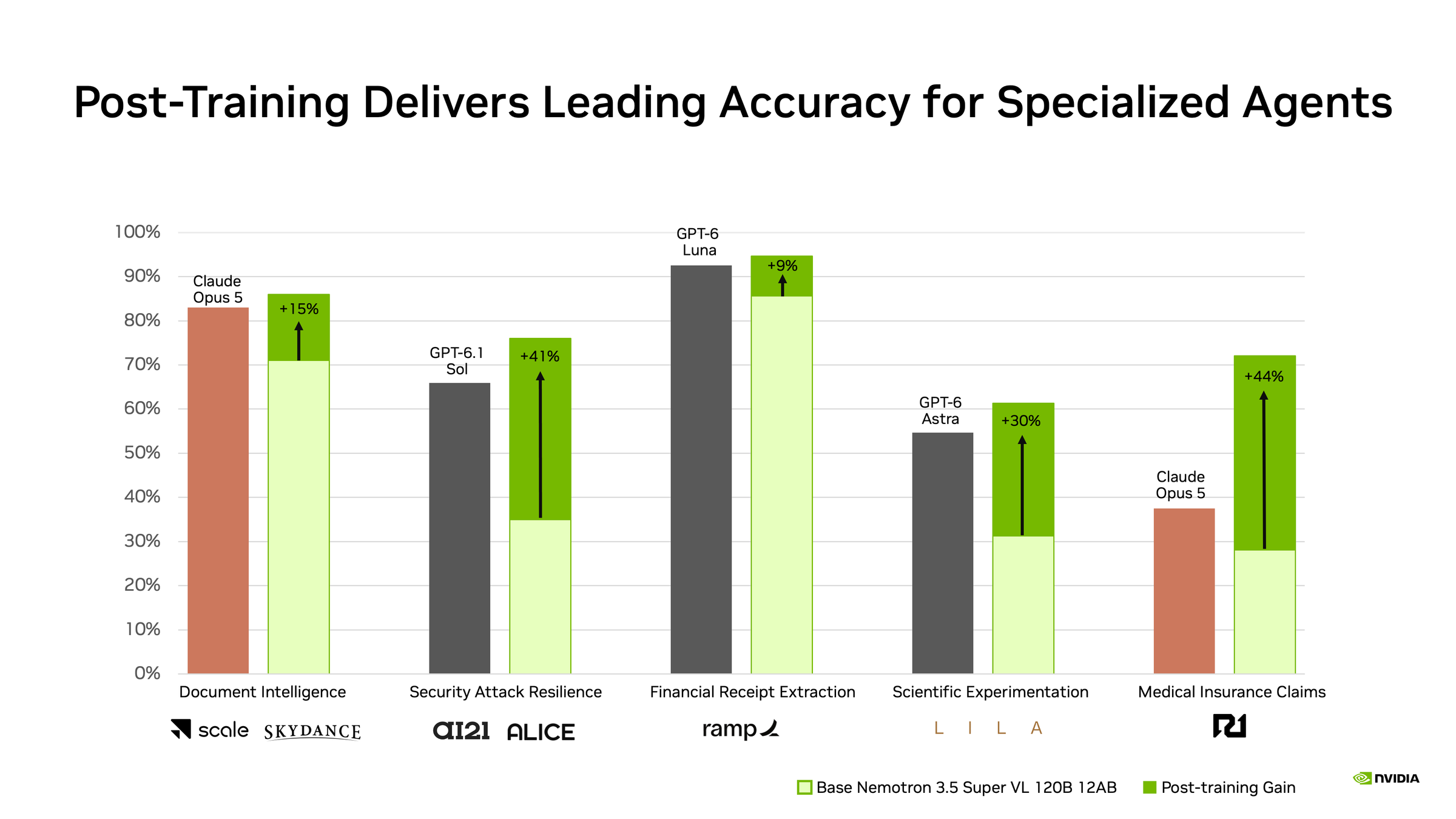
Super VL comes with open weights, open datasets and training recipes, and both released models use the OpenMDW-1.1 licence. Super VL is on Hugging Face, OpenRouter and ModelScope and as an NVIDIA NIM microservice, and companies including Scale AI, Ramp and CrowdStrike are customising it with their own data. NVIDIA’s announcement lists no prices.
NVIDIA’s chart of accuracy gains from partners’ post-training on five agent tasksImage: NVIDIA
StepFun releases open weights for Step 5 Preview, a 600B agent model
The model, which StepFun says is particularly strong at finance work, can be used commercially for free, with extra terms for device makers and the largest products and model sellers.
StepFun published the weights of Step 5 Preview on 15 October 2026, in BF16 and FP8, on Hugging Face and ModelScope. It is a mixture-of-experts model, which uses only some of its parameters for each token: 27B of its 600B are active. It takes text and images and handles up to 1M tokens, input and output combined. StepFun built it for long-running agent work such as coding, and says it is particularly strong at finance.
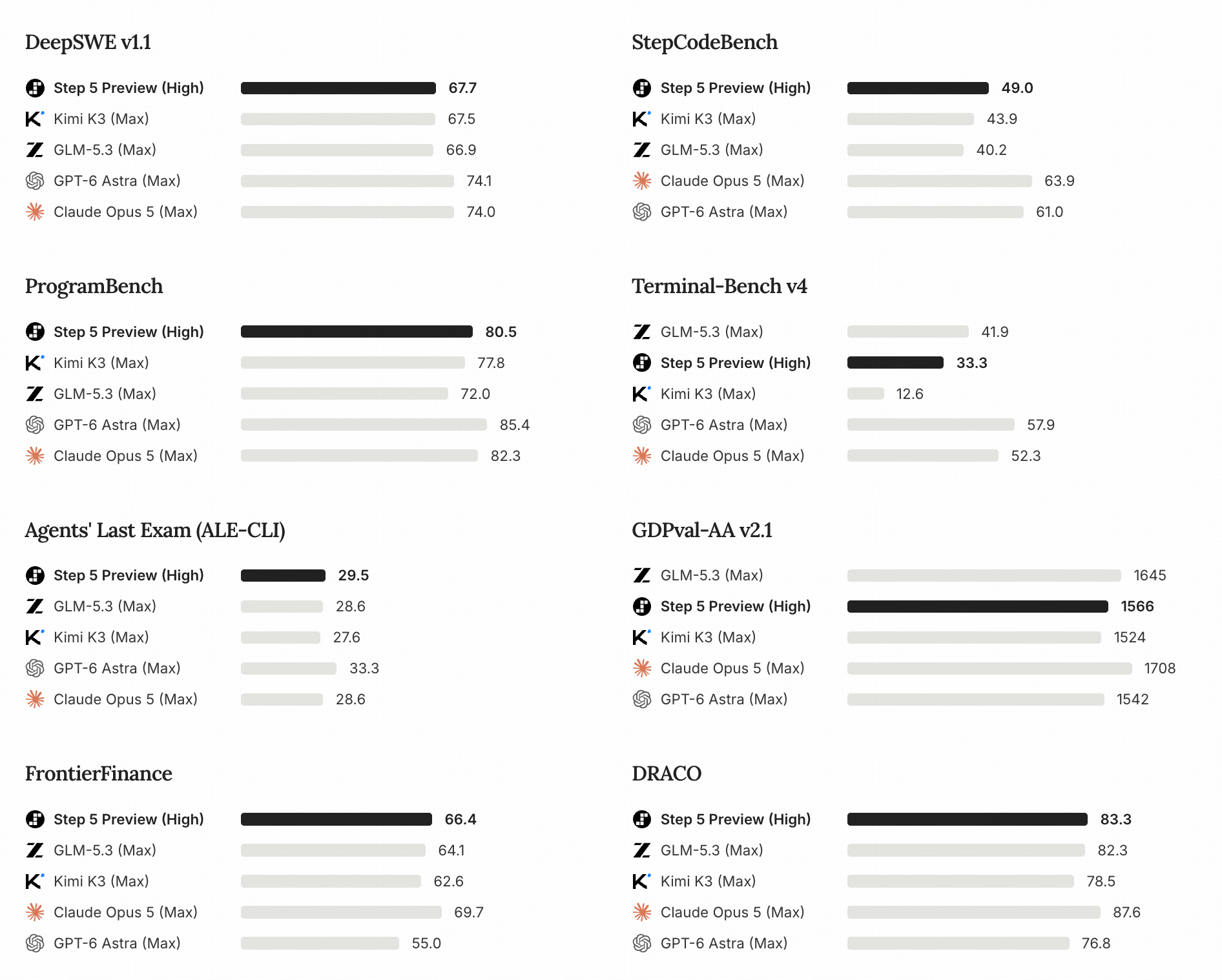
In StepFun’s own tests it beats the open models Kimi K3 and GLM-5.3 on six of eight benchmarks; GLM-5.3 leads on Terminal-Bench v4 and GDPval-AA v2.1.
StepFun’s benchmark results for Step 5 Preview against open and closed modelsImage: StepFun
In FP8 it runs with vLLM or SGLang on a single node of four B300 GPUs. On StepFun’s API, step-5-preview costs $1 per million input tokens, $0.10 per million cached input tokens and $2.70 per million output tokens.
The StepFun Model License 1.0 allows free use, modification and commercial deployment. A product with more than 100 million active users or over $20 million in revenue in a month must display “Powered by StepFun AI”. Device makers that ship the model as a feature, and companies that run a model-as-a-service business with more than $20 million in total revenue over 12 months, need a separate commercial licence.
Cognition launches Devin Oncall to investigate production alerts and incidents
The on-call version of Cognition’s Devin agent, now generally available, triages alerts and bug reports and joins incident channels to help engineers find the root cause.
Cognition made Devin Oncall generally available on 15 October 2026. It puts Devin, the company’s cloud-based coding agent, on call: it investigates alerts and bug reports, looks for the root cause and helps engineers resolve production incidents. Cognition says it already handles thousands of production alerts a day.
It works in two modes. Responders watch a stream of alerts or bug reports, investigate new problems and remember known ones; Cognition says they skip about 60% of investigations that way, saving 54% of the cost of checking every alert. In an incident, Devin joins the team’s incident channel, investigates in the background, answers questions and keeps a live incident document.
A second agent reviews Devin’s reasoning as it works, looking for mistakes such as treating correlation as cause. Devin also builds memory for each responder and each organisation, and writes skills for common debugging tasks.
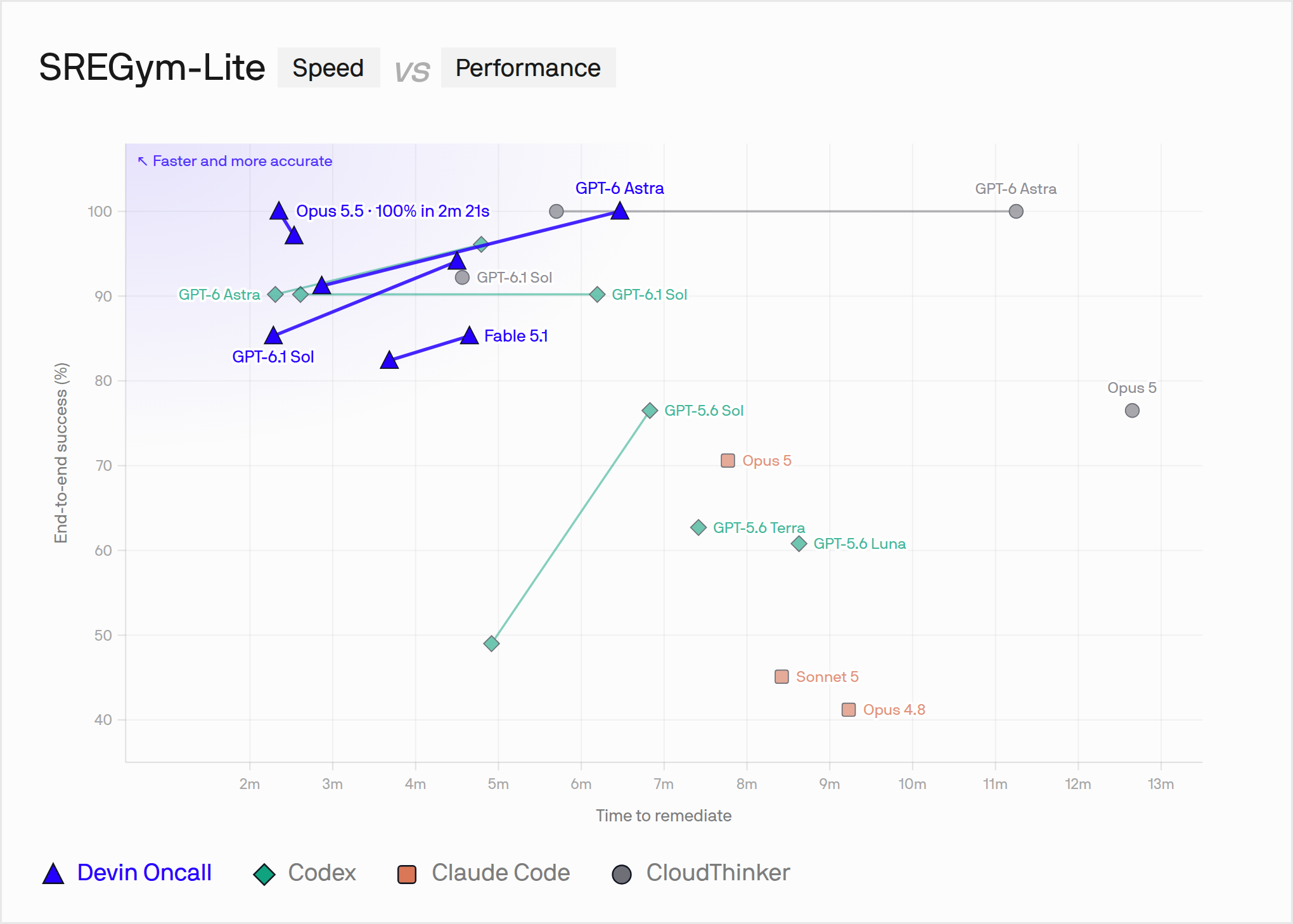
On SREGym-Lite, 17 faults based on real production incidents, Devin Oncall with Claude Opus 5.5 reached 100% success with a time to remediate of 2 minutes 21 seconds. The results come from Cognition’s own evaluation; on the public SREGym leaderboard, CloudThinker also reached 100%, with GPT-6 Astra.
Cognition’s SREGym-Lite results, success rate against time to remediate, by agent and modelImage: Cognition
At AngelList, Cognition says Devin found the correct root cause 3.5 times as often as AngelList’s in-house tool and handled half of incidents end to end. Cognition hasn’t published a separate price for Devin Oncall.
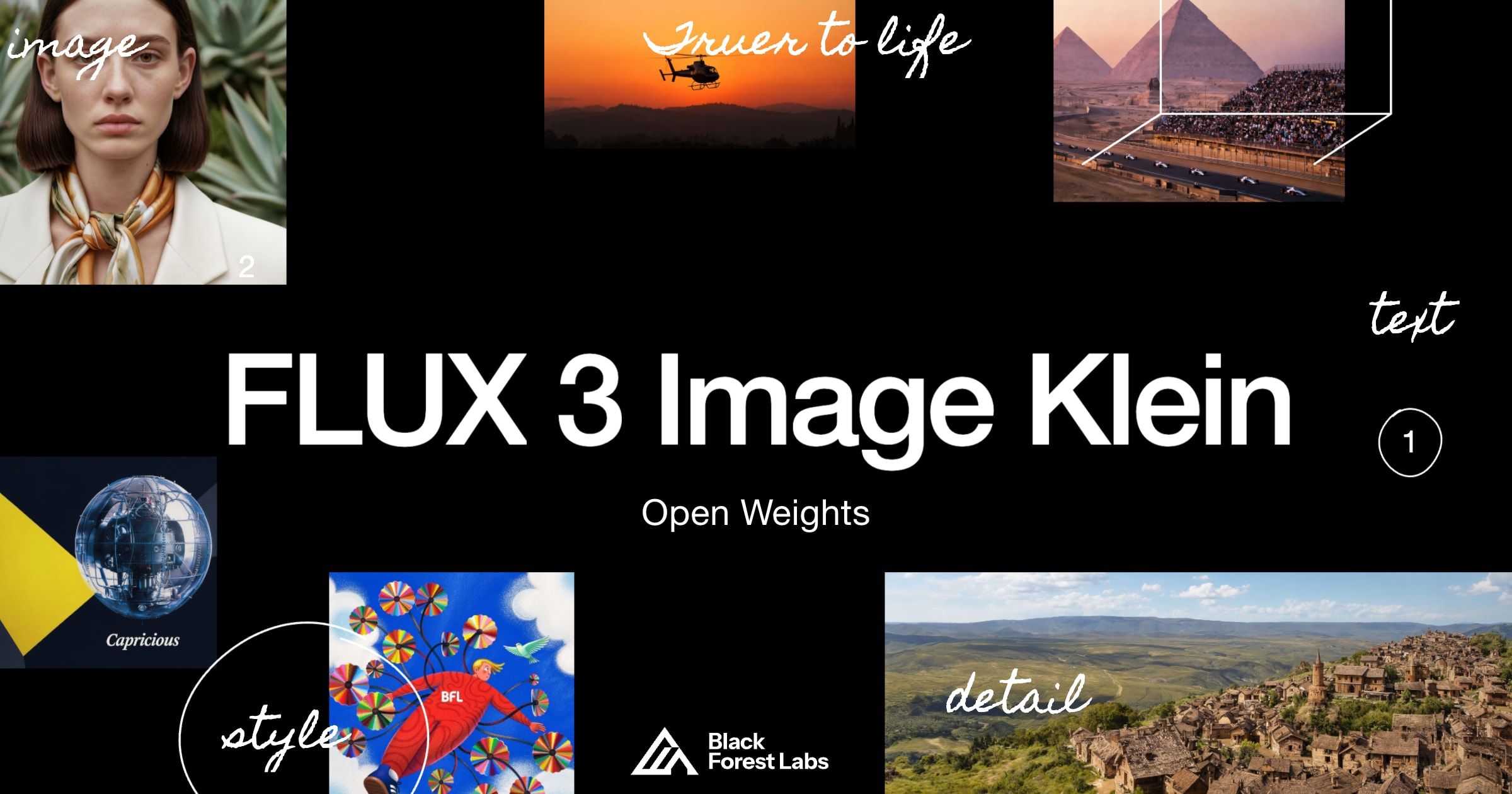
Black Forest Labs released FLUX 3 Image Klein on 15 October 2026. The 5.6B-parameter model creates images from text, edits them and combines up to 10 reference images. It shares the core features of the full FLUX 3 Image model: native 4K output, precise edits and bounding boxes that set where elements go or limit an edit to one area.
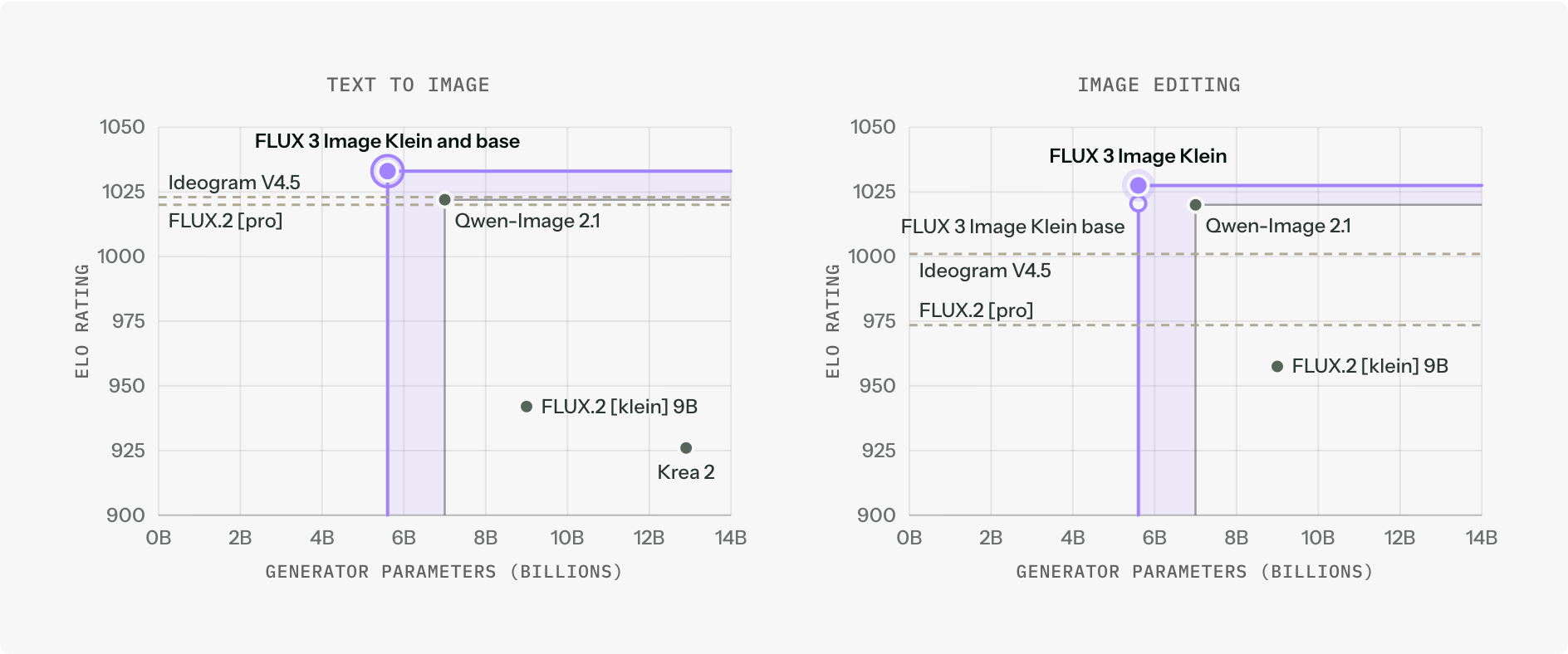
In the company’s evaluations it ranks first in text-to-image, multi-reference generation and editing, ahead of the larger Qwen-Image 2.1 and the closed Ideogram V4.5 and FLUX.2 [pro]. Against FLUX.2 [klein] 9B, its Elo rating, a score built from head-to-head comparisons, is 91 points higher in text-to-image, with 38% fewer parameters.
Black Forest Labs’ Elo ratings against generator size, from its internal evaluationsImage: Black Forest Labs
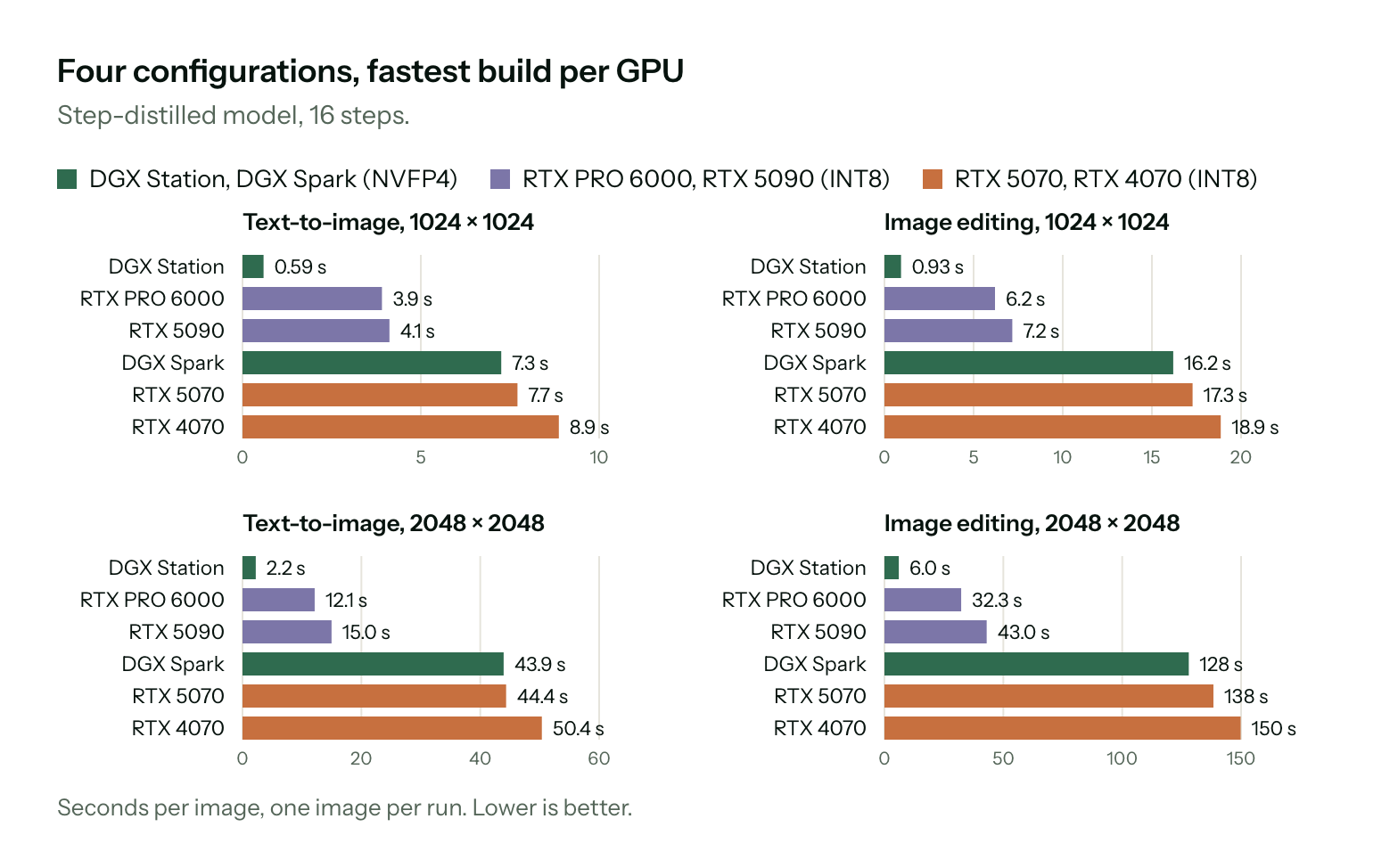
The release has a base model for fine-tuning and a step-distilled model, trained to need fewer generation steps, plus FP8, INT8 and NVFP4 builds made with NVIDIA. With the INT8 build it runs on GeForce RTX GPUs with as little as 8GB of memory, through ComfyUI or Diffusers.
Seconds per image for the step-distilled model on NVIDIA GPUs, measured by NVIDIAImage: Black Forest Labs
The weights use the FLUX Kommunity License, which allows free commercial use for individuals and companies with annual revenue under $5 million; larger organisations need a self-hosted licence or the API. In Black Forest Labs’ API the distilled model is flux-3-image-klein, at $0.009 for a 1K image and $0.036 at 4K.
Sources
PrimaryFLUX 3 Image Kleinbfl.ai · Black Forest Labs announcement, 15 October 2026
OfficialPricingbfl.ai · API prices for FLUX 3 Image Klein by resolution
07ModelOpenAIConfirmed
OpenAI brings GPT-Live-1.1 to ChatGPT Voice with new voices in six languages
The new version of the model behind ChatGPT’s Live voice option promises more natural accents and comes with a smaller Quip version for Free and Go users.
OpenAI began rolling out GPT-Live-1.1 to all ChatGPT users on 15 October 2026, with GPT-Live-1.1 Quip, a smaller version. Together they power Live, the ChatGPT Voice option that can listen and speak at the same time. The update also reaches voice in Codex and in dots, OpenAI’s always-on agents.
OpenAI says the new model has more natural accents across languages; when it launched GPT-Live-1 on 8 July 2026, it said the model could have a non-native accent in some languages. Live also uses a wider range of short phrases while it searches. The new voices, two per language, cover French, German, Hindi, Japanese, Korean and Mexican Spanish, plus an English voice called Bubbie. The choice varies by region and account.
In chats, Live is limited per rolling 24 hours:
Free: limited access to GPT-Live-1.1 Quip
Go: 3 hours with GPT-Live-1.1 Quip
Plus: 3 hours with GPT-Live-1.1
Pro: 15 hours on the $100 plan, unlimited on the $200 plan
Enterprise customers on usage-based pricing pay $0.05 a minute. Live still can’t take video or share a screen; the older Advanced option keeps those on mobile. OpenAI says GPT-Live-1.1 is coming to its API but hasn’t given a date or price.
Sources
PrimaryChatGPT release noteshelp.openai.com · Entry “GPT-Live-1.1 and new voices in ChatGPT”, 15 October 2026
OfficialChatGPT Voicehelp.openai.com · Help article with plans, limits and voices
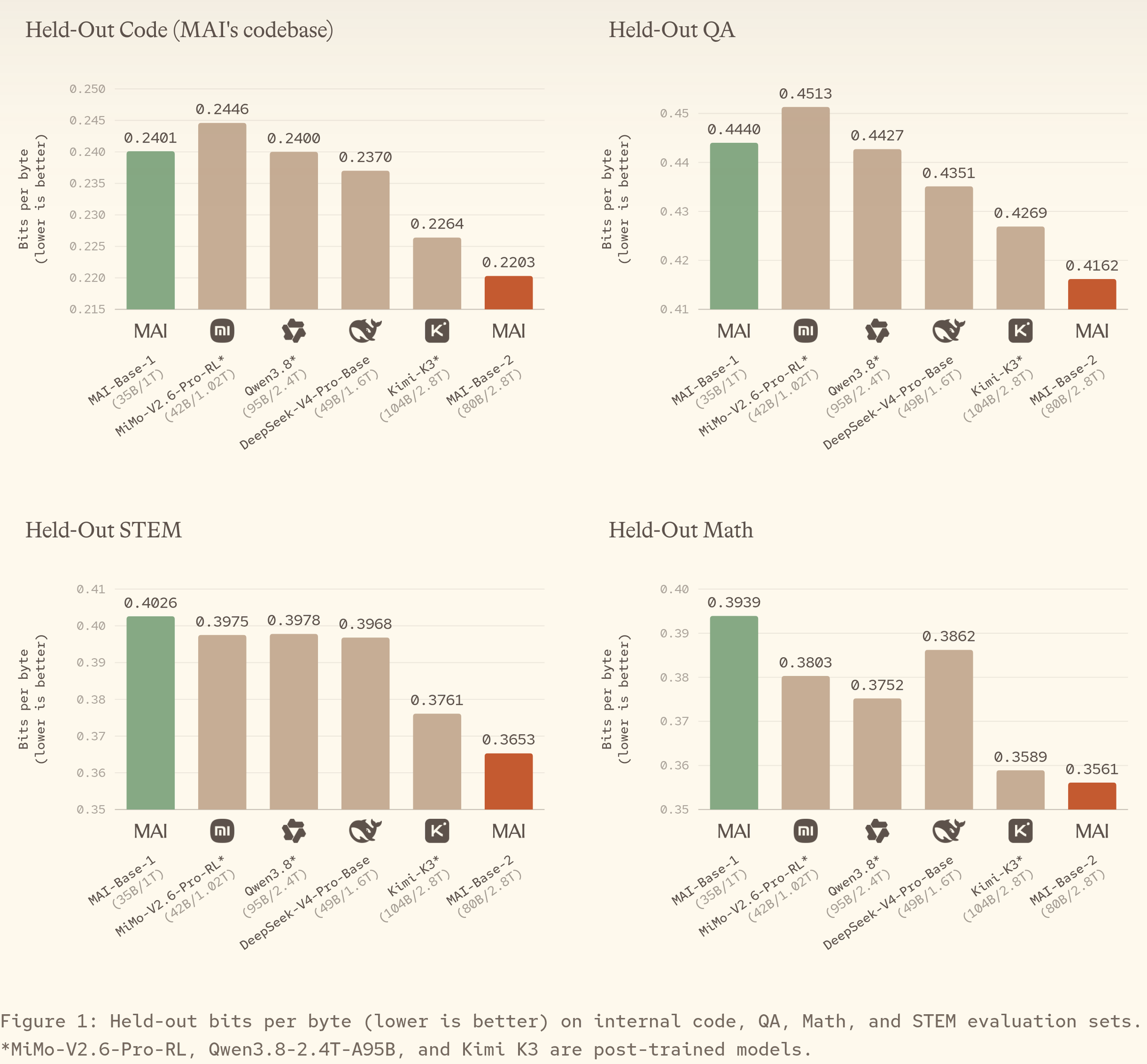
Microsoft AI has finished pre-trainingMAI-Base-2, a mixture-of-experts model with 2.8T parameters, 80B of them active per token. Its predecessor, MAI-Base-1, has 1T parameters with 35B active and underlies MAI-Thinking-1, which the lab announced in June 2026. A base model is the raw result of pre-training, before the post-training that shapes it into a usable assistant.
The lab tested it on held-out code, question answering, STEM and maths sets kept out of its training data, scoring bits per byte, where lower is better. MAI-Base-2 beat DeepSeek-V4-Pro-Base, the strongest open base model, and three post-trained open models, a comparison the lab says post-training may affect.
Figure 1 of the post, held-out bits per byte, where lower is betterImage: Microsoft AI
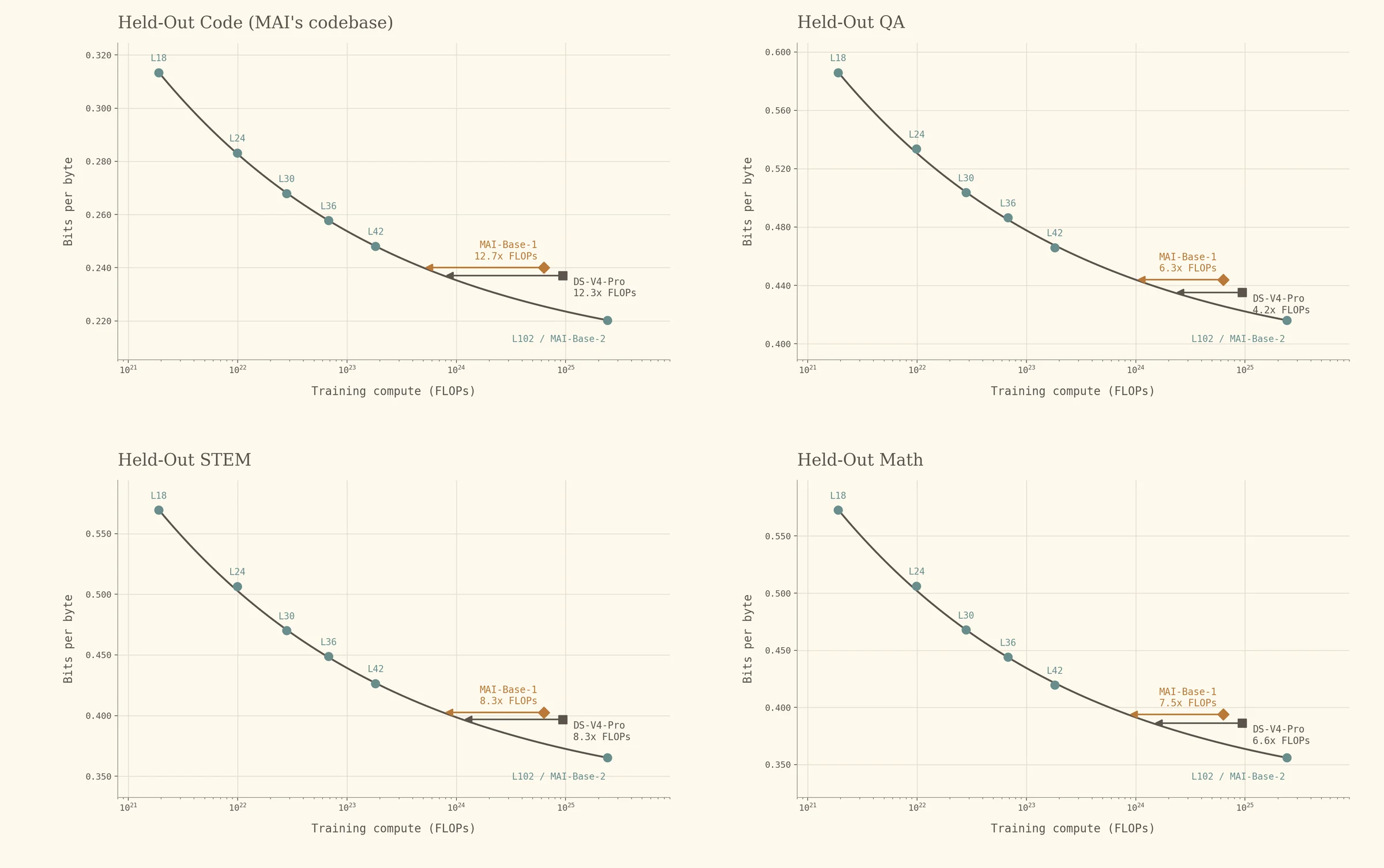
It also estimates that DeepSeek-V4-Pro-Base used 4.2 to 12.3 times the training compute that its own recipe would need for the same scores.
Figure 3 of the post, the compute each model needed against Microsoft AI’s recipeImage: Microsoft AI
Training ran on 16k GB200 GPUs for 38 days in August and September 2026, on a 50T-token mixture with a March 2026 knowledge cutoff. The lab says it used no distillation from other models, and unlike its predecessor, MAI-Base-2 learned from images from the start.
Microsoft AI plans to use the model first in Microsoft’s own products and to license the weights to trusted partners through Foundry. It hasn’t given a release date or price.
Simons Foundation launches a $15 million effort to help mathematicians adapt to AI
The foundation announced the partnership on 15 October 2026 and will award the money itself, partly through an open call for proposals. The work it funds should help researchers check AI-assisted results, learn new tools and set shared standards for AI use. Its president, David Spergel, says mathematicians, rather than any one company or institution, should lead the debate on how the tools are judged and adopted. The announcement doesn’t say when the call opens.
Tesla reveals the new Roadster, with a single-seat version it says can fly
Tesla says the Roadster’s active wings use actuators from its Optimus robot. The two-seat Performance version has a suction system that presses it onto the road. A limited Thrust version adds rear cold-gas thrusters for 0-60 in under 1 second, and the invite-only Rocket version seats one, isn’t approved for public roads and adds what Tesla calls a full flight system. Tesla’s Roadster pages give no price or delivery date.