


ResearchMIT CSAILConfirmed
Story 9 of 12 in the Tuesday 3 November editionMIT CSAIL shows GPT-6 Astra directly reading and editing neural network weights
Published on 2 November 2026, Weight-Space Programming diagnoses a reasoning loop inside Qwen3.5-0.8B and edits 0.016% of its weights without gradients to lift MATH-500 from 7.9% to 48.1%.

 Edited by Ashutosh Shrivastava
4 Nov 2026, 09:30 IST · 2 min read
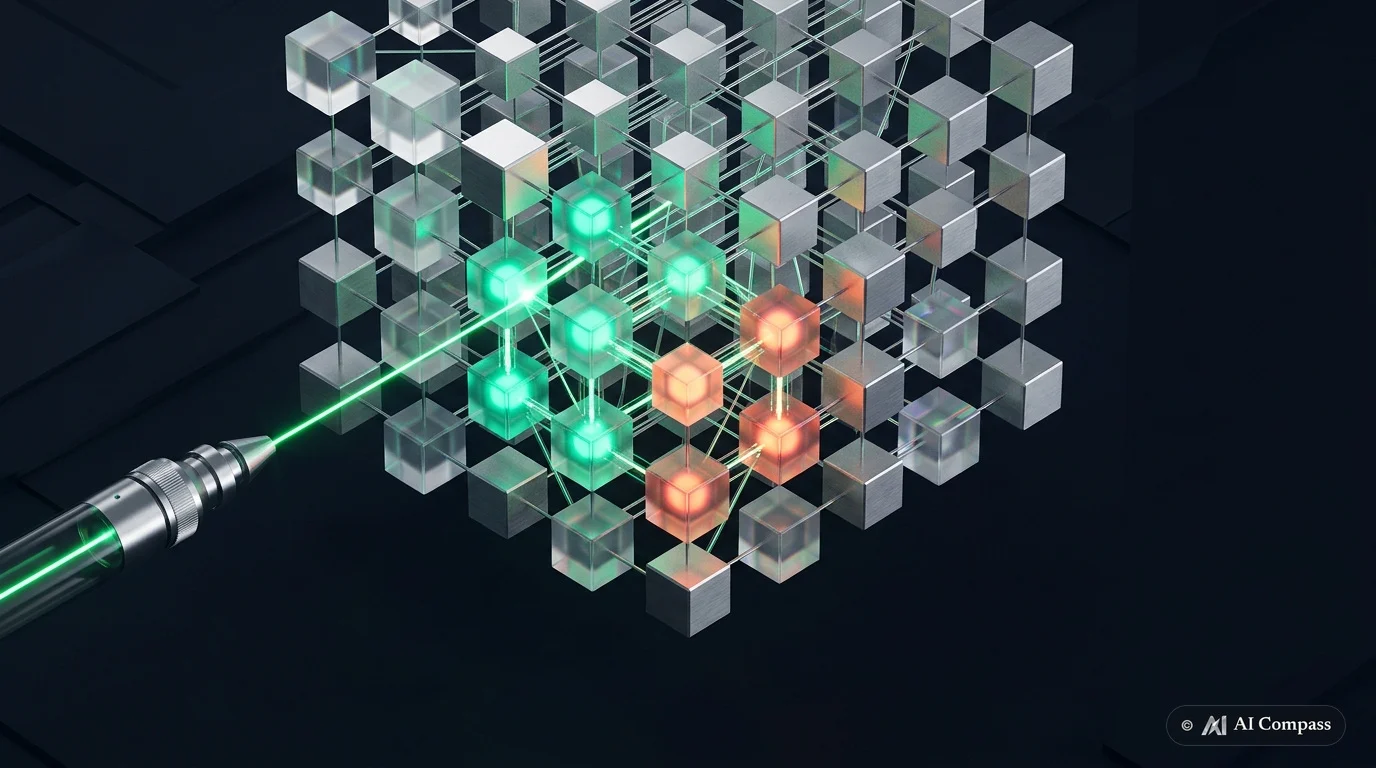
MIT CSAIL researchers Rikiya Takehi, Jayden Teoh, Alex Zhang and Omar Khattab introduced Weight-Space Programming on 2 November 2026, testing whether frontier language models can inspect, synthesise and repair neural networks directly in parameter space without gradient-based training loops.
Reading raw text dumps of 17,253 MLP weights with zero tools, GPT-6 Astra identified all four Atari-style games (Breakout, Pong, Pac-Man and Freeway) that separate policies were trained to play, and recovered language capabilities and induction heads from stripped transformer middle blocks. Asked to write game-playing networks from scratch with no environment rollouts, Astra produced zero-shot MinAtar weights that outscored policies trained with proximal policy optimisation (PPO) for 100 million steps, and fixed a stuck car-on-ramp PPO policy from 0% to 100% success across 1,024 episodes by editing 3.5% of its weights in one shot.
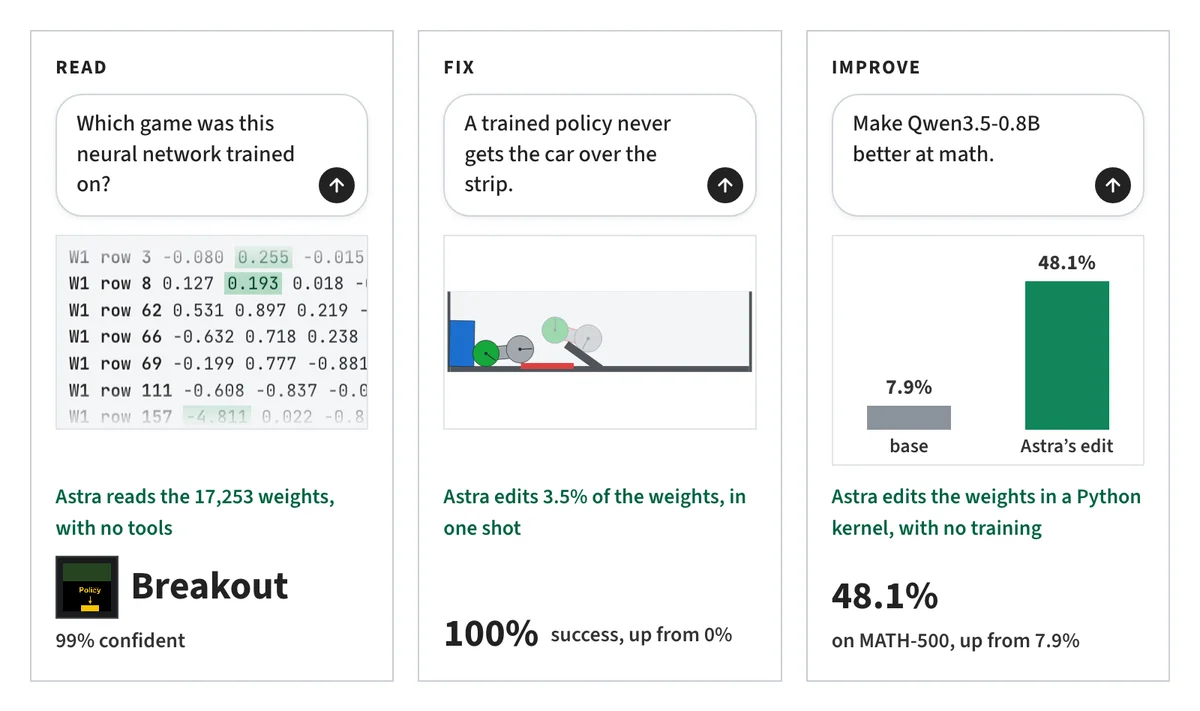
Given a Python kernel and 50 forward passes (no gradients) on Qwen3.5-0.8B, Astra traced repetitive thinking truncations to MLP neurons in layers 15 and 19 and edited 131,072 parameters (0.016% of weights). Under identical sampling settings, MATH-500 rose from 7.9% to 48.1%, GSM8K rose from 13.8% to 67.1% and out-of-distribution instruction following on IFEval climbed roughly 3 times from 21.0% to 62.3%. On Gemma 3 270M, which rarely looped (8.5%), weight edits could not instil absent mathematical knowledge (6.8% to 7.0%). Edited checkpoints and full agent logs are open-sourced on Hugging Face and GitHub.
Sources
- PrimarySparks of Weight-Space Programming: LLMs can natively read & write neural network weightsrikiyat.github.io
- OfficialRikiyaT/lm_understand-logs repository on GitHubgithub.com/RikiyaT
- OfficialRikiyaT/Qwen3.5-0.8B-weight-space-programming on Hugging Facehuggingface.co/RikiyaT
The rest of the day
Read the whole day
01ProductOpenAI
OpenAI details physical hardware engineering with GPT-6 Astra and BenchCAD 2.0
Two OpenAI engineers designed a working handheld Codex voice prototype with GPT-6 Astra in under a week, while an internal model reached 0.875 on BenchCAD 2.0.

02ProductGoogle
Google Labs expands its Dreambeans personalised storytelling app to India
Adults aged 18 and over in India can generate daily visual story cards on Android, iOS and the web across 14 languages using selected Google app context.

03Open sourceSarvam AI
Sarvam AI open-sources Sarvam Prism for 44 ms single-pass enterprise decisions
Built on Sarvam 105B under the Apache 2.0 licence, the calibrated decision model scores candidate options in one forward pass on a single NVIDIA B200 GPU.
04ModelOpenRouter
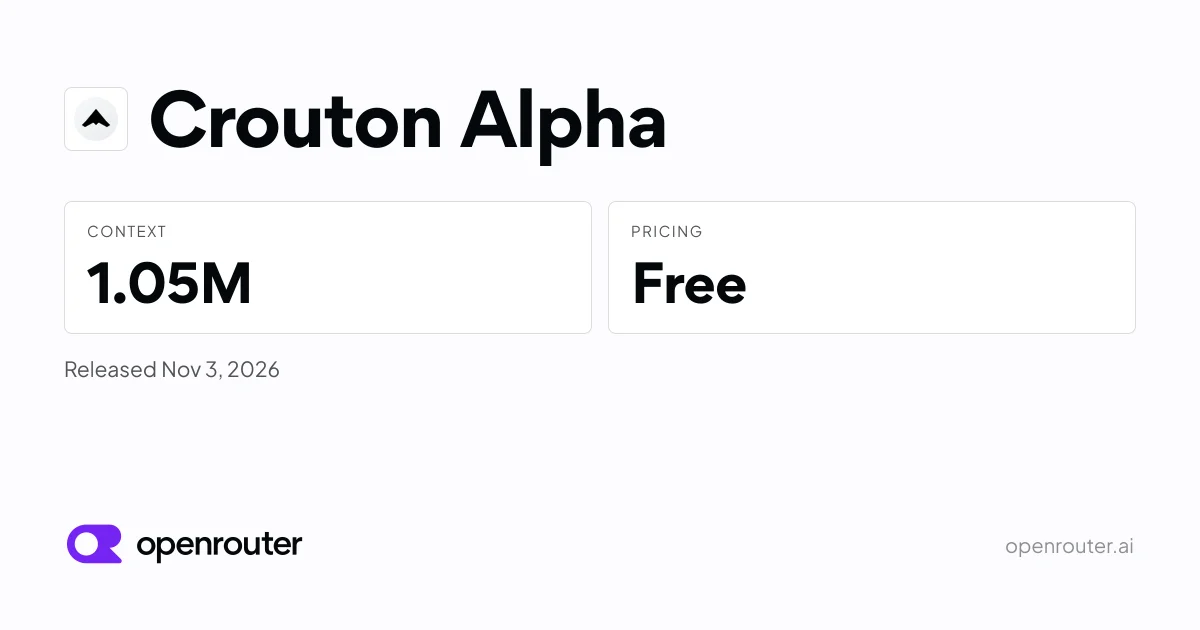
OpenRouter launches free 1M-context multimodal stealth model Crouton Alpha
Released on 3 November 2026 under stealth/crouton-alpha, the undisclosed provider’s reasoning model accepts text, image, audio, video and file inputs with zero prompt logging.
Spotted an error? Email aiforsuccess.in+compass@gmail.com or tag @ai_for_success on X