


ProductMetaConfirmed
Story 5 of 14 in the Thursday 5 November editionMeta rolls out Muse Realtime Voice and expressive Avatars across mobile, web and Mac
Driven by a two-step distilled causal Diffusion Transformer streaming 448x768 video at 25 fps with 870 ms latency, Muse avatars beat Runway and HeyGen in live human trials.

 Edited by Ashutosh Shrivastava
6 Nov 2026, 09:36 IST · 2 min read
Meta began rolling out Muse Realtime Voice and Muse Realtime Avatar on 5 November 2026 inside the Muse app across iOS, Android, web and macOS in the United States, following its September Connect 2026 preview. Users tap the phone icon in the top-right corner of the app to hold interruptible spoken conversations with their personal agent across hundreds of selectable voice styles, switching between audio-only mode, a compact floating avatar or full-screen face-to-face mode. Meta confirmed that voice conversations are also coming to AI Glasses and the Muse Charm wearable.
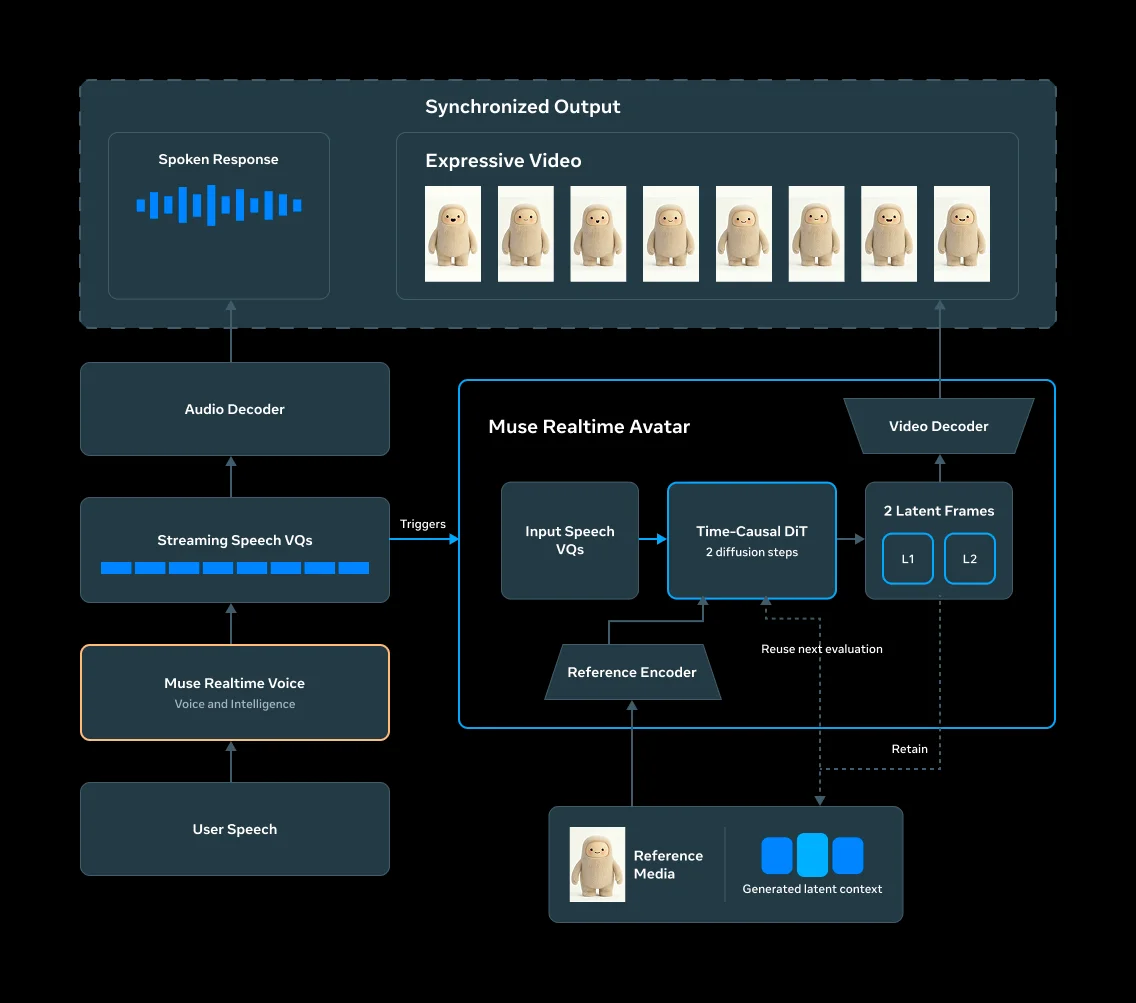
In a companion technical post, Meta detailed how Muse Realtime Voice emits a single stream of vector-quantised (VQ) speech tokens encoding both lexical content and vocal delivery. An audio decoder converts those VQ tokens into speech while Muse Realtime Avatar, an audio-driven, time-causal Diffusion Transformer (DiT), consumes the same stream alongside a reference image and a rolling window of recent video latents to animate photorealistic faces, stylised characters, animals or full-body figures.
Two-step distillation and live human evaluations
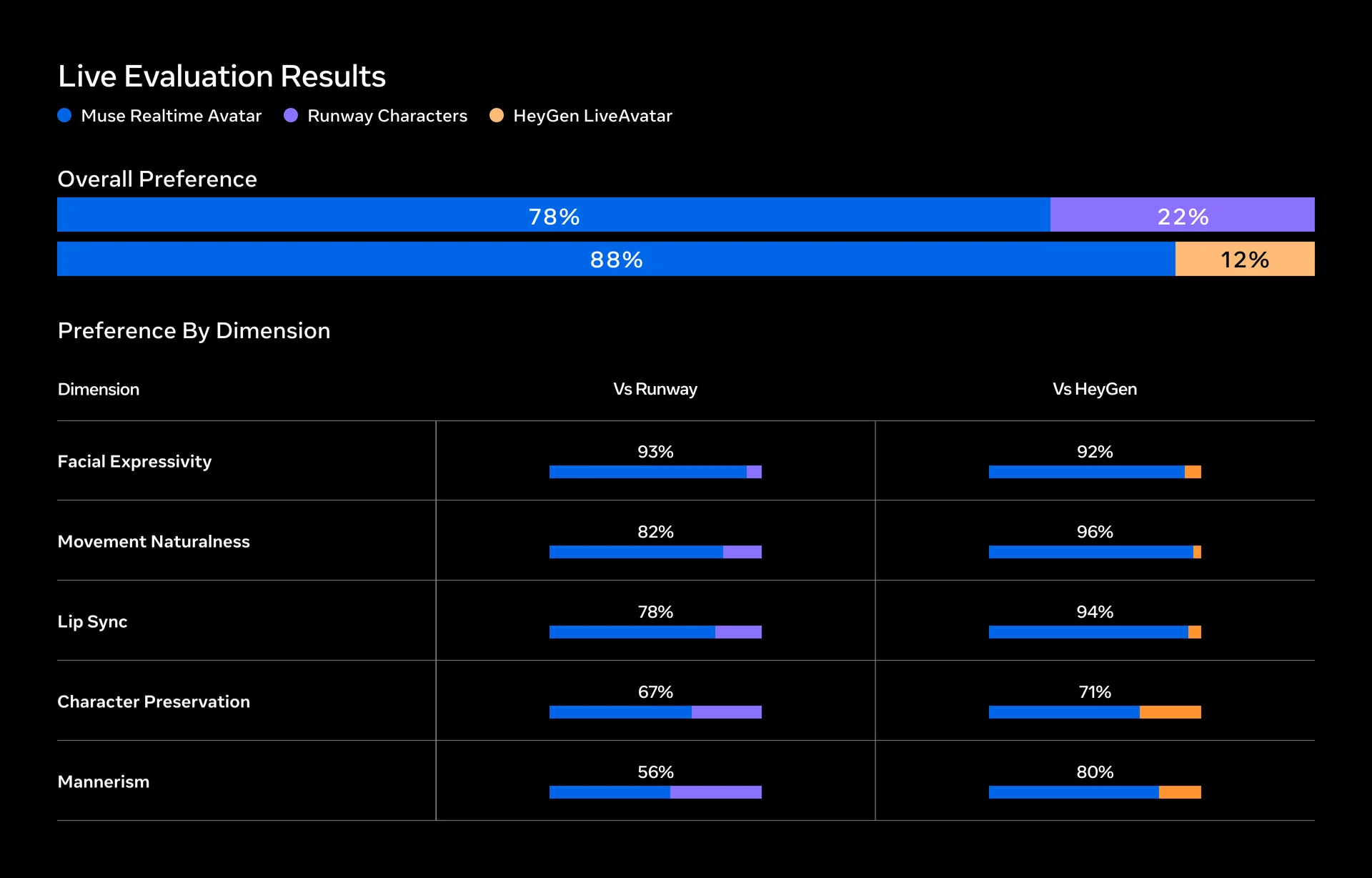
Using self-forcing and distribution-matching distillation with four-bit quantisation-aware training and persistent KV caches, Meta compressed its 40-step, three-way classifier-free-guidance teacher (120 neural function evaluations per chunk) into an unguided two-step causal student, a 60 times reduction that streams 448x768 portrait video at 25 frames per second with roughly 870 ms turn-to-response latency. In blind two- to three-minute live conversations, human raters preferred Muse Realtime Avatar 78% to 22% overall against Runway Characters and 88% to 12% against HeyGen LiveAvatar.
Sources
- PrimaryGive Your Muse a Voiceabout.fb.com
- OfficialBringing Your Muse to Life: Expressive Avatars for Real-Time Conversationresearch.meta.ai
- On XMeta AI announcement on Xx.com
The rest of the day
Read the whole day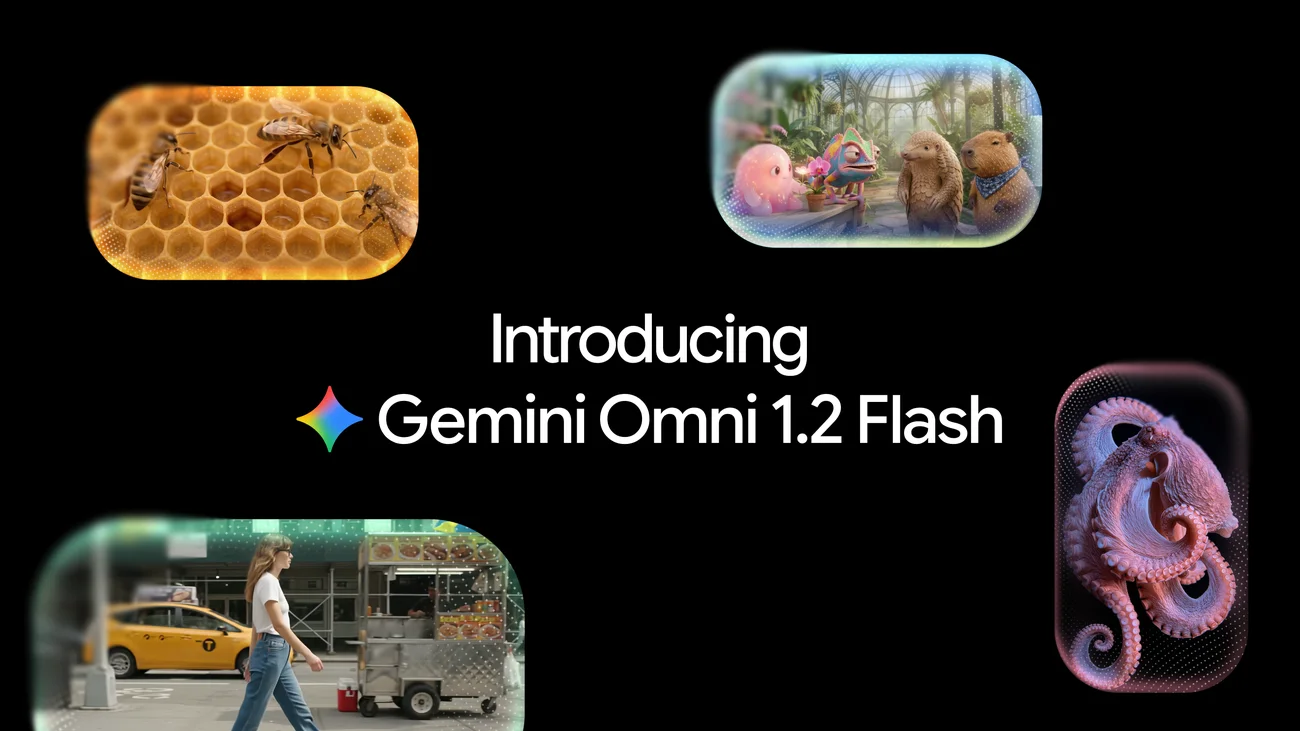
01ModelGoogle
Google launches Gemini Omni 1.2 Flash with 15-second video generation and 30% lower pricing
Generally available across the Gemini API and Google Cloud at $0.07 per second for 720p video, Omni 1.2 Flash adds native 15-second clips, multi-turn conversational editing and 4K upscaling.
02ModelOpenAI
OpenAI introduces GPT-6 Cyber for authorized vulnerability discovery and exploit validation
Rated Critical in cybersecurity under OpenAI’s Preparedness Framework, the Daybreak Red model scores 48.5% on ExploitGym and completed 95% of RemoteExploitBench tasks.
03ModelThinking Machines Lab
Thinking Machines Lab debuts 594B Inkling 2 Small MoE on Tinker with Apache 2.0 weights planned
Activating 17B parameters per token with vision and variable reasoning effort, Inkling 2 Small scores 31 on the AA Intelligence Index and 86.3% on SWEBench Pro v2 Hard.

04ProductAnthropic
Anthropic launches Personal Finance in Claude in US beta with read-only Plaid connections
US subscribers on Pro, Max and Ultra plans can link bank and card accounts via Plaid to query up to two years of transactions, recurring bills and interest charges.
Spotted an error? Email aiforsuccess.in+compass@gmail.com or tag @ai_for_success on X