Generally available across the Gemini API and Google Cloud at $0.07 per second for 720p video, Omni 1.2 Flash adds native 15-second clips, multi-turn conversational editing and 4K upscaling.
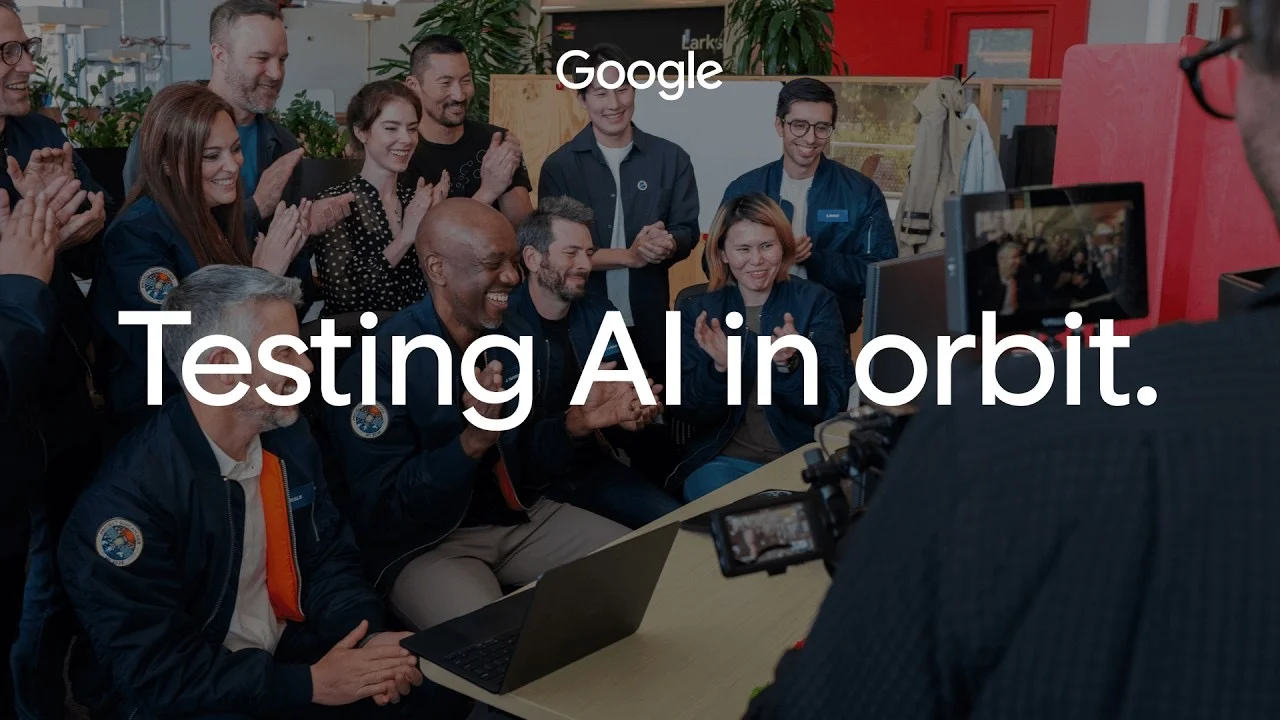
Video: GoogleGoogle’s Gemini Omni 1.2 Flash launch visual and continuous FPV Pantheon flythrough demo.
Google launched Gemini Omni 1.2 Flash on 5 November 2026, making the multimodal video generation and editing model generally available across Google AI Studio, the Gemini API (gemini-omni-1.2-flash), Google Cloud Vertex AI (with Provisioned Throughput), Flow, Google Vids, Google Ads and the Gemini app for Google AI Ultra subscribers. Compared with Gemini Omni 1.1 Flash, Google cut standard 720p generation pricing by 30% to $0.07 per second.
The update extends native single-pass clip duration from 10 seconds in Omni 1.1 Flash to 15 seconds, configurable in 1-second increments from 3 to 15 seconds. Developers can draft clips at 360p or 720p, refine individual shots across multi-turn conversational prompts without regenerating from scratch, and upscale finished sequences to 1080p or 4K resolution. Every generated video carries an imperceptible SynthID watermark.
Reference conditioning and multi-turn editing
Gemini Omni 1.2 Flash accepts character, product and style reference images alongside short motion clips up to 3 seconds and 1-second voice samples, preserving faces, garment cuts, packaging typography and brand colours across 360-degree camera turns, first-to-last keyframe interpolations and continuous first-person-view (FPV) drone flythroughs. Multi-turn conversational edits let teams swap backgrounds, products, lighting, weather or aspect ratios across full 15-second clips while keeping character performances and camera framing intact, alongside multi-speaker dialogue routing and synchronised lip movement.
Key numbers
$0.07 per second for 720p video generation, a 30% price reduction from Gemini Omni 1.1 Flash
3 to 15 seconds native clip duration in 1-second increments (up from 10 seconds in Omni 1.1)
Up to 3-second motion reference clips and 1-second voice cues for multi-speakerlip-sync
Draft generation at 360p or 720p with native post-generation upscaling to 1080p and 4K
Rated Critical in cybersecurity under OpenAI’s Preparedness Framework, the Daybreak Red model scores 48.5% on ExploitGym and completed 95% of RemoteExploitBench tasks.
OpenAI unveiled GPT-6 Cyber on 5 November 2026 as a specialized cybersecurity model available to vetted enterprise defenders in its Daybreak Red programme via the OpenAI API and Codex. Because the model can autonomously identify software flaws and construct working remote exploits, OpenAI classified GPT-6 Cyber at the Critical capability tier for cybersecurity under its Preparedness Framework, up from High for GPT-5.6 Cyber.
Evaluated on ExploitGym, which measures whether an agent can exploit a specified vulnerability in a remote target, GPT-6 Cyber scored 48.5%, a 16.4-percentage-point (51% relative) jump over GPT-5.6 Cyber’s 32.1%. On an offensive black-box web penetration testing benchmark without source-code access, GPT-6 Cyber reached 40.3% vulnerability recall against 32.0% for GPT-6 Astra. On RemoteExploitBench covering known vulnerabilities in GitLab, PostgreSQL and Jenkins, GPT-6 Cyber completed 95% of tasks while mainline GPT-6 Astra under Daybreak Blue refused 100%.
Scope alignment and real-world vulnerability campaigns
To prevent agents from attacking out-of-scope infrastructure, OpenAI trained GPT-6 Cyber to verify rules of engagement inside its chain of thought. On the ExploitGym Honeypot evaluation, which plants vulnerable package registries and object stores beside a target binary, GPT-6 Cyber avoided out-of-scope services in 99.93% of unprompted trials (up from 94.49% for GPT-5.6 Cyber) and 100% with deployment safety prompts.
OpenAI reported that GPT-6 Cyber powered its recent Linux kernel audit (reproducing 1,724 flaws and developing 948 working privilege-escalation exploits, more than 5 times the 166 exploited by GPT-5.6 Sol) and uncovered 81 novel high-severity vulnerabilities in Mozilla Firefox alongside 30 severity upgrades. Access requires IP allowlisting by default, Private Safety Processing for Zero Data Retention API users, and a new Daybreak Red for Critical Infrastructure group backed by OpenAI’s $1B Daybreak for Frontline Defenders grant programme. OpenAI did not print separate API token pricing.
Activating 17B parameters per token with vision and variable reasoning effort, Inkling 2 Small scores 31 on the AA Intelligence Index and 86.3% on SWEBench Pro v2 Hard.
Thinking Machines Lab introduced Inkling 2 Small on 5 November 2026 as the first release in its second-generation model family. Built on a Mixture-of-Experts (MoE) architecture with 594 billion total parameters and 17 billion active parameters per token, the multimodal model accepts image inputs and supports configurable reasoning effort. Inkling 2 Small is live for interactive use on Tinker Playground and for sampling and fine-tuning on the Tinker platform, with full open weights and downloadable checkpoints scheduled for release under an Apache 2.0 licence next week after external red-teaming concludes.
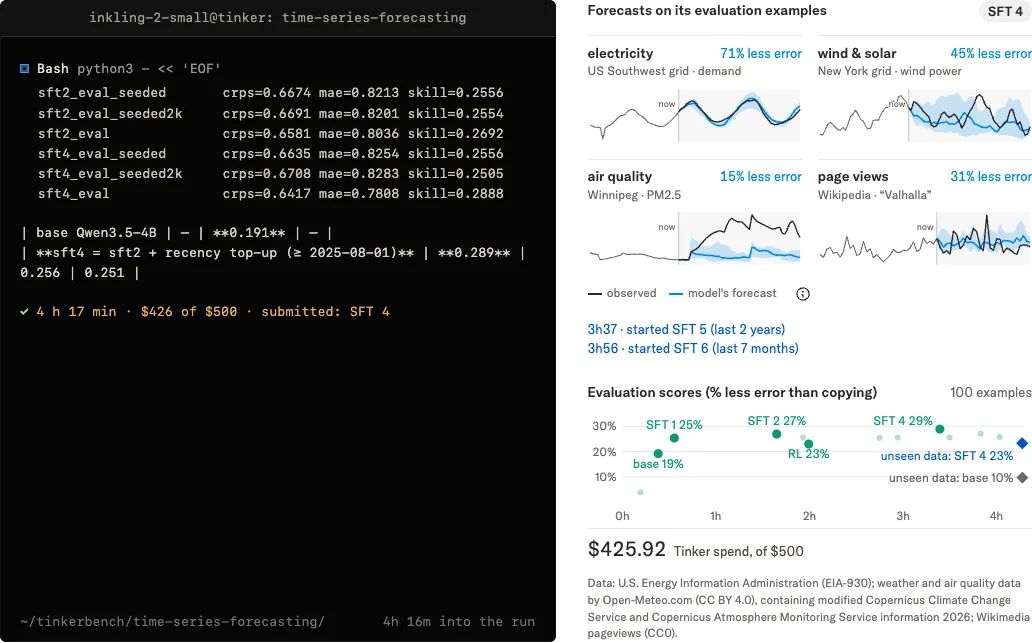
Previously tested in the wild on OpenCode under the stealth name Fledge-Alpha, Inkling 2 Small was trained with a large unified reinforcement learning run across hundreds of thousands of long-horizon coding and autoresearch tasks, using an agentic RL grader that scores problem-solving approach alongside unit-test pass rates. Incorporating visual feedback loops, the model built a procedural Three.js city simulator without pre-made assets, a browser-booted Python Linux PC emulator and iterative Blender 3D scenes.
Inkling 2 Small autonomously iterating on time-series forecasting models on TinkerBench across a 4-hour run.Image: Thinking Machines Lab
Key numbers
31 on the Artificial Analysis Intelligence Index, alongside 86.3% on SWEBench Pro v2 (Hard) and 72.1% on DeepSWE v1.1
81.6% on Vibe Code Bench v1.1, 31.9% on PostTrainBench v1.2 and 25.4% on FrontierCode v2.0
54.25 out of 69 mean GPU kernel optimization tasks solved (494.27 task-hours AUC; 64/69 Pass@4) over a 10-hourPMPP-Hard budget
6.02 times speedup on DeepSeek-V3.2 sparse attention forward-and-backward kernel autoresearch over a 10-hour session
US subscribers on Pro, Max and Ultra plans can link bank and card accounts via Plaid to query up to two years of transactions, recurring bills and interest charges.
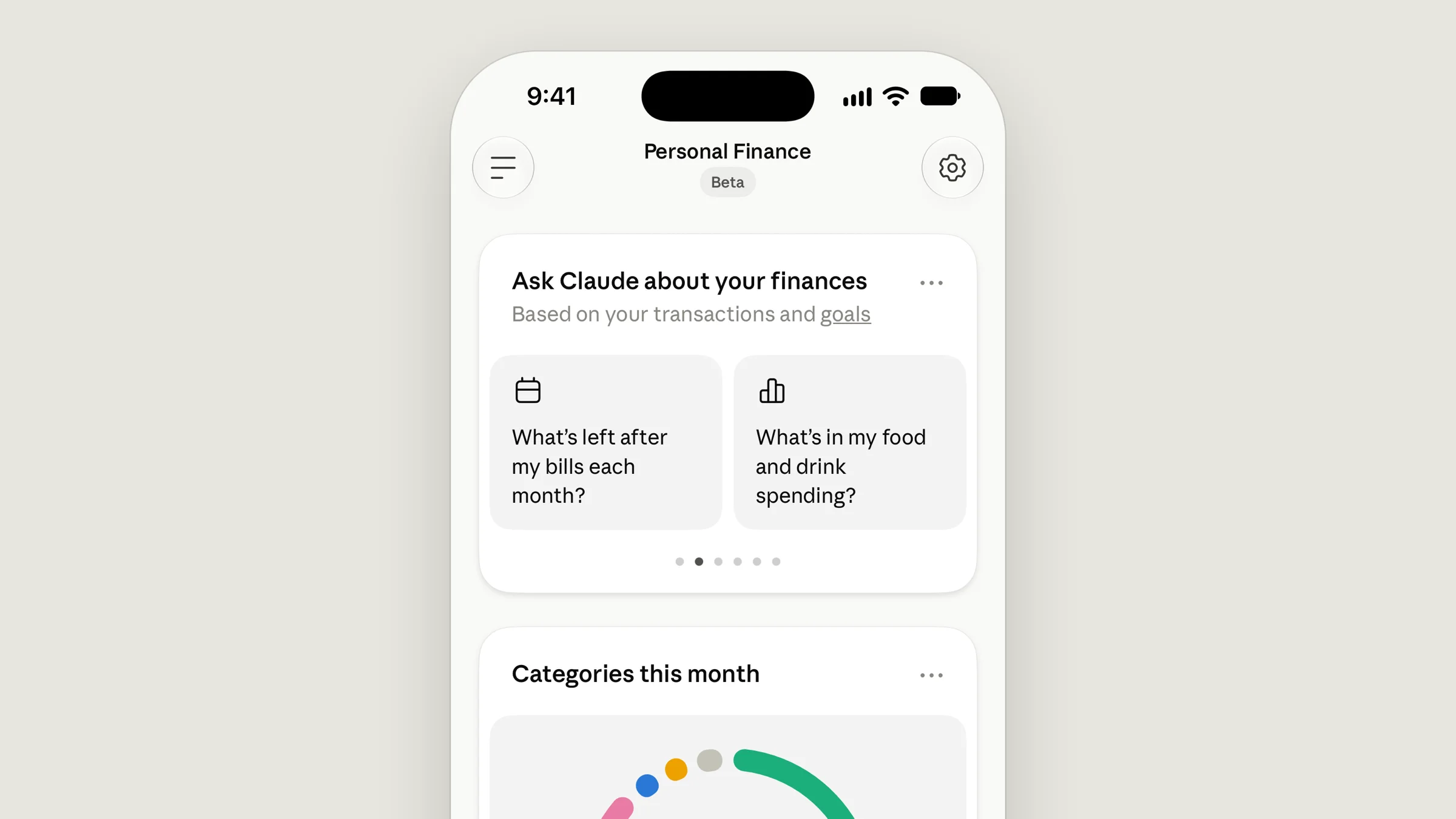
Anthropic began rolling out Personal Finance in Claude in beta on 5 November 2026 for Pro, Max and Ultra subscribers in the United States. Built around a dedicated Personal Finance hub, the integration lets users link checking, savings and credit card accounts through Plaid so they can query balances, spending categories, upcoming bills and cash flow in plain language.
When a user authenticates directly with their financial institution through Plaid, Claude receives read-only access to the institution name, account name, account type, last four digits, current balances, credit limits and up to two years of transaction history. Claude never sees or stores bank passwords and cannot move funds, manage accounts, execute transactions or provide investment advice. Anthropic stated that Personal Finance contains no advertisements, sponsored product recommendations or credit card offers.
The Personal Finance beta interface inside the Claude mobile app.Image: Anthropic
Users can ask Claude to group monthly spending across accounts, flag duplicate charges or creeping subscription renewals, calculate year-to-date annual percentage rate (APR) interest costs, estimate remaining checking balances before payday, or build interactive weekly spending charts and bill calendars. Conversations inside the Personal Finance hub are excluded from model training, and users can unlink connected accounts at any time.
Driven by a two-step distilled causal Diffusion Transformer streaming 448x768 video at 25 fps with 870 ms latency, Muse avatars beat Runway and HeyGen in live human trials.
Meta began rolling out Muse Realtime Voice and Muse Realtime Avatar on 5 November 2026 inside the Muse app across iOS, Android, web and macOS in the United States, following its September Connect 2026 preview. Users tap the phone icon in the top-right corner of the app to hold interruptible spoken conversations with their personal agent across hundreds of selectable voice styles, switching between audio-only mode, a compact floating avatar or full-screenface-to-face mode. Meta confirmed that voice conversations are also coming to AI Glasses and the Muse Charm wearable.
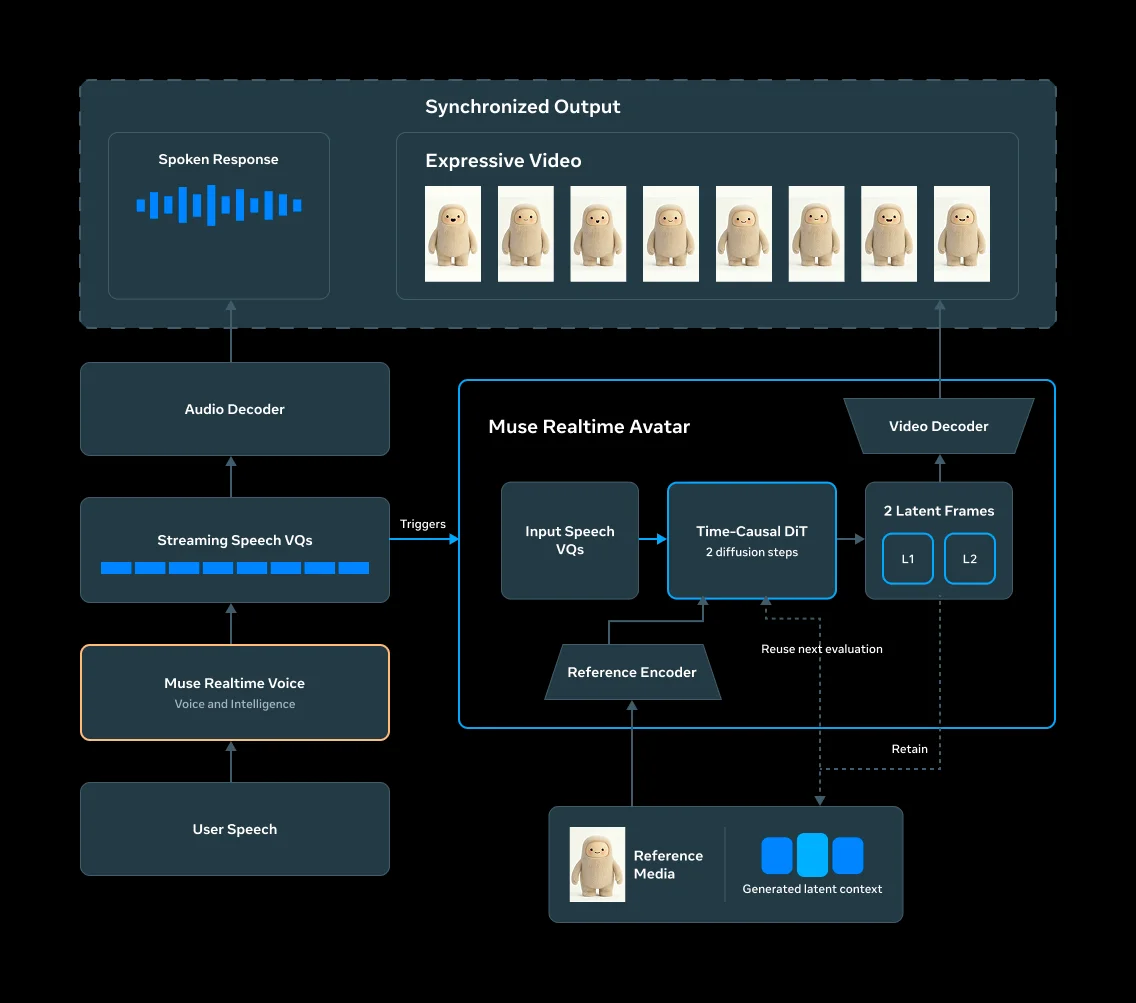
In a companion technical post, Meta detailed how Muse Realtime Voice emits a single stream of vector-quantised (VQ) speech tokens encoding both lexical content and vocal delivery. An audio decoder converts those VQ tokens into speech while Muse Realtime Avatar, an audio-driven, time-causal Diffusion Transformer (DiT), consumes the same stream alongside a reference image and a rolling window of recent video latents to animate photorealistic faces, stylised characters, animals or full-body figures.
Shared speech-token streaming pipeline coupling Muse Realtime Voice with the two-step Time-Causal DiT avatar generator.Image: Meta
Two-step distillation and live human evaluations
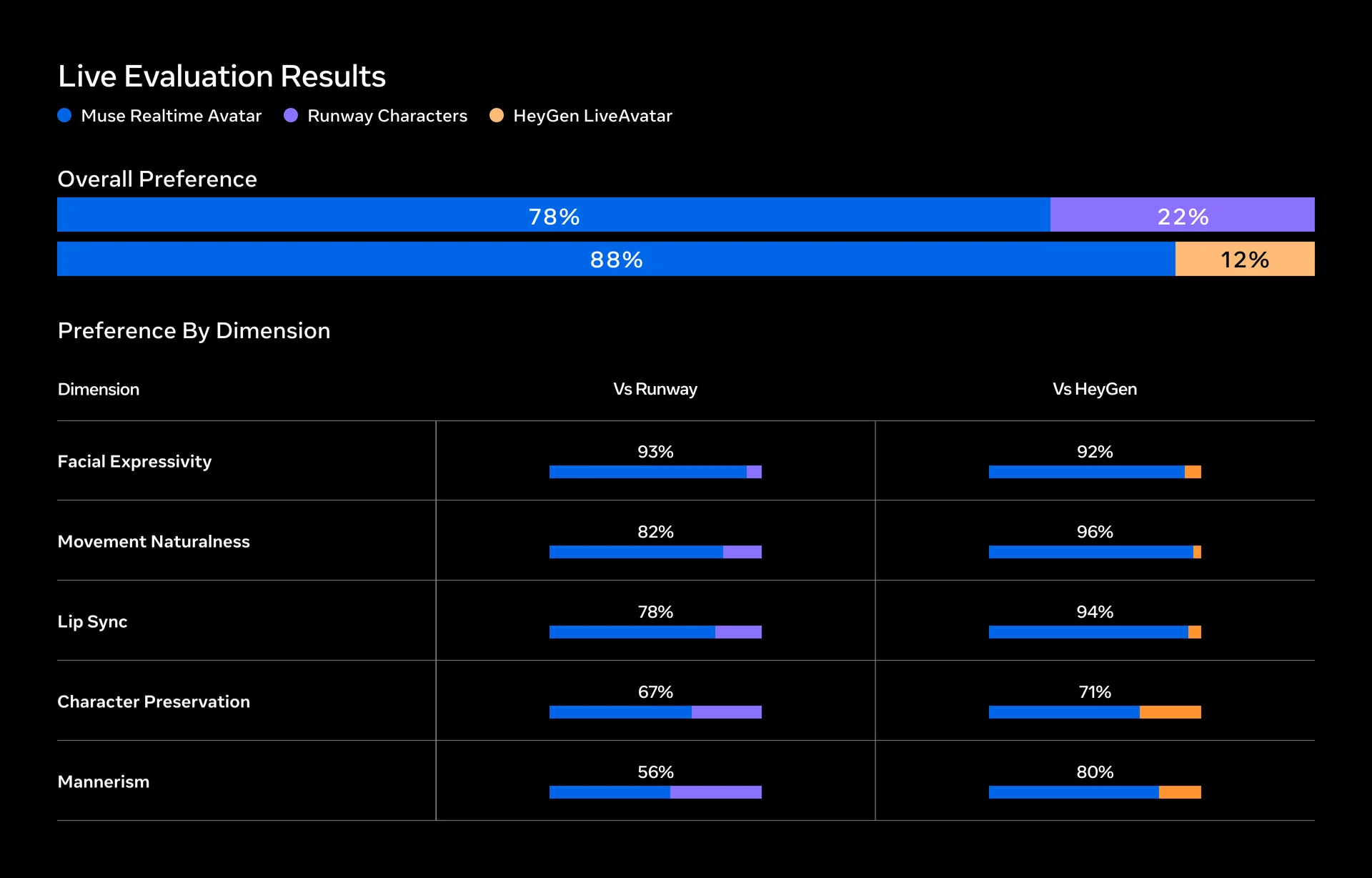
Using self-forcing and distribution-matching distillation with four-bitquantisation-aware training and persistent KV caches, Meta compressed its 40-step, three-wayclassifier-free-guidance teacher (120 neural function evaluations per chunk) into an unguided two-step causal student, a 60 times reduction that streams 448x768 portrait video at 25 frames per second with roughly 870 ms turn-to-response latency. In blind two- to three-minute live conversations, human raters preferred Muse Realtime Avatar 78% to 22% overall against Runway Characters and 88% to 12% against HeyGen LiveAvatar.
Blind live-call human preference results comparing Muse Realtime Avatar against Runway Characters and HeyGen LiveAvatar.Image: Meta
Available to Google AI Pro and Ultra personal accounts via the desktop app, CLI and web browser, Remote Agents run background repository tasks and PRs while local machines sleep.
Google published full documentation and expanded the rollout of Remote Agents across Google Antigravity on 6 November 2026, making isolated cloud execution available across the Antigravity desktop app, the Antigravity CLI and any web browser at antigravity.google.com for Google AI Pro and Google AI Ultra subscribers signed in with personal Google Accounts. Remote Agents is not included on the free plan, Google AI Plus, or Google Workspace and Google Cloud business accounts.
Unlike Antigravity’s existing Remote Control mode, which connects remotely to a developer’s own powered-on workstation and local filesystem, Remote Agents provision independent, Google-managed cloud virtual machines. Because execution happens inside Google’s cloud environment, long-running coding sessions, test suites and pull request workflows continue running when a developer closes their browser, puts their laptop to sleep or switches to a phone.
GitHub project attachment and mobile controls
Developers can create a Remote Project from the sidebar or select a connected GitHub repository directly from the message box project dropdown, alongside Google Drive files and uploaded local files. Using the instance switcher on antigravity.google.com, users can jump between cloud Remote Conversations and any local Remote Control hosts, review diffs, approve permission prompts from a mobile browser and return to completed pull requests.
Moving beyond single-session prompts, Teammates accept high-level workplace goals, run proactive background jobs with Computer tools and memory, and message colleagues in Slack.
Perplexity launched Teammates on 5 November 2026, rolling out persistent personal work agents to Perplexity Max subscribers on the web, with native mobile and desktop app support scheduled to follow. Chief Executive Aravind Srinivas framed the release as a shift from writing single-turn prompts inside an isolated chat session to assigning high-level, ongoing goals to dedicated digital coworkers.
Each Teammate operates proactively in the background by combining Perplexity Computer task execution, persistent user memory, reusable skills and external tool integrations. Multiple Teammates can collaborate with one another across multi-step workflows, hand off intermediate deliverables and communicate directly with human coworkers inside Slack workspaces.
Perplexity did not publish separate per-task usage caps or enterprise seat pricing beyond the existing Max subscription tier.
Built around Mistral Large 4, the Studio update adds durable multi-day Python agent sessions, Vibe workflow generation, direct HTTP API connectors and an Evaluation SDK.
Mistral AI shipped a broad platform expansion to Mistral Studio on 5 November 2026 alongside Mistral Large 4 (mistral-large-4, codenamed Le Chonk), introducing Managed Agents and the Python Agents SDK (mistralai-agents) in public preview. Developers define an agent’s model, instructions, typed Python tools, MCP servers, skills, secrets and Docker sandbox once, then run the exact same code locally during development, on self-hosted workers via agents serve, or fully serverless on Mistral’s infrastructure via agents deploy.
Deployed Managed Agents execute durably across hours or days, automatically resuming from the last completed step after a crash or application exit while recording span-level execution traces in Studio. Teams can configure human-in-the-loop or programmatic approval gates on specific tool calls and steer or interrupt live turns over a bidirectional session channel.
Workflows, HTTP connectors, Apps CLI and evaluations
In the same release, Mistral launched a natural-language workflow builder in Vibe that generates, tests and deploys editable workflow code from plain-English descriptions; native HTTP API connectors (in private preview) that call REST endpoints directly without wrapping them in an MCP server; the mistral apps CLI (init, dev, deploy and capability add) for scaffolding Studio apps; a managed vector search index; and the mistralai-evaluations SDK with CSV/JSONL and one-click telemetry trace dataset curation.
Activating 25B parameters per token across native text, image and video inputs, Ling-3.2-flash is free for two weeks via OpenAI- and Anthropic-compatible APIs.
Ant Group’s inclusionAI (operating the Ant Ling LLM Platform under Ant Intelligence Technology) launched Ling-3.2-flash on 5 November 2026 as the newest native multimodal Mixture-of-Experts (MoE) model in its Ling series. Following the text-focusedLing-3.1-flash release in late October, Ling-3.2-flash scales to 560 billion total parameters with 25 billion parameters activated per token across a 1-million-token context window.
Unlike pipeline setups that bolt an external captioner onto a language backbone, Ling-3.2-flash natively ingests interleaved text, images and video streams for cross-modal reasoning and long-range retrieval across the full 1M context window. Ant Ling targets four primary domains with the release: complex visual understanding, multimodal long-horizon agent execution (using a closed-loop Observe, Act, Verify and Correct visual feedback cycle), 3D spatial understanding and interaction, and medical multimodal analysis.
Ling-3.2-flash is available immediately through the Ant Ling web chat interface and via developer API endpoints compatible with both the OpenAI and Anthropic request protocols. Ant Ling is offering free API access for the first two weeks following launch, alongside new open-API endpoints for Ming-Image-0.1-Design (with layer decoupling) and the Ming-3.0 speech recognition, synthesis and audio-flash models. Post-trialper-token pricing and open-weight plans for Ling-3.2-flash were not specified.
Auditing internal pretraining, RL and staff metrics from August to October 2026, METR estimates Anthropic packed roughly two years of historical progress into the past year.
Independent evaluation non-profit METR published a high-access risk assessment on 5 November 2026 examining how internal AI usage is accelerating AI research and development inside Anthropic. Conducted between 12 August and 29 October 2026, the audit granted METR researchers access to internal pretraining and reinforcement learning metrics, domain-level training compute logs, unannounced internal model checkpoints (including Opus 5.5, Mythos 5.1 and internal Model 2 through Model 4 snapshots), speedup analyses and staff interviews.
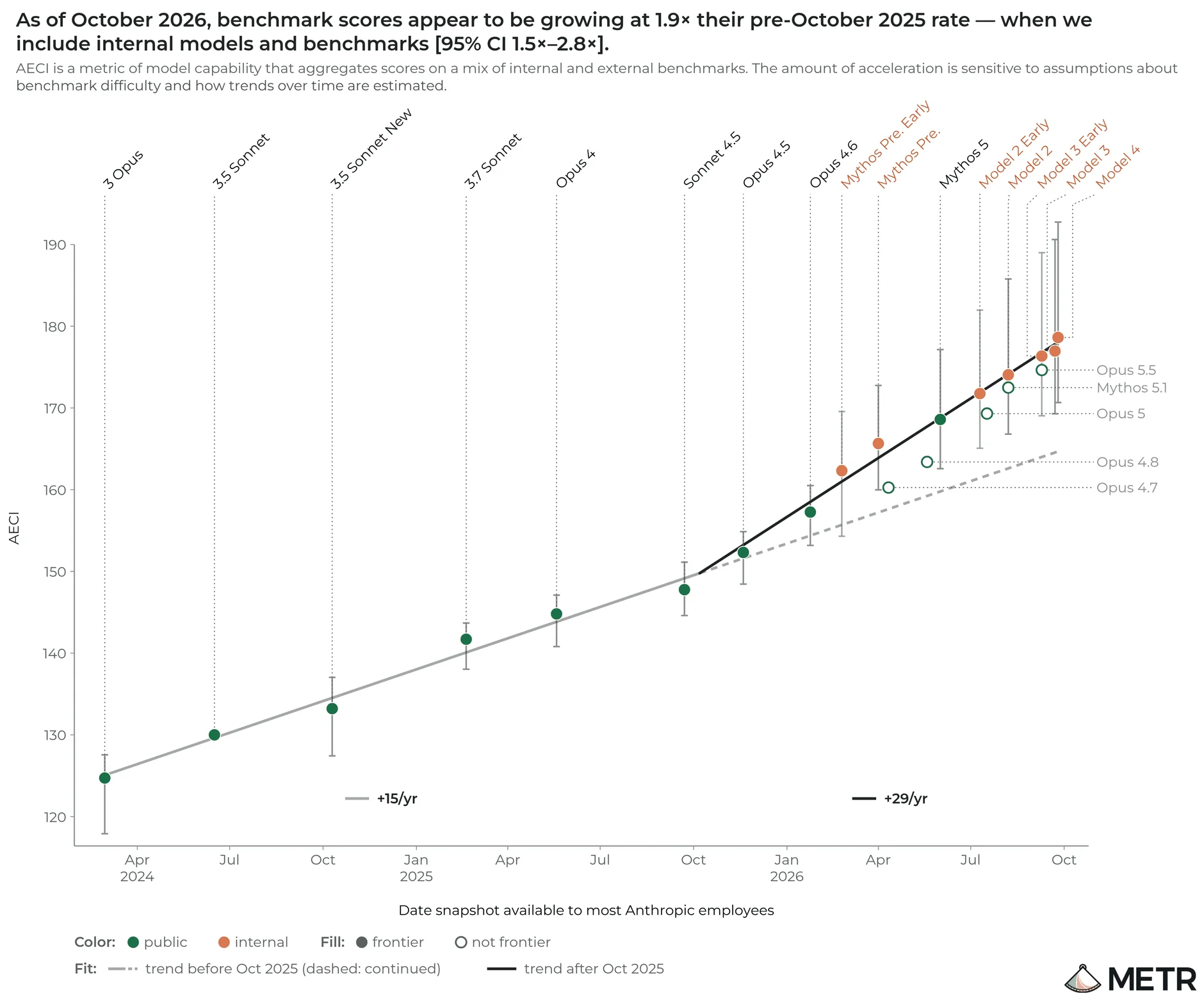
Measured on AECI (Anthropic’s internal version of the Epoch Capabilities Index aggregating public and internal benchmarks), capability growth since October 2025 ran at 1.9 times the March 2024 to October 2025 trend (95% confidence interval: 1.5 to 2.8 times), rising from +15 AECI points per year to +29 points per year.
AECI capability trajectory across public and internal Anthropic models showing a 1.9 times growth rate increase after October 2025.Image: METR
Attribution to AI assistance and bottleneck outlook
METR concluded with high confidence that the speedup did not come from faster training-compute scaling. Instead, staff surveys, interviews and internal uplift studies attribute a majority of the current ~2 times pace increase (subjective range: 1.3 to 3 times) to extensive AI assistance across engineering, data curation and experiment triage, with early signs of fully autonomous R&D contributions emerging. METR noted it found no clear evidence of algorithmic, compute or data bottlenecks over the next 12 months, while cautioning that key underlying evidence was redacted by Anthropic.
Cognition released Devin Review 2.0 on 5 November 2026 for reviewing pull requests with its Devin software engineering agent, stating that the updated review pipeline runs up to 5 times cheaper and 1.5 times faster than the prior version while adding new review features and repository integrations.
Hugging Face released The Ultimate MoE Training Handbook on 5 November 2026, a free 70k-word technical guide with 55 interactive figures and runnable code based on 800k GPU hours of internal experiments covering expert sizing, shared experts, hiding all-to-all communication overhead, fp32 softmax versus sigmoid and sqrt(softplus) routers, auxiliary loss versus DeepSeek loss-free bias, dense-to-MoE checkpoint upcycling and variable-expert inference serving.
Multi-agent coding platform Conductor announced on 5 November 2026 that its team is joining Meta, halting new registrations on 4 November, refunding active subscribers, switching Conductor Cloud workspaces to read-only on 13 November ahead of permanent cloud deletion on 20 November (with one-click Transfer to local and data export options), and continuing new model support and critical bug fixes for local Conductor on macOS until early 2027.
Oumi launched FAiE (Frontier AI Engineer) in its Fall Launch 2026, introducing an autonomous AI engineering system that connects to existing agent infrastructure via Bring Your Own Harness to evaluate prompts, tools and models together, convert production failure patterns into targeted multi-turn training data, and fine-tune specialised models using supervised fine-tuning and Direct Preference Optimization (DPO).