


Open sourceHugging FaceConfirmed
Story 10 of 18 in the Tuesday 17 November editionHugging Face releases Qwen3.8-27B-pi-adapted RL LoRA harness adapter
Open-weight TRL adapter from harness-hub on the Hugging Face Hub uses safeagents rule checks to lift SWE-bench Pro Hard 51 pass@1 from 29.4% to 62.7% on 17 November 2026.

 Edited by Ashutosh Shrivastava
18 Nov 2026, 09:45 IST · 2 min read
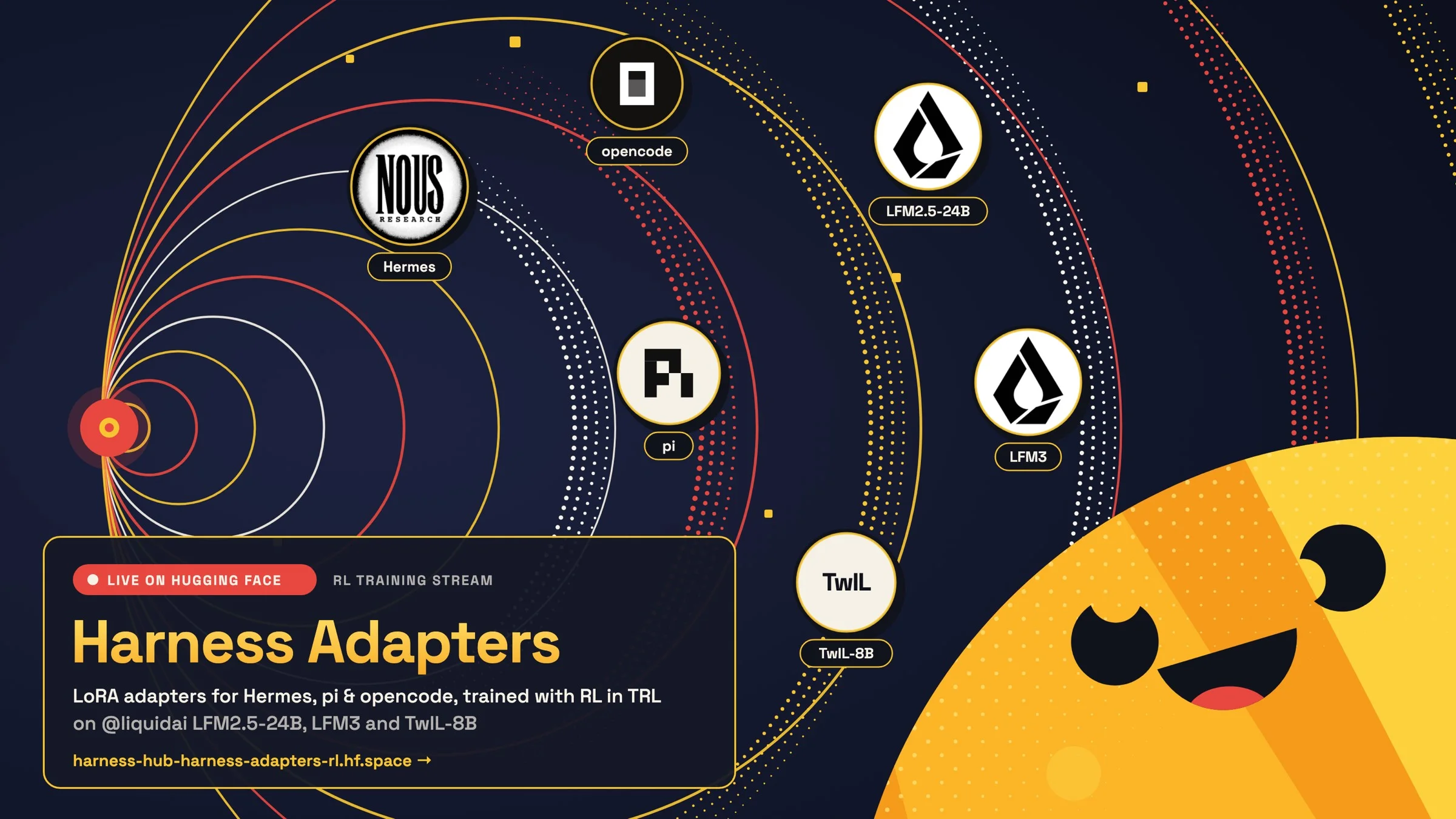
Hugging Face’s harness-hub team released open-weight Qwen3.8-27B-pi-adapted and its safe reinforcement learning methodology on 17 November 2026, training lightweight per-harness LoRA adapters directly inside unmodified local coding harnesses including pi, opencode and hermes. Building on earlier LFM2.5-24B-A2B, LFM3-1.7B and TwIL-8B runs alongside Hub OpenRouter inference routing, one shared base server can host adapters for multiple agent harnesses simultaneously.
Repo2RLEnvs trajectory tasks, safeagents proxy and pi coding benchmarks
Training mixes SmolDataEnvs with Repo2RLEnvs, which converts open-source coding sessions shared on the Hugging Face Hub into verifiable build-heavy RL environments. Every tool call passes through safeagents, a deterministic rule-based proxy running in 10 to 20 ms that blocks reward-hacking shortcuts and assigns violating rollouts a zero score.
Served over the openai-completions endpoint via vLLM, Transformers or llama.cpp, Qwen3.8-27B-pi-adapted raised pass@1 on SWE-bench Pro (Hard 51) from 29.4% to 62.7% and on Terminal-Bench 2.1 from 39.5% to 55.8%, while cutting tool calls per task by 55% to 62%.
Technical details
- Released model repo
- harness-hub/Qwen3.8-27B-pi-adapted (open-weight RL LoRA adapter for the pi coding agent)
- Benchmark gains (pass@1)
- SWE-bench Pro (Hard 51) 29.4% to 62.7%; Terminal-Bench 2.1 39.5% to 55.8%; 55% to 62% fewer tool calls
- RL environment and safety stack
- Repo2RLEnvs + SmolDataEnvs in TRL; safeagents rule-based tool proxy (10-20 ms per check)
- Serving engines and protocol
- Transformers, vLLM, llama.cpp and macOS Llama.app using api set to openai-completions
Release details & context
Why openai-completions configuration and micro-batch packing matter
On the model card, harness-hub notes that pi users must configure their local provider with api set to openai-completions rather than the default Responses API format, because Qwen3.8-27B-pi-adapted was trained and evaluated exclusively against Chat Completions tool formatting.
During TRL training, finished agent trajectories pack into four micro-batches up to 131,072 tokens for 24B-class runs and 65,536 tokens for 8B-class runs, enabling even non-agent reasoning checkpoints such as TwIL-8B to acquire multi-step tool habits without modifying the surrounding CLI harness.
Common questions
Why must pi users set api to openai-completions when running Qwen3.8-27B-pi-adapted?
Without setting api to openai-completions, the pi coding agent defaults to the Responses API schema, which this LoRA adapter was neither trained nor evaluated against.
Sources
- PrimaryHugging Face Blog: Harness adapters: Safe RL for efficient agentic developmenthuggingface.co/blog
- Officialharness-hub/Qwen3.8-27B-pi-adapted on Hugging Facehuggingface.co/harness-hub
- On XClément Delangue (@ClementDelangue) Qwen3.8-27B-pi-adapted thread on Xx.com
Hugging Face release timeline (4 launches tracked)
- Hugging Face releases Carbon-X, a 14.8B DNA-and-English language model
Hugging Face Biology Research released Carbon-X (HuggingFaceBio/Carbon-X), a 14.8B DNA model averaging 66.7% across five benchmarks vs 67.5% for GPT-6.1 Sol.
- Hugging Face publishes open-source Mixture-of-Experts training guide based on 800k GPU hours
Hugging Face published The Ultimate MoE Training Handbook, a 70k-word open guide with 55 interactive figures distilling 800k GPU hours of MoE experiments.
- Hugging Face routes Hub open-model inference through OpenRouter
Hugging Face switches Hub chat-model Inference Providers to OpenRouter across 80+ hosts with automatic failover, zero markup and Bucket traces.