Released alongside a base checkpoint with a 512k-token context window, the 33B open-weight model serves as the teacher agent for Nanbeige’s upcoming small-model distillation pipeline.
Nanbeige LLM Lab has released Nanbeige4.3-33B and its pretrained base checkpoint, Nanbeige4.3-33B-Base, on Hugging Face under an Apache 2.0 licence. Designed as the flagship 33B teacher model for the Nanbeige4.3 series, the release anchors the lab’s distillation pipeline for upcoming smaller models such as Nanbeige4.3-3B. The model supports a 524,288-token (512k) context window across English and Chinese, uses a configurable chat template with thinking enabled by default, retains prior reasoning turns when preserve_thinking is set to true for multi-turn coding and office workflows, and prefers XML-formatted tool calls alongside JSON compatibility. It runs on Hugging Face Transformers, SGLang and vLLM with four-way tensor parallelism using the Qwen3 reasoning and coder tool parsers.
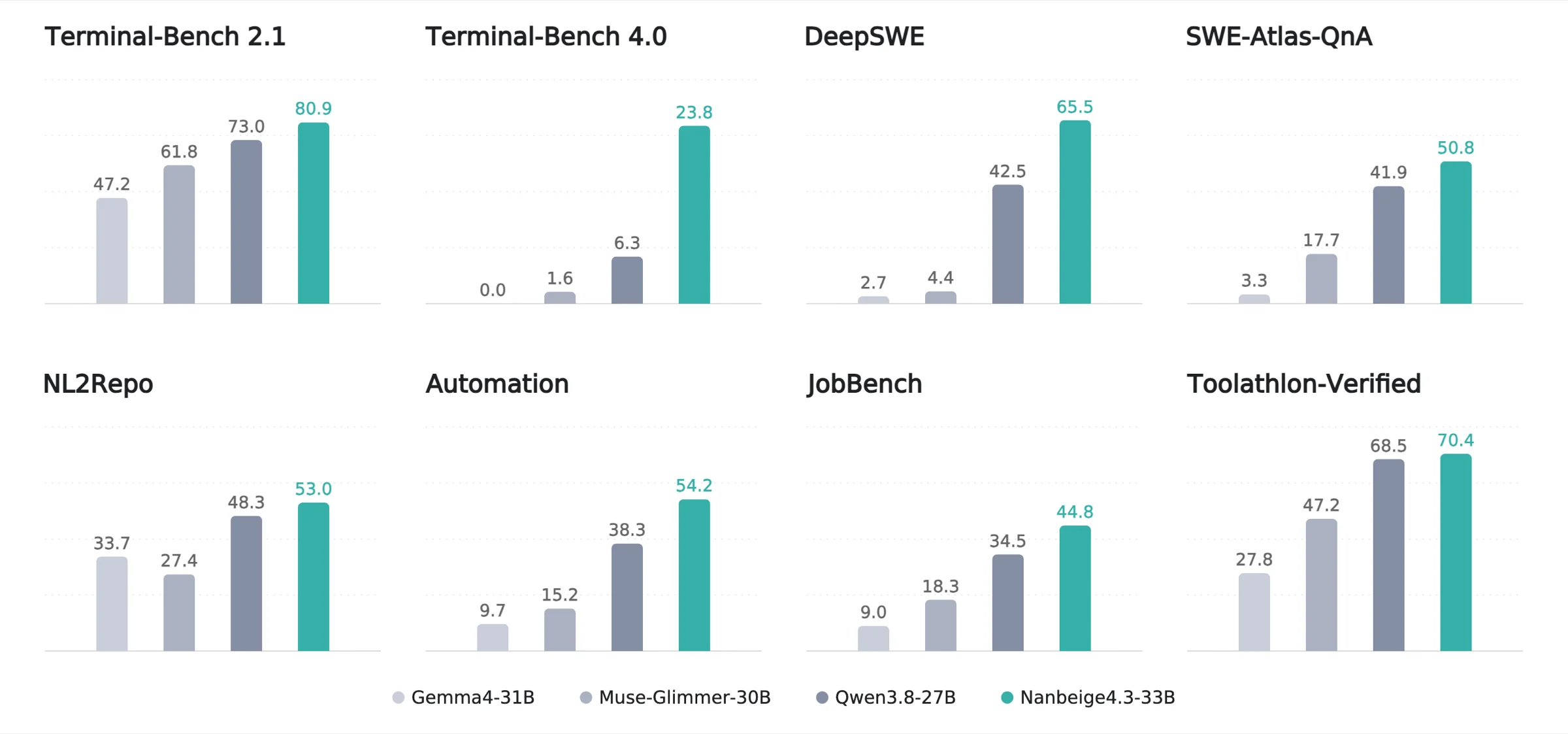
Evaluated at maximum thinking effort with preserve_thinking enabled against 30B-scale open models, Nanbeige4.3-33B leads on 17 of 20 reported coding, cowork and reasoning benchmarks, trailing Qwen3.8-27B slightly on SWE-Bench Pro (60.3 to 61.7) and GDPval (84.8 to 86.4), and Gemma4-31B on GPQA Diamond (89.5 to 91.3). The model card’s summary chart and table differ slightly on two rival scores, listing Gemma4-31B at 33.7 in the chart versus 33.8 in the table on NL2Repo, and Muse-Glimmer-30B at 18.3 in the chart versus 16.6 in the table on JobBench.
Evaluated at maximum thinking effort, Nanbeige4.3-33B leads 30B-class peers across eight coding and cowork benchmarks.Image: Nanbeige LLM Lab
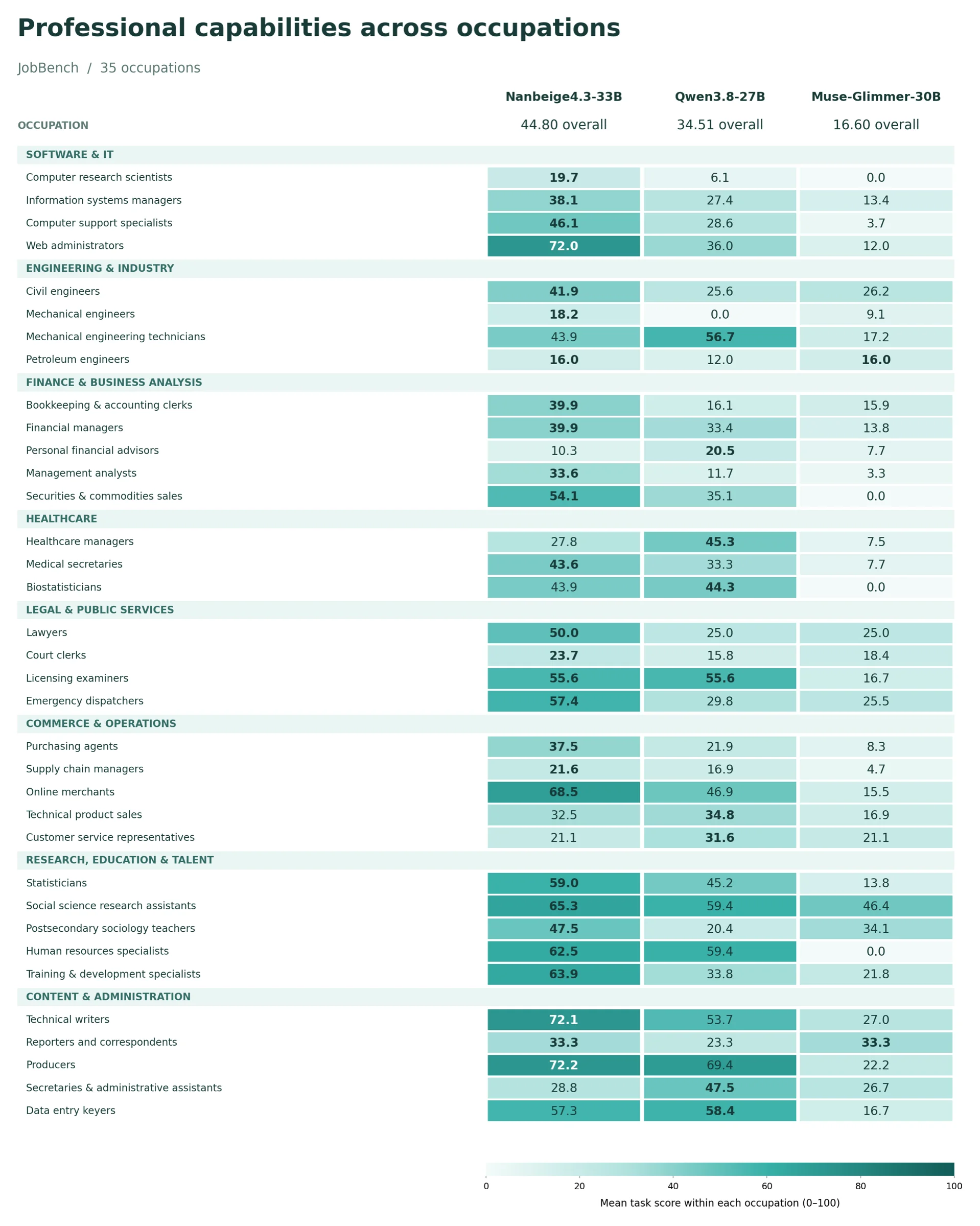
Using the Claude Code harness equipped with a search tool across 35 professional occupations on JobBench, Nanbeige4.3-33B outperforms Qwen3.8-27B and Muse-Glimmer-30B in 29 of the 35 categories, led by producers, technical writers and web administrators.
Mean task scores across 35 JobBench occupations, where Nanbeige4.3-33B averages 44.80 overall compared with 34.51 for Qwen3.8-27B.Image: Nanbeige LLM Lab
Key numbers
Context window: 524,288 tokens (512k), with 65,536 max new tokens recommended for agentic tasks and 262,144 for reasoning
YC-bench: $1,025,437 across 10-turn dialogue history, compared with $641,290 for Qwen3.8-27B
Reasoning benchmarks: 95.2 on AIME 2026 and 84.0 on AA-LCR, ahead of Qwen3.8-27B (94.5 and 82.0)
Licence: Apache 2.0 for both Nanbeige4.3-33B and Nanbeige4.3-33B-Base on Hugging Face
Announced on 21 October 2026 on the Hugging Face blog, the free library provides physics-validated OpenUSD models of robot arms, grippers, appliances and data-centre cooling gear for Isaac Sim and AI factory digital twins.
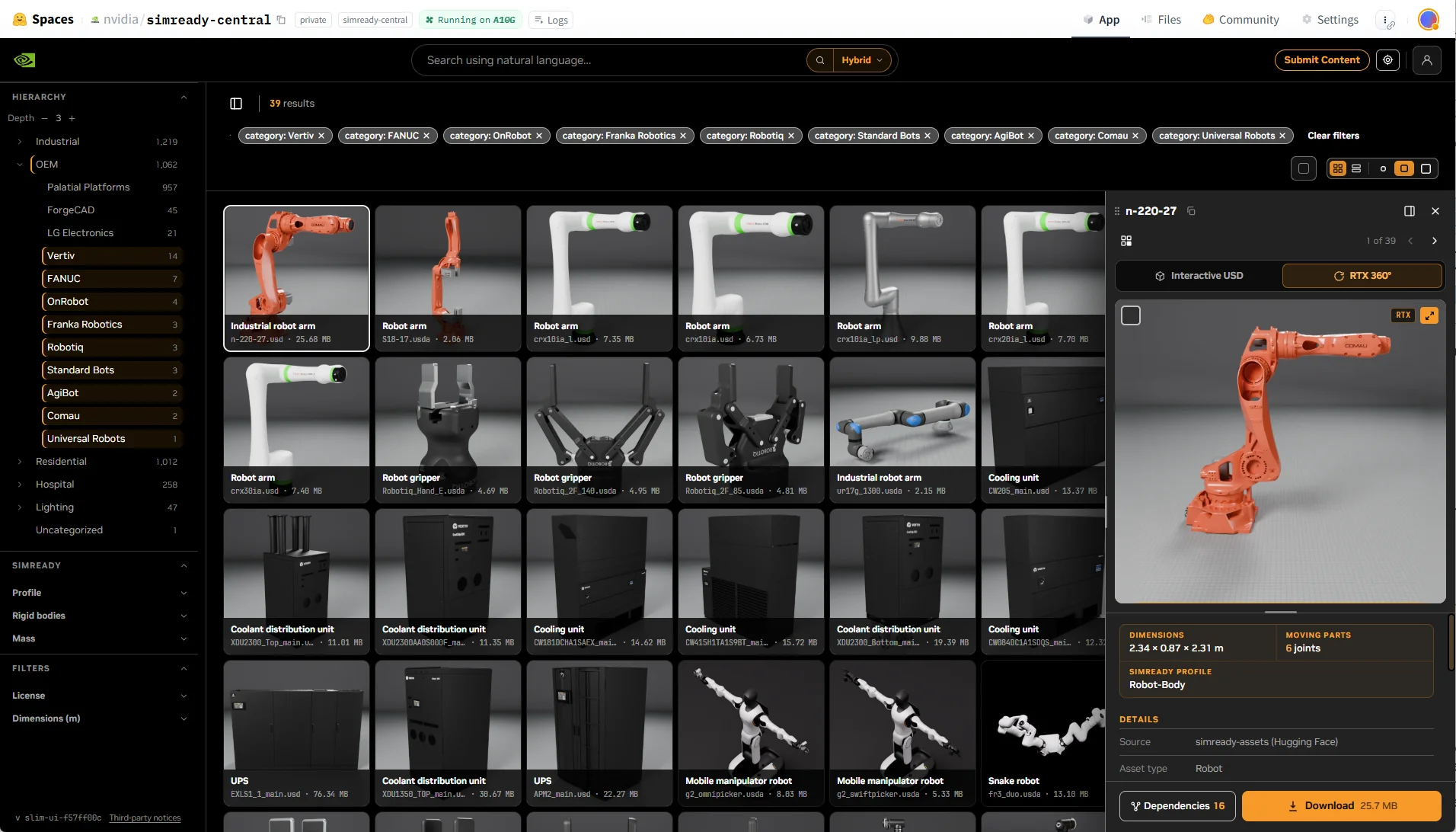
NVIDIA and Hugging Face have launched the SimReady Central Library on Hugging Face, an open, ungated collection of more than 2,000 simulation-ready (SimReady) OpenUSD 3D assets, including 2,575 USD assets in the companion nvidia/simready-assets dataset. Standard 3D CAD models show geometry alone, requiring engineers to manually add physical properties before running a simulation. SimReady assets come pre-configured against SimReady Foundation specifications and profiles with mass, collision geometry and friction properties for robotic manipulation, or electrical and thermal metadata for industrial facilities.
Equipment manufacturers and simulation providers use NVIDIA’s CAD-to-SimReady and submission skills to validate models against these profiles and host them in their own Hugging Face datasets. Participating contributors include robotics makers Comau, FANUC, Franka Robotics, Robotiq, Standard Bots and Universal Robots; data-centre infrastructure supplier Vertiv; home appliance and robotics maker LG Electronics; and simulation asset providers Palatial, which contributes the NVIDIA Robotics 1K Dataset, and ForgeCAD.
Natural-language discovery across the library is powered by NVIDIA USD Search, which runs on an RTX PRO 6000 Hugging Face Space and indexes USD properties directly inside Hugging Face search. Developers and coding agents such as GPT-6 Astra can query the search endpoint to assemble pick-and-place warehouse cells in NVIDIA Isaac Sim and Isaac Lab or generate alternative AI factory layouts that automatically verify equipment overlaps and aisle clearances.
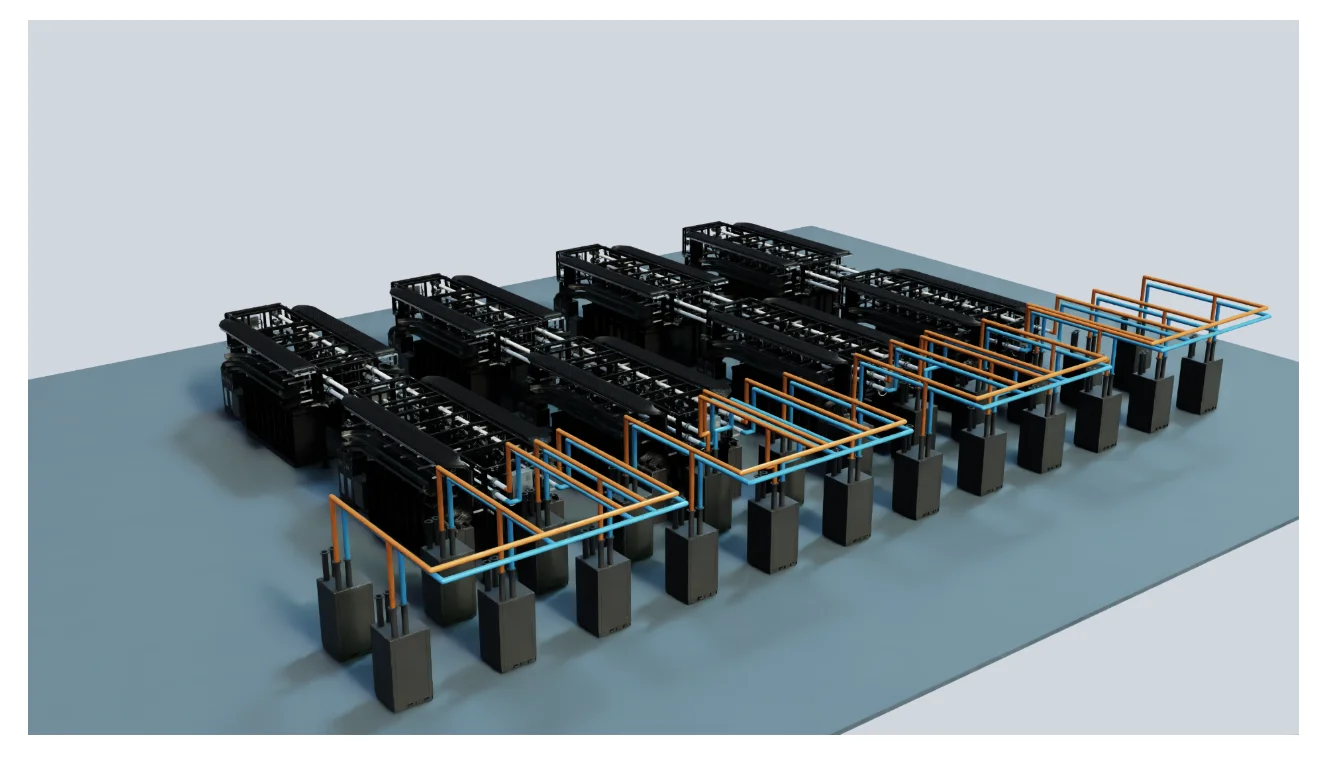
An AI factory layout assembled in OpenUSD from SimReady server racks and cooling units for clearance checks.Image: NVIDIA