Google Cloud customers can now access the full Anthropic-managed Claude Platform, including Managed Agents, Agent Skills and zero-day model launches, while authenticating with Google Cloud IAM and retiring Google Cloud spend commitments.
Anthropic and Google Cloud have made Claude Models on Google Cloud (Anthropic managed) generally available on Google Cloud Marketplace following a private preview. The offering sits alongside Claude on Vertex AI as a second deployment path: Google Cloud handles procurement, identity and billing, while requests run directly on Anthropic’s first-party Claude Platform (platform.claude.com).
How the integration works
Organisations subscribe to the listing in Google Cloud Marketplace, enable the service (aws-external-anthropic.googleapis.com) inside a Google Cloud project and grant IAM roles such as roles/anthropic.PlatformAdmin or roles/anthropic.ApiUser. Workloads authenticate with Google Cloud Application Default Credentials, workload identity federation or service account keys rather than separate Anthropic API keys, and requests pass through a Google Cloud proxy to Anthropic’s backend.
Usage appears on the customer’s consolidated Google Cloud invoice and retires existing Google Cloud spend commitments under standard Marketplace mechanics. Workspaces created through Google Cloud support both global and US-only data residency configurations.
Platform features included
Because requests run on Anthropic’s managed platform rather than a cloud-hosted model port, teams receive zero-day access to new Anthropic models and harness capabilities as soon as they launch on the Claude API:
Models: Claude Opus 5.5, Claude Sonnet 5.5 and Claude Haiku 4.5.
Agent infrastructure: Claude Managed Agents, Agent Skills, the Model Context Protocol (MCP) connector, code execution, memory and context compaction.
Cost and throughput controls: Prompt Caching, Batch Processing and the Files API.
Neither Anthropic nor Google Cloud announced separate price markups beyond standard Claude Platform token rates billed through Google Cloud Marketplace.
Published on the Google AI Studio blog on 19 October 2026 and shared on 22 October 2026, the single-binary Rust tool gives coding agents and developers progressive terminal access to Gemini text, image, video, audio, embedding and research APIs without MCP schema overhead.
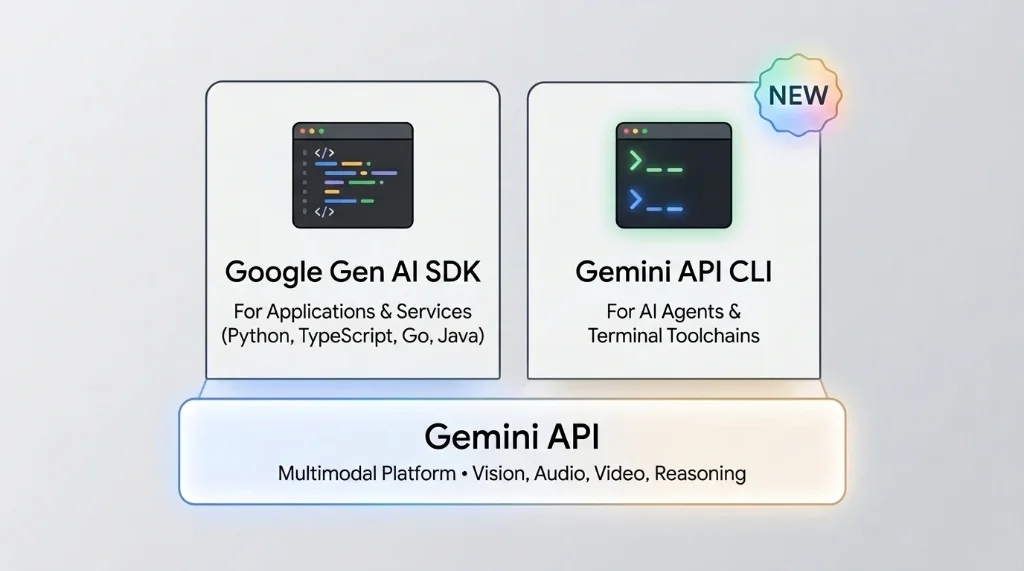
Google has open-sourcedgemini-api, a single-binary Rust command-line tool (google-gemini/gemini-api-cli, Apache-2.0 licence) that wraps the Gemini API into seven composable shell commands for coding agents such as Claude Code, Gemini CLI, Cursor and Antigravity as well as human developers.
Mechanism and agent ergonomics
Unlike Model Context Protocol (MCP) servers that load every tool schema into the model’s prompt at session start, gemini-api uses progressive disclosure: an agent runs gemini-api --help to see the seven top-level verbs and inspects subcommand flags only when needed. Binary outputs such as generated images, video or audio are written to disk while only the file path is printed to stdout, keeping raw base64 payloads out of the agent’s context window. Every command supports --json, --dry-run, --output and stdin piping.
Supported capabilities
generate: text and structured JSON via Gemini models, images via Nano Banana 2, video via Veo 3.1, speech across 30 voices and music tracks via Lyria 3.
analyze, transcribe and embed: multimodal inspection of images, video, audio and PDFs (automatically routing files above 100MB through the Files API), timestamped speaker-diarized transcription and text or multimodal embeddings.
agent, files and batch: autonomous multi-step web research via deep-research-pro on the Interactions API, remote file lifecycle management and asynchronous Batch API jobs at a 50% token discount.
Ideogram’s first native vector model (ideogram-vector-1) generates editable SVG files with clean bezier paths, smooth gradients and sharp typography directly from text prompts or existing raster images in the web app and API.
Ideogram has launched Ideogram Vector (ideogram-vector-1), a native vector generation model available in the Ideogram web app and through two v2 API endpoints: POST /v2/svg/generate/ideogram-vector-1 for text-to-vector generation and POST /v2/svg/vectorize/ideogram-vector-1 for converting raster images into editable SVGs.
How it works
Rather than generating a bitmap and running a post-hoc contour tracer, Ideogram Vector produces structured SVG markup with grouped layers, clean anchor paths, smooth multi-stop gradients and crisp lettering. Users can upload style references or character and object reference images (style_reference_images and reference_images), select LOW, MEDIUM or HIGH quality presets, and immediately recolour palettes, isolate path groups or resize artwork infinitely in the browser or tools such as Figma and Illustrator.
Key numbers
Text-to-vector API price: $0.13 per SVG at Low quality, $0.16 at Medium and $0.20 at High ($0.32 per SVG when using image references).
Image-to-vector API price: $0.10 per vectorised image.
Web app plans: Free tier included with daily limits; Plus is $15 per month billed annually ($20 monthly) and Pro is $42 per month billed annually ($60 monthly).
Powered by gpt-6-luna, POST /v1/decisions evaluates up to 400 bounded yes-or-no, multiple-choice or scored rubric questions per request up to 10 times faster than the Responses API, with zero output token charges.
OpenAI has made the Decisions API (POST /v1/decisions) generally available on gpt-6-luna. Designed for workloads that need structured judgements rather than free-form prose, the endpoint accepts text, images or native JSON (input_json) and evaluates a batch of independent questions in parallel at up to 10 times the speed of gpt-6-luna through the Responses API.
Decision types and GA additions
Each question in the questions array specifies one of three typed schemas: predicate (returns a boolean outcome when a calibrated probability between 0 and 1 meets a configurable threshold), choice (selects one key from up to 20 options with per-option probability distributions) or score (assigns a 1-indexed integer across 2 to 10 ordered rubric levels, plus an expected value score_ev and level probabilities).
New for general availability are native GPT-Live triggers that fire mid-conversation events during voice sessions without blocking speech, prompt caching on shared input prefixes, image attachments inside per-question instructions, and enterprise compliance controls including Private Link, Zero Data Retention, HIPAA eligibility and US or EU regional processing.
Key numbers
Batch capacity: up to 400 questions per request (doubled from 200 in public beta) and up to 50 images per request across a 128k context window.
Input pricing on gpt-6-luna: $0.10 per 1M uncached input tokens and $0.01 per 1M cached input tokens (90% discount), with zero charge for output tokens.
Announced at AGNTCon + MCPCon alongside the open-source Agent Substrate on GKE, Agent Compute Engine uses Google Titanium IPUs and Cloud Hypervisor microVMs to isolate, snapshot and resume stateful AI agents.
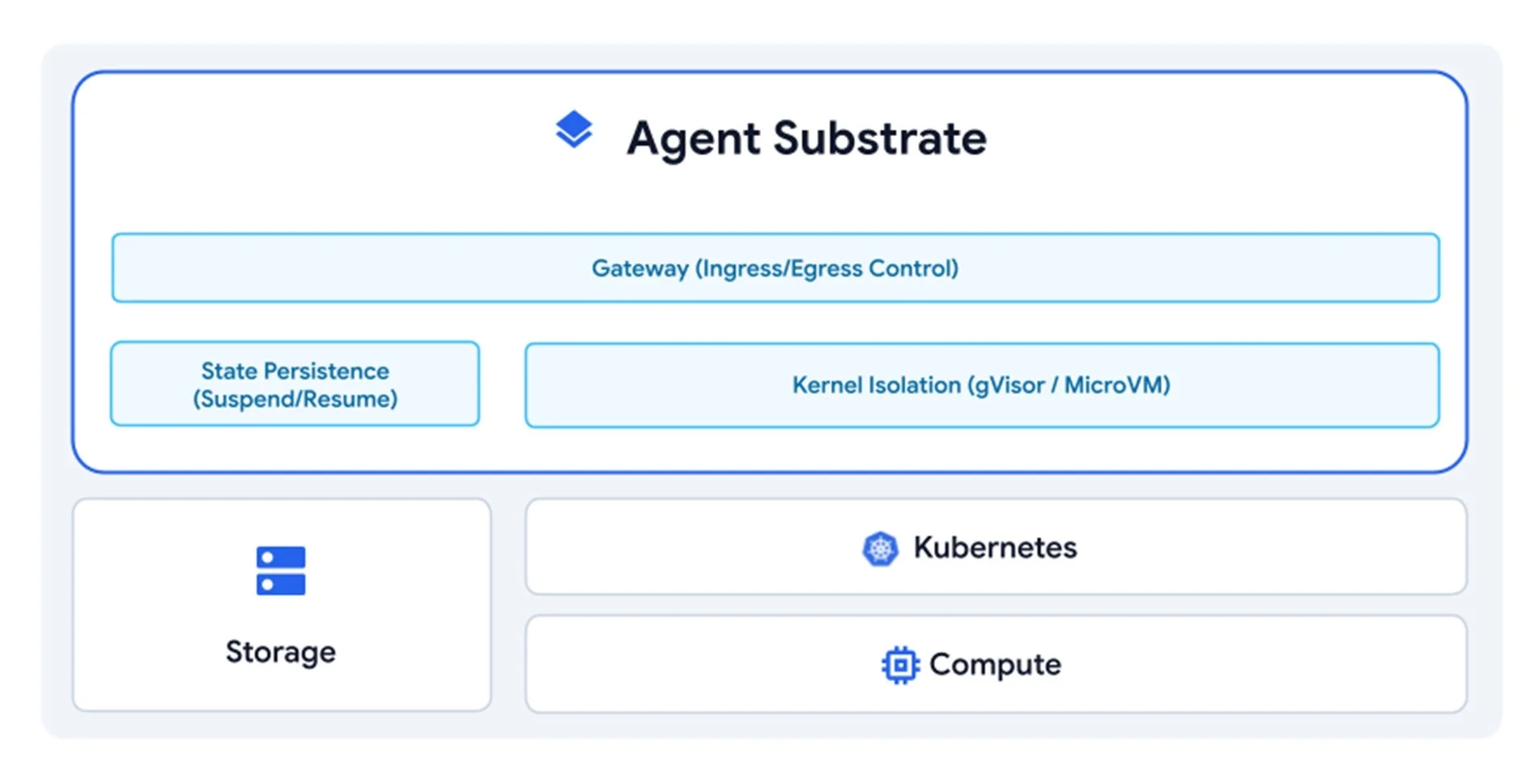
At AGNTCon + MCPCon, Google Cloud introduced Agent Compute Engine, a managed sandbox service built on the open-source Agent Substrate (ate.dev, released for Google Kubernetes Engine on 15 September 2026) and Google’s custom Titanium Infrastructure Processing Units (IPUs).
Agent Substrate pairs gateway controls, state persistence and gVisor or microVM kernel isolation on Kubernetes.Image: Google Cloud
MicroVM isolation and state persistence
Every agent session runs inside its own hardware-backed microVM managed by Cloud Hypervisor, providing a dedicated kernel boundary against prompt-injected shell commands or untrusted code execution. Titanium IPUs offload network and storage I/O from the host CPU, while copy-on-write memory sharing deduplicates base runtime pages across concurrent sandboxes and snapshots memory state so paused agents release compute while waiting on user input or external APIs, then restore into persistent Hyperdisk storage.
On GKE, the underlying Agent Substrate architecture delivers up to 10 times higher compute density and sub-500mssuspend-and-resume latencies at 500 activations per second across 200k agents.
Governance and security controls
Google Cloud also detailed governance updates across Gemini for business: an Agent Gateway and Agent Registry with cryptographic SPIFFE Agent Identity, OpenTelemetry traces in Cloud Monitoring, Envoy-basedcross-cloud policy enforcement, local endpoint sandboxes for Claude Code and Antigravity CLI, and token budget rules that downgrade routine tasks to lower-cost models. Agent Compute Engine enters preview in the coming months; Google Cloud has not announced pricing.
Agent Skills (agentskills.io) joins the Agentic AI Foundation alongside OpenAI’s Open Responses, Hugging Face and Meta’s OpenEnv, and Alibaba’s OpenSandbox to keep reusable agent workflows under vendor-neutral governance.
At AGNTCon + MCPCon in Seattle, Anthropic announced that it has donated the Agent Skills open specification (agentskills.io) to the Agentic AI Foundation (AAIF), a directed fund of the Linux Foundation that Anthropic co-founded in December 2025 when it contributed the Model Context Protocol (MCP).
How Agent Skills and AAIF fit together
First released by Anthropic in October 2025 and published as an open specification in December 2025, an Agent Skill is a directory containing a SKILL.md file with YAML frontmatter (name and description), markdown procedural instructions and optional helper scripts or reference templates. Agents load only the short frontmatter at startup and read the full instructions on demand. Since December 2025, more than 70 platforms including ChatGPT, Cursor, GitHub Copilot, Gemini CLI, Goose, Snowflake and VS Code have adopted the format, with over 100k skills published on GitHub.
Anthropic will co-maintain the specification with community contributors as AAIF standardises enterprise skill discovery, versioning and distribution. In the same announcement, AAIF accepted three additional open-source projects: OpenAI’s Open Responses (openresponses.org), Hugging Face and Meta’s OpenEnv for reinforcement-learning environments, and Alibaba’s OpenSandbox, bringing AAIF to seven hosted projects and more than 195 member organisations.
Working with verification startup Theorem, Anthropic’s Frontier Red Team tasked Claude with fixing bugs and generating 180 million lines of machine-checked Rocq proofs directly over compiled RISC-V Linux binaries.
Anthropic’s Frontier Red Team and verification startup Theorem (theorem.dev) have published a large-scale study showing that Claude can autonomously patch memory-safety bugs and write machine-checked formal proofs in the Rocq (formerly Coq) theorem prover for unmodified C, C++ and Rust libraries drawn from Google’s OSS-Fuzz benchmark.
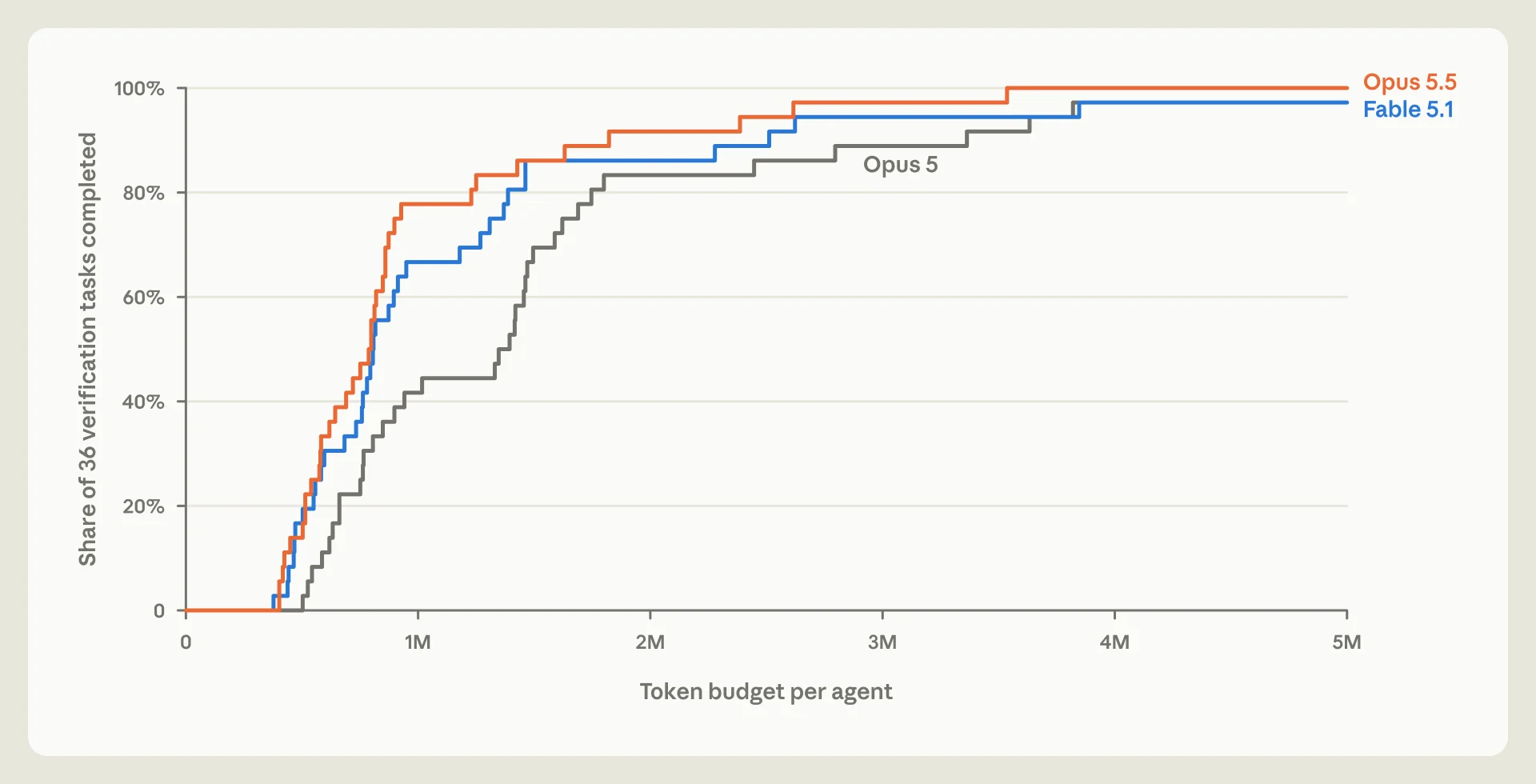
On a 36-task verification benchmark, Claude Opus 5.5 reached 50% completion using roughly 40% fewer tokens than Claude Opus 5.Image: Anthropic
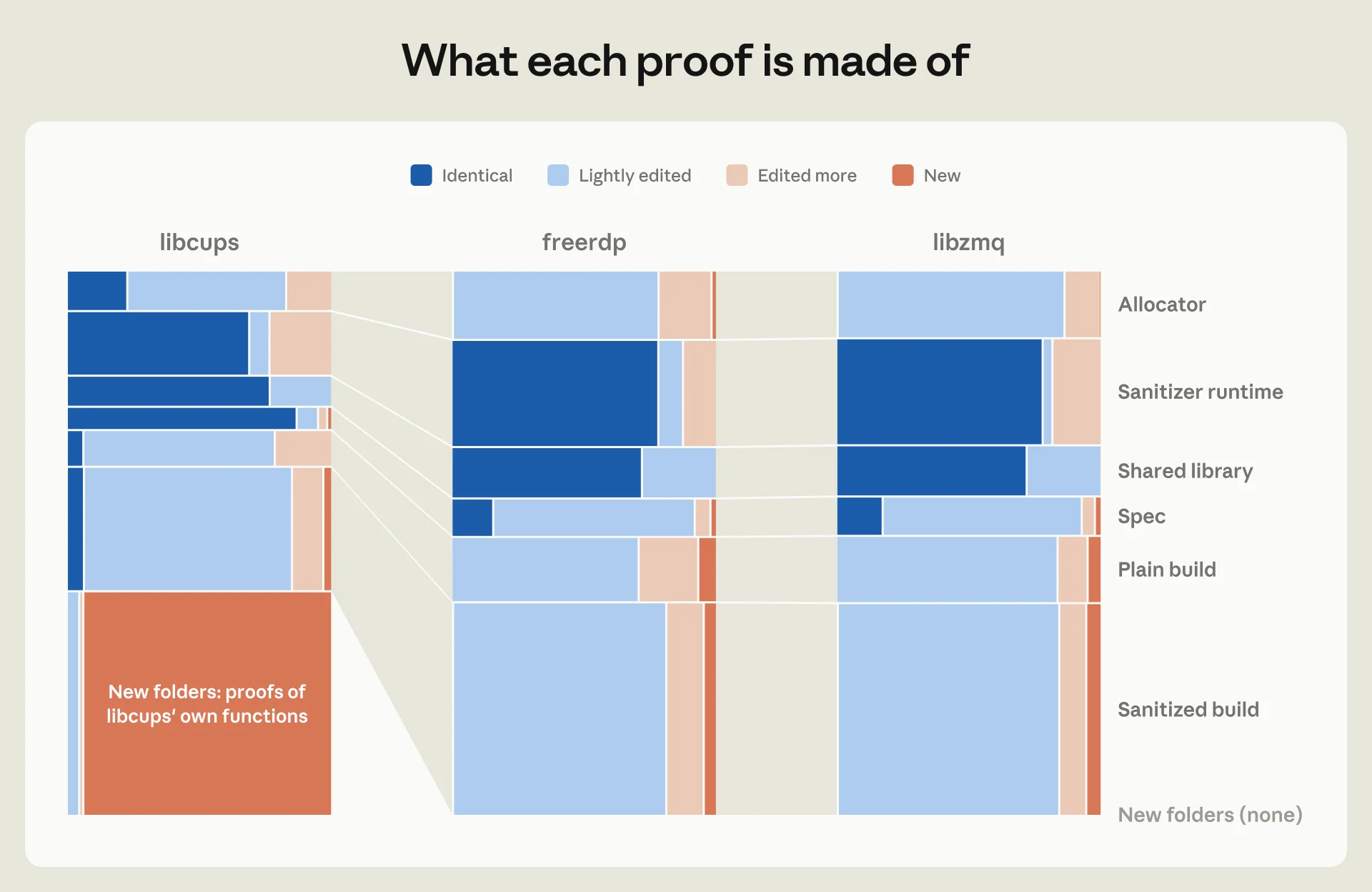
Sharing a common workspace let freerdp and libzmq reuse allocator and runtime proofs from libcups, cutting token use by 17%.Image: Anthropic
Binary-level Rocq proofs
Rather than asking engineers to rewrite production code in a verification-specific language, the team compiled each OSS-Fuzz target into a standalone RISC-V Linux executable with AddressSanitizer enabled (median size 18,000 instructions) and loaded its machine code into Rocq alongside a formal RISC-Vinstruction-set specification. Claude agents working inside Claude Code fixed underlying bugs in the source code and then constructed inductive invariants proving that the compiled binary never reaches an invalid instruction, failed assertion or AddressSanitizer memory error on any byte sequence up to 64MB.
Across 239 entry points in 123 libraries, Claude produced roughly 180 million lines of Rocq (~600k lines per proof), published at theorem-labs/oss-verify-proofs.
Functional correctness milestones
Beyond crash-freedom, Claude verified functional correctness on two self-contained systems: it proved in 20 days (~$20k in tokens) that the Linux kernel’s x86 zlib_inflate implementation conforms to RFC 1950 and returns Z_DATA_ERROR on invalid streams, and it wrote a 19,000-line Rust Python interpreter verified in Verus that matched CPython on 99.95% of 1.7M random test programs.
Simulating a panel of debating physicians that balances diagnostic value against test spend, the Microsoft AI Diagnostic Orchestrator reached 83% accuracy on complex New England Journal of Medicine cases and 80% on emergency department cases.
Microsoft AI has published peer-reviewed studies of the Microsoft AI Diagnostic Orchestrator (MAI-DxO) in Science (doi:10.1126/science.aeh7930) and BMJ Digital Health and AI, alongside the open-source Sequential Diagnosis Benchmark (microsoft.github.io/sdbench).
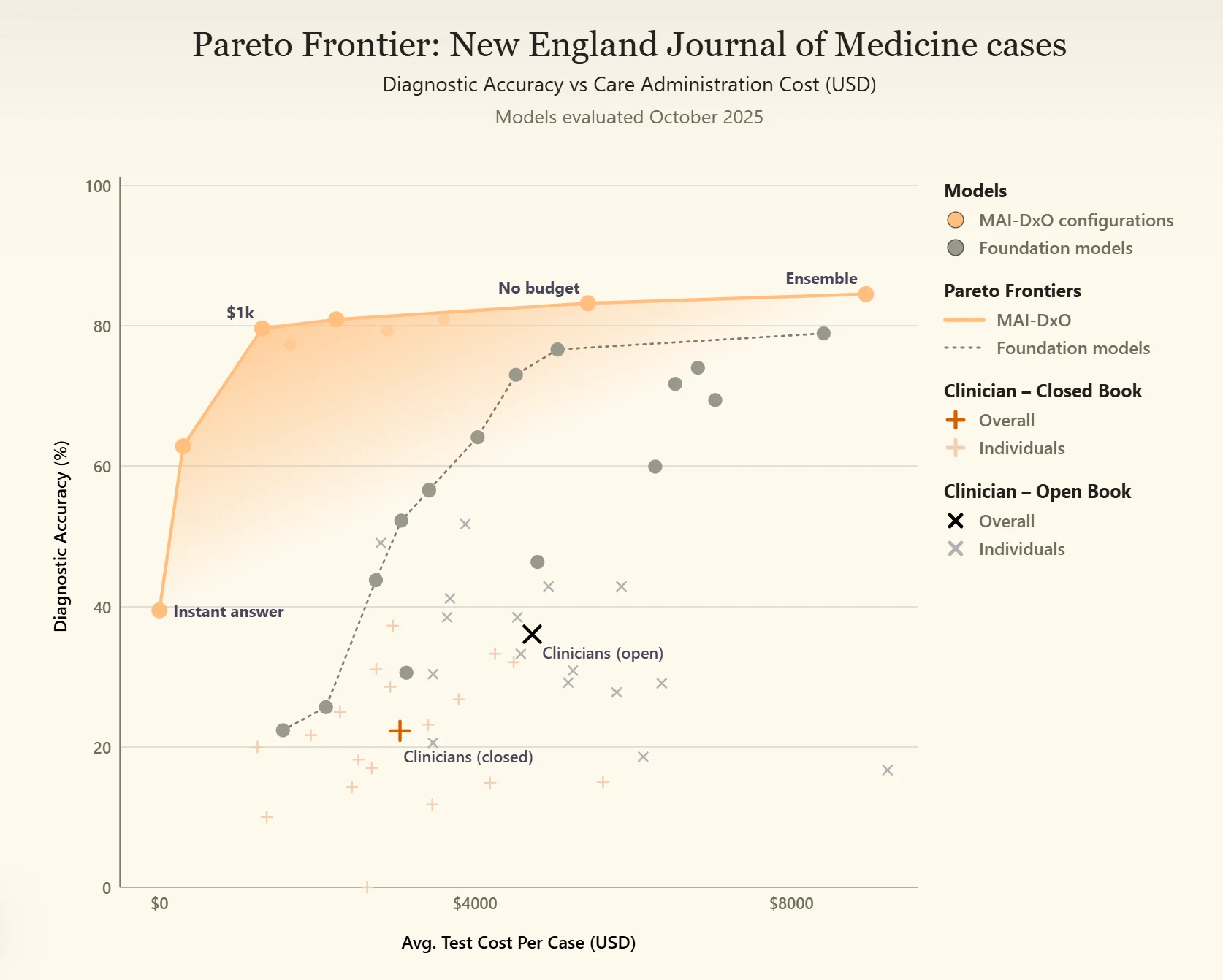
On 304 NEJM cases, MAI-DxO shifts the accuracy-versus-cost Pareto frontier above standalone models and clinicians.Image: Microsoft AI
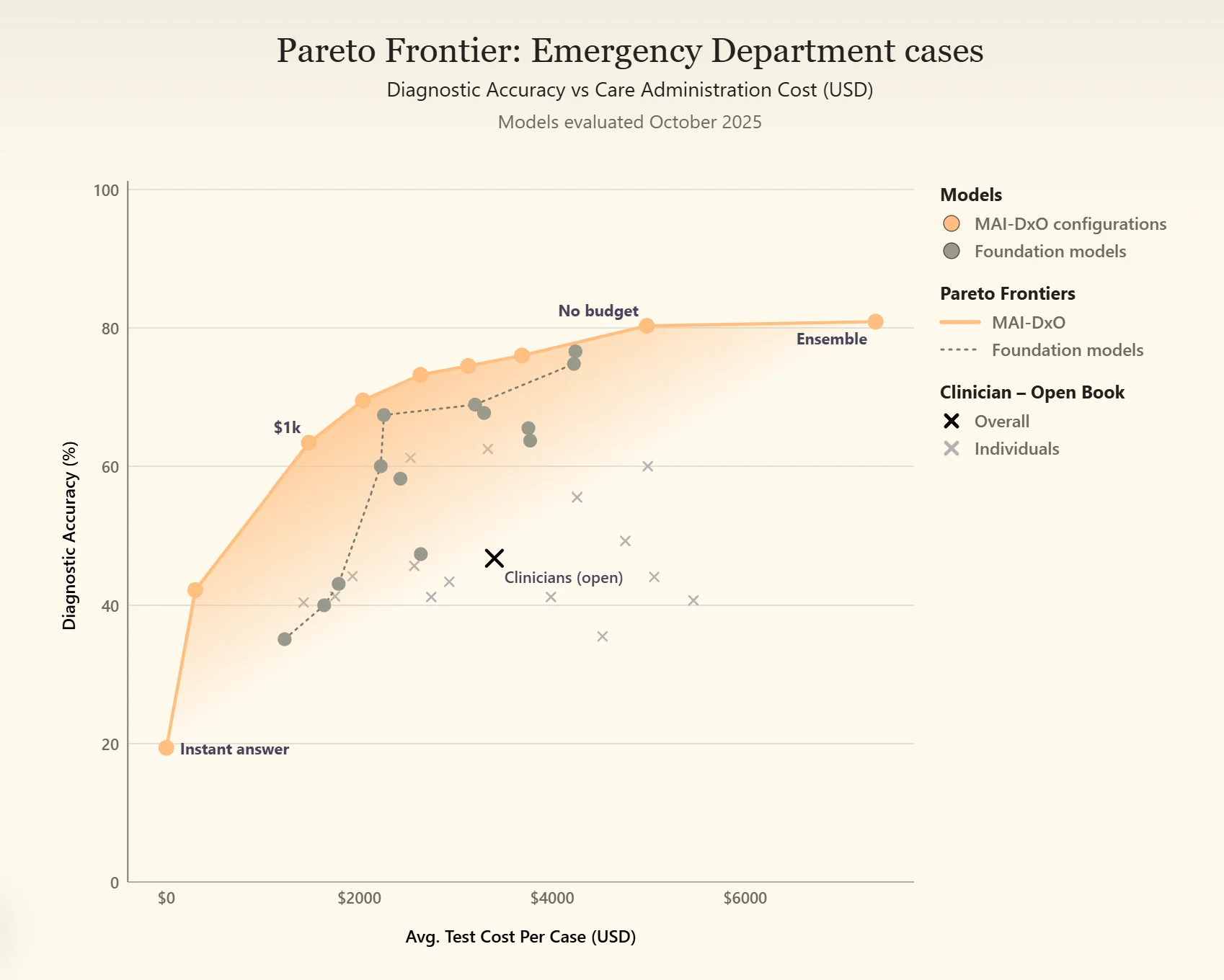
On MIMIC-IV-ED emergency department cases, MAI-DxO reaches 80% diagnostic accuracy against 47% for open-book clinicians.Image: Microsoft AI
Multi-agent debate and cost control
Unlike static medical benchmarks such as USMLE where all patient findings are handed to a model at once, SDBench forces diagnostic systems to start from an initial complaint, ask follow-up history questions and order laboratory or imaging tests sequentially while tracking cumulative US healthcare test costs.
MAI-DxO wraps frontier language models in a structured virtual panel of five specialist roles: hypothesis generation, test selection, devil’s-advocate challenge, cost stewardship and quality checklist review. Across rounds of chain-of-debate reasoning, the panel updates a differential diagnosis and weighs expected information gain against the dollar cost of each test before committing to a final diagnosis.
Clinical evaluation next steps
On 304 New England Journal of Medicine (NEJM) clinicopathological cases, MAI-DxO achieved 83% diagnostic accuracy compared with 22% for 21 practising US and UK physicians working without reference materials (3.7 times as accurate) and 36% for physicians with textbooks and internet search (2.3 times as accurate); a cost-constrained configuration reached 81% at less than half the test spend. Microsoft AI is now launching a prospective clinical study with Beth Israel Deaconess Medical Center in Boston.
Hugging Face Biology Research, working with TIGEM, the University of Naples Federico II and Zhongguancun Academy, released Carbon-X (HuggingFaceBio/Carbon-X, Apache-2.0 licence), a 14.8B-parameter model adapted from Qwen3-14B with a hybrid English BPE and 6-mer DNA tokenizer trained on 302B tokens. Across five genomics benchmarks with thinking disabled, Carbon-X averages 66.7%, 27 points above Qwen3-14B and within 0.8 points of GPT-6.1 Sol (67.5%) at roughly 1/1,800 of the per-problem cost.
SpaceXSI has started rolling out native phone app integrations for Grok Bot on iOS and Android. After users grant per-app device permissions, Grok Bot can create, inspect and update entries directly inside Calendar, Reminders, Contacts and other built-in mobile apps from natural-language chat or voice requests.
Artificial Analysis released Coding Agent Index v2.0, evaluating model-and-harness combinations across 290 tasks weighted equally across Cognition’s FrontierCode v1.1 (100 tasks, replacing DeepSWE v1.1), Laude Institute’s Terminal-Bench 4.0 (66 tasks) and Scale AI’s revised SWE-Atlas-QnA-AA (124 tasks, graded by GPT-6 Luna xhigh). Claude Opus 5.5 (max) in Claude Code leads at 61.7 ($11.42 average cost per task), followed by Claude Sonnet 5.5 in Claude Code (59.3) and Muse Wonder Full in Muse Code (58.9).