
Open sourceZyphraConfirmed
Story 8 of 14 in the Monday 9 November editionZyphra open-sources Apache 2.0 ZONOS3-Mini MoE speech and voice-cloning model
Activating 100M of its 800M parameters over a 15 Hz audio codec, ZONOS3-Mini hits 80 ms median time to first audio on an H100 while running locally on WebGPU, MLX and ggml.

 Edited by Ashutosh Shrivastava
10 Nov 2026, 09:50 IST · 1 min read
Zyphra released ZONOS3-Mini and its companion ZAC 1 neural audio codec under the Apache 2.0 licence on 9 November 2026. The text-to-speech and zero-shot voice-cloning model uses a sparse mixture-of-experts (MoE) backbone with 800M total parameters and 100M active per token, pairing Gated DeltaNet linear-recurrence layers with standard attention in a 3:1 ratio. Zyphra pretrained the model on 112 H100 GPUs in 2.5 days before applying Direct Preference Optimisation (DPO) and Group Relative Policy Optimisation (GRPO) to reduce word skips and unstable prosody.
Low-frame-rate codec and edge runtimes
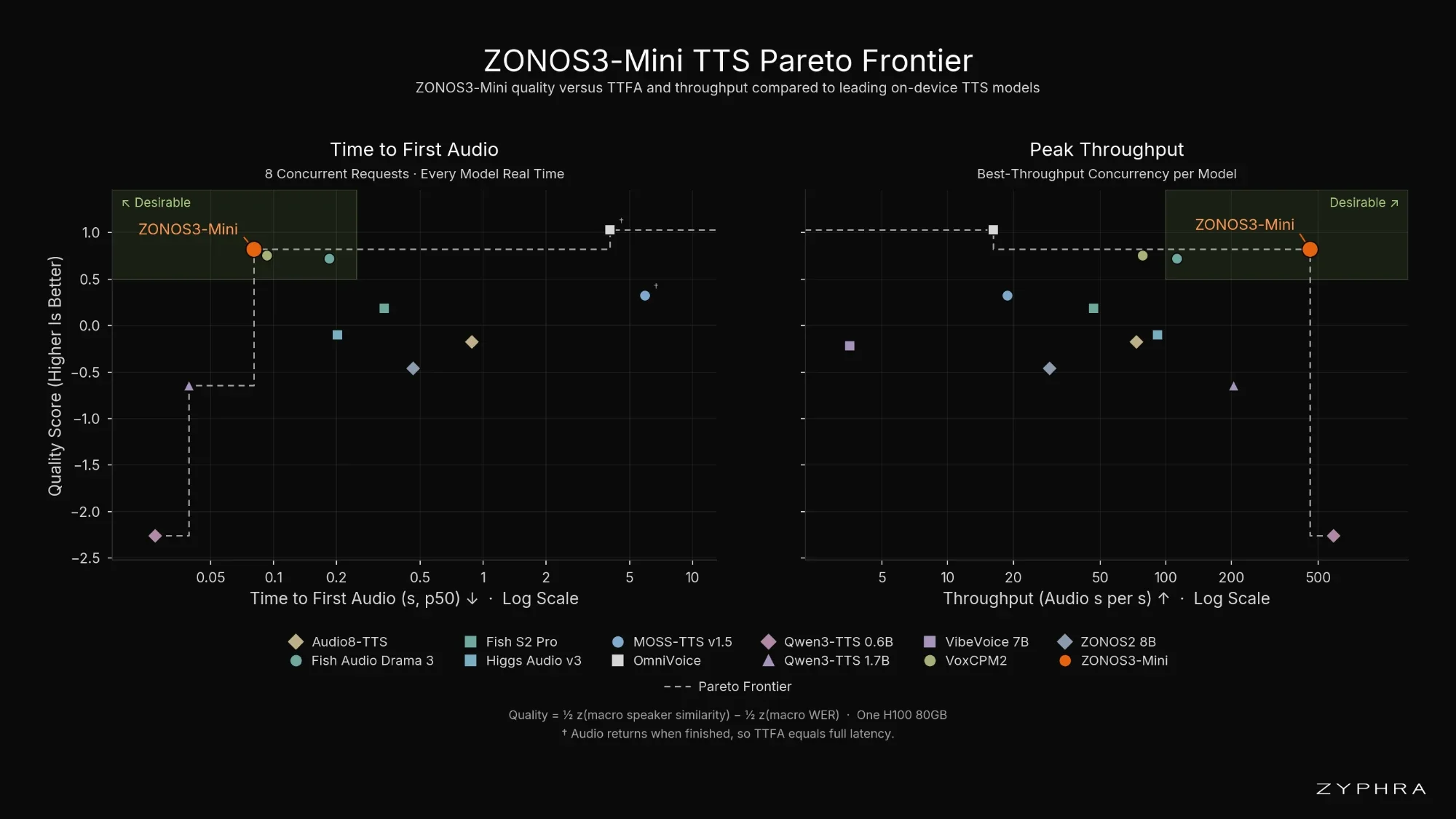
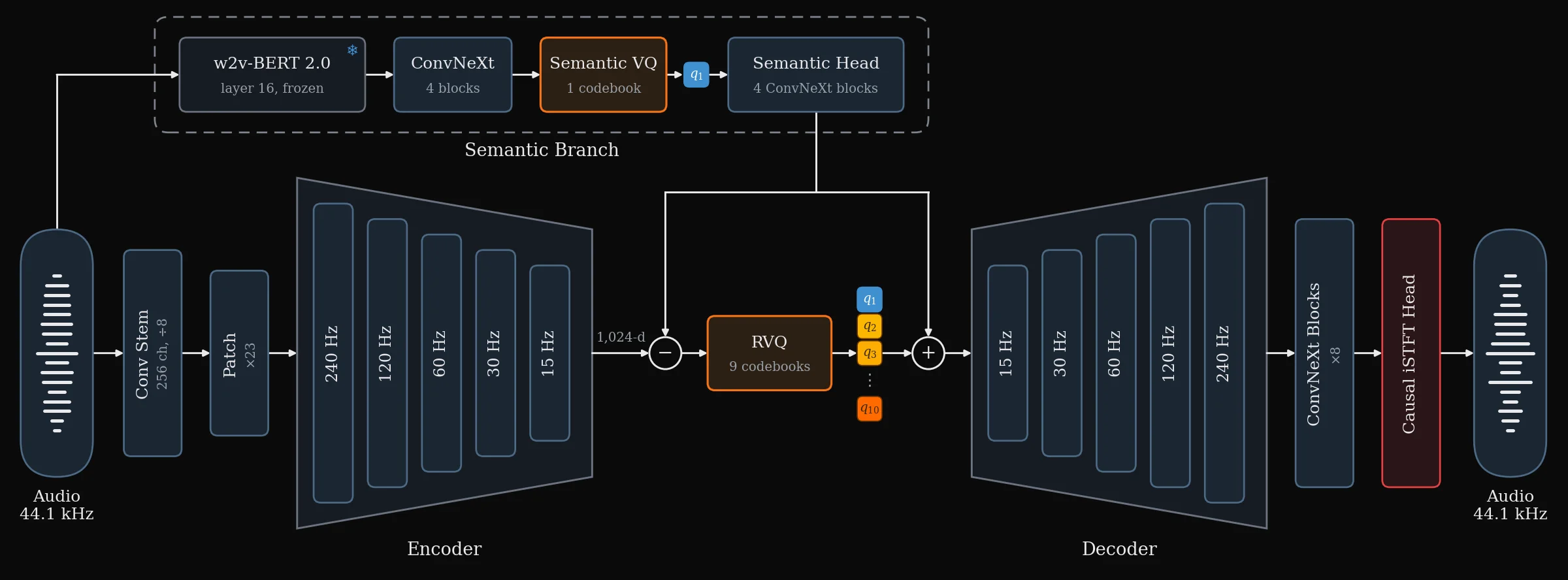
Instead of generating dense 50 Hz audio tokens, ZONOS3-Mini predicts tokens from ZAC 1, a 44.1 kHz codec operating at 15 Hz across one w2v-BERT 2.0 semantic codebook and nine residual vector-quantisation (RVQ) acoustic codebooks, conditioned on Zyphra’s MECT-B2 speaker encoder. On one H100 80GB GPU across 55 subsets of Zyphra’s ZTTS2-Eval suite, ZONOS3-Mini achieves an 80 ms median time to first audio at eight concurrent requests and peaks at 457 seconds of generated audio per second, advancing the quality-versus-latency Pareto frontier against Qwen3-TTS, Higgs Audio v3 and Fish S2 Pro. Reference inference implementations ship for SGLang-Omni, CUDA, Apple Silicon MLX, C++/ggml and in-browser WebGPU.
Sources
- PrimaryZONOS3-Mini: Pareto-Optimal Open-Weight Speech Synthesiszyphra.com
- OfficialZyphra/ZONOS3-Mini model repository on Hugging Facehuggingface.co/Zyphra
- On XZyphra (@ZyphraAI) launch thread on Xx.com