Both frontier releases run on the same 1M-token model, cutting standard API pricing by 20% to $8 and $40 per million tokens while adding cyber and bio safeguards to Fable 5.2.
Anthropic released Claude Fable 5.2 for general access alongside Claude Mythos 5.2 for verified security and life-sciences teams on 9 November 2026. Unlike separate model sizes, both variants share the same underlying weights and 1M-token context window: Fable 5.2 applies automated classifiers and refusal safeguards against dual-use cyber and biological misuse, while Mythos 5.2 removes those filters for organisations approved through Anthropic’s Cyber Verification Program and Life Sciences Verification Program.
Access, speed and pricing
Claude Fable 5.2 is available across the Claude Platform API, Claude Code, Claude Pro via usage credits, and Claude Max and Ultra plans up to 50% of a subscriber’s weekly usage allowance. Anthropic states that the 5.2 generation runs up to 30% faster than 5.1 while lowering standard API pricing from $10 and $50 to $8 per million input tokens and $40 per million output tokens. Prompt-cache reads cost $0.20 per million tokens, with cache writes billed at $10 for five-minute retention or $16 for one-hour retention. An optional fast mode increases output speed by up to 2.5 times at $16 per million input tokens and $80 per million output tokens.
Scientific and security evaluations
In prerelease evaluations reported by Anthropic, the model designed three working electronic devices from scratch, solved two open black-hole physics problems, and formalised the proof of Fermat’s Last Theorem in 30 hours. Anthropic’s benchmark table is drawn directly in HTML on the launch page rather than published as an image: across general coding, scientific reasoning and operating-system control, Fable 5.2 and Mythos 5.2 lead Claude Opus 5.5 and OpenAI’s GPT-6 Astra, while Mythos 5.2 posts higher scores on restricted offensive security suites including CyScenarioBench (76.3%) and CVE Rediscovery (89.6%). Independent evaluator Artificial Analysis ranked Claude Fable 5.2 first overall on its Intelligence Index v5 with a score of 65.
Key numbers
$8 input and $40 output per million tokens (20% below 5.1), or $16 and $80 in 2.5 times fast mode
69.9% on FrontierSWE v2 and 49.1% on FrontierCode 2.0, ahead of 62.3% and 45.5% for Claude Opus 5.5
74.6% (Fable 5.2) and 75.3% (Mythos 5.2) on Terminal-Bench-Science 0.1, compared with 68.1% for GPT-6 Astra
89.3% on OSWorld 2.1 computer use and 64.9% on RoboDojo Sim embodied control
Built for high-volume agent loops and on-device assistants, Muse Ember pairs native text, image, audio and video input over a 1M-token context window with API pricing three times cheaper per task than Claude Haiku 5.5.
Meta introduced Muse Ember on 9 November 2026 as the compact, low-latency member of its proprietary Muse model family. Accepting native text, image, audio and video inputs across a 1M-token context window, the model targets multi-step coding agents, visual perception pipelines and voice interfaces. Developers can call Muse Ember through the Meta Model API, Muse Code and Google Cloud Vertex AI, while consumer rollouts extend the model to Meta AI on Apple Watch and WearOS smartwatches.
Efficiency and evaluation discrepancies
On the Meta Model API, Muse Ember costs $0.10 per million uncached input tokens, $0.004 per million cached input tokens, and $0.50 per million output tokens. According to Meta and Artificial Analysis, Muse Ember matches Anthropic’s Claude Haiku 5.5 at 36 on the Artificial Analysis Intelligence Index while finishing the benchmark suite at an average cost of roughly $0.14 ($0.136) per task against $0.411 for Haiku 5.5. Meta’s benchmark charts on the research blog are rendered interactively in HTML rather than as downloadable images. One figure differs across sources: Meta’s research table lists 37.8% on AutomationBench-AA, whereas Artificial Analysis’s summary post reports 68.1% on the same benchmark.
Key numbers
$0.10 input, $0.004 cached input, and $0.50 output per million tokens across a 1M-token window
1608 Arena Elo on Code Arena WebDev, ranking first among small models
61.6% on Agents’ Last Exam and 40.9% on Terminal-Bench 4.0
80.6% on PerceptionBench with tool use and 46 on Coding Agent Index-AA
Completing four custom accelerator systems in one year, Google adds AMD EPYC confidential pods and doubled-memory inference boards alongside orchestration tools for stateful AI agents.
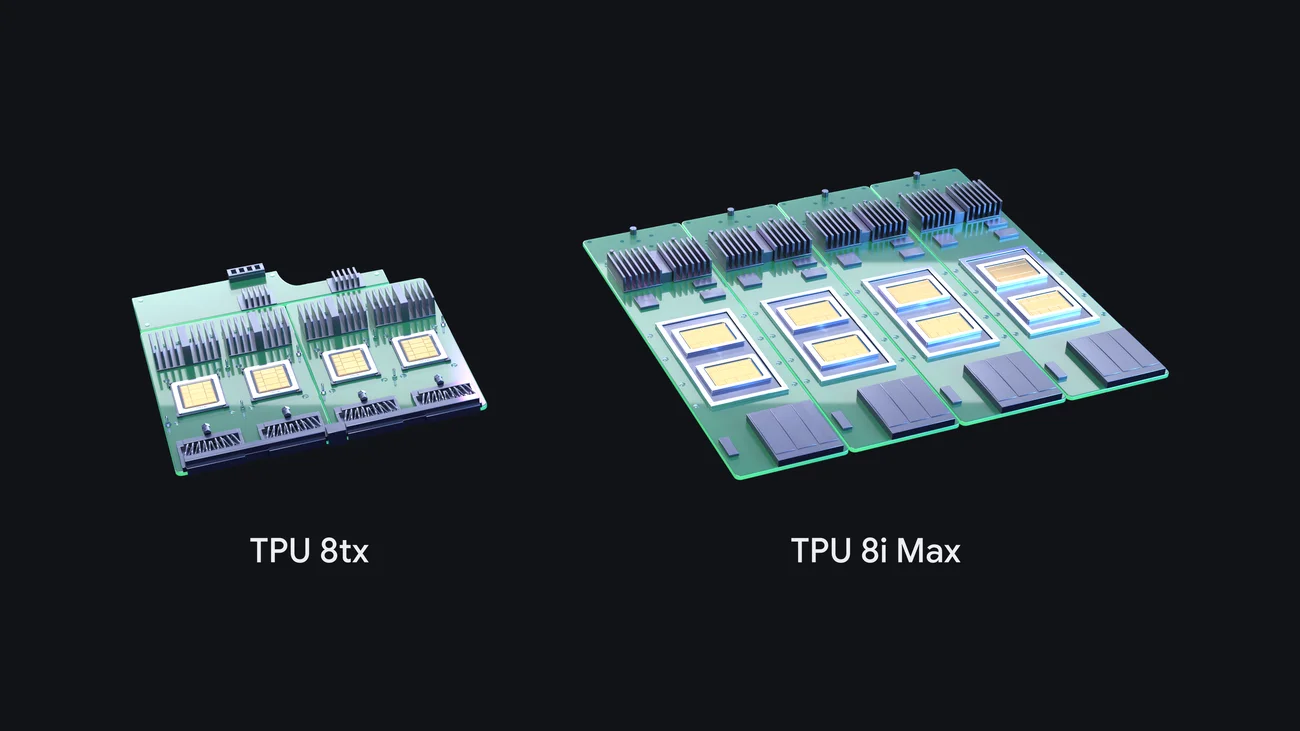
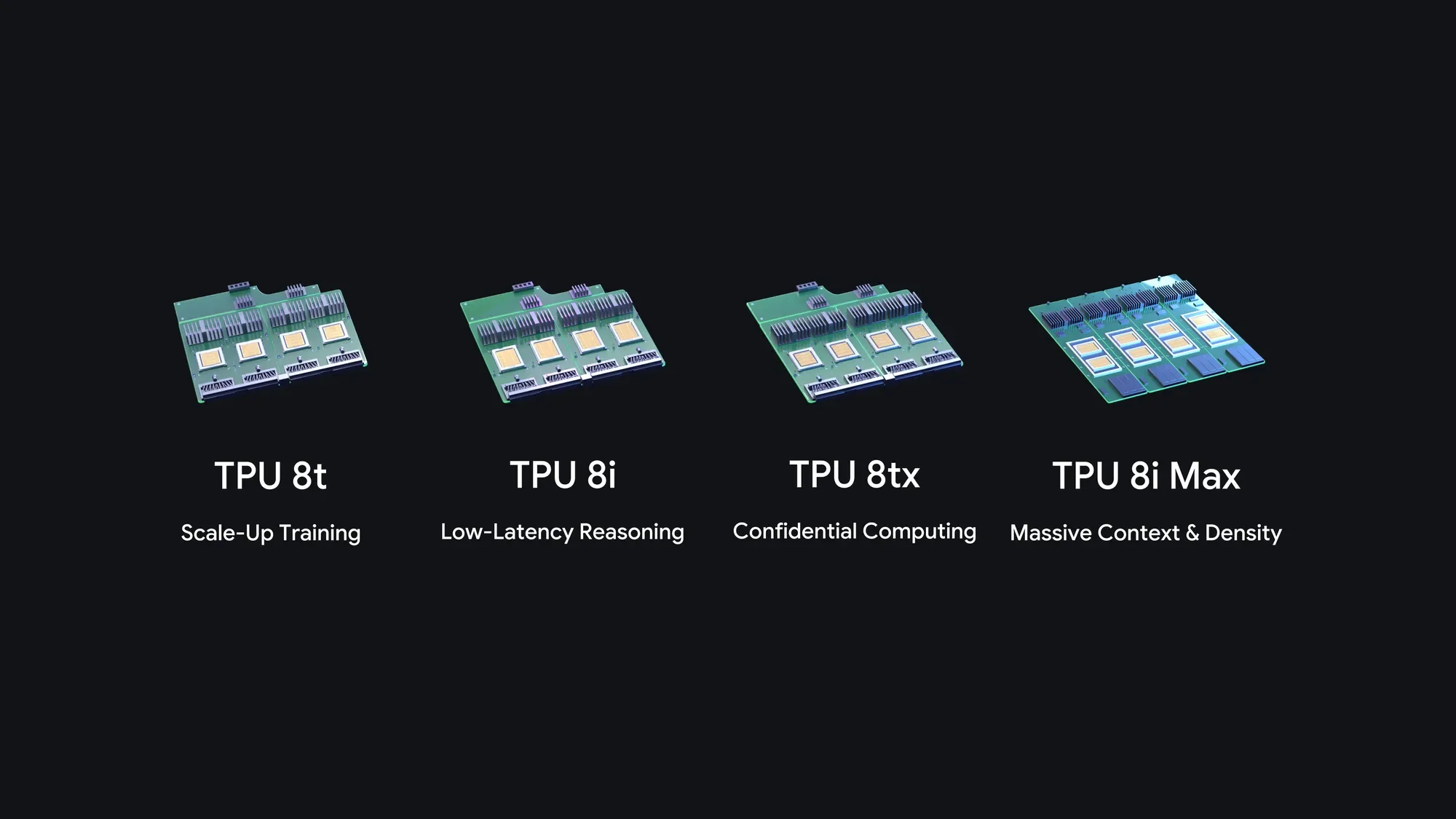
Google Cloud announced two eighth-generation Tensor Processing Unit systems on 9 November 2026, TPU 8tx and TPU 8i Max, bringing its eighth-generation accelerator lineup to four distinct configurations alongside TPU 8t and TPU 8i. TPU 8tx pairs TPU 8t silicon with fifth-generation AMD EPYC host processors over Google’s Boardfly optical interconnect to deliver hardware-encrypted confidential computing for regulated inference and mid-scale training. TPU 8i Max scales up the inference-focused 8i board with 2 times the compute, 2 times the on-chip SRAM and 2 times the HBM bandwidth to serve million-token context windows and dense mixture-of-experts workloads.
Google’s four eighth-generation TPU boards span scale-up training, low-latency reasoning, confidential computing and long-context density.Image: Google
Agent Compute Engine and TPU Sync
Alongside the boards, Google introduced software layers aimed at stateful agentic traffic, where models pause while external code executes or tools return data. Agent Compute Engine suspends and resumes idle agent sessions across TPU pods, while open-source TPU Sync pools HBM, host DRAM, local storage and pod networking into one unified key-value (KV) cache tier. Google reports that TPU Sync cuts KV-cache transfer latency and time to first token by more than 90% on multi-turn agent workloads. Cloud Pathways and dynamic pod slicing also reached general availability on Google Kubernetes Engine (GKE), delivering up to 5 times faster cluster startup and 4.5 times faster fault recovery. Google did not publish hourly cloud instance rates in the announcement.
Built on NVIDIA Cosmos and unveiled at CoRL in Austin, GR00T 2 jointly denoises future video frames and robot action chunks so humanoids learn physical skills from human demonstrations.
NVIDIA unveiled GR00T 2 and Isaac Lab 3.0 at the Conference on Robot Learning (CoRL) in Austin on 9 November 2026. Rather than mapping camera frames directly to joint torques like standard vision-language-action models, GR00T 2 is a world-action model built on NVIDIA Cosmos: a single diffusion transformer jointly denoises predicted future video frames and multi-step robot action chunks. Predicting how objects and hands move in pixel space lets the policy transfer physical intuition from human videos with zero robot action labels.
Training scale and onboard latency
NVIDIA pretrained GR00T 2 across 402,730 hours of egocentric human video, 10,184 hours of handheld Universal Manipulation Interface (UMI) gripper trajectories spanning 2,897 tasks, and 23,500 hours of robot teleoperation. Alongside the paper, NVIDIA released Human-1M-100K, an open 100,000-hour subset of the egocentric corpus on Hugging Face, with model code scheduled for December 2026. On real-world bimanual and humanoid benchmarks, GR00T 2 completes 40 of 50 tasks zero-shot, reaches 71% success from a single robot demonstration, and hits 95% after five demonstrations and 30 minutes of post-training on one RTX 5090 GPU. A distilled variant, GR00T 2 Turbo, executes onboard a Unitree G1 humanoid’s Jetson Thor computer at 124 ms per prediction.
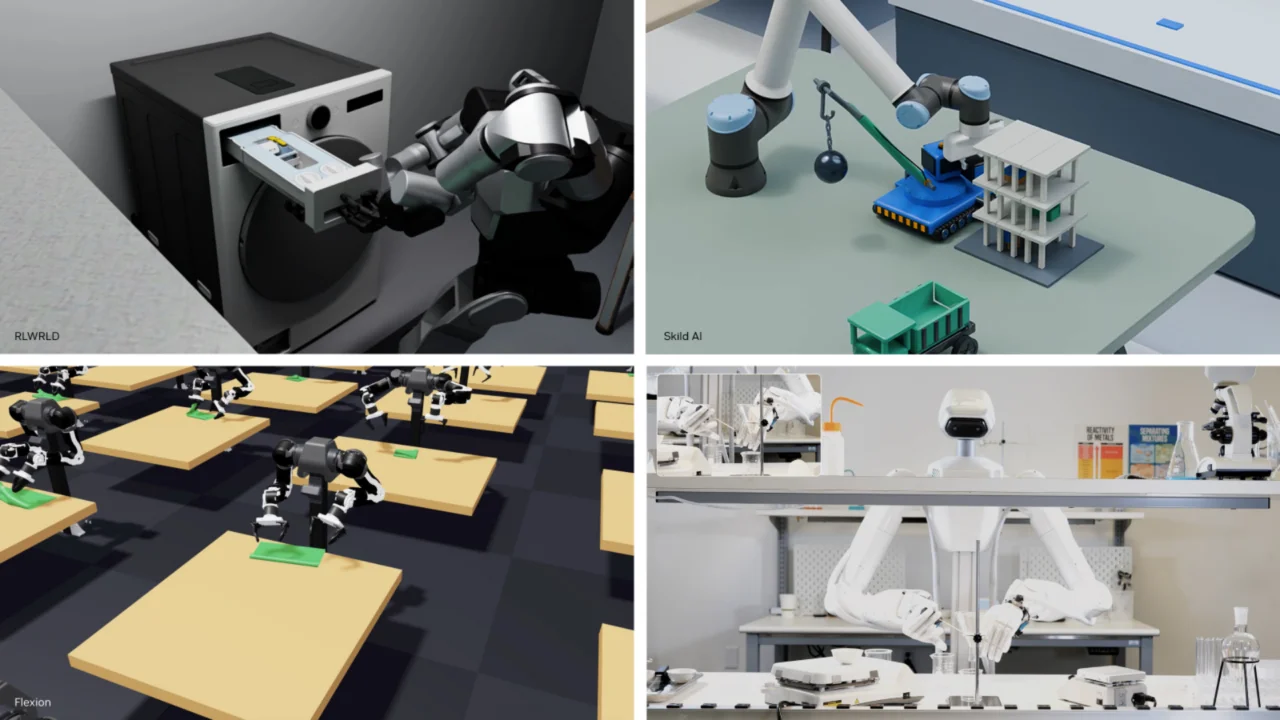
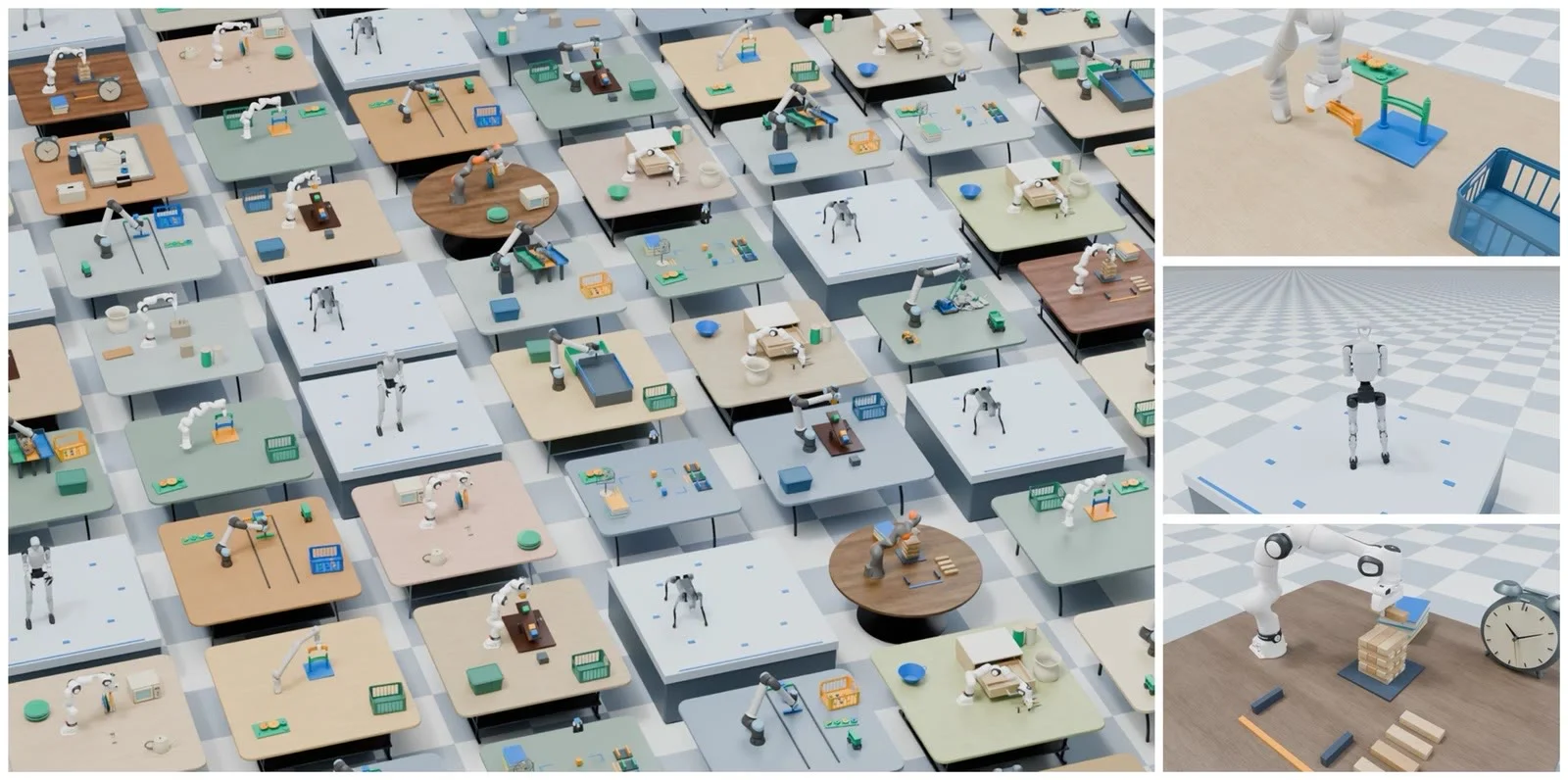
Partner simulation and physical manipulation tasks demonstrated alongside GR00T 2 and Isaac Lab 3.0 at CoRL.Image: NVIDIA
Rolling out across Jimeng, Doubao and Volcano Ark, the updated image model preserves untouched pixels across 100 sequential edits and generates native transparent PNG layers.
ByteDance Seed introduced Seedream 5.5 on 9 November 2026, upgrading its flagship image generation and editing model for commercial design pipelines. Standard diffusion editors gradually drift in colour, facial identity and background geometry after several conversational revisions; Seedream 5.5 constrains latent updates to edited regions so unmasked pixels remain stable across up to 100 sequential editing rounds. The model also outputs native four-channel RGBA images with clean alpha transparency around hair, glass and UI stickers without requiring a separate background-removal pass.
Realism and commercial evaluations
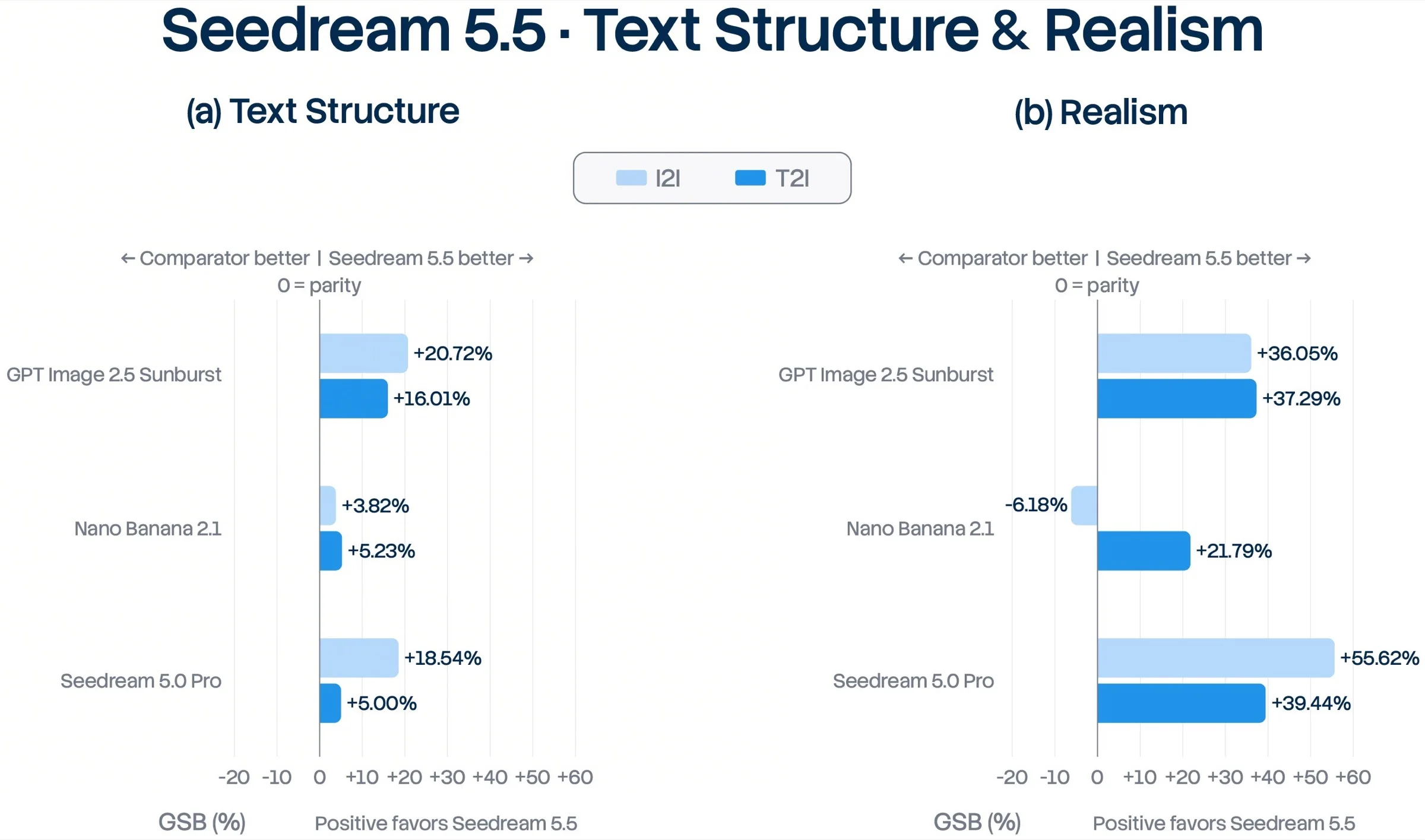
To reduce synthetic skin sheen and garbled signage, ByteDance Seed retrained the model’s layout and texture stages for dense Chinese and English typography as well as natural lens grain. On Good-Same-Bad (GSB) human preference evaluations published by the team, Seedream 5.5 outperforms GPT Image 2.5 Sunburst, Google’s Nano Banana 2.1 and Seedream 5.0 Pro on text-to-image realism and bilingual text structure, with only image-to-image realism against Nano Banana 2.1 (-6.18%) favouring the rival model. Seedream 5.5 is rolling out across Jimeng, Doubao, Doubao Work and enterprise API platform Volcano Ark; ByteDance Seed did not disclose international per-image API pricing in the blog post.
Good-Same-Bad human preference margins comparing Seedream 5.5 against GPT Image 2.5 Sunburst, Nano Banana 2.1 and Seedream 5.0 Pro.Image: ByteDance Seed
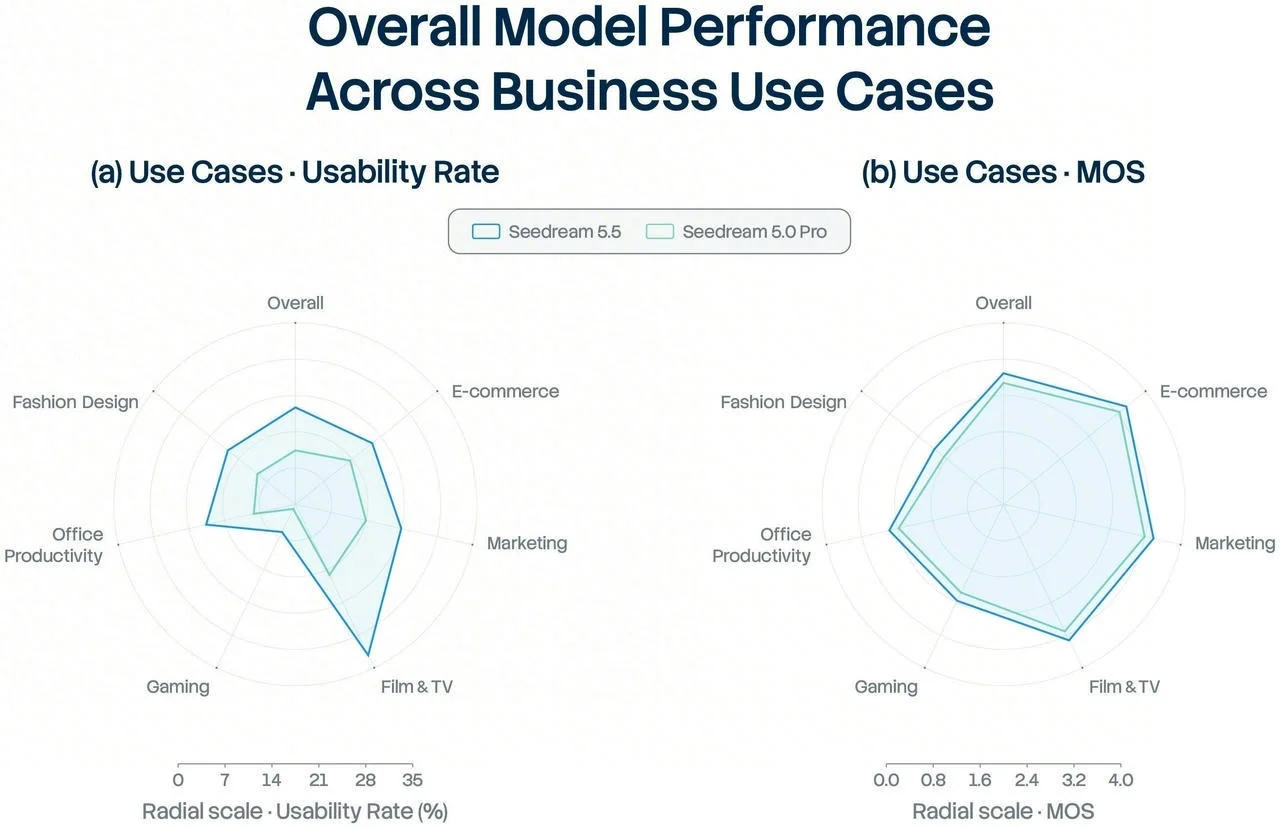
Usability rate and mean opinion score gains across six commercial design categories relative to Seedream 5.0 Pro.Image: ByteDance Seed
Assembled in roughly one week by Epic engineers directing coding-agent swarms, the experimental build wires Claude Code, Codex, Cursor and OpenCode directly into Unreal subsystems.
Epic Games released the experimental Unreal Engine 5.9 MegaJam Preview on 9 November 2026 ahead of the Epic AI MegaJam running from 12 to 15 November 2026. According to Epic Games and CEO Tim Sweeney, a small internal engineering team built the preview branch in roughly one week by directing swarms of autonomous coding agents across the engine’s C++ and Python codebase rather than writing every integration manually.
Agent harnesses, Canvas and browser runtime
The preview embeds an experimental Unreal Assistant panel that connects external coding harnesses, including Claude Code, Codex, Cursor and OpenCode, directly to an auto-launching Unreal Model Context Protocol (MCP) server. Epic also expanded Unreal’s Python scripting APIs across MetaSounds audio graphs, Niagara particle systems, Procedural Content Generation (PCG), physics constraints and UMG user interfaces so agents can inspect and mutate whole levels programmatically without custom C++ glue. An integrated Unreal Canvas workspace generates concept art and converts 2D prompts into textured 3D meshes inside the editor, while a revived WebAssembly and WebGPU export target packages playable Unreal projects to run directly in desktop browsers. The preview is free to download through the Epic Games Launcher, GitHub source access and Linux archives, though Epic warns that experimental APIs may change before stable 5.9.
Integrated into Newton 1.8 RC with a companion WebGPU browser runtime, Steel groups varied robot morphologies on GPU warps to run 3.8 times faster than NVIDIA PhysX.
Skild AI released Steel (Scalable Throughput-optimized Engine for Embodied Learning) on 9 November 2026 as a GPU rigid-body dynamics solver inside Newton 1.8 Release Candidate, the open-source physics engine co-developed by NVIDIA, Google DeepMind and Disney Research under the Linux Foundation. Traditional GPU simulators run fastest when thousands of parallel environments contain identical robots and identical object counts, but stall under warp divergence when training generalist policies across mixed arms, hands, quadrupeds and humanoids.
Heterogeneous batching and throughput
Steel eliminates that bottleneck by grouping articulations with matching joint counts across disparate scenes and dynamically routing narrow-phase collision contacts per environment. Skild AI also coupled the rigid-body solver with Material Point Method (MPM) sand, finite-element cloth and deformable cables, alongside an interactive steel-webgpu solver that runs directly in web browsers. Skild AI’s 20-task benchmark chart is rendered in HTML on its blog rather than as a static image: across 20 heterogeneous robotics environments, Steel reaches 3.8 times the geometric-mean simulation throughput of NVIDIA PhysX, compared with 2.9 times for MuJoCo Warp.
Two-way coupling in Steel between an articulated Franka arm and a deformable cable solver.Video: Skild AI
Activating 100M of its 800M parameters over a 15 Hz audio codec, ZONOS3-Mini hits 80 ms median time to first audio on an H100 while running locally on WebGPU, MLX and ggml.
Zyphra released ZONOS3-Mini and its companion ZAC 1 neural audio codec under the Apache 2.0 licence on 9 November 2026. The text-to-speech and zero-shotvoice-cloning model uses a sparse mixture-of-experts (MoE) backbone with 800M total parameters and 100M active per token, pairing Gated DeltaNet linear-recurrence layers with standard attention in a 3:1 ratio. Zyphra pretrained the model on 112 H100 GPUs in 2.5 days before applying Direct Preference Optimisation (DPO) and Group Relative Policy Optimisation (GRPO) to reduce word skips and unstable prosody.
Low-frame-rate codec and edge runtimes
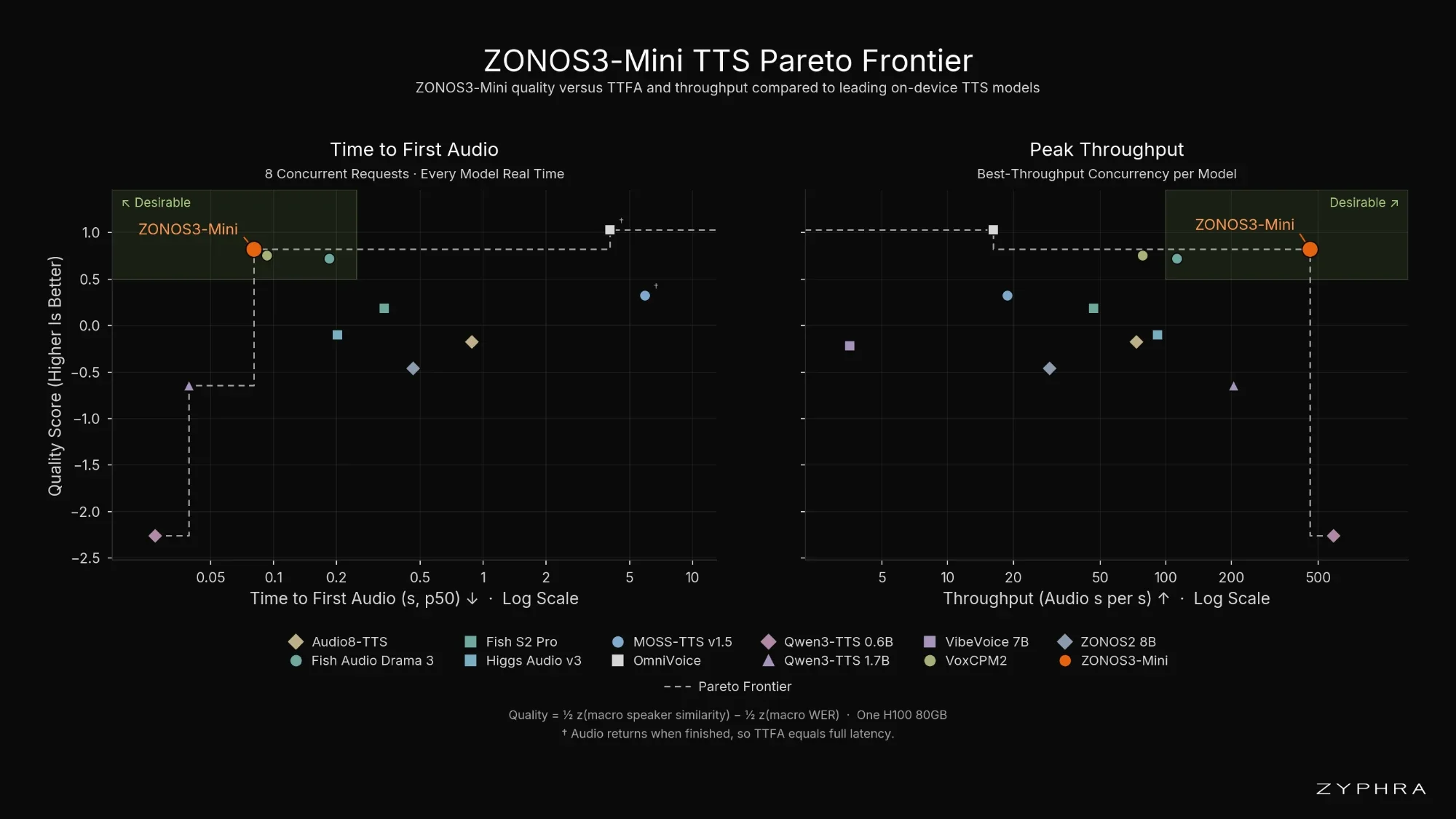
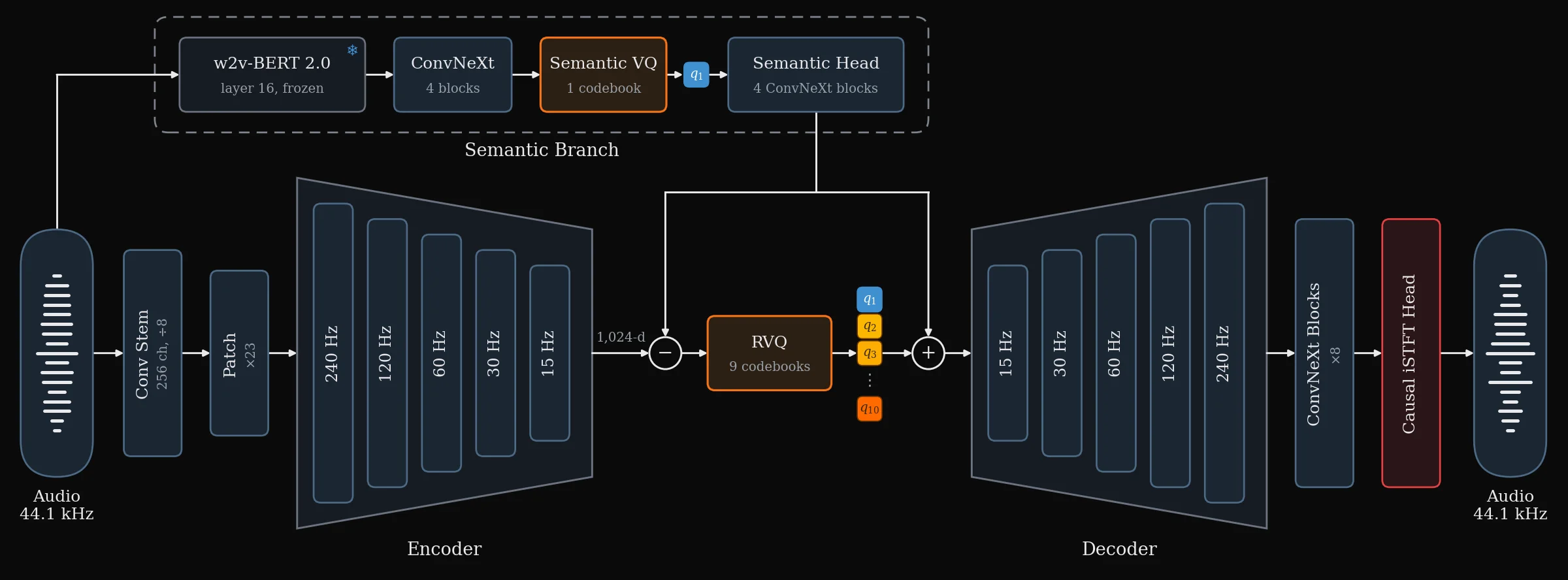
Instead of generating dense 50 Hz audio tokens, ZONOS3-Mini predicts tokens from ZAC 1, a 44.1 kHz codec operating at 15 Hz across one w2v-BERT 2.0 semantic codebook and nine residual vector-quantisation (RVQ) acoustic codebooks, conditioned on Zyphra’s MECT-B2 speaker encoder. On one H100 80GB GPU across 55 subsets of Zyphra’s ZTTS2-Eval suite, ZONOS3-Mini achieves an 80 ms median time to first audio at eight concurrent requests and peaks at 457 seconds of generated audio per second, advancing the quality-versus-latency Pareto frontier against Qwen3-TTS, Higgs Audio v3 and Fish S2 Pro. Reference inference implementations ship for SGLang-Omni, CUDA, Apple Silicon MLX, C++/ggml and in-browser WebGPU.
Quality score against median time to first audio and peak throughput across 11 open and commercial TTS models on one H100 80GB GPU.Image: Zyphra
ZAC 1 compresses 44.1 kHz speech to a 15 Hz frame rate across one semantic and nine acoustic codebooks.Image: Zyphra
Built on Automattic’s global edge infrastructure, Spacefast gives ChatGPT, Claude, Cursor and CLI agents a live URL, MySQL database, storage and version rollbacks in one command.
Automattic, the company behind WordPress.com and WooCommerce, launched Spacefast on 9 November 2026 to turn prototypes generated inside AI chats and coding agents into hosted full-stack web applications. Founded inside Automattic by former Beeper engineer Batuhan and backed by infrastructure serving more than 15 billion monthly pageviews, Spacefast connects through Model Context Protocol (MCP) plugins or a single terminal publish command to ChatGPT, Claude, Cursor, Meta’s Muse, Grok Bot and OpenCode.
Managed backend and plan tiers
Unlike static preview sandboxes that vanish when a chat session closes, each Space provisions a persistent public or access-controlled URL, a managed MySQL database, file upload storage, environment secrets, automatic version history with one-click rollbacks, and pinned on-page visual comments that feed revision instructions straight back to the user’s coding agent. Spacefast offers a free Personal plan with $1 of monthly compute credit, up to 20 Spaces and 1 GB of disk storage; a Go tier at $5 a month ($5 usage credit, 100 Spaces, 10 GB storage); a Pro tier at $15 a month ($15 usage credit, 500 Spaces, 25 GB storage and up to five team members included before $15 per extra seat); and custom Enterprise contracts.
Released under the MIT licence by Expo co-founder Charlie Cheever, Exact drops webviews and JavaScript bridges in favour of a Rust layout kernel and built-in agent test driver.
Expo open-sourced Exact on GitHub under the MIT licence on 9 November 2026, introducing an experimental cross-platform UI stack created by co-founder Charlie Cheever specifically for human-and-agentco-authoring. Instead of mixing imperative component trees with styling workarounds, Exact separates presentation into a constrained declarative language called Contract while keeping state and data logic in TypeScript or Rust.
Compiler pipeline and native painters
An ahead-of-time compiler lowers each Contract specification into a compact execution plan. On the web, that plan runs through a roughly 20 KB DOM runtime with zero virtual-DOM diffing overhead. On desktop and mobile targets, a shared Rust layout kernel computes geometry and hands draw commands directly to native platform painters across macOS AppKit, iOS UIKit and GPU-rendered Linux windows, with no embedded webview and no asynchronous JavaScript bridge. Because every UI node maps deterministically to its Contract source, Exact ships with a headless agent driver that lets coding agents build screens, inspect live layout bounds, trigger user actions and assert visual states programmatically. Windows and Android painters are listed on the repository roadmap rather than complete in the initial preview.
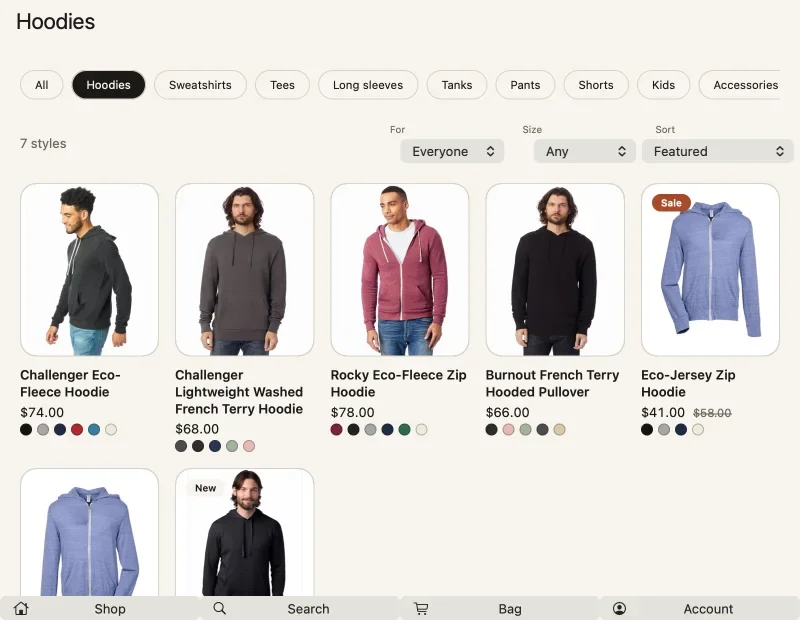
Exact’s Softwear reference storefront rendered natively from the same Contract UI definition that drives its web target.Image: Expo
Adobe and The Walt Disney Company announced a multi-year alliance on 9 November 2026 to deploy Adobe Firefly Foundry, Creative Cloud and GenStudio across Disney’s film, television and marketing teams. Under the agreement, custom generative models trained on Disney’s characters and worlds remain strictly isolated to Disney’s internal production pipelines and are never pooled into public Firefly training sets. Neither company disclosed financial terms.
Runway announced Sightline on 9 November 2026, rolling the new visual workspace out immediately to every paid Runway subscription tier. Sightline replaces scattered folder uploads and single-prompt boxes with a spatial canvas where creative teams can arrange reference moodboards, generate images and videos side by side, and iterate across visual formats in one continuous project view.
Google integrated the Google Maps Platform directly into Google AI Studio on 9 November 2026, letting developers generate geospatial web applications with photorealistic 3D maps, Places data, routing and Street View from natural-language prompts. A built-in sandbox provides up to 100 free Maps API calls per day inside AI Studio without requiring a Google Cloud billing account or manual API key setup before production export.
OpenAI rolled out multi-computer support in its developer environment dot on 9 November 2026, allowing engineers to link cloud devboxes, remote GPU machines and secondary laptops into a single local workspace. Agents inside dot can run builds, training jobs and file edits across connected machines simultaneously without manual SSH juggling, with the feature enabled out of the box in the latest release.