

Coding agentGoogleConfirmed
Story 2 of 13 in the Wednesday 11 November editionGoogle Antigravity adds built-in browser subagent control across parallel tabs
Available in Google Antigravity v2.30.0+ on the desktop App and CLI, Browser Use spawns isolated Gemini Flash subagents to playtest localhost builds, inspect console errors and run multi-tab web checks without stealing focus.

 Edited by Ashutosh Shrivastava
12 Nov 2026, 10:05 IST · 3 min read
Google Antigravity rolled out built-in Browser Use across the Antigravity desktop App and Antigravity CLI (v2.30.0+ when signed in with a personal Google Account), documented on 11 November 2026 a day after Google Antigravity’s /swarm multi-agent preview. Developers can ask in plain language or invoke the /browser slash command to test a running localhost server, click through responsive viewports, fill forms, inspect console errors and failed network requests, and verify visual UI fixes before an agent completes its turn.
Side-panel actuation, parallel tabs and sandbox rules
Rather than requiring a separate external Chrome setup in the desktop App, the main coding agent delegates live UI work to an isolated browser subagent running inside the embedded side-panel webview. Each browser subagent runs in its own context window on a Gemini Flash model by default so full-page DOM snapshots and screenshots do not consume main-thread context or higher-tier model quota; if Flash quota runs out, the agent pauses and asks the user before switching models.
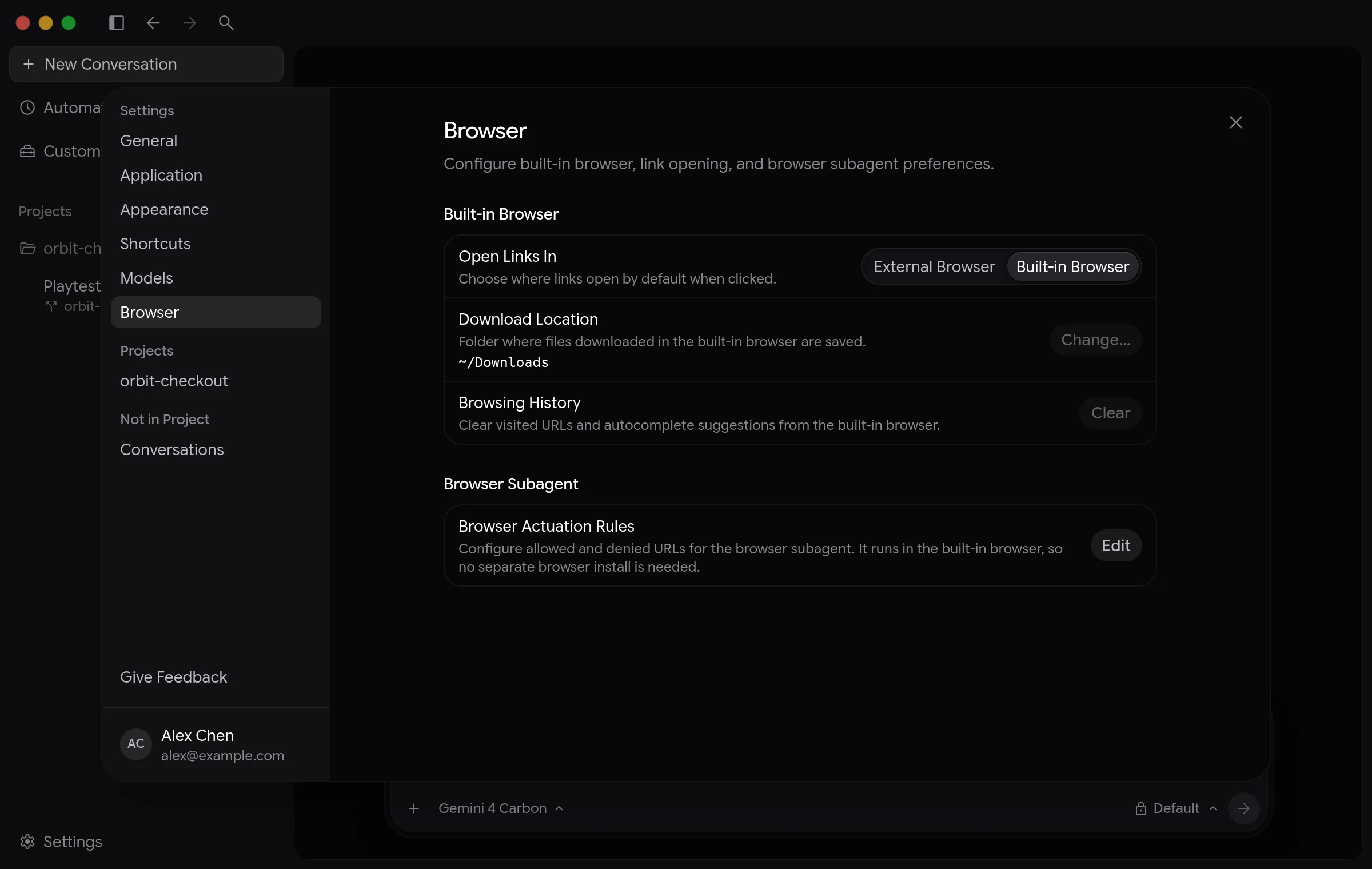
While acting, the embedded browser displays an animated step-status cursor without stealing keyboard focus from the editor or hijacking a foreground tab the developer is reading. Multiple browser subagents can also operate concurrently in dedicated parallel tabs for cross-environment audits, governed by configurable Browser Actuation Rules for allowed and denied URLs, download paths, and manual sign-in handoffs, while CLI sessions execute browser tasks through Chrome DevTools.
Technical details
- Minimum version and OS
- Google Antigravity v2.30.0+ on macOS, Windows and Linux (personal Google Accounts)
- Default subagent model
- Gemini Flash in an isolated context window across Free, Plus, Google AI Pro and Google AI Ultra
- Enterprise and remote fallback
- Chrome DevTools /browser against local Chrome v144+ (also in IDE v2.6.0+ and VS Code extension v1.9.0+)
- CLI monitoring shortcuts
- /browser to launch; /agents, Alt + J or Ctrl + K to inspect active browser subagents
- Sandbox and auth controls
- Isolated persistent cookie profile, URL allow/deny rules, red Stop takeover and manual SSO/MFA handoff
Release details & context
Account eligibility, OAuth pause-and-resume and Chrome DevTools fallback
In the Google Antigravity Browser Use documentation, the embedded browser subagent in v2.30.0+ applies to personal Google Accounts on Free, Plus, Google AI Pro and Google AI Ultra plans, whereas manual side-panel browsing works across all desktop accounts from v2.26.0+. Business or enterprise workspaces, SSH windows and Antigravity Remote Agents instead route /browser through Chrome DevTools on local Chrome v144+ (enabled via chrome://inspect/#remote-debugging and npx, and also available in Antigravity IDE v2.6.0+ and the VS Code extension v1.9.0+).
Complementing parallel code builders in Antigravity /swarm, each Antigravity account keeps a dedicated cookie profile isolated from the user’s system browser, automatically pausing for manual developer sign-in whenever a workflow encounters Google Sign-In, Microsoft/Apple/Okta/Auth0 SSO, MFA prompts, passkeys or CAPTCHAs.
Common questions
How do enterprise or Remote Agent sessions run browser tests in Google Antigravity?
Workspace enterprise accounts, SSH sessions and Remote Agents connect /browser via Chrome DevTools to a local Chrome v144+ instance rather than the personal-account embedded browser subagent.
What happens when the Antigravity browser subagent hits a login screen or CAPTCHA?
The subagent pauses automatically and hands control to the developer to complete OAuth, SSO, MFA, passkey or CAPTCHA steps inside its isolated cookie profile before resuming.
Sources
- PrimaryBrowser use in Google Antigravity documentationantigravity.google
Google release timeline (24 launches tracked)
- Google unveils confidential TPU 8tx and high-memory TPU 8i Max with open-source TPU Sync
Google introduces confidential TPU 8tx and high-memory TPU 8i Max accelerators alongside Agent Compute Engine and the open-source TPU Sync KV-cache layer.
- Google AI Studio adds zero-setup Google Maps Platform toolkit with free daily sandbox calls
Google embeds a Google Maps Platform toolkit into AI Studio with 100 free daily sandbox calls and no credit card requirement.
- Google launches Gemini 4 Carbon at $2 and $10 introductory API pricing
Google ships Gemini 4 Carbon at $2 and $10 introductory API pricing per million tokens, ranking first on CursorBench 4.0, WANDR and AutomationBench.
- Google Antigravity adds Gemini 4 Carbon and previews /swarm multi-agent orchestration
Google Antigravity adds Gemini 4 Carbon for Ultra subscribers and previews /swarm to coordinate parallel coding and verifier agents.