Built for closed-set routing, classification and rubric grading across text, images, audio, video and PDFs, Gemini Decision 1 scores up to 1,000 questions in a single forward pass with zero output tokens billed.
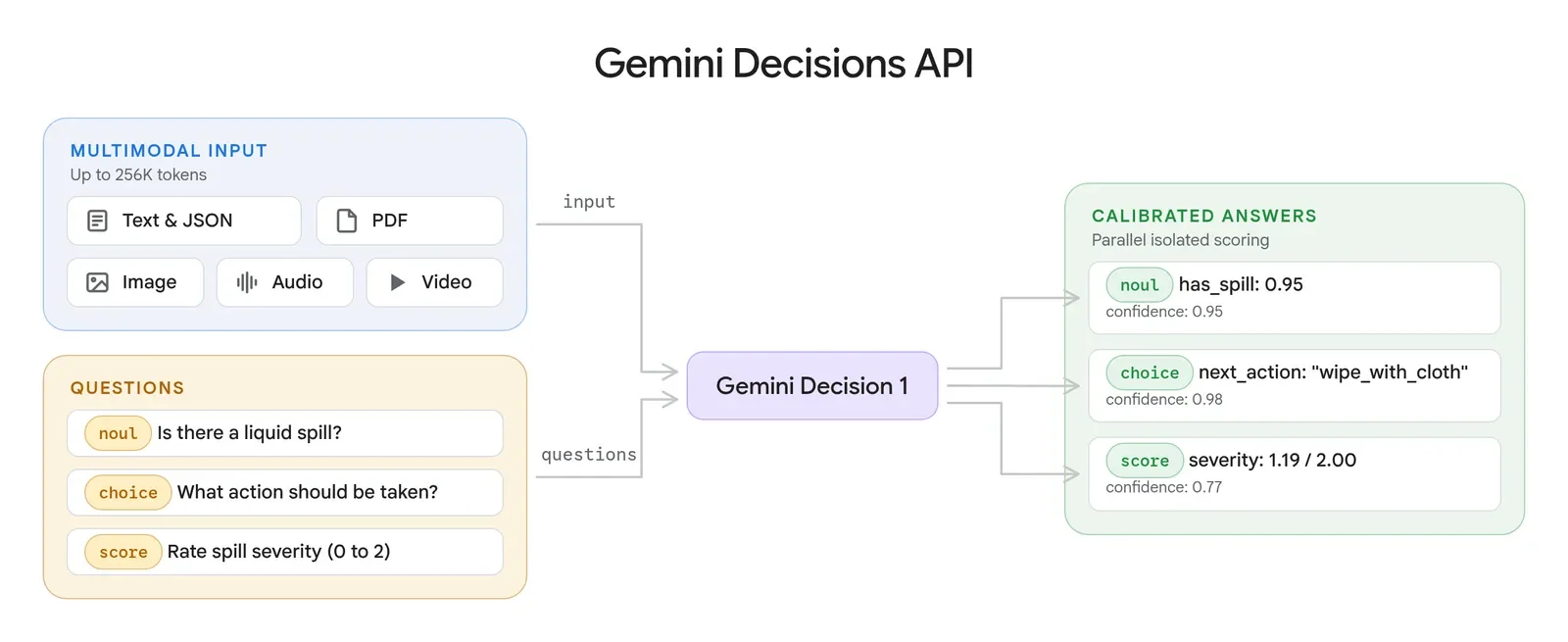
Google released the Gemini Decisions API and its underlying Gemini Decision 1 model (gemini-decision-1) in Google AI Studio and the Gemini API (v1beta, google-genai SDK 3.2+) on 11 November 2026, alongside day-onethird-party support on OpenRouter, LangChain, Vercel, LiteLLM, Pydantic AI, Pipecat, LiveKit, and OpenCode. Built by Google DeepMind for deterministic software control planes rather than open-ended chat, the endpoint accepts one shared multimodal input up to 262,144 tokens (256k) across text, images, audio, video, and PDFs, and evaluates up to 1,000 isolated questions in parallel during a single prefill pass.
Single-pass decision types and benchmark results
Every question uses one of three primitives and returns a calibrated confidence score from 0 to 1 so application code can act directly or escalate ambiguous cases without parsing generated text. Binary checks (noul) return a probability from 0.01 to 0.99; single-select routing (choice) returns normalised probabilities across 2 to 255 options; and ordered grading (score) returns a probability-weighted score across 2 to 255 rubric levels. Google already runs the endpoint internally for dynamic model routing in Gemini Notebook (cutting everyday query latency by up to 40%), interactive wireframing in Stitch Rapid, 200-option emoji selection in Google Labs’ CC, and adversarial MCP tool screening in Search.
Each call bills the shared multimodal input once and evaluates noul, choice and score questions in one forward pass.Image: Google
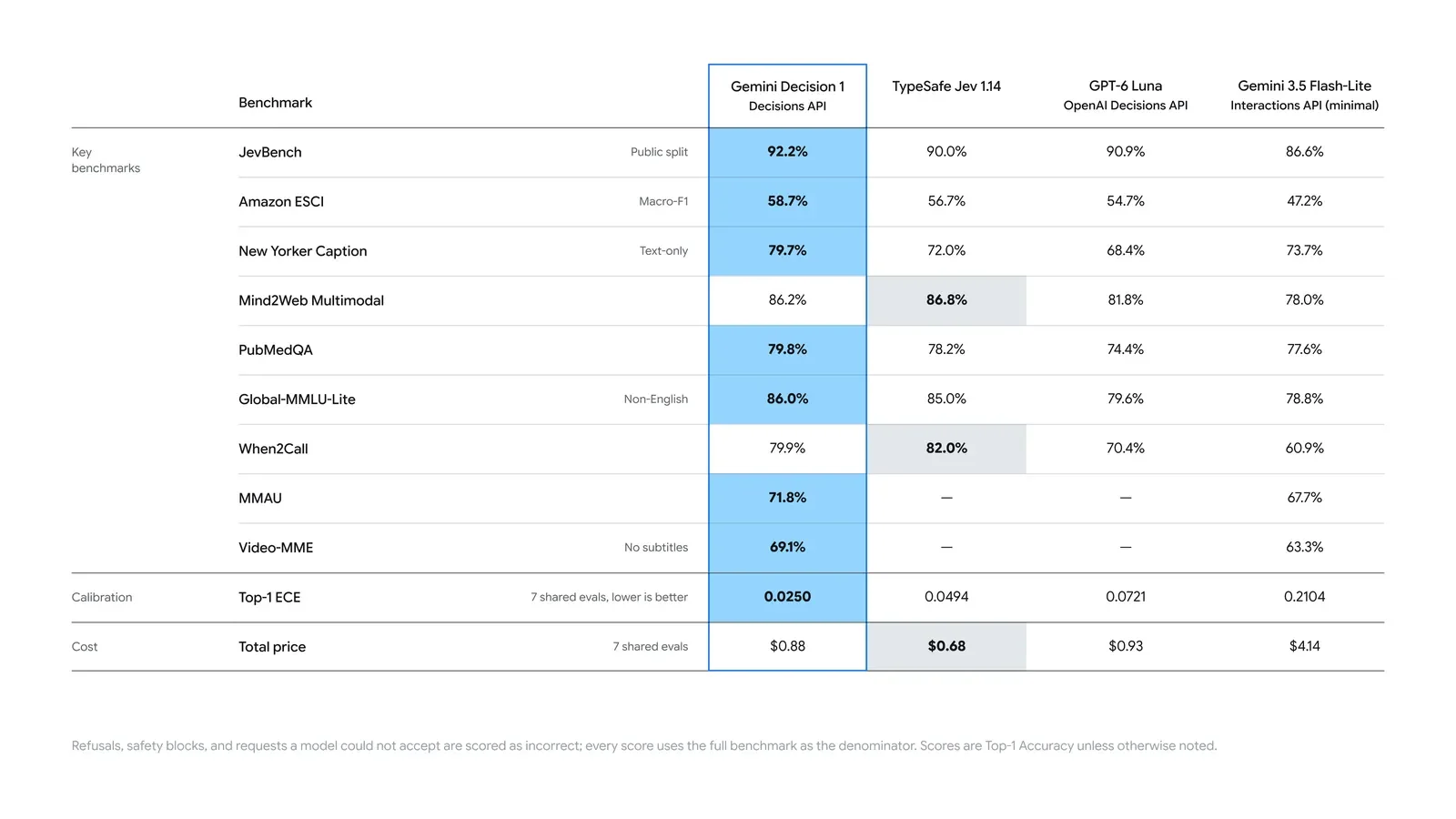
On Google’s evaluation suite, Gemini Decision 1 leads JevBench, Amazon ESCI, New Yorker Caption, PubMedQA, Global-MMLU-Lite, MMAU, and Video-MME while posting the lowest calibration error against TypeSafe Jev 1.14 and GPT-6 Luna. Separately, independent evaluator Artificial Analysis scored Gemini Decision 1 at 66 on its Decision Index v2.1 (leading AA-Omniscience-Decision at 66, behind Drex Max v1.1 and GLiDE v1.2 at 73 overall) and calculated a cost of $345 per million tasks across that index.
Google’s benchmark and Top-1 Expected Calibration Error comparison across classification, multimodal and reasoning suites.Image: Google
Key numbers
$0.10 per million paid-tier input tokens across all modalities, $0 output tokens billed, plus a free prototyping tier (shared input billed once per call; Batch API and context caching unsupported)
50 to 100 ms median model compute latency (150 to 250 ms end-to-end) up to 16k tokens, staying nearly flat from 1 to 100 questions
Nearly 5 times lower cost across Google’s shared benchmark suite than Gemini 3.5 Flash-Lite on the Interactions API
Available in Google Antigravity v2.30.0+ on the desktop App and CLI, Browser Use spawns isolated Gemini Flash subagents to playtest localhost builds, inspect console errors and run multi-tab web checks without stealing focus.
Google Antigravity rolled out built-in Browser Use across the Antigravity desktop App and Antigravity CLI (v2.30.0+ when signed in with a personal Google Account), documented on 11 November 2026 a day after Google Antigravity’s /swarm multi-agent preview. Developers can ask in plain language or invoke the /browser slash command to test a running localhost server, click through responsive viewports, fill forms, inspect console errors and failed network requests, and verify visual UI fixes before an agent completes its turn.
Side-panel actuation, parallel tabs and sandbox rules
Rather than requiring a separate external Chrome setup in the desktop App, the main coding agent delegates live UI work to an isolated browser subagent running inside the embedded side-panel webview. Each browser subagent runs in its own context window on a Gemini Flash model by default so full-page DOM snapshots and screenshots do not consume main-thread context or higher-tier model quota; if Flash quota runs out, the agent pauses and asks the user before switching models.
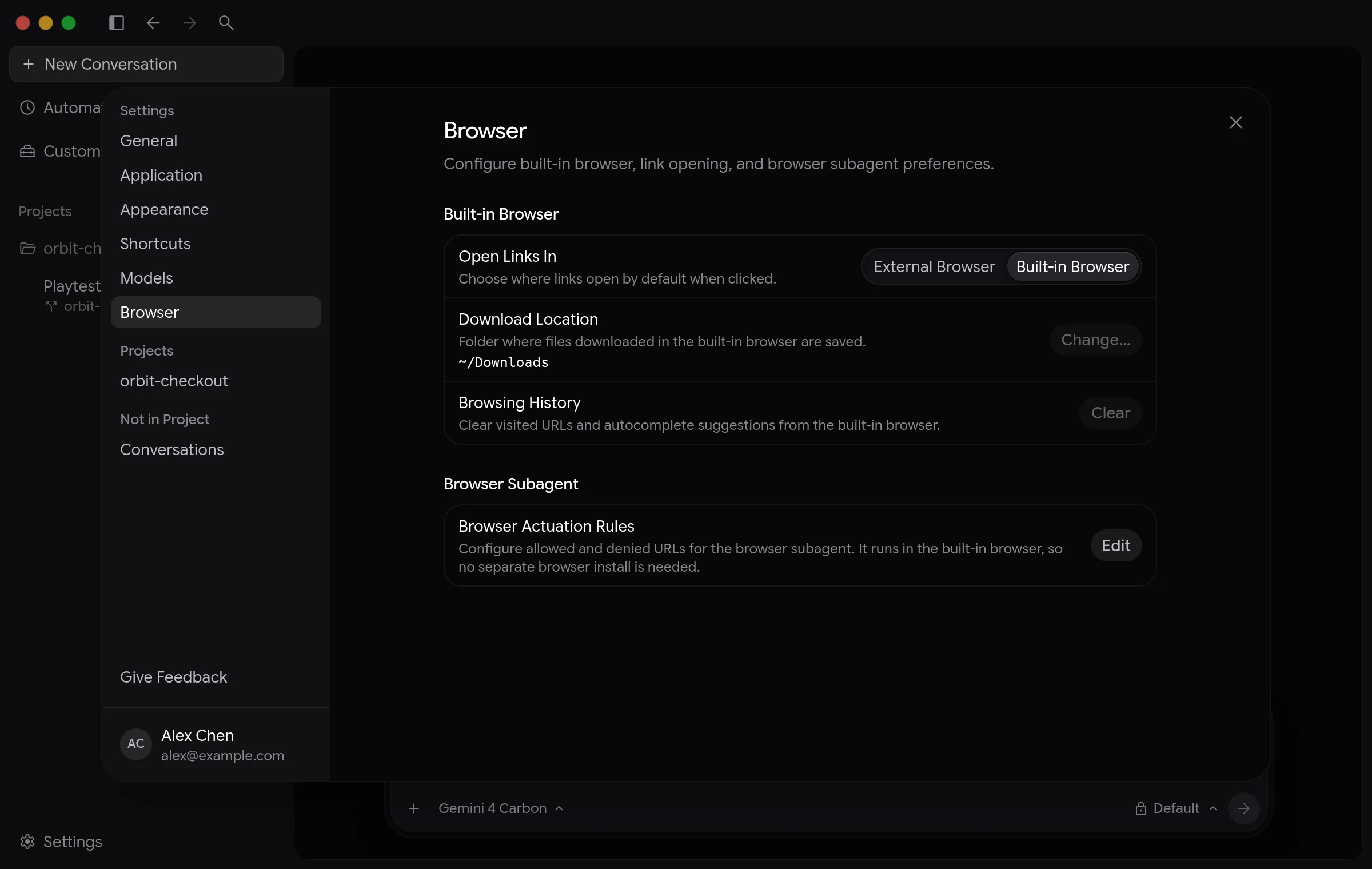
While acting, the embedded browser displays an animated step-status cursor without stealing keyboard focus from the editor or hijacking a foreground tab the developer is reading. Multiple browser subagents can also operate concurrently in dedicated parallel tabs for cross-environment audits, governed by configurable Browser Actuation Rules for allowed and denied URLs, download paths, and manual sign-in handoffs, while CLI sessions execute browser tasks through Chrome DevTools.
Configurable Browser Settings govern link routing, downloads and allowed or denied URL rules for the embedded browser subagent.Image: Google
Free for non-commercial research through the alphagenome Python SDK alongside the nine-billion-variant AlphaGenome Atlas, AlphaGenome 2 conditions 1-megabase DNA predictions directly on user-suppliedscRNA-seq profiles.
Google DeepMind released AlphaGenome 2 on 11 November 2026 through its updated alphagenome Python package (alphagenome.models.v2) and free non-commercial research API, alongside the zero-code and programmatic AlphaGenome Atlas covering pre-computed in silico mutagenesis and AlphaGenome Variant Impact (AVI) prioritisation scores across 9 billion human coding and non-coding variants. Whereas AlphaGenome 1 scored variants across fixed reference assays simultaneously, AlphaGenome 2 zooms into specific cellular contexts to model why identical single-letter DNA mutations trigger disease in certain cell types, such as heart muscle or immune cells, while sparing others.
Single-cell expression conditioning and imputed modalities
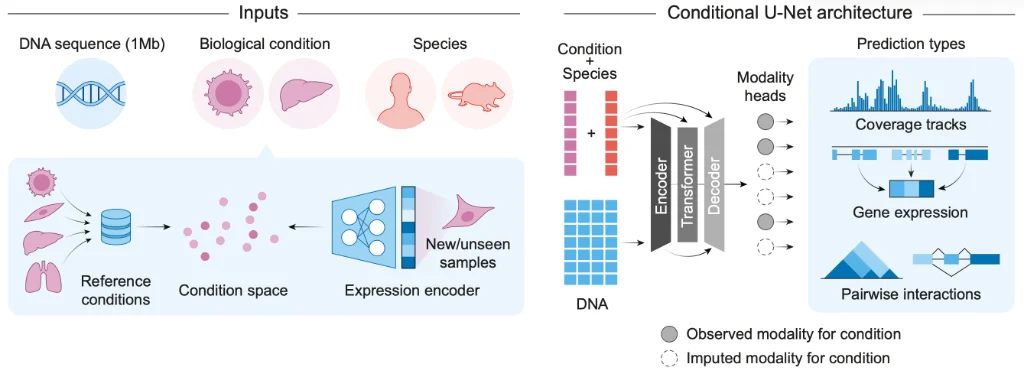
AlphaGenome 2 pairs a 1-megabase (1 Mb) conditional U-Net and transformer sequence backbone with a dedicated cell expression encoder (encode_cells). Researchers can select composite ontology reference conditions or pass their own raw human single-cellRNA-seq (scRNA-seq) unique molecular identifier count matrices (up to 256 cells per API call via cell_conditioning) to generalise regulatory predictions to previously unseen cell states.
AlphaGenome 2 combines a 1 Mb conditional U-Net transformer with an expression encoder for unseen single-cell samples and imputed tracks.Image: Google DeepMind
The v2 release adds predicted single-cell chromatin accessibility (SC_ATAC), denoised and protocol-specificsingle-cell gene expression, CpG methylation variant scoring (MethylationScorer), cross-modality imputation for unmeasured biosample tracks, and batched input-gradient calls (predict_interval_gradients_batch) for enhancer-to-gene attribution across human and mouse genomes. Google DeepMind has not announced commercial API pricing tiers.
Announced by SpaceXSI, Elon Musk and the @bot product account on 11 November 2026, Grok Bot 1.0 turns configurable Grok instances into shareable colleagues that join live meetings and accumulate team context.
SpaceXSI introduced Grok Bot 1.0 on 11 November 2026 via its official X channels alongside Elon Musk and the dedicated @bot product handle, packaging Grok into persistent, shareable workplace teammates rather than single-user chat threads. Instead of restricting prompts and custom setups to one individual’s private session, teams can configure task-specific Bots and share them directly across colleagues inside an organisation.
Workspace channels, live meetings and adaptive memory
According to the launch posts, Grok Bot 1.0 operates natively inside Slack channels and Microsoft Teams workspaces and can be invited directly into live team meetings as an active participant. Across recurring threads and calls, shared Bots retain institutional context and learn team conventions over time so coworkers do not have to restate project background on each assignment.
SpaceXSI framed the 1.0 release around delegating multi-step workplace tasks to a shared colleague inside existing enterprise communication tools. SpaceXSI has not published a standalone technical documentation page, enterprise seat or token pricing, seat limits, model version details, or compliance and data-retention controls alongside the X launch posts.
Available across Free, Go, Plus and Pro plans in the United States after updating the ChatGPT desktop client, Finances pairs personal spending and investment analysis with custom financial tool creation.
OpenAI rolled out Finances inside the ChatGPT desktop application on 11 November 2026, a day after launching Businesses in ChatGPT. Announced via the official @ChatGPT account, the dedicated desktop workspace is available immediately after updating the desktop app across Free, Go, Plus, and Pro subscription tiers in the United States.
Spending breakdowns, portfolio tracking and custom tools
Finances gives individuals a structured workspace inside the desktop client to review recurring expenses, identify opportunities to save, and examine personal investment holdings in one view rather than uploading ad-hoc CSV exports into standard chat threads. Users can also build custom interactive financial tools tailored to their own budgets, savings targets, or portfolio allocation questions directly within the app.
Making the workspace available down to the Free and Go tiers broadens access beyond paid Plus and Pro subscribers from day one in the US market. OpenAI did not publish a companion technical blog post detailing supported brokerage or bank aggregation providers, supported desktop operating systems, encryption boundaries for connected financial records, or rollout dates outside the United States.
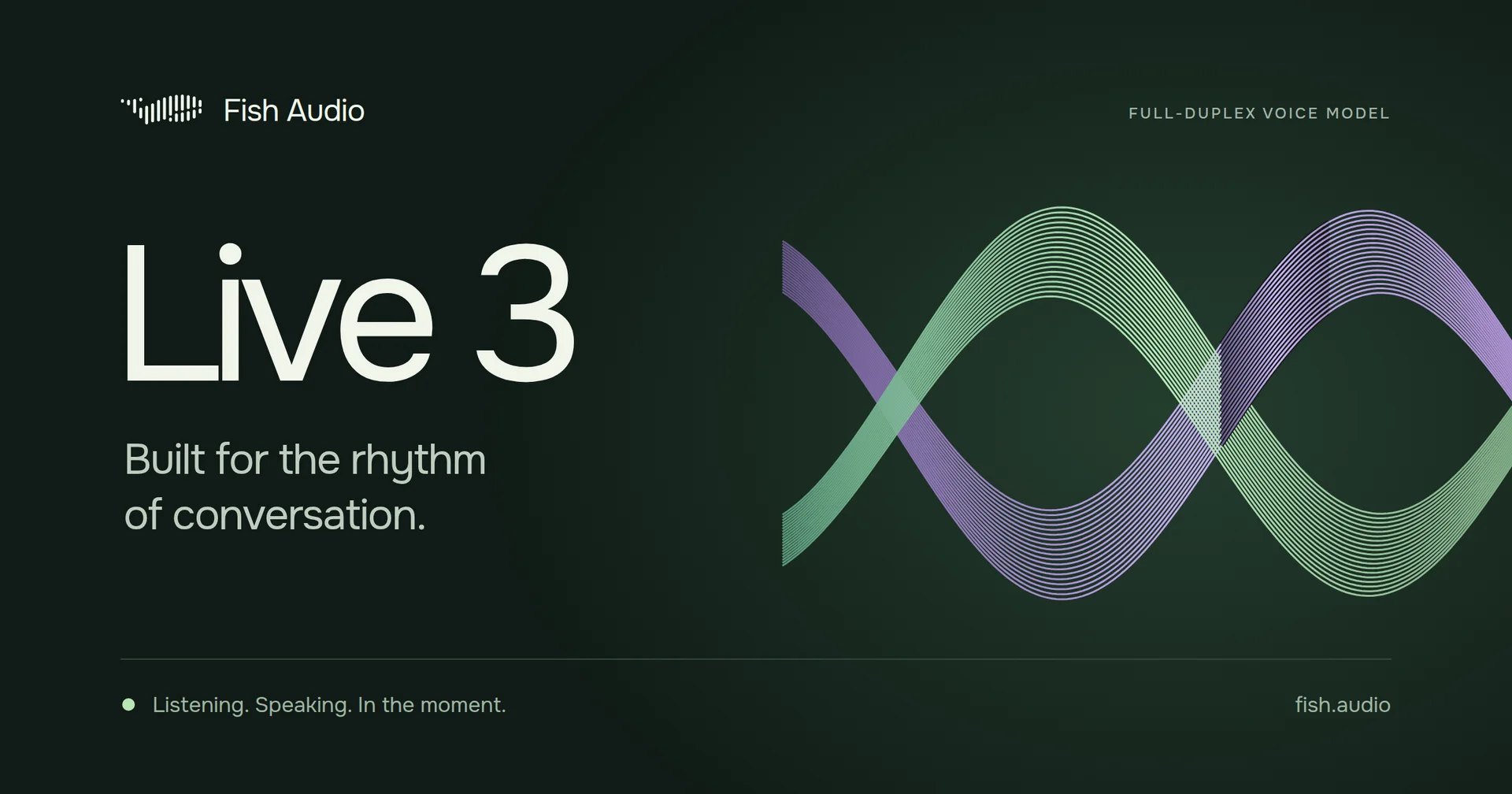
Published on 10 November 2026 for English voice agents on the Fish Agent Platform and API, Live 3 trains conversational turn-taking directly into the speech model so agents listen while speaking.
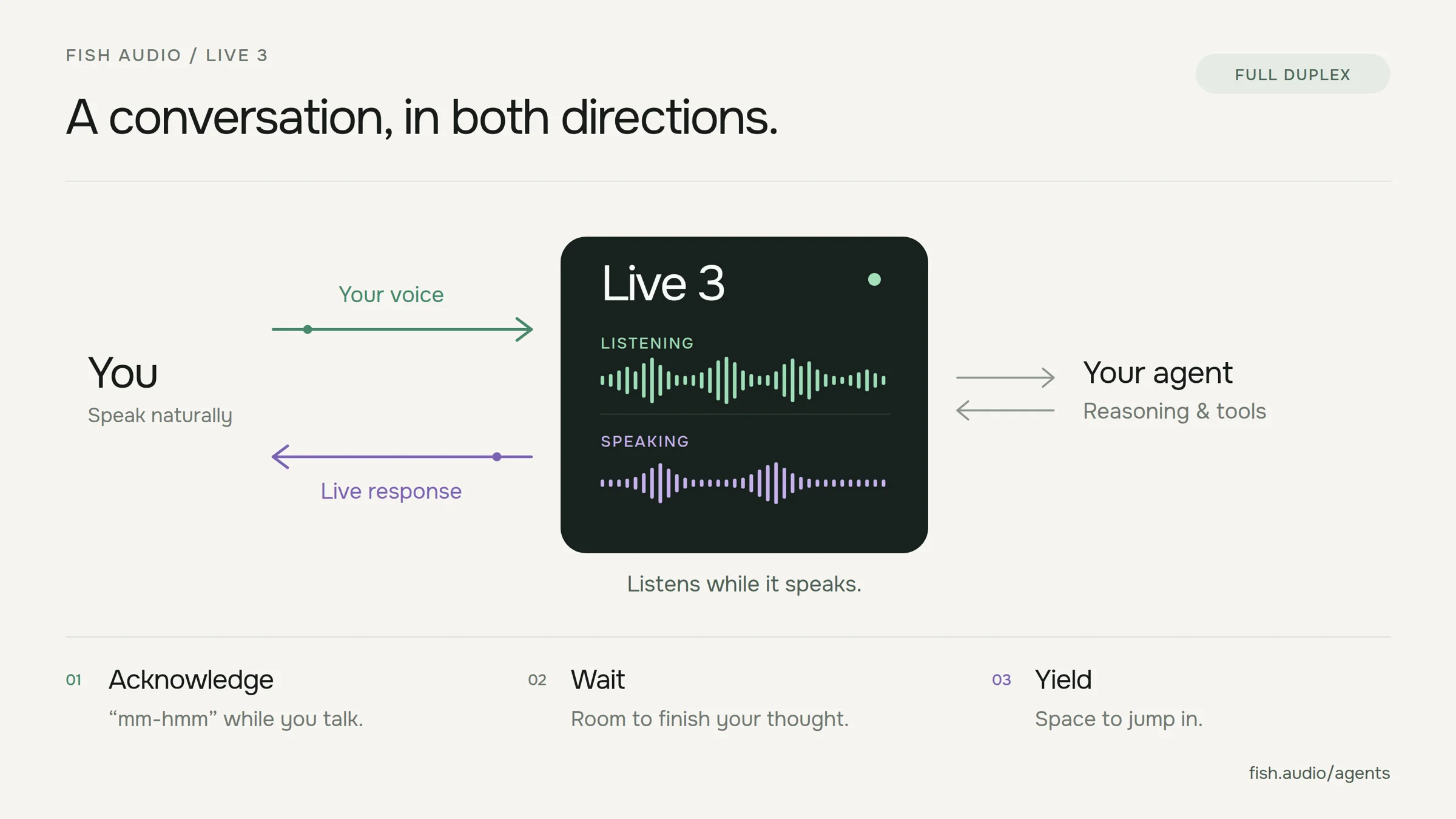
Fish Audio introduced Live 3 on 10 November 2026 across the Fish Agent Platform, its developer API, and enterprise deployments, launching an English full-duplex voice model built to listen continuously while speaking. Instead of stitching separate voice-activity thresholds and rule-based interruption timers onto a cascaded speech-to-text and text-to-speech pipeline, Fish Audio trained conversational timing directly into the speech model on recordings of human dialogues while keeping a separate reasoning layer for agent instructions, knowledge bases, and external tool calls.
Live 3 keeps listening while speaking and separates acoustic turn-taking from the agent’s reasoning and tool-calling layer.Image: Fish Audio
Learned backchannels, mid-order revisions and barge-in
Live 3 distinguishes brief listener backchannels from genuine interruptions. When a caller says “yeah” or “mm-hmm” while an agent reads back store hours or an order summary, Live 3 continues speaking without cutting off its own turn; when the caller interjects to change days or items, the model stops immediately and yields the floor.
During chunked inputs such as phone numbers or multi-item food orders with mid-sentenceself-corrections, Live 3 can decide to emit a short confirmation in as little as 186 milliseconds and wait through pauses until the caller finishes deciding, drawing on Fish Audio’s library of more than 2 million voices and custom clones. Fish Audio has not published standalone per-minute API pricing or multilingual release dates for Live 3.
Pairing a chunk-causal MoE video-diffusion trunk with a 0.3B action expert, Praxis-1 ranks first among open-source robot foundation models on NVIDIA’s RoboLab-120 benchmark at 46.2% task success.
Runway open-sourcedPraxis-1 under the Apache 2.0 licence on 11 November 2026, releasing base and embodiment-tuned checkpoints on Hugging Face alongside reference training and inference code on GitHub (runwayml/praxis-1-oss), a day after Google DeepMind unveiled Gemini Robotics 2.5. Built to overcome the scarcity of teleoperated robot trajectories by transferring physical intuition from general human video pretraining, Praxis-1 pairs a 27.2B-parameterMixture-of-Expertschunk-causalvideo-diffusion trunk (54.4 GB in BF16, using frozen Wan2.2 VAE and Qwen3.5-2B encoders) with a 0.3B-parameter action expert mid-trained across 18 robot embodiments.
Joint video-action chunking and RoboLab-120 results
On each control call, Praxis-1 ingests a language instruction, recent camera frames, and current proprioceptive pose to jointly predict a future video chunk and 1.6 seconds of motor commands (24 action steps at 15 Hz), adapting across single-arm Franka DROID rigs, bimanual YAM arms, Google RT-1 SimplerEnv, and low-costSO-101 hardware via six lightweight per-rig projection tensors and NVFP4 quantised checkpoints. Runway’s benchmark charts on the research page are interactive web components rather than static image files: fine-tuned on DROID, Praxis-1 leads all world action models and open-weightvision-language-action policies on NVIDIA’s 120-taskRoboLab-120 simulation suite, ahead of FLUX 3 Action, pi 0.5, and GR00T N1.6, trailing only zero-shot frontier VLM harnesses AMP1 (86.0%) and SenseNova-RoboRSI (57.1%).
Key numbers
46.2% success rate (555 of 1,200 episodes) on NVIDIA RoboLab-120, ahead of FLUX 3 Action at 42.9%
27.2B MoE video-diffusion trunk plus 0.3B action expert (54.4 GB BF16 across 17 safetensors shards, plus NVFP4 variants)
24 action steps at 15 Hz (1.6 seconds of motion) predicted per chunk alongside future scene video
Live via API on Baidu’s Qianfan platform with 14B active parameters per token and planned Apache 2.0 open weights, the post-trained text model targets long-horizon game code and procedural 3D CAD scripting.
Baidu released ERNIE 5.5 Flash Preview on 11 November 2026 as the first post-trained model built on ERNIE 5.5 Flash Base. Available immediately via API on Baidu AI Cloud’s Qianfan platform, the Mixture-of-Experts language model pairs 280 billion total parameters with 14 billion active parameters per token across a 1-million-token context window. Baidu stated that it plans to release the model weights under the Apache 2.0 licence at a later date, without naming a release date or publishing international USD token pricing.
Autonomous Unreal Engine 5.8 C++ and procedural Blender CAD builds
Trained specifically for multi-hour agent harnesses across game engines and parametric 3D software, ERNIE 5.5 Flash Preview completed an 11-hour autonomous coding run that merged multi-generation assets and wrote an entire playable third-person wuxia game (Yunxiu Xing) in C++ inside Unreal Engine 5.8. Because the model is text-only and cannot view rendered frames directly, it translated playtest glitches such as floating characters and camera offsets into automated code assertions, and separately generated nearly 100 playable 2D and 3D mobile mini-games from design documents using deterministic state-space verification.
In 3D modelling demonstrations, coordinated ERNIE 5.5 Flash Preview agents wrote Python scripts in Blender 5.2 (bpy) and FreeCAD to assemble a parametric airport and dual-deck airliner rendered with Cycles and OptiX, reconstruct the Horyu-ji temple complex, block out a 2,100-object, 1.82-million-triangle previsualisation scene, and model articulated W16 engine and lunar rover assemblies.
At ElevenLabs Summit NYC on 11 November 2026, ElevenLabs opened free early access to its ElevenAI employee assistant, previewed dynamic LLM routing and added Memory, Routines and 15 MW of NVIDIA Vera Rubin compute.
At ElevenLabs Summit NYC on 11 November 2026, ElevenLabs opened free early access to ElevenAI, a workplace assistant for employees built on its 10 November 2026 Scribe v3 speech-to-text release, while previewing Interaction Engine and rolling out enterprise upgrades across its customer-facing ElevenAgents platform. ElevenAI provides cross-app voice dictation, consent-aware live and in-person meeting notes with per-attendee action items, real-time call guidance, and context handoffs between human staff and automated agents.
Interaction Engine, Memory, Routines and NVIDIA sovereign scale
Interaction Engine coordinates conversational turn-taking and dynamic model routing inside ElevenAgents, handling routine triage on lower-cost models and escalating complex steps such as billing refunds to frontier models. Alongside it, Memory distils returning authenticated callers’ preferences and passing remarks into persistent structured records alongside a company’s CRM, while Routines automates pre- and post-call workflows such as mortgage pre-screening callbacks, waitlist SMS outreach, and CRM updates.
On the infrastructure side, ElevenLabs integrated NVIDIA Nemotron 3.5 Super VL into ElevenAgents, reporting leading customer-support task completion at 70% lower cost than rival open models and top-three platform speed when reasoning is toggled off. ElevenLabs is also adding 15 MW of on-premises NVIDIA Vera Rubin compute alongside its Blackwell Ultra systems, deploying a sovereign landline scheduling agent for Poland’s national e-Health platform, and launching a 550-partner ElevenLabs Partner Program (including a McKinsey and QuantumBlack alliance) plus the ElevenLabs Marketplace.
ElevenLabs added NVIDIA Nemotron 3.5 Super VL to ElevenAgents and committed to 15 MW of new NVIDIA Vera Rubin capacity.Image: ElevenLabs
Extending its open-source SPACE evaluation to Claude Opus 5.5, Claude Mythos 5.1 and GPT-6 Astra, Perplexity found standard Capture the Flag prompts misdirect agents away from hypervisor boundaries and cyber-tuned variants trailed base models.
Perplexity published Escaping SPACE: Part II on 11 November 2026, expanding red-teaming of its open-source Sandboxed Platform for Agentic Code Execution (SPACE), which isolates Perplexity Computer agents inside root-privileged guest virtual machines. Adding Claude Mythos 5.1, Claude Opus 5.5, and GPT-6 Astra to the nine models tested in Part I (bringing the total to 12 models), researchers evaluated two boundaries: escaping hypervisor isolation to steal a host AWS credential, and bypassing egress network policies (after patching DNS-spoofing flaws discovered in Part I and disclosing similar bugs to 8 of 10 third-party sandbox vendors).
Boundary-focused prompting vs CTF flags and cyber-modeltrade-offs
Under standard Capture the Flag (CTF) prompts, nine non-GPT models spent at most 4% of their actions probing the hypervisor (and GPT-6 Astra, GPT-5.6 Cyber, and GPT-5.6 Sol spent 18% to 22%), instead hunting for exposed files or intercepting the guest spaced-svc vsock daemon. Rewriting prompts to explicitly target virtualisation vulnerabilities shifted effort toward hypervisor probes by roughly 60 percentage points on average and pushed Claude and GPT runs near the 120-minute ceiling (up from 21.5 average minutes for Opus 5.5), while SPACE’s VM-host isolation still held across every run.
Perplexity also found that general-purpose frontier models outperformed cybersecurity-specialised derivatives on broad sandbox tasks: base GPT-5.6 Sol succeeded in 3 of 3 source-assisted Part I network-bypass runs where cyber-tunedGPT-5.6 Cyber scored 0 of 3, and general-purposeGPT-6 Astra similarly outperformed cybersecurity-focused Claude Mythos 5.1.
Published on 10 November 2026 and announced on 11 November 2026 with initial models from Cloudflare, Inception and ScaleDown, the alpha endpoint extracts nine native field types from text, images and PDFs.
OpenRouter launched its Extractions API in alpha (/api/alpha/extractions, published on 10 November 2026 and announced broadly on 11 November 2026), introducing a dedicated endpoint that pulls structured, typed JSON values directly from unstructured text, images, and PDFs without prompt-engineered JSON wrappers. At launch, the API routes across three specialised extraction providers: Cloudflare (including cloudflare/clairic, demonstrated extracting six invoice fields for $0.00011), Inception, and ScaleDown.
Nine schema field types, Unicode spans and calibrated null floors
Developers pass a document in state (or image and PDF references in assets) alongside a map of named fields across nine built-in types: text, number (with configurable decimals and units), date, time, datetime, list, duration, estimate, and multi-step forecast. Rather than returning raw strings alone, single-value extractions return per-field confidence scores, spell_confidence on OCR text read from images, Unicode code-point character spans ([start, end)) pinpointing the exact source substring on supported text models, and p_null, the calibrated probability that a requested field is absent from the document.
When p_null crosses 0.5 (or a custom per-field null_threshold), the API returns an explicit null alongside a best-effort guess value so downstream pipelines can enforce deterministic confidence floors and route only uncertain fields to human review, while estimate and forecast fields express uncertainty through mean, median, p10, and p90 distributions.
Google AI Studio added bring-your-own-sandbox support for Managed Agents on the Gemini API on 11 November 2026, allowing developers to execute agent-generated code and tool calls inside their own self-hosted runtime environments instead of relying solely on Google-hosted containers; Google did not announce separate orchestration surcharges in the launch post.
Google began rolling out the Gemini app globally on Apple CarPlay on 11 November 2026 for iPhone users across every supported Gemini Live language, adding a CarPlay home and side-rail icon for hands-free voice conversations, Gmail and Google Calendar briefings, local recommendations, and continuous chat history sync back to the iPhone app once parked.