


ModelGoogleConfirmed
Story 1 of 13 in the Wednesday 11 November editionGoogle launches Gemini Decisions API and Gemini Decision 1 at $0.10 per million input tokens
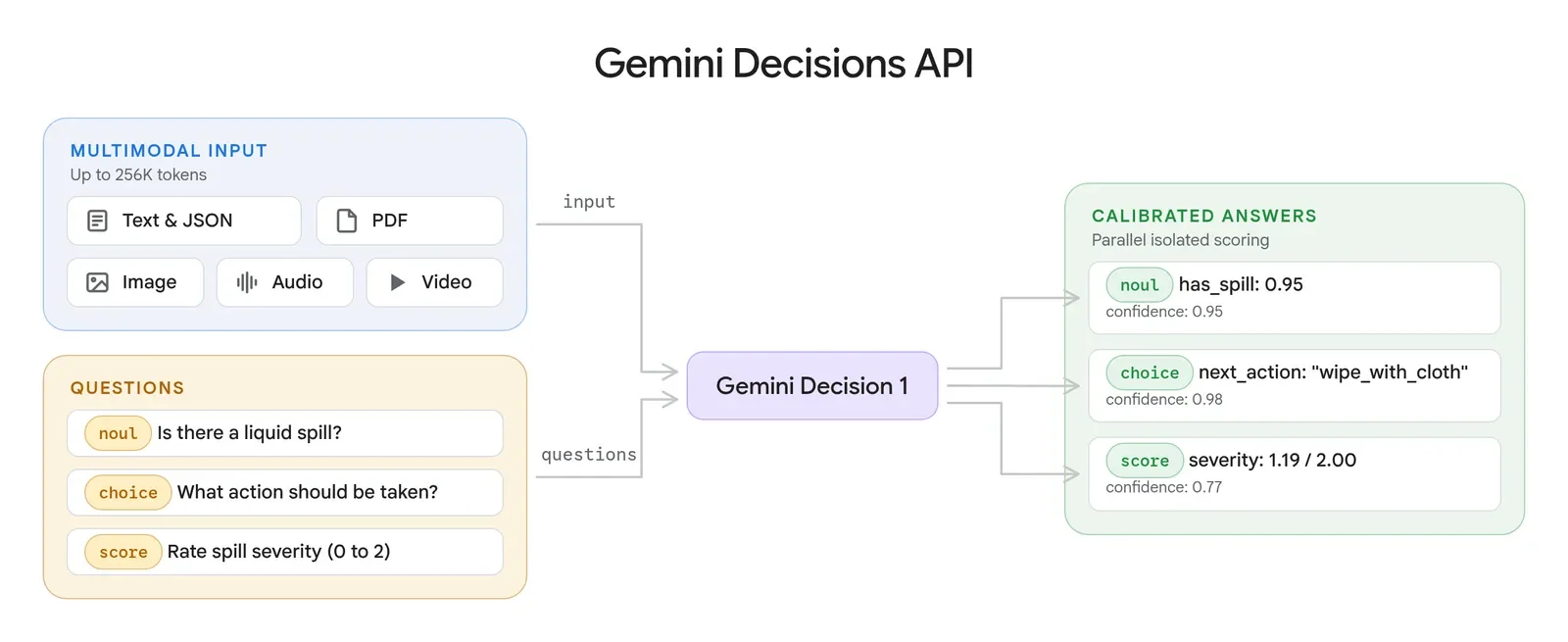
Built for closed-set routing, classification and rubric grading across text, images, audio, video and PDFs, Gemini Decision 1 scores up to 1,000 questions in a single forward pass with zero output tokens billed.

 Edited by Ashutosh Shrivastava
12 Nov 2026, 10:05 IST · 4 min read
Google released the Gemini Decisions API and its underlying Gemini Decision 1 model (gemini-decision-1) in Google AI Studio and the Gemini API (v1beta, google-genai SDK 3.2+) on 11 November 2026, alongside day-one third-party support on OpenRouter, LangChain, Vercel, LiteLLM, Pydantic AI, Pipecat, LiveKit, and OpenCode. Built by Google DeepMind for deterministic software control planes rather than open-ended chat, the endpoint accepts one shared multimodal input up to 262,144 tokens (256k) across text, images, audio, video, and PDFs, and evaluates up to 1,000 isolated questions in parallel during a single prefill pass.
Single-pass decision types and benchmark results
Every question uses one of three primitives and returns a calibrated confidence score from 0 to 1 so application code can act directly or escalate ambiguous cases without parsing generated text. Binary checks (noul) return a probability from 0.01 to 0.99; single-select routing (choice) returns normalised probabilities across 2 to 255 options; and ordered grading (score) returns a probability-weighted score across 2 to 255 rubric levels. Google already runs the endpoint internally for dynamic model routing in Gemini Notebook (cutting everyday query latency by up to 40%), interactive wireframing in Stitch Rapid, 200-option emoji selection in Google Labs’ CC, and adversarial MCP tool screening in Search.
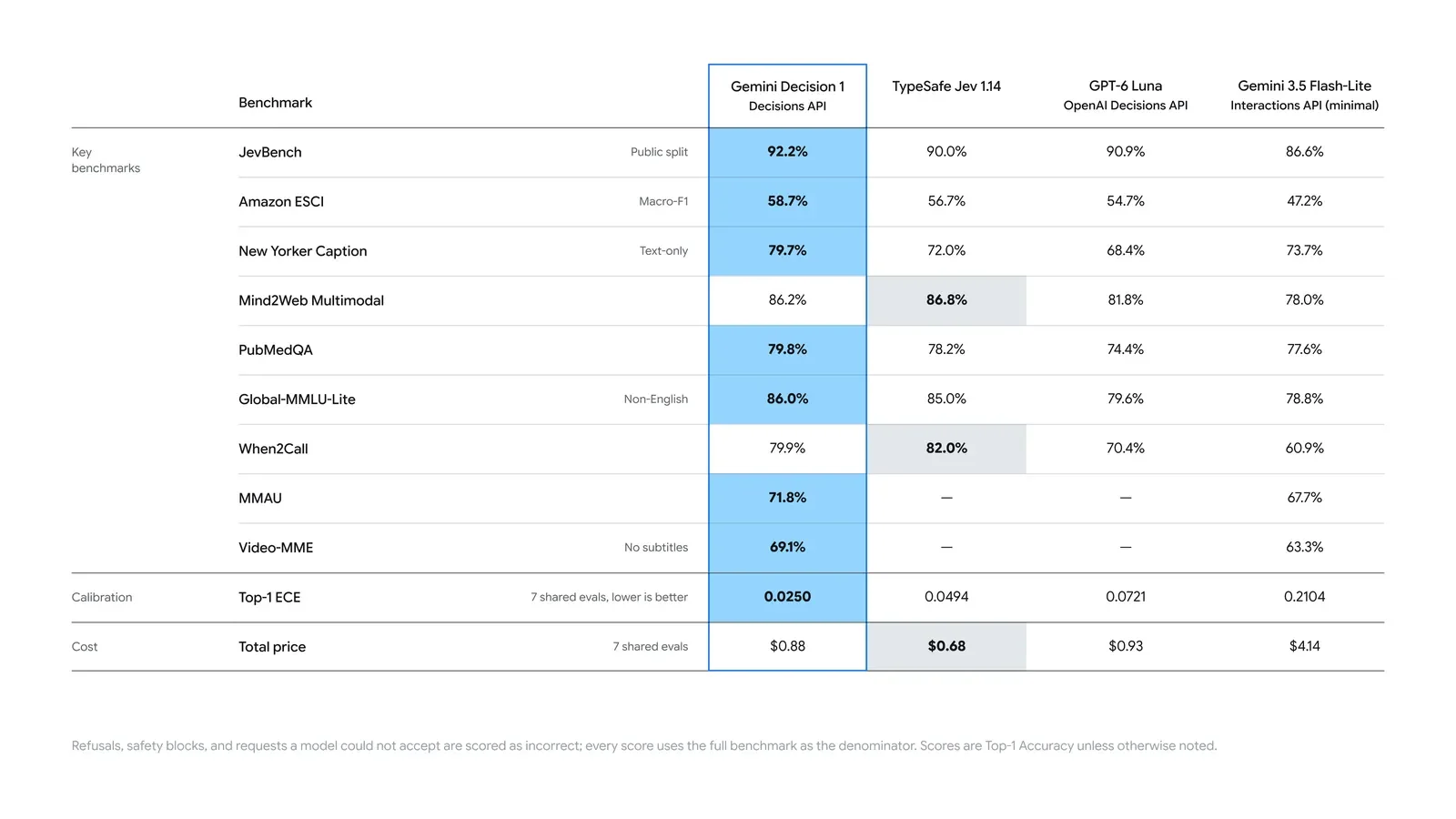
On Google’s evaluation suite, Gemini Decision 1 leads JevBench, Amazon ESCI, New Yorker Caption, PubMedQA, Global-MMLU-Lite, MMAU, and Video-MME while posting the lowest calibration error against TypeSafe Jev 1.14 and GPT-6 Luna. Separately, independent evaluator Artificial Analysis scored Gemini Decision 1 at 66 on its Decision Index v2.1 (leading AA-Omniscience-Decision at 66, behind Drex Max v1.1 and GLiDE v1.2 at 73 overall) and calculated a cost of $345 per million tasks across that index.
Key numbers
- $0.10 per million paid-tier input tokens across all modalities, $0 output tokens billed, plus a free prototyping tier (shared input billed once per call; Batch API and context caching unsupported)
- 50 to 100 ms median model compute latency (150 to 250 ms end-to-end) up to 16k tokens, staying nearly flat from 1 to 100 questions
- Nearly 5 times lower cost across Google’s shared benchmark suite than Gemini 3.5 Flash-Lite on the Interactions API
Technical details
- Endpoint and SDK version
- POST v1beta/decisions with gemini-decision-1 (google-genai and @google/genai SDK 3.2+)
- Input and batching limits
- Up to 262,144 tokens (256k) across text, images, audio, video and PDFs; up to 1,000 questions per pass
- Decision primitives
- noul (0.01 to 0.99 binary), choice (2 to 255 options) and score (2 to 255 ordered rubric levels)
- Paid and free pricing
- $0.10 per 1M input tokens (billed once per shared input), $0 output tokens and free prototyping tier
- Latency and launch partners
- 50 to 100 ms compute (150 to 250 ms end-to-end) across OpenRouter, LangChain, Vercel, LiteLLM, LiveKit and Pipecat
Release details & context
Order-invariant choice scoring and external calibration results
In the Google AI Studio Decisions API guide and Gemini Developer API pricing reference, client.decisions.create sorts choice option keys alphabetically in UTF-8 byte order before evaluation (and breaks exact probability ties alphabetically) so JSON key ordering never alters routing probabilities, while binary noul checks accept optional true_description and false_description criteria. Google AI Studio ships three starter templates: Doorstep Parcels, Speed Sketch and Find the Zoo Keeper, expanding AI Studio prototyping alongside Google Maps Platform sandboxes and Gemini 4 Carbon.
On the Artificial Analysis Decision Index v2.1, Gemini Decision 1’s overall score of 66 matches Elephant 9B and TypeSafe Jev 1.14 with a 0.18 overall Brier calibration error (between Drex Max v1.1 at 0.16 and Jev 1.14 at 0.19), posting 49 on HLE-MultiChoice (0.20 Brier), 0.14 Brier on When2Call and 33% across all 15 questions on AA-Paperclip at $345 per 1M tasks (comparable to GPT-6 Luna Decisions at $339).
Common questions
Does changing option order in a choice request shift Gemini Decision 1’s probabilities?
No, the Decisions API sorts choice option keys alphabetically in UTF-8 byte order prior to inference and breaks exact ties alphabetically so output probabilities remain invariant to JSON key order.
Are Batch API jobs or context caching supported on the Gemini Decisions API?
No, neither Batch API execution nor context caching is supported on 11 November 2026, though the shared multimodal input (up to 262,144 tokens) is billed only once across up to 1,000 parallel questions at $0.10 per 1M tokens with $0 output charges.
Sources
- PrimaryGemini Decisions API: Fast, calibrated multimodal decisionsblog.google
- OfficialDecisions API guide in Google AI Studio documentationai.google.dev
- OfficialGemini Developer API pricingai.google.dev
- On XSundar Pichai (@sundarpichai) launch announcement on Xx.com
- On XArtificial Analysis (@ArtificialAnlys) Decision Index v2.1 evaluation on Xx.com
Google release timeline (24 launches tracked)
- Google unveils confidential TPU 8tx and high-memory TPU 8i Max with open-source TPU Sync
Google introduces confidential TPU 8tx and high-memory TPU 8i Max accelerators alongside Agent Compute Engine and the open-source TPU Sync KV-cache layer.
- Google AI Studio adds zero-setup Google Maps Platform toolkit with free daily sandbox calls
Google embeds a Google Maps Platform toolkit into AI Studio with 100 free daily sandbox calls and no credit card requirement.
- Google launches Gemini 4 Carbon at $2 and $10 introductory API pricing
Google ships Gemini 4 Carbon at $2 and $10 introductory API pricing per million tokens, ranking first on CursorBench 4.0, WANDR and AutomationBench.
- Google Antigravity adds Gemini 4 Carbon and previews /swarm multi-agent orchestration
Google Antigravity adds Gemini 4 Carbon for Ultra subscribers and previews /swarm to coordinate parallel coding and verifier agents.