


ResearchGoogle DeepMindConfirmed
Story 3 of 13 in the Wednesday 11 November editionGoogle DeepMind releases AlphaGenome 2 API for single-cell DNA variant prediction
Free for non-commercial research through the alphagenome Python SDK alongside the nine-billion-variant AlphaGenome Atlas, AlphaGenome 2 conditions 1-megabase DNA predictions directly on user-supplied scRNA-seq profiles.

 Edited by Ashutosh Shrivastava
12 Nov 2026, 10:05 IST · 3 min read
Google DeepMind released AlphaGenome 2 on 11 November 2026 through its updated alphagenome Python package (alphagenome.models.v2) and free non-commercial research API, alongside the zero-code and programmatic AlphaGenome Atlas covering pre-computed in silico mutagenesis and AlphaGenome Variant Impact (AVI) prioritisation scores across 9 billion human coding and non-coding variants. Whereas AlphaGenome 1 scored variants across fixed reference assays simultaneously, AlphaGenome 2 zooms into specific cellular contexts to model why identical single-letter DNA mutations trigger disease in certain cell types, such as heart muscle or immune cells, while sparing others.
Single-cell expression conditioning and imputed modalities
AlphaGenome 2 pairs a 1-megabase (1 Mb) conditional U-Net and transformer sequence backbone with a dedicated cell expression encoder (encode_cells). Researchers can select composite ontology reference conditions or pass their own raw human single-cell RNA-seq (scRNA-seq) unique molecular identifier count matrices (up to 256 cells per API call via cell_conditioning) to generalise regulatory predictions to previously unseen cell states.
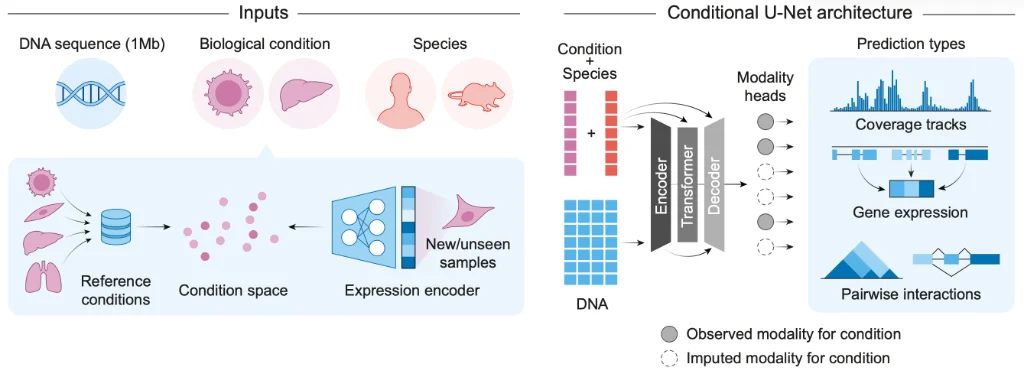
The v2 release adds predicted single-cell chromatin accessibility (SC_ATAC), denoised and protocol-specific single-cell gene expression, CpG methylation variant scoring (MethylationScorer), cross-modality imputation for unmeasured biosample tracks, and batched input-gradient calls (predict_interval_gradients_batch) for enhancer-to-gene attribution across human and mouse genomes. Google DeepMind has not announced commercial API pricing tiers.
Study details
- SDK module and licence tier
- alphagenome.models.v2 Python package and free non-commercial research API (commercial pricing unannounced)
- Sequence and cell inputs
- 1-megabase (1 Mb) human and mouse DNA windows conditioned on ontology IDs or up to 256 scRNA-seq cells
- AlphaGenome Atlas scale
- Pre-computed in silico mutagenesis and AVI prioritisation scores across 9 billion human variants
- New v2 output modalities
- SC_ATAC, protocol-specific scRNA-seq, CELL_EMBEDDINGS, MethylationScorer and SPLICE_SITES (5 channels)
- Track provenance tags
- observed, imputed_supported and imputed_exploratory metadata on every predicted biosample track
Release details & context
API migration changes from AlphaGenome 1 and track provenance metadata
In the AlphaGenome 1 to AlphaGenome 2 migration guide and AlphaGenome Atlas portal, alphagenome.models.v2 shifts from scoring all fixed reference assays at once to evaluating one cellular condition per single call (or per-item Ensembl gene ID cell_conditionings in batch calls). DeepMind expanded SPLICE_SITES from 4 condition-agnostic channels to 5 condition-specific channels (strand-separated donor and acceptor tracks plus padding), switched chromatin contact maps to un-coarsened targets, and retired PROCAP in favour of CAGE.
Variant scorers in v2 return raw_score only (dropping AlphaGenome 1’s quantile_score calibrated over 300,000 gnomAD v3 variants), while supported_conditions() and observed_metadata() label every track’s imputation_mode as observed, imputed_supported or imputed_exploratory, extending DeepMind’s November research releases alongside AlphaProof Code and Gemini Robotics 2.5.
Common questions
Why did AlphaGenome 2 drop quantile_score from variant scoring outputs?
AlphaGenome 1 calibrated quantile_score across 300,000 common gnomAD v3 variants on fixed tracks, which does not transfer cleanly to arbitrary user-supplied single-cell conditions, so v2 returns raw_score directly.
How does AlphaGenome 2 distinguish directly trained tracks from imputed cell assays?
Every returned track carries an imputation_mode tag marking it as observed, imputed_supported or imputed_exploratory, queryable via supported_conditions() and observed_metadata().
Sources
- PrimaryAlphaGenome documentation and AlphaGenome Atlasalphagenomedocs.com
- OfficialMigrating from AlphaGenome 1 to AlphaGenome 2alphagenomedocs.com
- On XGoogle DeepMind (@GoogleDeepMind) AlphaGenome 2 launch thread on Xx.com
- On XSundar Pichai (@sundarpichai) on AlphaGenome 2 on Xx.com
Google DeepMind release timeline (8 launches tracked)
- Google DeepMind unveils Gemini 4 Carbon frontier model
Google DeepMind’s Gemini 4 Carbon scores 59 on Artificial Analysis v5.0 and 88.2% on SEC-bench Pro at Argon’s $2/$10 per million token API price.
- Google DeepMind publishes economic framework for multi-agent AGI regimes
Google DeepMind modelled four AI capability regimes, finding that multi-agent coordination thresholds trigger abrupt jumps in firm concentration and wages.
- Google DeepMind uses AlphaProof Code and Gemini 4 Carbon to formally verify Signal
Google DeepMind’s AlphaProof Code generates 6 million lines of Lean proofs in 4 weeks to verify Signal down to compiled machine code.
- Google DeepMind unveils Gemini Robotics 2.5 for dexterous manipulation and factory kitting
Google DeepMind rolls out Gemini Robotics 2.5, reaching 96% autonomous kitting accuracy on Apollo 2 humanoids in Mercedes-Benz factory pilots.