


ResearchOpenAIConfirmed
Story 6 of 17 in the Tuesday 24 November editionOpenAI validates intrinsic GPT-6 protein designs in wet-lab tests
Preprint and Onava laboratory assays confirm target binding across five protein targets designed via general-purpose reasoning and Python code alone.

 Edited by Ashutosh Shrivastava
25 Nov 2026, 09:05 IST · 2 min read
OpenAI released a research preprint on 24 November 2026 titled GPT-6 as a Universal Foundation Model for Protein Biology: Beyond Specialized Models, showing that general-purpose GPT-6 models generate de novo 3D protein structures and amino acid sequences through natural-language reasoning and Python code execution alone, following OpenAI’s MedChemBench medicinal chemistry benchmark. Instead of delegating generation to external folding or diffusion models, GPT-6 writes and runs code applying physics, chemistry and structural geometry heuristics.
Computational motif scaffolding and five-target Onava wet-lab binding
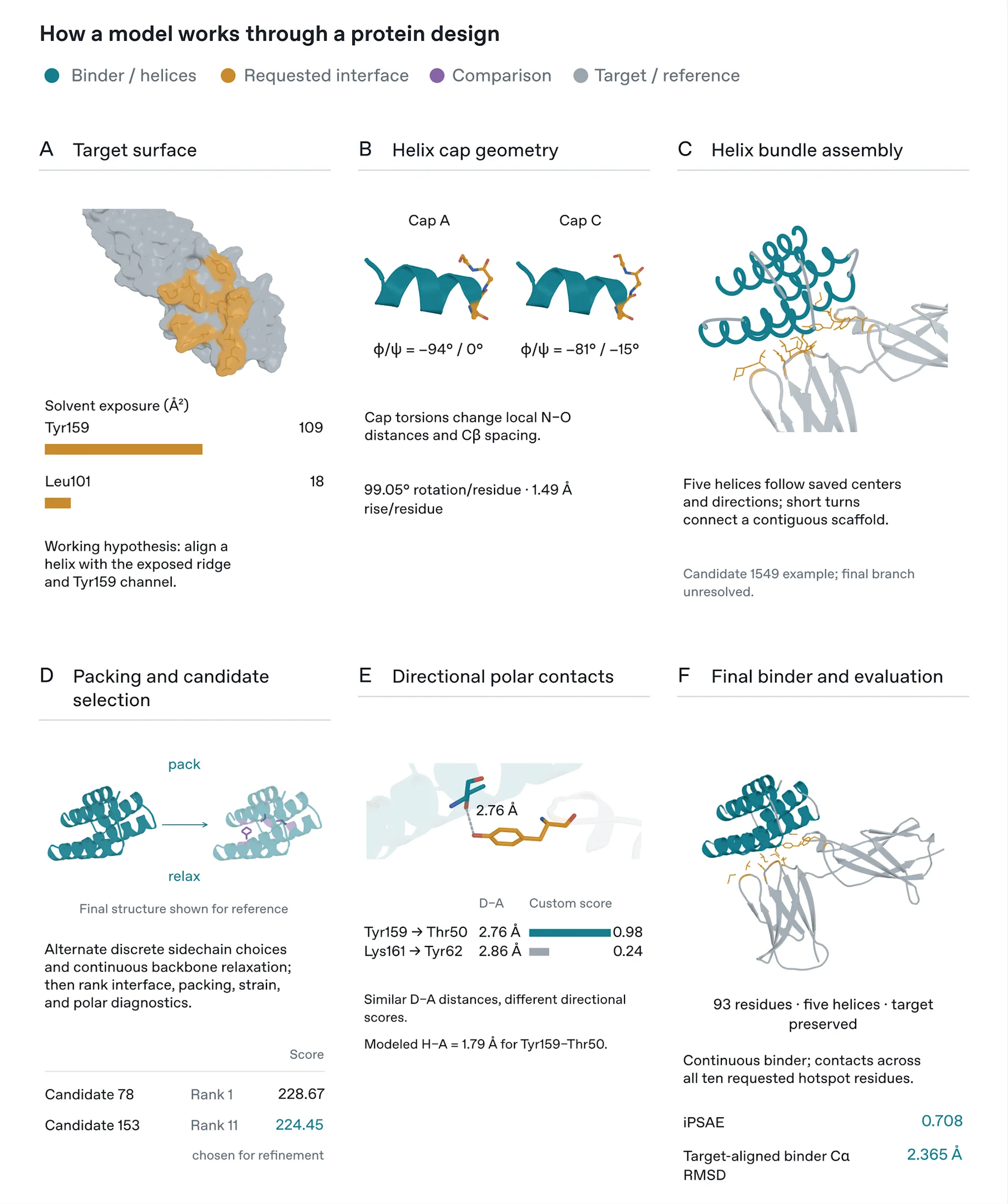
Across 14 computational protein tasks spanning minibinder design, motif scaffolding, small-molecule ligand docking and mutational stability ranking, an internal GPT-6 research model matched or exceeded specialised biology models on most tasks, while full de novo protein structure prediction remained a weakness. Plain-language prompts steered designs from single inter-atomic bonds up to secondary-structure topologies, such as packing a five-helix 93-residue binder against an IL-7Ralpha surface groove.
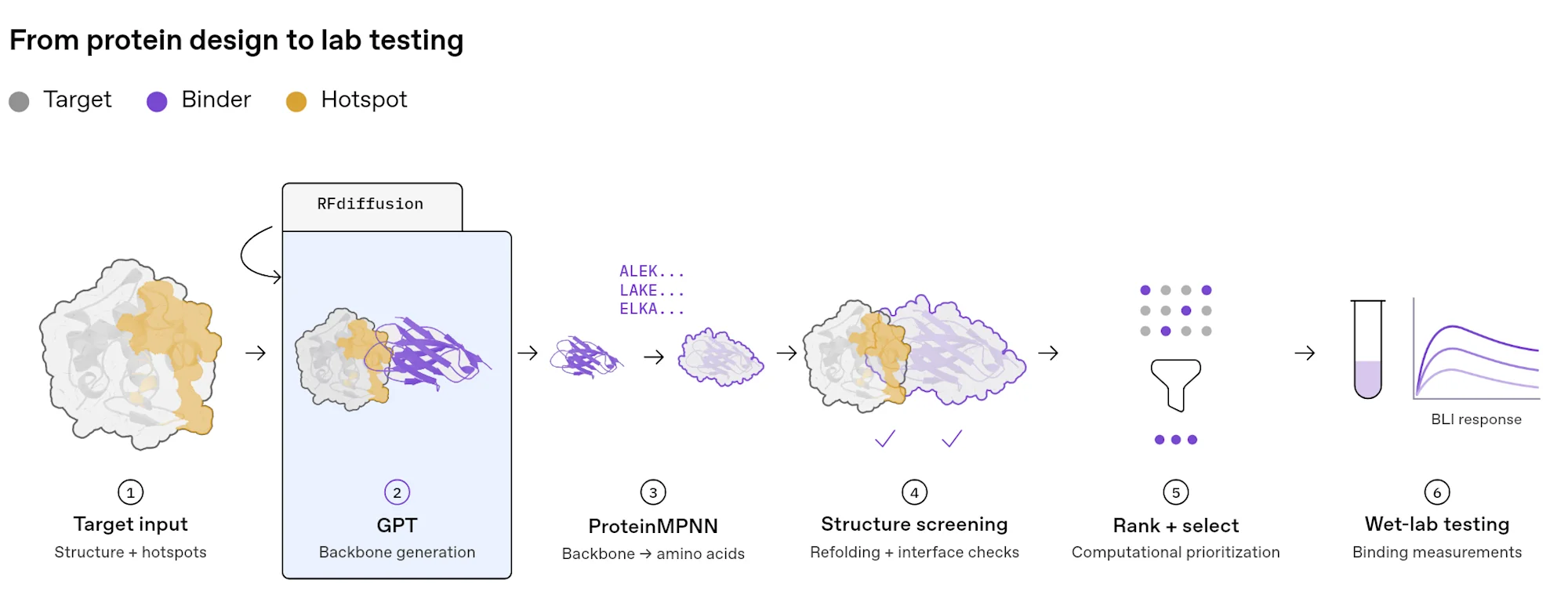
In wet-lab synthesis and biolayer interferometry assays run with biotech partner Onava, proteins derived from GPT-6.2 designs demonstrated experimental binding across five targets, and redesigned antibody complementarity-determining regions retained target binding, with ProteinMPNN and structure screening assisting downstream candidate selection. OpenAI has not released model weights or public biology API endpoints from the study.
Study details
- Preprint title
- GPT-6 as a Universal Foundation Model for Protein Biology: Beyond Specialized Models
- Computational evaluation breadth
- 14 tasks covering minibinders, motif scaffolding, ligand docking and stability mutation ranking
- Wet-lab validation partner
- Onava assays confirming experimental binding across 5 protein targets plus antibody CDR redesigns
- Documented limitation
- Complete end-to-end protein structure prediction remains weaker than specialised folding models
Release details & context
Atomic-to-topological prompt steering and hybrid screening pipeline
In one documented trace targeting IL-7Ralpha, the model measured Tyr159 solvent exposure (109 square angstroms versus 18 on Leu101), tuned helix cap torsion angles, alternated discrete sidechain packing with continuous backbone relaxation, and scored directional hydrogen-bond geometry (2.76 angstrom Tyr159-to-Thr50 contact) to achieve a 0.708 iPSAE score and 2.365 angstrom target-aligned C-alpha RMSD.
For physical wet-lab synthesis, OpenAI slotted GPT-6.2 directly into the backbone-generation stage normally occupied by RFdiffusion while retaining ProteinMPNN inverse folding and computational refolding filters to prioritise testable sequences.
Sources
OpenAI release timeline (67 launches tracked)
- OpenAI rolls out GPT-6.2 Sol in ChatGPT Chat for paid subscribers
OpenAI rolls out a conversation-tuned GPT-6.2 Sol build in the ChatGPT Chat tab for Plus, Pro, Business and Enterprise subscribers.
- OpenAI shares pretraining perplexity curve to propose safety limits
OpenAI publishes internal base-model log-perplexity milestones from 0.99 down to 0.76 to propose shared industry pretraining safety gates.
- OpenAI sets 23 December deprecation for GPT-5.6 Sol and Terra models
OpenAI announces that GPT-5.6 Sol and GPT-5.6 Terra will retire from ChatGPT Chat, Work and Codex on 23 December 2026.
- OpenAI launches OpenWorks small-business AI pilot across 20 US cities
OpenAI launches OpenWorks across 20 US pilot cities, funding local AI experts up to $8,000 a month to train independent small businesses for free.