


ResearchOpenAIConfirmed
Story 5 of 13 in the Friday 20 November editionOpenAI introduces MedChemBench for medicinal chemistry reasoning
Evaluating 11 GPT models on 20 November 2026 across 99 literature problems and 761 molecules, led by GPT-6.2 Astra at 84.5% xhigh credit.

 Edited by Ashutosh Shrivastava
21 Nov 2026, 08:30 IST · 2 min read
OpenAI introduced MedChemBench on 20 November 2026, a 99-problem evaluation suite built from 117 published medicinal chemistry papers and patents spanning 761 distinct molecular structures. Each task supplies historical project context, biological targets and prior assay measurements, grading models across four components: assembling molecular structures with exact atom connectivity and stereochemistry, explaining scientific evidence, ranking and selecting candidate compounds, and predicting numerical properties across competing traits.
PRMT5 potency trade-offs, 18-atom ring assembly and Astra scores
To test multi-parameter optimisation, tasks such as PRMT5 cancer inhibitor design ask models to weigh cellular target potency against membrane permeability and liver-enzyme clearance where stronger binding often degrades metabolic stability. Evaluated single-shot without external chemistry tools across 11 GPT models, GPT-6.2 Astra earned 84.5% of available credit at the shared xhigh reasoning setting, ahead of GPT-6 Astra (83.3%, or 83.8% at max effort), GPT-6.1 Sol (82.0%), GPT-6.1 Terra (75.1%) and GPT-5.6 Sol (58.2%).
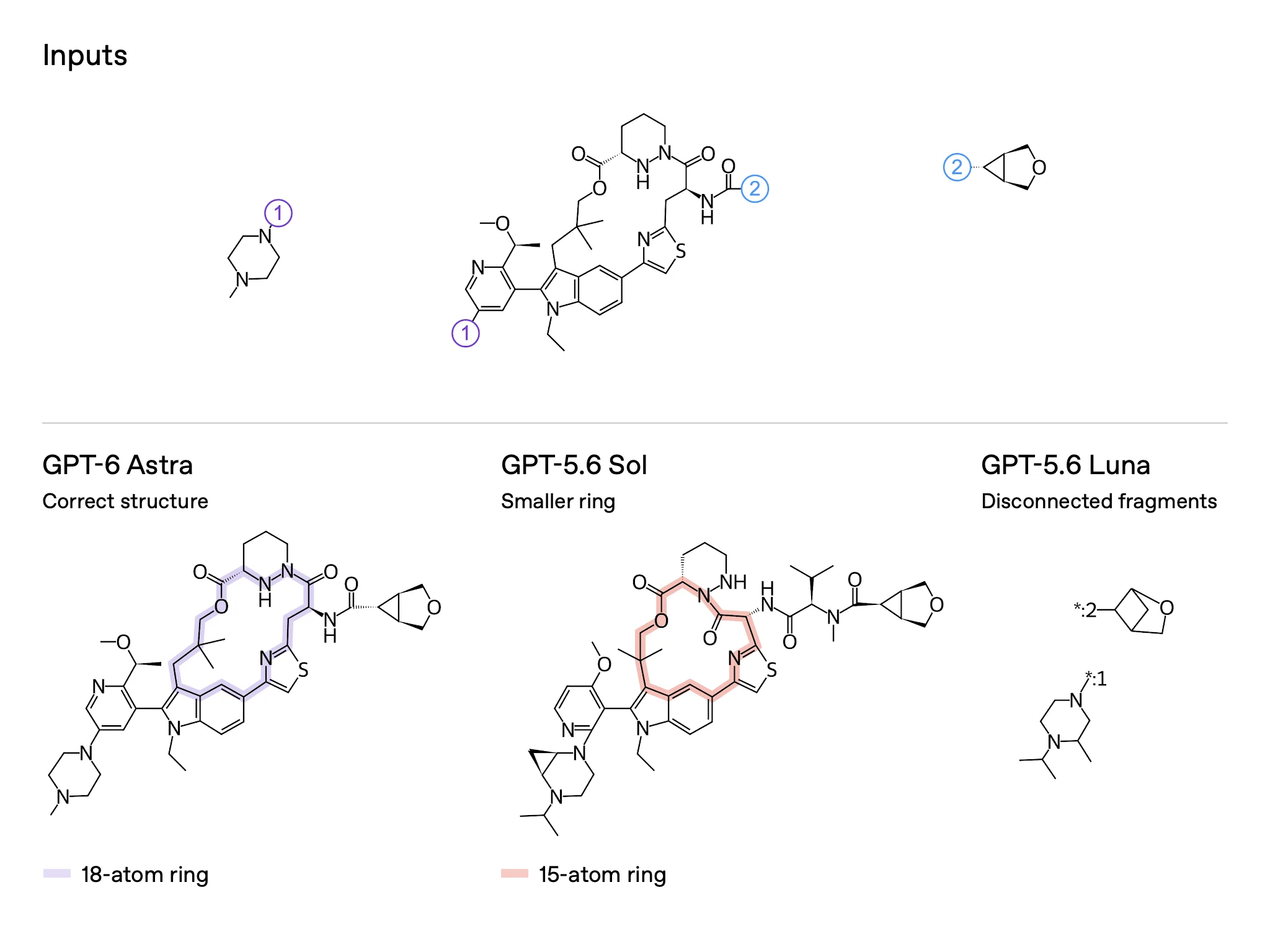
Component breakdowns show a sharp capability split: GPT-6 Astra captured 95.4% of structure credit at xhigh (reconstructing an 18-atom macrocycle across all 10 trials where GPT-5.6 Sol shrank it to a 15-atom ring and GPT-5.6 Luna split it into disconnected fragments), but scored roughly half the available credit on compound selection and numerical property prediction. OpenAI has not announced a public dataset download link.
Study details
- Corpus and molecular scope
- 99 problems curated from 117 medicinal chemistry papers and patents across 761 molecules
- Four graded components
- Molecular structures, scientific reasoning, compound ranking/selection and property predictions
- Shared xhigh benchmark scores
- GPT-6.2 Astra 84.5%, GPT-6 Astra 83.3% (83.8% max), GPT-6.1 Sol 82.0%, GPT-6.1 Terra 75.1%, GPT-5.6 Sol 58.2%
- Evaluation harness constraints
- Single-attempt text/vision responses across 51 model-effort pairs without external tools or lab feedback
Release details & context
Partial-credit assay grading and historical data contamination caveats
MedChemBench awards partial credit on numerical property predictions based on proximity to withheld wet-lab measurements while requiring models to reproduce baseline assay numbers already given in the prompt without distortion, extending OpenAI’s life-sciences evaluations alongside ChatGPT for Academic Researchers.
OpenAI cautioned that MedChemBench tests retrospective reasoning on published literature rather than closed-loop laboratory synthesis: prior pretraining exposure to source papers and patents cannot be ruled out, and models ran without cheminformatics tool calls or iterative experimental feedback.
Common questions
Where do frontier GPT models still struggle most on MedChemBench?
While Astra models earn 95.4% of available credit on reconstructing molecular structures and stereochemistry, they earn only roughly half the credit when ranking candidate compounds and predicting numerical assay values across competing properties.
Editor’s weekly perspective
Benchmarks, science, defences and legal oversight: Evaluates 11 GPT models across 99 medicinal chemistry problems and 761 molecules, led by GPT-6.2 Astra at 84.5%.
Sources
OpenAI release timeline (59 launches tracked)
- OpenAI details Codex Performance Factory keeping ChatGPT fast
OpenAI details Performance Factory, its cloud Codex system running 17 automated ChatGPT regression investigations per day.
- OpenAI ties GPT-6.2 Responses API reasoning to prompt prefix
OpenAI binds GPT-6.2 Responses API reasoning items to preceding conversation prefixes for higher cache hit rates and lower token use.
- OpenAI brings ChatGPT dots to Business Standard and Plus test
OpenAI rolls out proactive ChatGPT dots agents to all Business Standard workspaces and starts testing with a small cohort of Plus users.
- OpenAI expands ChatGPT Health to desktop, Android and Sites
OpenAI expands ChatGPT Health in the US to desktop, Android Health Connect, ChatGPT Sites and proactive Pro dots suggestions.