


ResearchThinking Machines LabConfirmed
Story 10 of 17 in the Tuesday 24 November editionThinking Machines Lab trains Inkling 2 Small forecasting agent
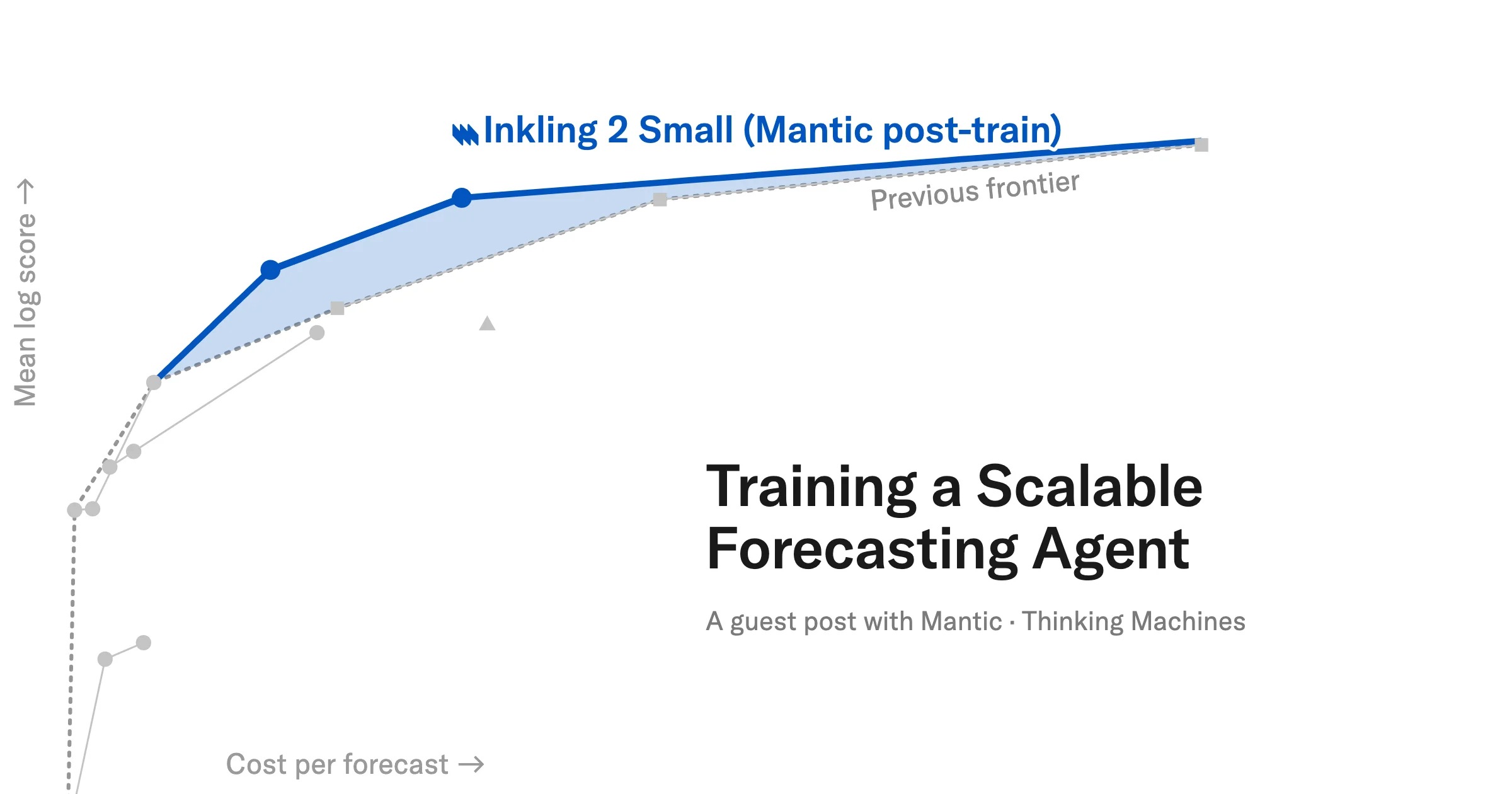
Mantic AI post-training on Tinker matches Claude Fable 5.2 medium accuracy at 7% of the per-forecast cost across 45,000 synthetic training questions.

 Edited by Ashutosh Shrivastava
25 Nov 2026, 09:05 IST · 2 min read

Thinking Machines Lab published a joint engineering study with Mantic AI on 25 November 2026 IST detailing an end-to-end probabilistic forecasting agent post-trained from Thinking Machines Lab’s Apache 2.0 Inkling 2 Small checkpoint on Tinker. Combining historical research, Python code execution and probability-distribution submission inside one rollout, the fine-tuned model matches Claude Fable 5.2 (medium) accuracy at 7% of the cost (15 times cheaper per forecast), demonstrated across 100,000 S&P 500 forecasts spanning 50 economic and geopolitical scenarios.
Synthetic news questions, 1.32 TB historical Wikipedia index and hybrid RL rewards
Because deduplicated public prediction markets yield fewer than roughly 1,000 non-sports, non-crypto global questions and live third-party search APIs would have stretched concurrent rollout training to nine years, the team generated 45,000 quantitative questions from historical news and built local point-in-time databases, including 1.32 TB of indexed and embedded Wikipedia revision history searchable as of any past date.
Post-training ran across multiple reasoning-effort stages on Tinker using asynchronous in-flight reinforcement learning via StableReinforce (cutting experiment runtime 3 times across thousands of parallel environments). To stabilise noisy single-event outcomes, rewards blended actual resolution log scores with expected log scores against a frontier-model ensemble reference; Mantic AI has not released the fine-tuned forecasting weights publicly.
Study details
- Base model and RL infrastructure
- Inkling 2 Small post-trained on Tinker via asynchronous in-flight StableReinforce (3 times faster runtime)
- Accuracy and unit economics
- Matches Claude Fable 5.2 (medium) forecasting log score at 7% of cost (15 times cheaper per forecast)
- Training corpus and point-in-time index
- 45,000 LLM-generated quantitative news questions plus a 1.32 TB historical Wikipedia revision database
- Reward formulation
- Weighted sum of actual outcome log score and negative forward KL to a frontier-model ensemble reference
Release details & context
Emergent low-effort efficiency vs high-effort quantitative coding
Keeping the agentic harness non-prescriptive produced distinct behaviours across reasoning budgets after RL post-training, building on Thinking Machines Lab’s Inkling 2 Mini looped model work. At low reasoning effort, the post-trained agent beat Inkling 2 Small Base at lower token cost by retrieving decisive historical facts in fewer tool calls.
At high reasoning effort, such as forecasting South Korea’s August 2026 producer price index for coal and petroleum products, the agent acted like a quantitative analyst by running exhaustive point-in-time searches and writing Python scripts to model time-series distributions before submitting probabilities.
Sources
Thinking Machines Lab release timeline (4 launches tracked)
- Thinking Machines Lab debuts 594B Inkling 2 Small MoE on Tinker with Apache 2.0 weights planned
Thinking Machines Lab launched Inkling 2 Small (594B total, 17B active) on Tinker, scoring 31 on the AA Intelligence Index with Apache 2.0 weights planned.
- Thinking Machines Lab releases Inkling 2 Small weights on Apache 2.0
Thinking Machines Lab releases open weights for its 594B-total, 17B-active Inkling 2 Small multimodal MoE on Hugging Face under an Apache 2.0 licence.
- Thinking Machines Lab open-sources 26B Inkling 2 Mini looped model
Thinking Machines Lab releases Apache 2.0 Inkling 2 Mini (26.4B total, 5.4B looped active parameters), scoring 20.1 on AA Index v5.0 and 48.2% on DeepSWE v1.1.