


ResearchGoogleConfirmed
Story 1 of 13 in the Wednesday 25 November editionGoogle Research Cogentic drops six autonomous math and factoring proofs
Apache 2.0 GitHub release adds unconditional L[1/3] integer factorisation, sub-quasi-polynomial discrete logarithms, Nash equilibria and log-rank preprints.

 Edited by Ashutosh Shrivastava
26 Nov 2026, 09:00 IST · 3 min read
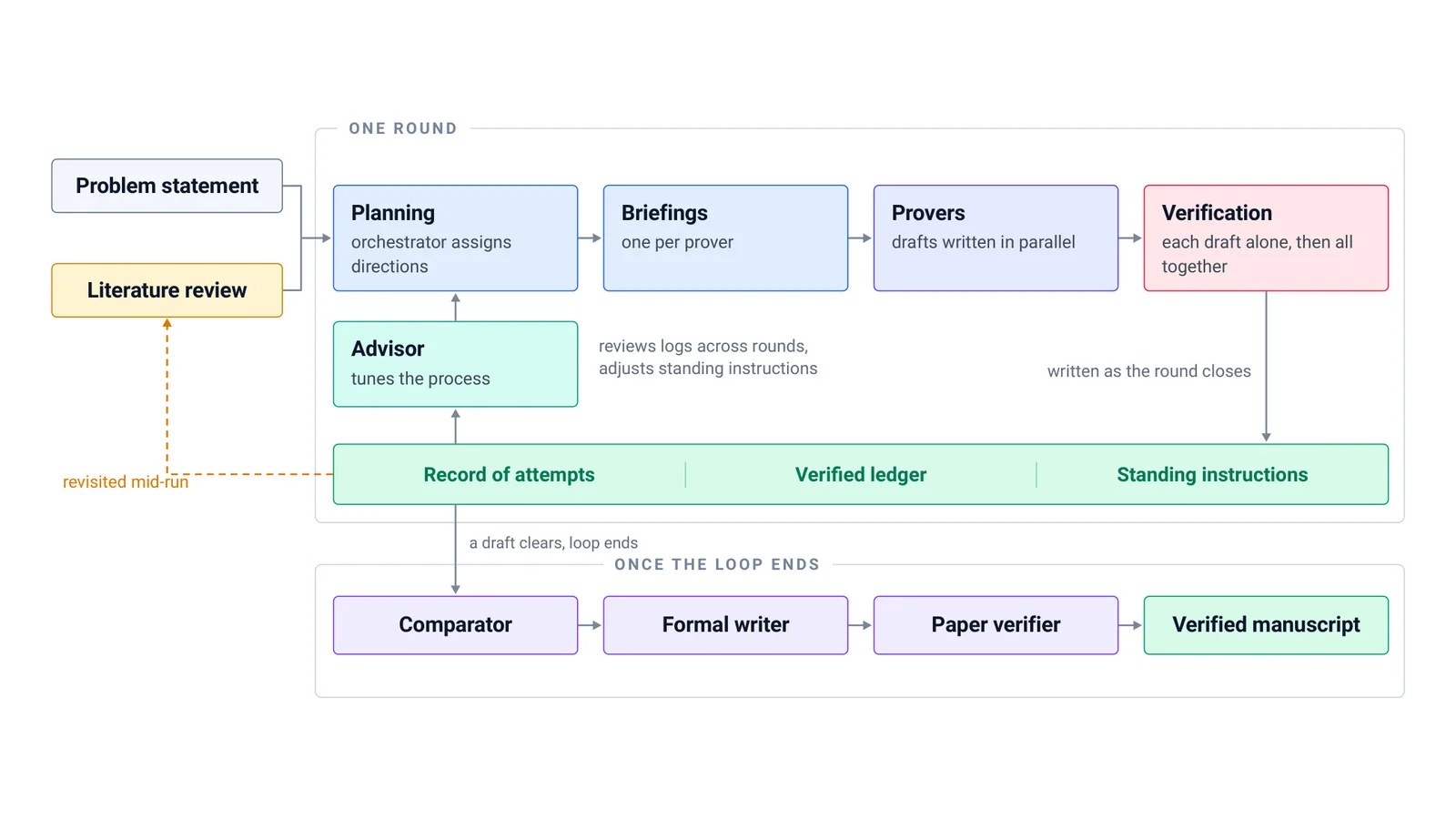
Google Research committed six new mathematics and theoretical computer science preprints to google-research/cogentic_research_papers on 25 November 2026 under an Apache 2.0 licence. Produced by Cogentic, the multi-agent proof-discovery harness detailed in arXiv 2609.40324, the system uses an orchestrator to dispatch independent provers across competing proof strategies, runs adversarial verifier agents against every candidate step, and promotes surviving lemmas into a persistent verified ledger using Gemini 3.1 Pro or early Gemini 4 Argon base models, expanding Google’s automated research push alongside Google DeepMind’s Gemini 4 quantum circuit work.
Unconditional factorisation, discrete logs and complexity preprints
The flagship 54-page manuscript, Unconditional Integer Factorization in Time LN[1/3, O(1)], constructs a classical zero-error Las Vegas algorithm running in worst-case expected time LN[1/3, 10^5] and deterministic workspace LN[1/3, 40], certifying every output prime factor deterministically via the Agrawal-Kayal-Saxena test. Its explicit constant 10^5 leaves practical RSA cryptography unaffected, yet the bound matches the heuristic General Number Field Sieve exponent without unproven hypotheses, improving on Lenstra and Pomerance’s rigorous LN[1/2, 1] result from 1992.
Five companion papers address discrete logarithms in fixed-characteristic finite fields in sub-quasi-polynomial time, deterministic subexponential integer factoring, an exact polynomial-time algorithm for 1/5-approximate Nash equilibria in bimatrix games, breaking the square-root barrier for the log-rank conjecture, and unconditional edge reconstruction of linear-density simple graphs. Google notes the repository is research output rather than a product and has not announced commercial API access for Cogentic.
Study details
- Repository and licence
- google-research/cogentic_research_papers on GitHub (Apache 2.0)
- Base models and harness
- Cogentic multi-agent orchestrator (arXiv 2609.40324) on Gemini 3.1 Pro and early Gemini 4 Argon
- Factorisation time and workspace
- Worst-case expected time LN[1/3, 10^5] and deterministic workspace LN[1/3, 40]
- Discrete logarithm bound
- Expected bit operations exp((2+o(1)) (ln n)^2 / ln ln ln n) = (p^n)^o(log n) in fixed characteristic
Release details & context
Proof architecture inside the factorisation and discrete logarithm manuscripts
The factorisation paper combines four self-contained components: a Siegel-zero-free single-integer hybrid smooth weight cancelling local Euler factors in arithmetic progressions, a truncated discrete Laplace sampler decoupling evaluation fibres, smoothness-cancelling backward telescoping over a bounded-depth geometric ladder, and Stark-Chebotarev square certification paired with deterministic 3-adic Newton-Hensel square roots.
In the 36-page discrete logarithm preprint, Cogentic replaces PGL2 degree-halving Frobenius polynomials with sparse affine linearised Frobenius pencils over a slowly growing intermediate field, improving unconditionally on the quasi-polynomial algorithms of Kleinjung-Wesolowski (2022) and Lido (2026). The repository also holds earlier Cogentic papers from 30 October, 18 November and 23 November 2026 on convex games, VC sample compression, fictitious play and subadditive prophet inequalities.
Common questions
Does Google Research’s Cogentic integer factorisation paper break practical RSA encryption?
No, the unconditional algorithm carries an explicit constant of 10^5 inside its LN[1/3, 10^5] runtime bound, making it a theoretical complexity result rather than a practical attack on deployed RSA keys.
How does the Cogentic harness discover proofs across multiple attempts?
Cogentic pairs an orchestrator and parallel prover agents with adversarial verification components and a persistent verified ledger so later rounds build only on checked intermediate results.
Sources
- PrimaryGoogle Research: Cogentic Research Papers on GitHubgithub.com/google-research
- OfficialarXiv 2609.40324: Cogentic: Multi-Agent Orchestration for Automated Proof Discoveryarxiv.org
Google release timeline (46 launches tracked)
- Google adds GIF creation to Gemini app on Gemini Omni 1.2 Flash
Google launches native GIF generation in the Gemini app powered by its Gemini Omni 1.2 Flash video model.
- Google adds server-side file slicing and Office support to Gemini API
Google adds server-side file slicing and native Office and OpenDocument uploads to the Gemini API across all Gemini 4 models.
- Google rolls out Gemini 4 Neon to Google Workspace users in Gemini app
Google rolls out Gemini 4 Neon to Google Workspace customers inside the Gemini app.
- Google launches Workspace MCP servers, gwscli and Agent Gateway
Google launches Workspace MCP servers, the gwscli terminal client and Google Cloud Agent Gateway in GA, mandating agent MCP or CLI routing from February 2027.