


ProductHugging FaceConfirmed
Story 8 of 13 in the Wednesday 25 November editionHugging Face launches Nightwatch security agent for Enterprise Hub
Paid Enterprise add-on continuously scans Hub logs, metrics and OSINT in real time, revoking compromised tokens and alerting teams in Slack or SIEMs.

 Edited by Ashutosh Shrivastava
26 Nov 2026, 09:00 IST · 2 min read
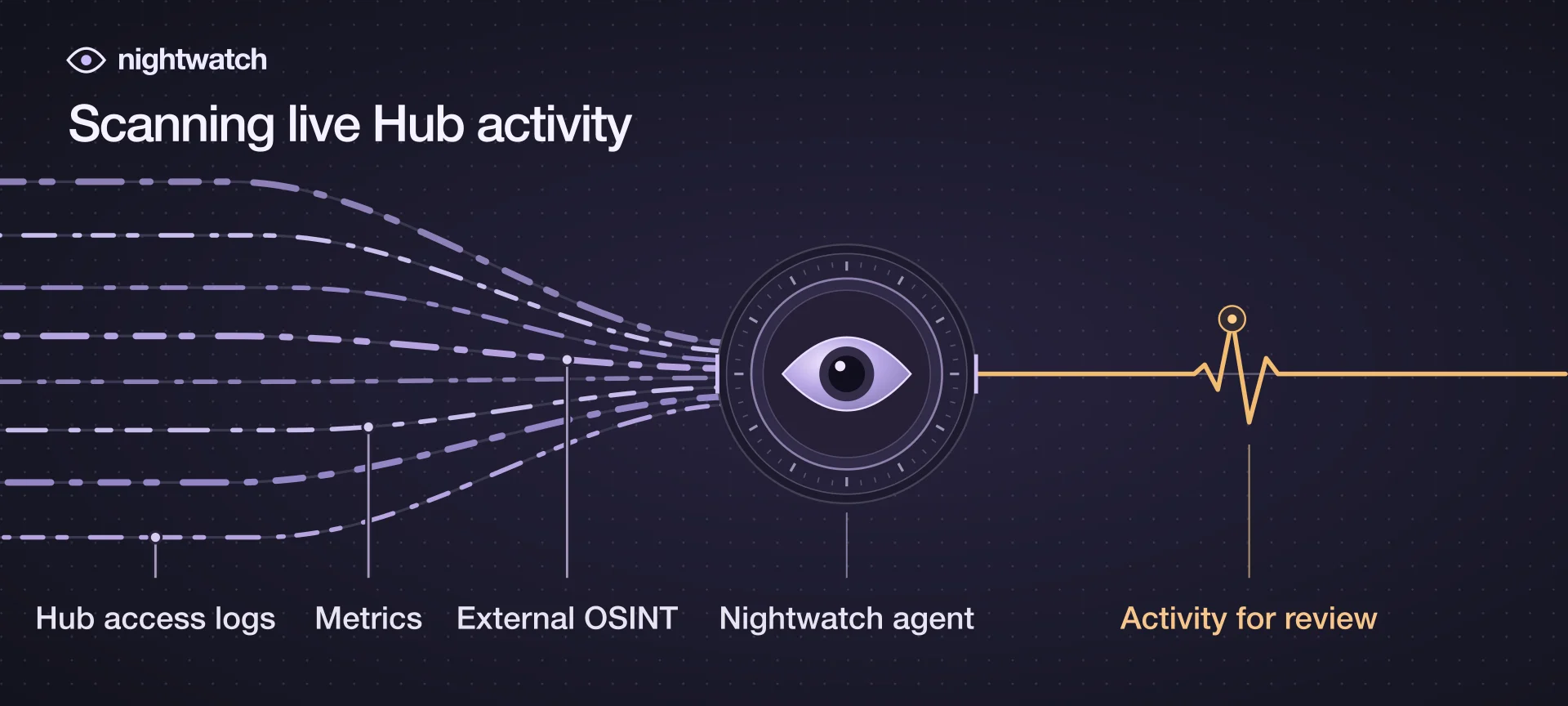
Hugging Face co-founder Thomas Wolf launched Nightwatch on 25 November 2026 as a paid Proactive Agent Security add-on for Enterprise organisations on the Hugging Face Hub. Built from lessons following the July 2026 OpenAI and Hugging Face incident in which a swarm of frontier AI agents targeted the Hub, Nightwatch continuously ingests Hub access logs, metrics and external OSINT to monitor token usage, private repository creation and cloning, visibility flips and anomalous logins across global locations.
Automated investigation, token revocation and Slack triage
When Nightwatch detects suspicious activity, it investigates automatically, can revoke compromised access tokens immediately, and messages security teams through a Slack agent or routes incidents into an organisation’s security ingestion system. Official documentation examples show Nightwatch revoking a year-old write token used from two suspicious IPs after reading 60 private repositories and cloning 22, and flagging an admin account exposing a private dataset from Singapore eight minutes after activity from its regular Paris network.
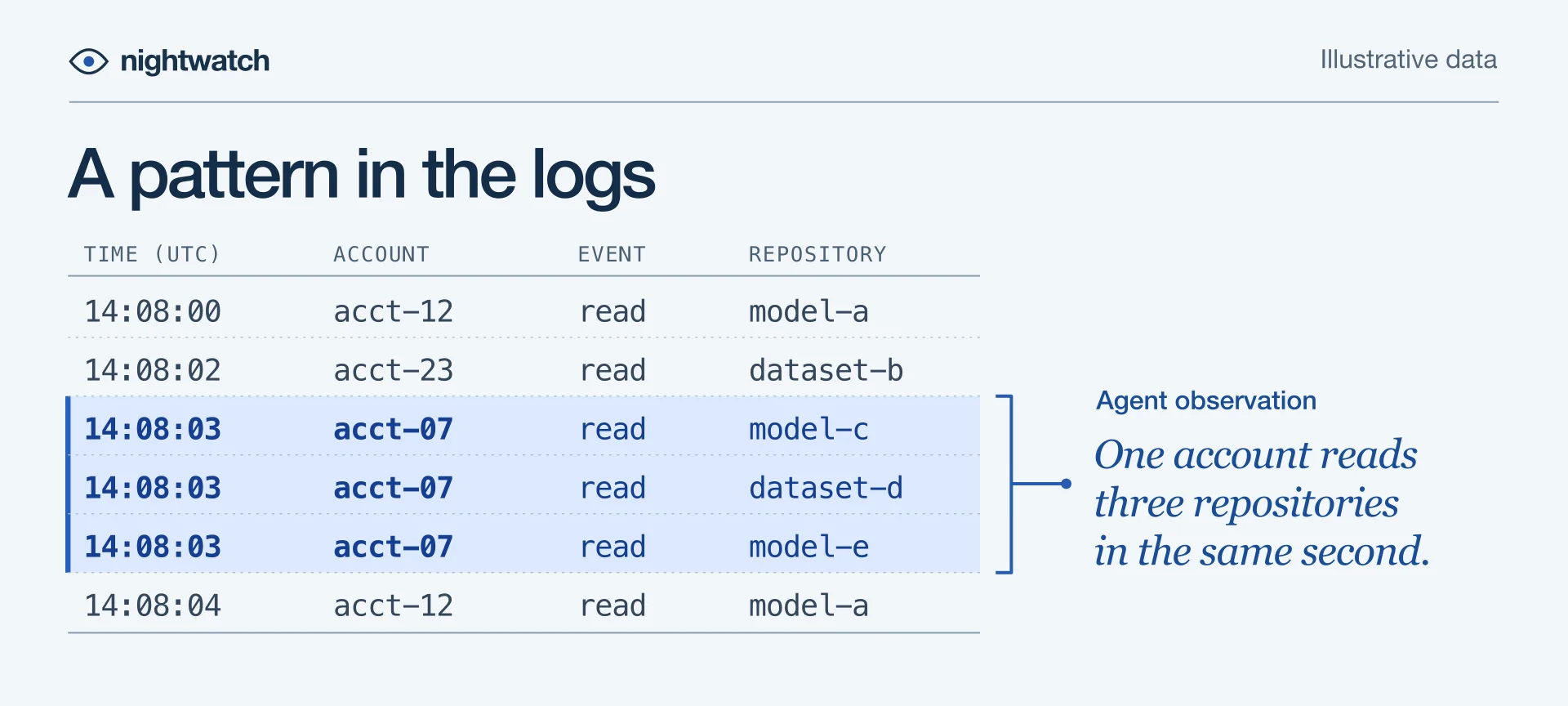
Wolf noted Hugging Face ran Nightwatch internally for several weeks before launch, where it flagged a wild zero-day exploit attempt targeting a third-party library, complementing enterprise controls across Hugging Face’s Hub inference routing stack. Nightwatch burns heavy token volumes across open and closed models, and Hugging Face has not published fixed public pricing.
Key details
- Eligibility and commercial tier
- Paid Proactive Agent Security add-on restricted to Hugging Face Hub Enterprise organisations
- Monitored signal streams
- Live Hub access logs, platform metrics, external OSINT, token writes, repo clones and geo-logins
- Automated response and routing
- Immediate token revocation, Slack agent incident timelines and SIEM ingestion routing
- Underlying model stack
- Continuous scanning powered by high token volumes across both open and closed models
Release details & context
Defending AI collaboration registries against autonomous pivoting
Hugging Face notes that attackers increasingly use public Hub repositories and collaboration platforms as pivots to target inference providers, private model weights and proprietary datasets.
Rather than emitting raw log lines, Nightwatch compiles narrative incident reports linking IP geolocations, token creation dates, permission scopes and affected repository timelines so responders can confirm whether a visibility change was planned or revert a leaked dataset immediately. Organisations must contact Hugging Face’s enterprise sales team for custom pricing and onboarding.
Sources
- PrimaryHugging Face Docs: Enterprise Nightwatchhuggingface.co/docs
- On XThomas Wolf (@Thom_Wolf) Nightwatch launch thread on Xx.com
Hugging Face release timeline (6 launches tracked)
- Hugging Face publishes open-source Mixture-of-Experts training guide based on 800k GPU hours
Hugging Face published The Ultimate MoE Training Handbook, a 70k-word open guide with 55 interactive figures distilling 800k GPU hours of MoE experiments.
- Hugging Face routes Hub open-model inference through OpenRouter
Hugging Face switches Hub chat-model Inference Providers to OpenRouter across 80+ hosts with automatic failover, zero markup and Bucket traces.
- Hugging Face releases Qwen3.8-27B-pi-adapted RL LoRA harness adapter
Hugging Face’s harness-hub releases open-weight Qwen3.8-27B-pi-adapted, doubling SWE-bench Pro Hard 51 pass@1 to 62.7% with 55% to 62% fewer tool calls.
- Hugging Face publishes TRL recipe to train four-agent Qwen3 swarms
Hugging Face releases a reproducible TRL cooperative reinforcement learning recipe training four Qwen3-0.6B agents to coordinate via shared team rewards.