


Open sourceSenseTimeConfirmed
Story 9 of 13 in the Wednesday 25 November editionSenseTime open-sources 8B SenseNova-U1.6 with native self-correction
Apache 2.0 NEO-unify multimodal model ships in BF16, FP8, INT8, GGUF and ComfyUI LoRAs, raising UltraTextBench 7% via self-critique, released 24 November 2026.

 Edited by Ashutosh Shrivastava
26 Nov 2026, 09:00 IST · 2 min read
SenseTime open-sourced SenseNova-U1.6-8B-MoT under the Apache 2.0 licence on 24 November 2026 on Hugging Face (sensenova/SenseNova-U1.6-8B-MoT), GitHub and ModelScope. Extending the encoder-free, VAE-free NEO-unify architecture from U1.5, the single 8B Mixture-of-Transformers model handles visual understanding, text-to-image generation and image editing, adding native self-correction through interleaved text and image generation.
Self-correcting infographics, MOPD training and local checkpoints
When rendering text-heavy posters or infographics, SenseNova-U1.6 produces an initial image, compares it against the prompt, writes an internal critique spotting blurred lettering, typos, garbled characters or wrong numbering, and generates a corrected revision in one pass. SenseTime trained dedicated aesthetic reward models across portraits, illustrations and layout-heavy posters, merging specialist experts via multi-expert on-policy distillation (MOPD).
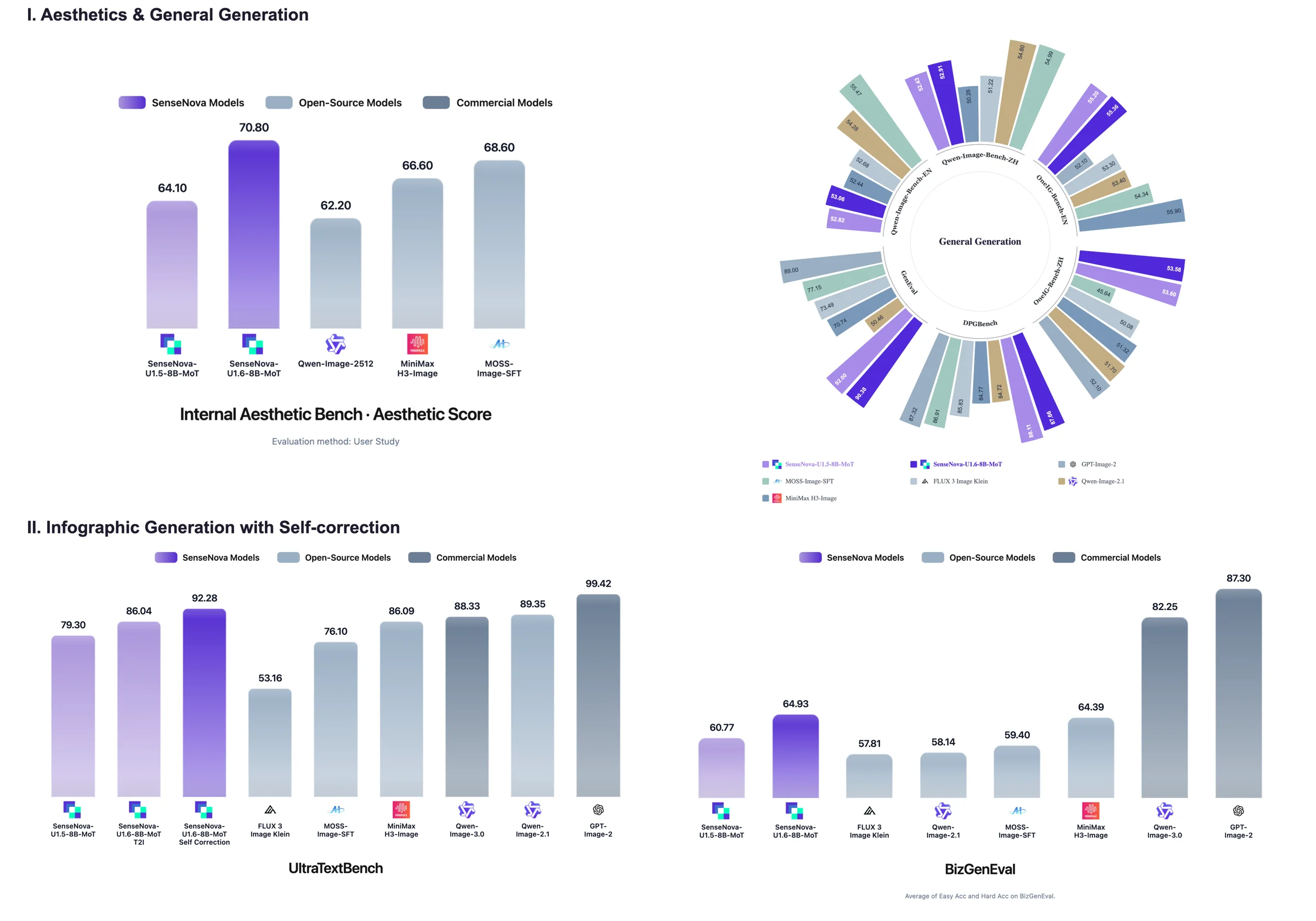
As shown in SenseTime’s evaluation suite, U1.6 improves overall aesthetic quality by roughly 10% over U1.5 in user studies and gains an average 7% relative boost on UltraTextBench dense infographics when self-correction is enabled, while also lifting BizGenEval scores. Alongside the sharded BF16 checkpoint (needing 24 GB GPU VRAM, 64 GB RAM and 35 GB disk), SenseTime released consolidated FP8 and INT8 W8A8 weights, GGUF quantisations (Q4_0, Q6_K, Q8_0), 4-step and 8-step Turbo LoRAs, and native ComfyUI workflows. SenseTime has not announced commercial API token rates outside its China platform.
Technical details
- Model ID and licence
- sensenova/SenseNova-U1.6-8B-MoT (Apache 2.0 for both weights and SenseNova-U1 code)
- Quantisations and adapters
- BF16, FP8 W8A8, INT8 ConvRot W8A8, GGUF (Q4_0, Q6_K, Q8_0), 4-step and 8-step ComfyUI LoRAs
- Recommended local hardware
- Linux with one 24 GB CUDA GPU, 64 GB system RAM and ~35 GB disk space (Python 3.11 + uv)
- Documented benchmark highlights
- UltraTextBench 92.28 with self-correction vs 86.04 T2I; BizGenEval 64.93 vs 60.77 for U1.5
Release details & context
Documented limitations and ComfyUI integration details
SenseTime’s model card explicitly flags remaining failure modes: brief under-specified prompts tend to look conventional, dense multi-reference edits or long text blocks remain less reliable without self-correction, and generated portraits can occasionally exhibit unnatural limb proportions or poses.
Separate Hugging Face cards ship consolidated inference formats under SenseNova-U1.6-8B-MoT-Native, SenseNova-U1.6-8B-MoT-GGUF and SenseNova-U1.6-8B-MoT-LoRAs, while hosted web access runs across Seko, SenseNova Studio and SenseNova Token Plan.
Common questions
What GPU memory is required to run SenseNova-U1.6-8B-MoT locally?
SenseTime’s quick-start guide recommends a Linux machine with one 24 GB CUDA GPU, 64 GB of system RAM and about 35 GB of disk space for the standard BF16 checkpoint, with smaller FP8, INT8 and GGUF quantisations also published.
Sources
- PrimaryHugging Face: sensenova/SenseNova-U1.6-8B-MoT model cardhuggingface.co/sensenova
- OfficialGitHub: SenseNova-U1.6 model documentationgithub.com/OpenSenseNova
- OfficialSenseTime: SenseNova U1.6 open-source release announcementsensetime.com
Related open source launches
- inclusionAI open-sources 124B Ling-3.2-air multimodal MoE model
inclusionAI releases MIT-licensed Ling-3.2-air (124B total, 5.5B active), lifting AutomationBench-AA from 15.7% to 61% over Ling-3.0-flash-VL.
- Prism ML open-sources 5.9 GB Ternary Bonsai 2.5 27B agent model
Prism ML releases Apache 2.0 Ternary Bonsai 2.5 27B in 5.93 GB, matching 77.2 vs 77.7 FP16 tool calling and 90% of FP16 agentic coding.
- NVIDIA open-sources 18.88M Nemotron 3.5 Parse datasets and DFlash2
NVIDIA publishes 18.88 million CC-BY-4.0 document-parsing examples, a NeMo RLVR fine-tuning workflow, and the DFlash2 speculator for Nemotron 3.5 Parse.
- Hugging Face publishes TRL recipe to train four-agent Qwen3 swarms
Hugging Face releases a reproducible TRL cooperative reinforcement learning recipe training four Qwen3-0.6B agents to coordinate via shared team rewards.