


ResearchByteDance SeedConfirmed
Story 5 of 12 in the Thursday 26 November editionByteDance Seed unveils U-MoLT looped transformer with 1.7 times efficiency
Minimal U-MoLT BlaGPT code, arXiv preprint, and a fused MoLA Triton kernel decouple recurrent depth from multi-pass KV-cache and decode latency overhead.

 Edited by Ashutosh Shrivastava
27 Nov 2026, 08:45 IST · 3 min read
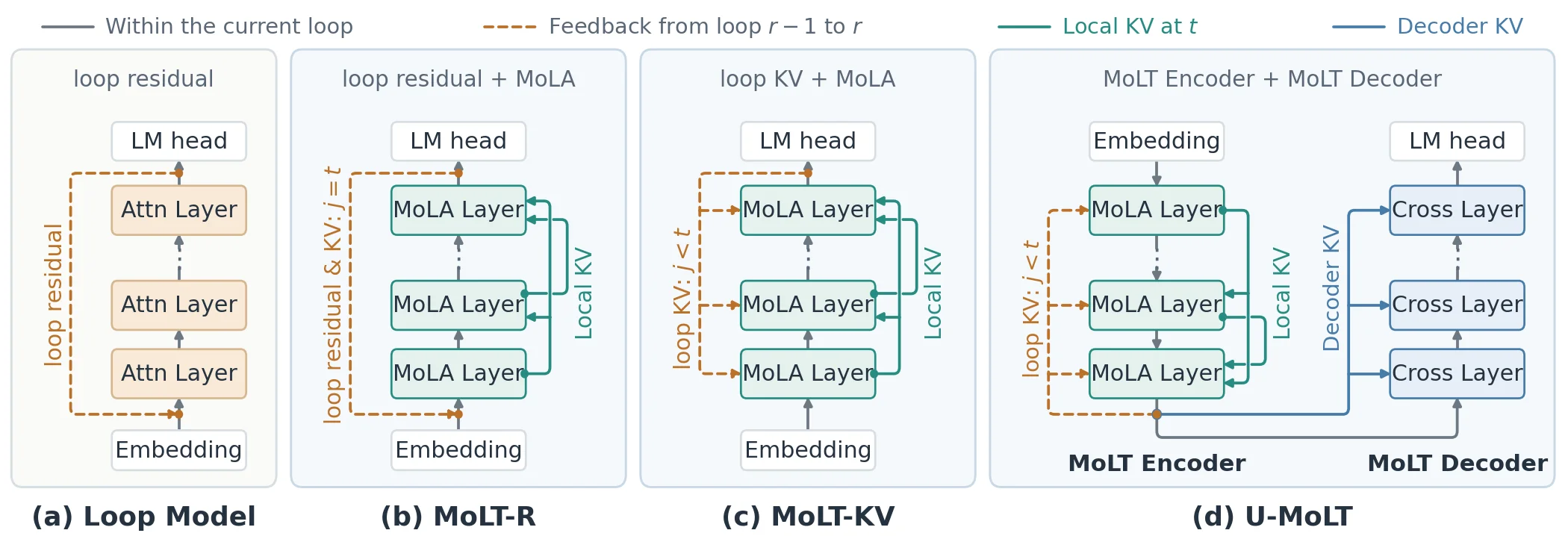
Researchers from ByteDance Seed, Huazhong University of Science and Technology, and the University of Toronto released the Mixture-of-Loops Transformer (MoLT) preprint (arXiv 2611.34923), a minimal U-MoLT implementation on BlaGPT, and a fused Mixture-of-Loops Attention (MoLA) Triton kernel on GitHub on 26 November 2026. The work builds on November’s wave of looped architectures following Z.ai’s GLM-5.4 loop transformer and Thinking Machines Lab’s Inkling 2 Mini.
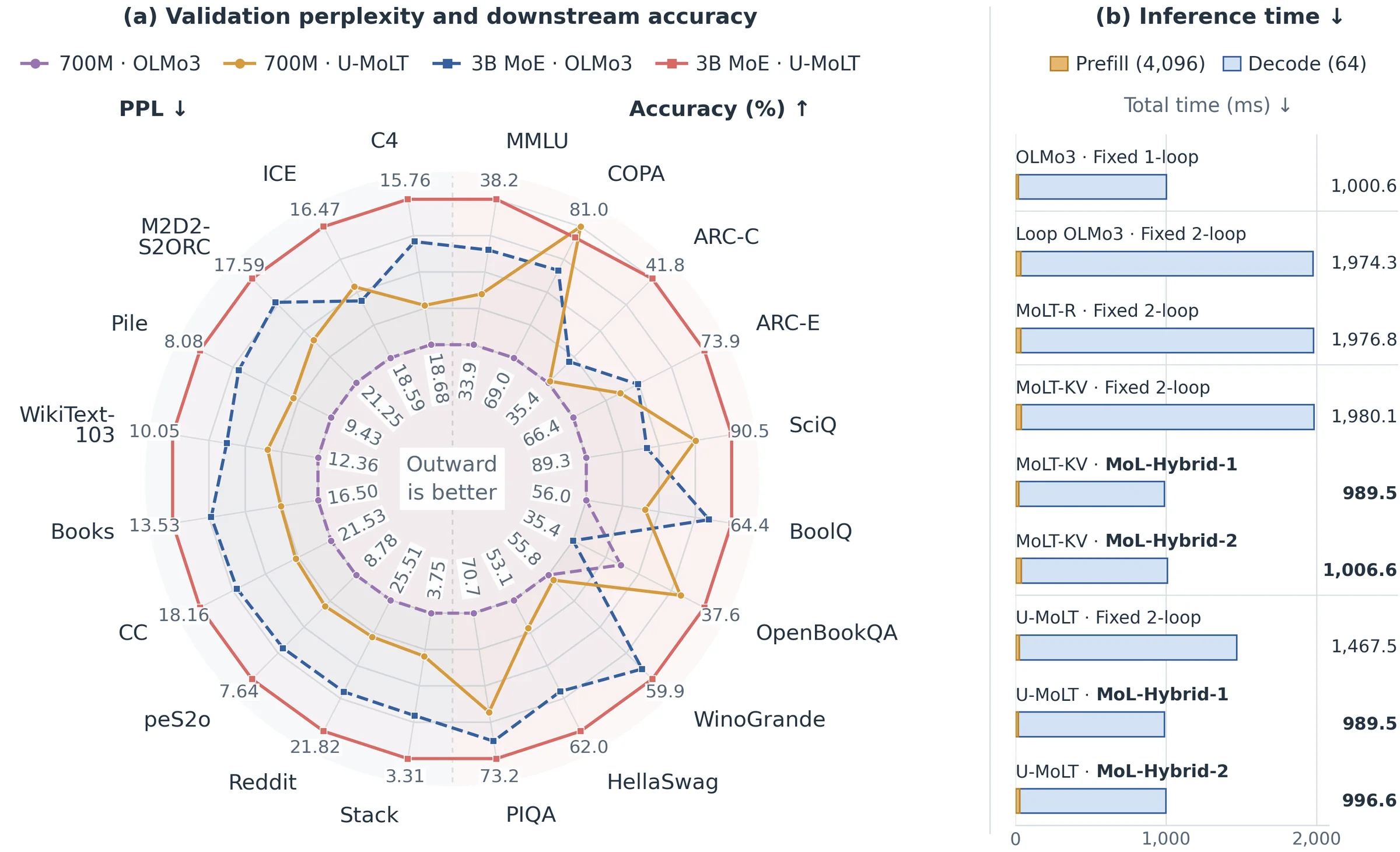
How MoLT-KV and U-MoLT eliminate multi-pass decode stalls
Standard looped transformers pass computation between recurrent iterations strictly through the residual stream, forcing sequential multi-pass decoding and multiplying persistent KV-cache memory. MoLT treats keys and values as selective cross-loop memory via MoLA. Its efficiency variant, MoLT-KV, restarts every loop from raw token embeddings while attending to current-loop local KV and strict-prefix memory KV from the prior loop, breaking same-position cross-loop dependence to allow parallel loop-forcing training and single-traversal decoding.
A U-shaped split, U-MoLT, separates a looped encoder from a causal cross-only decoder so intermediate decoder passes can be skipped at inference without altering outputs. Across 400B-token pretraining runs against OLMo3, U-MoLT achieves 1.7 times validation cross-entropy token efficiency at 700M parameters, raises 3B MoE 10-task accuracy by 2.1 percentage points (62.2% vs 60.1%), and matches non-looped OLMo3 decode latency at 996.6 ms versus 1,000.6 ms.
Study details
- Code and kernels released
- U-MoLT on BlaGPT (umolt_s.json) and fused MoLA Triton kernel in hustvl/MoLT
- 400B pretraining gains
- 1.7 times token efficiency at 700M; 3B MoE (660M active) 62.2% vs 60.1% OLMo3
- Continued pretraining result
- 1.4 times mean token efficiency on 100B-token Qwen3.5-0.8B-Base across 11 domains
- Inference latency profile
- 996.6 ms vs 1,000.6 ms OLMo3 on S-size (~113M) models with single-pass KV
Release details & context
MoLT family variants and remaining open-source roadmap
The paper distinguishes three architectural points along the expressivity-efficiency curve. MoLT-R keeps the residual stream across loops and reads preceding-loop local KV for peak expressivity at fixed multi-loop decode cost; MoLT-KV drops loop residuals for strict-prefix memory KV with single-traversal decoding; U-MoLT pairs a looped encoder with per-layer cross-only decoder KV projections from the normalised encoder state.
Across 1.5B dense models trained on 400B tokens, U-MoLT lifts 10-task average accuracy from 61.2% (OLMo3-1.5B) to 62.6%, including 79.0% versus 76.0% on COPA and 42.1% versus 40.4% on ARC-C. The authors note that standalone MoLT-R, MoLT-KV, MoL-Hybrid decoding, and full 700M/1.5B/3B pretraining scripts remain unchecked on the repository roadmap.
Common questions
How does U-MoLT avoid multiplying KV-cache size during inference?
U-MoLT restarts each encoder loop from token embeddings using strict-prefix prior-loop KV and uses a cross-only decoder that skips intermediate passes, keeping persistent KV cache at single-pass size.
What code is currently available in the hustvl/MoLT repository?
The repository currently ships the paper PDF, a minimal U-MoLT implementation on BlaGPT with the umolt_s.json config, and the fused MoLA Triton kernel with unit tests.
Sources
- PrimaryGitHub Repository: hustvl/MoLT (U-MoLT code and MoLA Triton kernel)github.com/hustvl
- OfficialarXiv 2611.34923: Mixture-of-Loops Transformerarxiv.org
ByteDance Seed release timeline (2 launches tracked)
- ByteDance Seed launches Seedream 5.5 with 100-round edit stability and RGBA transparency
ByteDance Seed ships Seedream 5.5 with pixel-stable editing across 100 turns, native RGBA alpha output and stronger bilingual typography on Volcano Ark.