


CreativeinclusionAIConfirmed
Story 3 of 12 in the Thursday 26 November editioninclusionAI open-sources 6B Ming-Image-0.2-Design under MIT licence
Native 2K Diffusion Transformer ranks first among open-weight image models on AA-Image-T2I v2.1 and runs in BF16 on one 80 GiB GPU via vLLM-Omni.

 Edited by Ashutosh Shrivastava
27 Nov 2026, 08:45 IST · 2 min read
Ant Group’s research unit inclusionAI open-sourced inclusionAI/Ming-Image-0.2-Design on Hugging Face and GitHub under the MIT licence, with updated leaderboard results, galleries, and DiT parameter specifications published on 26 November 2026. The 6B-parameter Diffusion Transformer targets graphic design, typography, multi-section web mockups, posters, spatial visuals, and transparent-background assets alongside inclusionAI’s 124B Ling-3.2-air multimodal MoE.
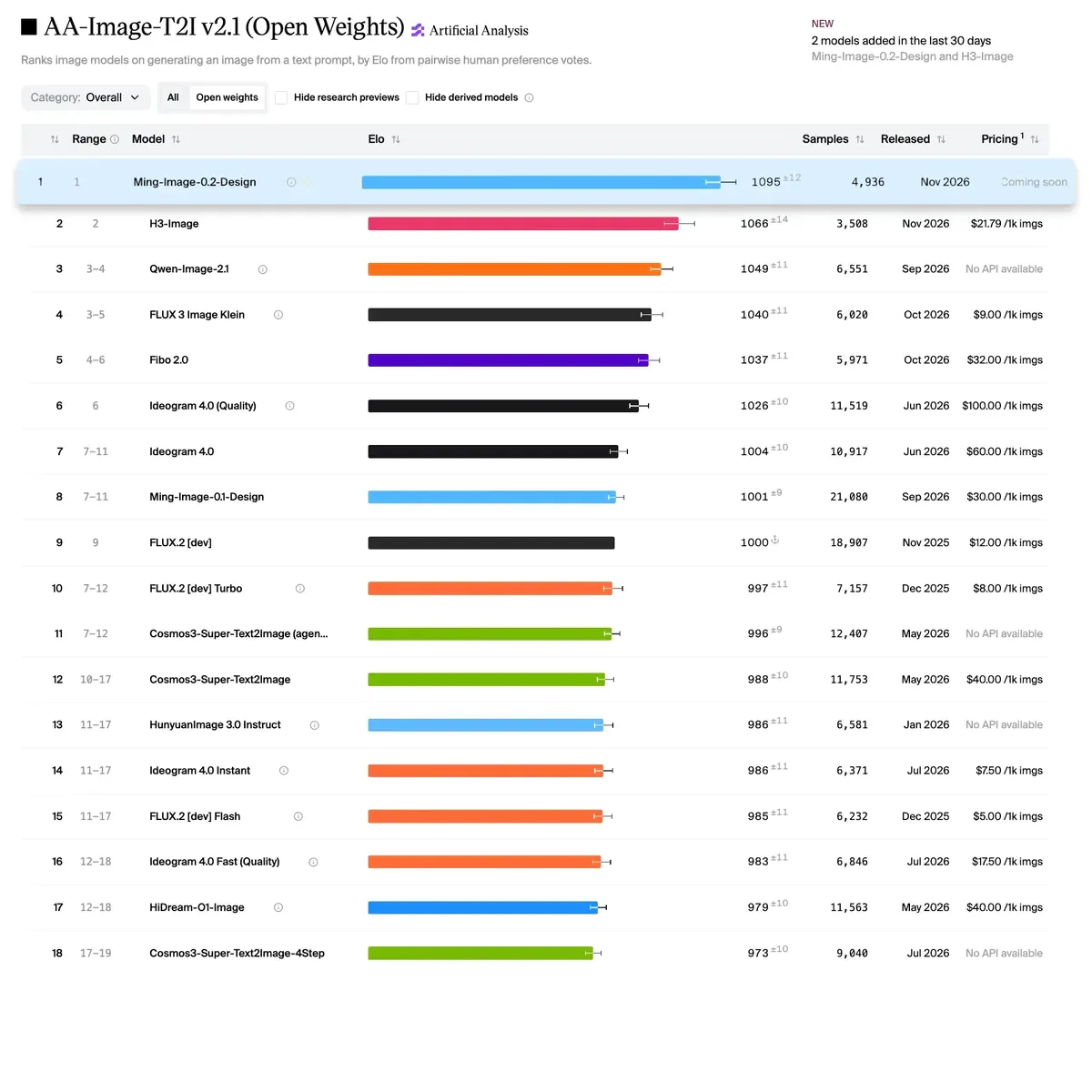
AA-Image-T2I v2.1 ranking and native 2K serving
On the Artificial Analysis AA-Image-T2I v2.1 text-to-image benchmark as of 25 November 2026, inclusionAI reports Ming-Image-0.2-Design ranks first overall among open-weight models with an Elo score of 1,095, ahead of FLUX.2 [max] (1,076) and Qwen-Image-2.0 (1,059).
The release keeps the same inference pipeline as Ming-Image-0.1-Design and runs in BF16 on one 80 GiB CUDA GPU using 12 default sampling steps and CFG 1.0, served through vLLM-Omni. Native 2K aspect buckets cover 2048 by 2048, 2560 by 1440, 2432 by 1824, and 1664 by 2496 pixels. Companion tools include Ming-Image-0.1-Design-Layer for transparent element decomposition and Ling-3.2-flash for turning web mockups into interactive HTML pages.
Key details
- Architecture and size
- 6B-parameter Diffusion Transformer (DiT)
- Licence and weights
- MIT on Hugging Face (inclusionAI/Ming-Image-0.2-Design) and ModelScope
- Validated hardware and defaults
- Single 80 GiB CUDA GPU, BF16, 12 sampling steps, CFG scale 1.0
- Serving and agent skills
- vLLM-Omni plus ling-ui-design and image-to-editable-ppt cookbook skills
Release details & context
Prompt enhancement and editable layer workflow
For complex multi-panel compositions, inclusionAI recommends passing Figma-style structured prompts through a prompt enhancer backed by Ling-3.0-flash-VL or qwen3.8-27B rather than raw short captions. Passing explicit width and height flags maps output to internal 1024-level or 2048-level aspect buckets before optional final resizing, while the older square resolution flag remains backwards-compatible.
Downstream editing relies on two companion open components in the Ming-Image repository: Ming-Image-0.1-Design-Layer separates flattened outputs into independently editable transparent layers down to character parts, and the ling-cookbook skills convert generated canvases into UI designs or editable PowerPoint slides.
Common questions
What GPU memory is required to run Ming-Image-0.2-Design locally?
inclusionAI’s validated BF16 serving setup runs on a single CUDA GPU with 80 GiB of VRAM using vLLM-Omni at 12 default sampling steps.
How can generated Ming-Image-0.2-Design layouts be turned into editable assets?
Teams can decompose flattened images into transparent layers with Ming-Image-0.1-Design-Layer or use inclusionAI’s cookbook skills for UI code and editable slides.
Sources
- PrimaryHugging Face Model Card: inclusionAI/Ming-Image-0.2-Designhuggingface.co/inclusionAI
- OfficialGitHub Repository: inclusionAI/Ming-Imagegithub.com/inclusionAI
inclusionAI release timeline (5 launches tracked)
- Ant Group’s inclusionAI releases Ling-3.1-flash-1019 under MIT licence
inclusionAI published Ling-3.1-flash-1019 under the MIT licence, pairing 560B parameters with a 1M context window.
- Ant Group’s inclusionAI launches 560B Ling-3.2-flash multimodal MoE model with 1M context window
Ant Group’s inclusionAI released Ling-3.2-flash (560B total, 25B active, 1M context) with native image and video inputs, free via API for its first two weeks.
- inclusionAI open-sources 560B and 124B LingSante-3.1 medical MoEs
inclusionAI releases open-weight 560B LingSante-3.1-flash (65.72 HealthBench Professional) and 124B multimodal LingSante-3.1-air-VL on Hugging Face.
- inclusionAI open-sources 124B Ling-3.2-air multimodal MoE model
inclusionAI releases MIT-licensed Ling-3.2-air (124B total, 5.5B active), lifting AutomationBench-AA from 15.7% to 61% over Ling-3.0-flash-VL.