Lead storyOpen sourceNVIDIAConfirmed
NVIDIA open-sources 18.88M Nemotron 3.5 Parse datasets and DFlash2
Three CC-BY-4.0 Hugging Face corpora, a NeMo SFT and GRPO recipe, and a speculative draft model ship for single-GPU document parsing on vLLM.

 AI Compass
The day’s major AI releases, written up and sourced.
Thursday 26 November 2026 · 12 launches · the whole day in 14 minutes
Lead storyOpen sourceNVIDIAConfirmed
Three CC-BY-4.0 Hugging Face corpora, a NeMo SFT and GRPO recipe, and a speculative draft model ship for single-GPU document parsing on vLLM.
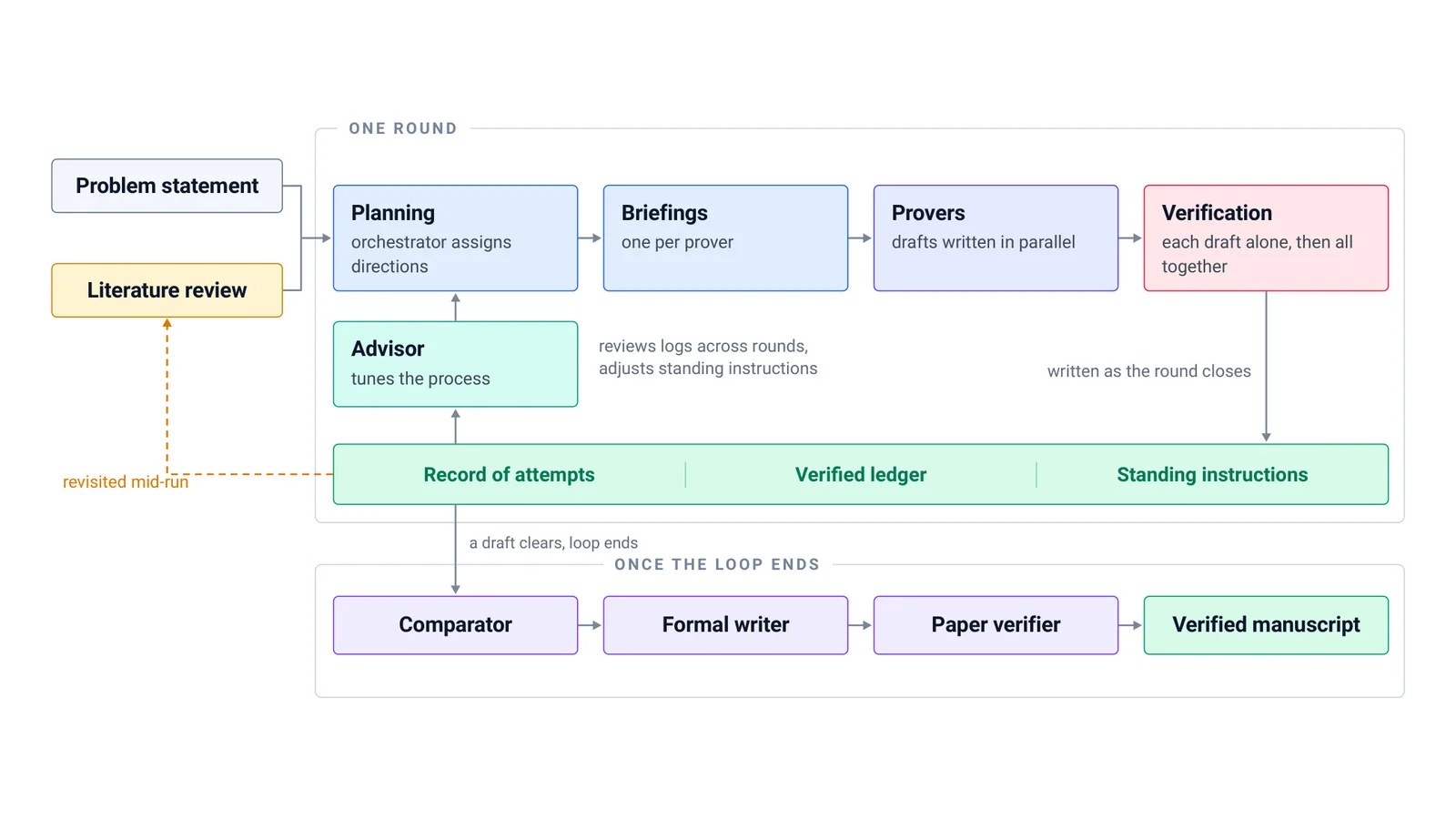
NVIDIA published the open training corpora, fine-tuning stack, and speculative decoder behind its compact document-parsing model nvidia/Nemotron-3.5-Parse on Hugging Face on 26 November 2026. The drop adds three CC-BY-4.0 datasets spanning 18.88 million image-and-annotation pairs: nvidia/Synthetic-Charts-V1 (9.98 million rendered charts across bars, lines, scatter plots, areas, pies, and matrices), nvidia/OCR-Synthetic-Multilingual-v2 (7.9 million pages in 28 scripts), and nvidia/Synthetic-Tables-V1 (1 million HTML-rendered table pages preserving headers and merged cells). It follows NVIDIA’s broader open tooling push alongside NVIDIA’s MotionBricks real-time motion toolkit.
NVIDIA’s recipe pairs supervised fine-tuning in NeMo Automodel with reinforcement learning with verifiable rewards (RLVR) using Group Relative Policy Optimization (GRPO) in NeMo RL, generating candidate extractions via vLLM. Rather than enforcing one rigid token sequence on dense layouts, verifiable rewards score text fidelity, bounding boxes, table cells, chart series recovery, and clean stopping.
On a matched development evaluation, adding GRPO cut repetition-loop failures by roughly 77% (from 126 to 29 pages), reduced 9,000-token truncations from 185 to 35, and raised the overall score from 66.24 to 71.38. In a 256-form synthetic dental odontogram adaptation benchmark, sampled first-attempt pass@1 rose from 0% on the base checkpoint to 95.85% after SFT and 96.58% after RLVR.
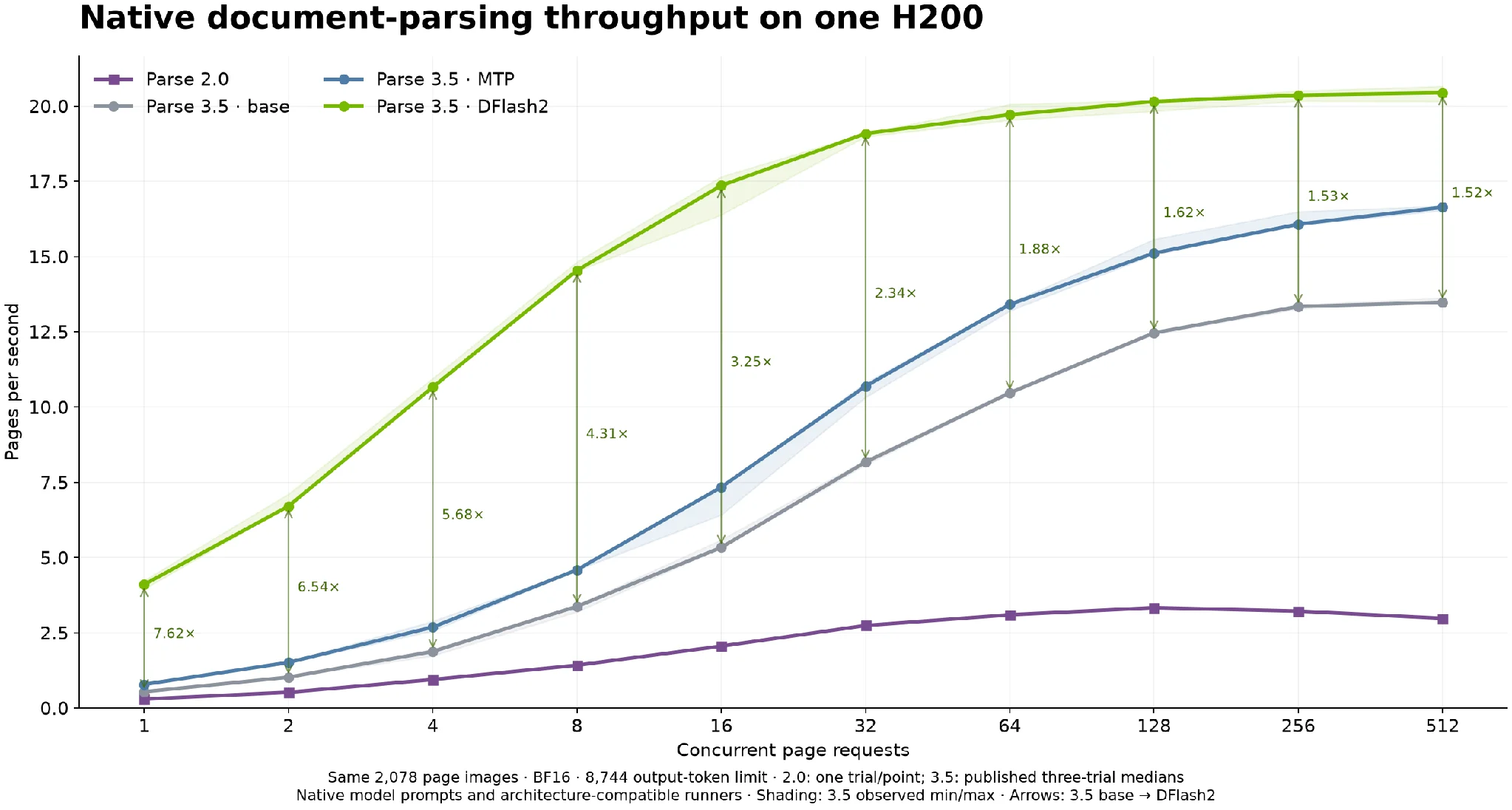
An optional DFlash2 draft model proposes up to 32 tokens ahead and averages roughly 14 accepted draft tokens per verification step. On one NVIDIA H200 GPU in BF16 across 2,078 pages, DFlash2 raises native single-pass throughput by 7.62 times at concurrency 1 and 1.52 times at concurrency 512, reaching 20.44 pages per second against 13.48 without speculation and 2.98 on Parse 2.0.
02ProductOpenAIConfirmed
Corrected ChatGPT metering affects Go, Plus, Pro, and Business subscribers with no back-charges plus one banked reset live on 26 November 2026.
OpenAI corrected a launch-time billing error on 26 November 2026 that had been under-counting ChatGPT subscription usage for GPT-6.2 Astra and GPT-6.2 Sol. Announcing the fix on X at 08:20 IST, OpenAI product lead Thibault Sottiaux (@thsottiaux) said the metering mistake had incorrectly discounted consumption on both models for most subscribers since launch.
With corrected accounting live, identical prompts consume a larger share of a subscriber’s rolling allowance. Compared with usage metering during GPT-6.2’s opening week, ChatGPT users now reach plan limits 40% faster on GPT-6.2 Astra and 25% faster on GPT-6.2 Sol. Sottiaux noted that both models still deliver higher effective usage than the older GPT-6 Astra and GPT-6.1 Sol tiers, and confirmed that no other OpenAI models were affected.
OpenAI will not charge customers retroactively for the discounted past consumption. To apologise for the abrupt tightening of effective quotas, OpenAI granted one extra banked usage reset to every user across Go, Plus, Pro, and Business plans, which Sottiaux confirmed went online at 12:56 IST on 26 November 2026. OpenAI has not published exact per-tier numeric message caps for GPT-6.2 Astra or Sol.
03CreativeinclusionAIConfirmed
Native 2K Diffusion Transformer ranks first among open-weight image models on AA-Image-T2I v2.1 and runs in BF16 on one 80 GiB GPU via vLLM-Omni.

Ant Group’s research unit inclusionAI open-sourced inclusionAI/Ming-Image-0.2-Design on Hugging Face and GitHub under the MIT licence, with updated leaderboard results, galleries, and DiT parameter specifications published on 26 November 2026. The 6B-parameter Diffusion Transformer targets graphic design, typography, multi-section web mockups, posters, spatial visuals, and transparent-background assets alongside inclusionAI’s 124B Ling-3.2-air multimodal MoE.
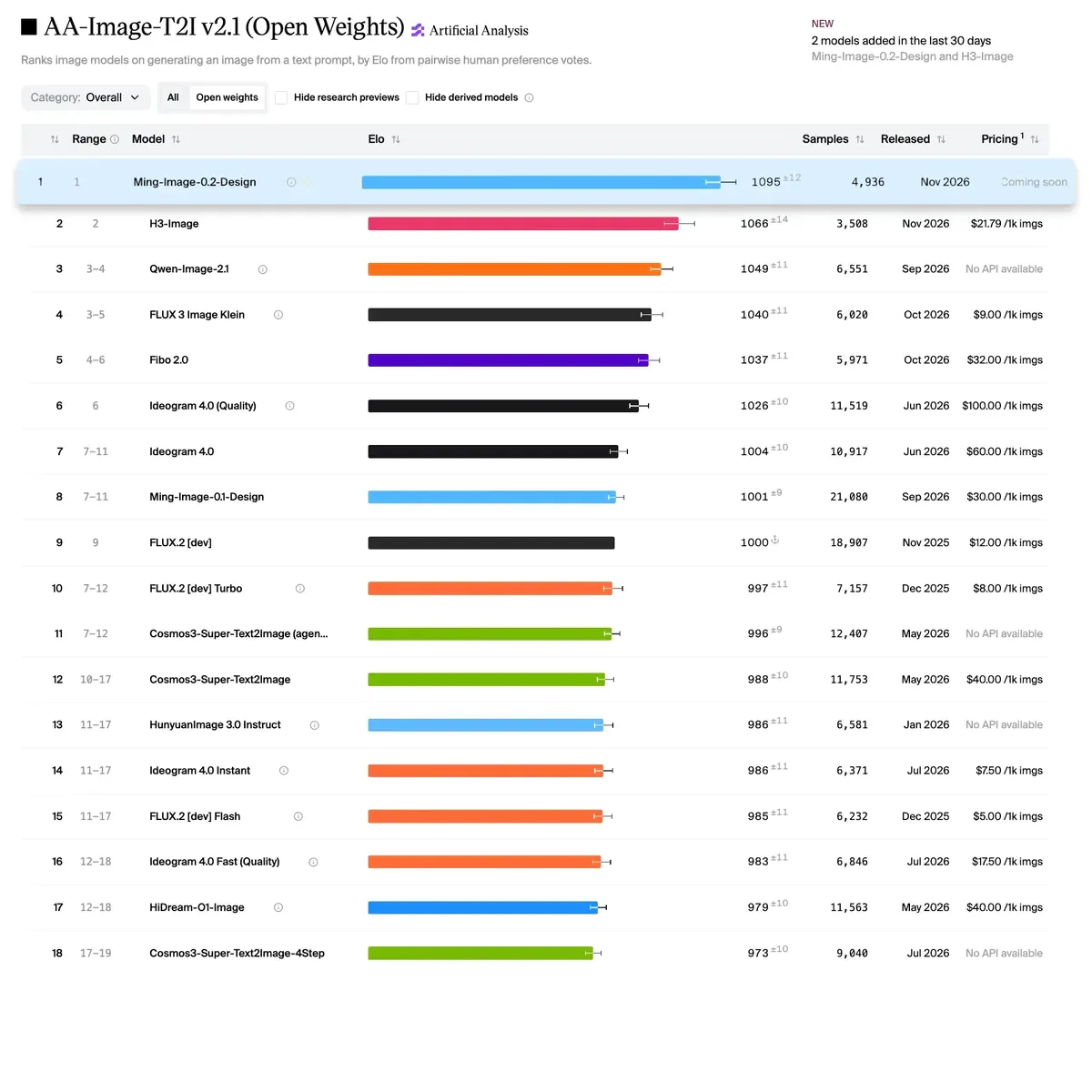
On the Artificial Analysis AA-Image-T2I v2.1 text-to-image benchmark as of 25 November 2026, inclusionAI reports Ming-Image-0.2-Design ranks first overall among open-weight models with an Elo score of 1,095, ahead of FLUX.2 [max] (1,076) and Qwen-Image-2.0 (1,059).
The release keeps the same inference pipeline as Ming-Image-0.1-Design and runs in BF16 on one 80 GiB CUDA GPU using 12 default sampling steps and CFG 1.0, served through vLLM-Omni. Native 2K aspect buckets cover 2048 by 2048, 2560 by 1440, 2432 by 1824, and 1664 by 2496 pixels. Companion tools include Ming-Image-0.1-Design-Layer for transparent element decomposition and Ling-3.2-flash for turning web mockups into interactive HTML pages.
04ModelQwenConfirmed
Hosted QwenCloud API endpoints add regional dialect support across ASR, expressive TTS, and 240k-context full-duplex voice starting at $0.15 per million tokens.
Alibaba’s Qwen team rolled out a multilingual and regional dialect upgrade across its hosted Qwen-Audio-3.1 speech foundation endpoints on QwenCloud on 26 November 2026, covering qwen-audio-3.1-asr-flash, qwen-audio-3.1-tts-flash, and qwen-audio-3.1-realtime-flash alongside its flagship Qwen4-Max MoE API.
Language support now spans 59 languages and 8 Chinese dialects on ASR-Flash, 65 languages and 6 Chinese dialects on TTS-Flash, and 53 languages and 6 Chinese dialects on Realtime-Flash. ASR-Flash adds controllable multi-dialect transcription, classical Chinese cadence tuning, punctuation prediction, and multi-speaker dialogue formatting. TTS-Flash supports tag-based control of emotion, tone, persona, speaking rate, and noise-robust voice cloning. Realtime-Flash handles full-duplex turn-taking, interruptions, and external tool calls inside a 240k-token input window.
Published QwenCloud pricing puts ASR-Flash at $0.15 per million input tokens and $0.47 per million output tokens (600 RPM), and TTS-Flash at $0.23 input and $1.87 output (180 RPM). Realtime-Flash bills $0.93 per million audio input tokens, $0.23 text input, $0.70 text output, and $1.87 combined audio-and-text output (60 RPM). Qwen has not announced open model weights.
05ResearchByteDance SeedConfirmed
Minimal U-MoLT BlaGPT code, arXiv preprint, and a fused MoLA Triton kernel decouple recurrent depth from multi-pass KV-cache and decode latency overhead.
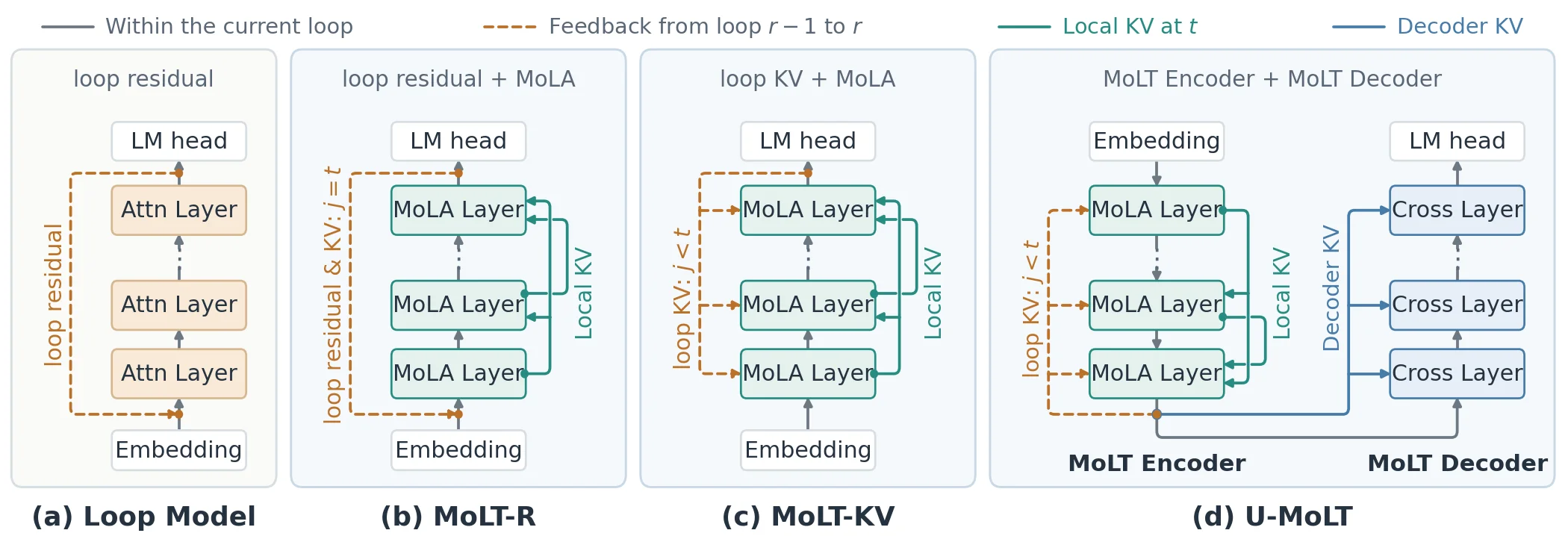
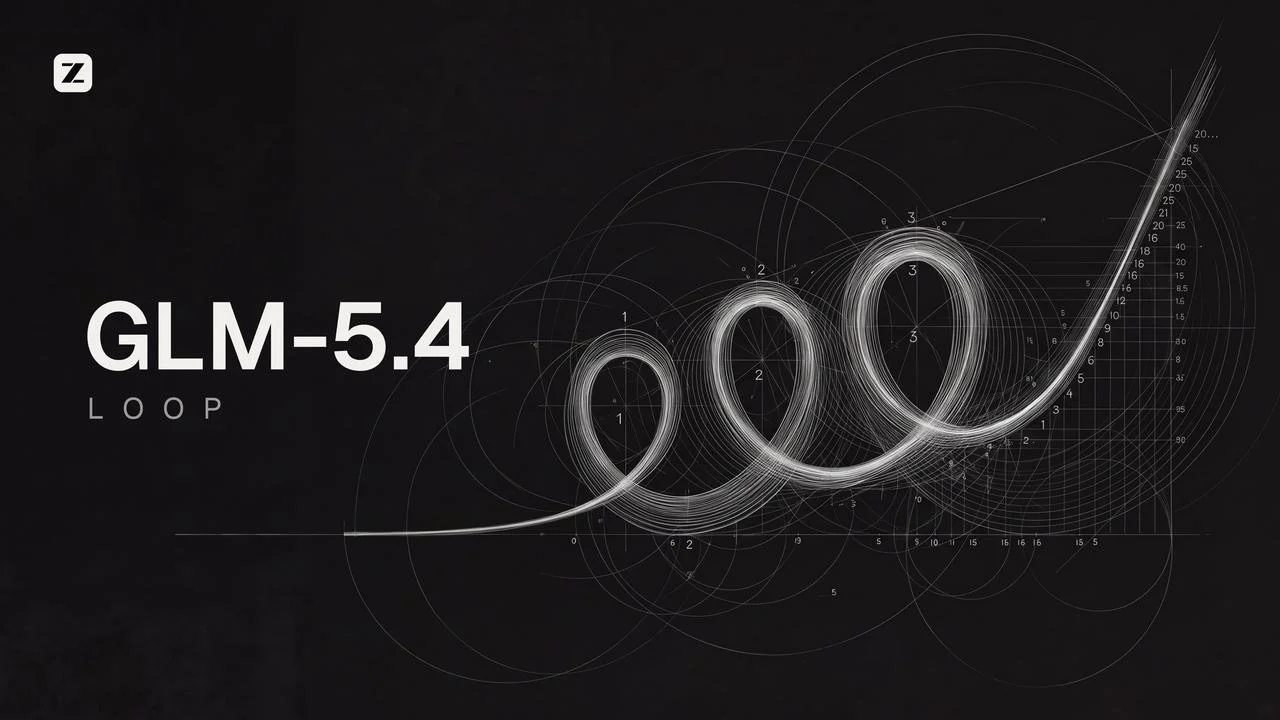
Researchers from ByteDance Seed, Huazhong University of Science and Technology, and the University of Toronto released the Mixture-of-Loops Transformer (MoLT) preprint (arXiv 2611.34923), a minimal U-MoLT implementation on BlaGPT, and a fused Mixture-of-Loops Attention (MoLA) Triton kernel on GitHub on 26 November 2026. The work builds on November’s wave of looped architectures following Z.ai’s GLM-5.4 loop transformer and Thinking Machines Lab’s Inkling 2 Mini.
Standard looped transformers pass computation between recurrent iterations strictly through the residual stream, forcing sequential multi-pass decoding and multiplying persistent KV-cache memory. MoLT treats keys and values as selective cross-loop memory via MoLA. Its efficiency variant, MoLT-KV, restarts every loop from raw token embeddings while attending to current-loop local KV and strict-prefix memory KV from the prior loop, breaking same-position cross-loop dependence to allow parallel loop-forcing training and single-traversal decoding.
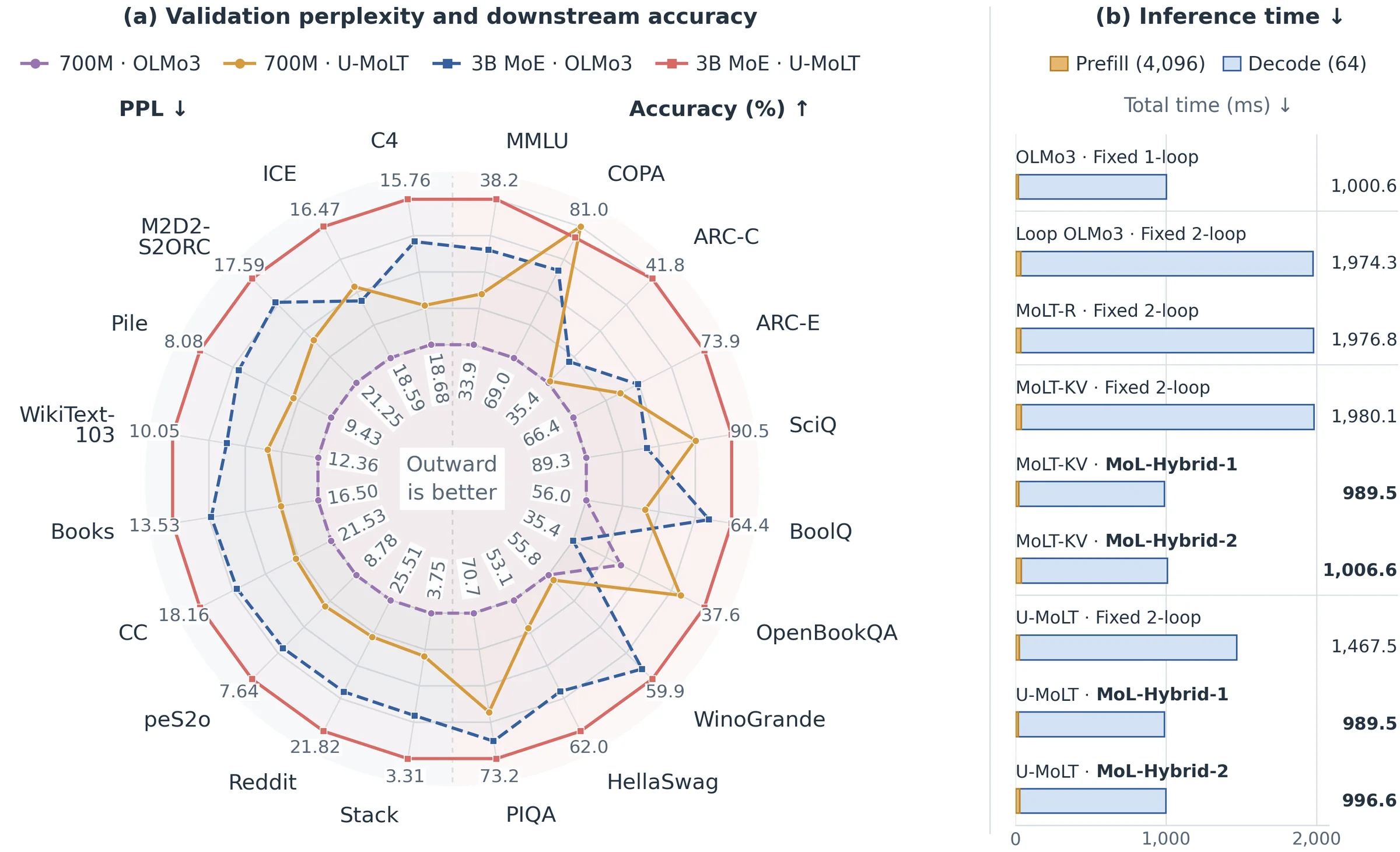
A U-shaped split, U-MoLT, separates a looped encoder from a causal cross-only decoder so intermediate decoder passes can be skipped at inference without altering outputs. Across 400B-token pretraining runs against OLMo3, U-MoLT achieves 1.7 times validation cross-entropy token efficiency at 700M parameters, raises 3B MoE 10-task accuracy by 2.1 percentage points (62.2% vs 60.1%), and matches non-looped OLMo3 decode latency at 996.6 ms versus 1,000.6 ms.
06ModelShanghai AI LaboratoryConfirmed
Open-weight Intern-S2-Preview derivative activates 3B parameters per token, serves on one H200 via vLLM, and leads 31 public clinical benchmarks.
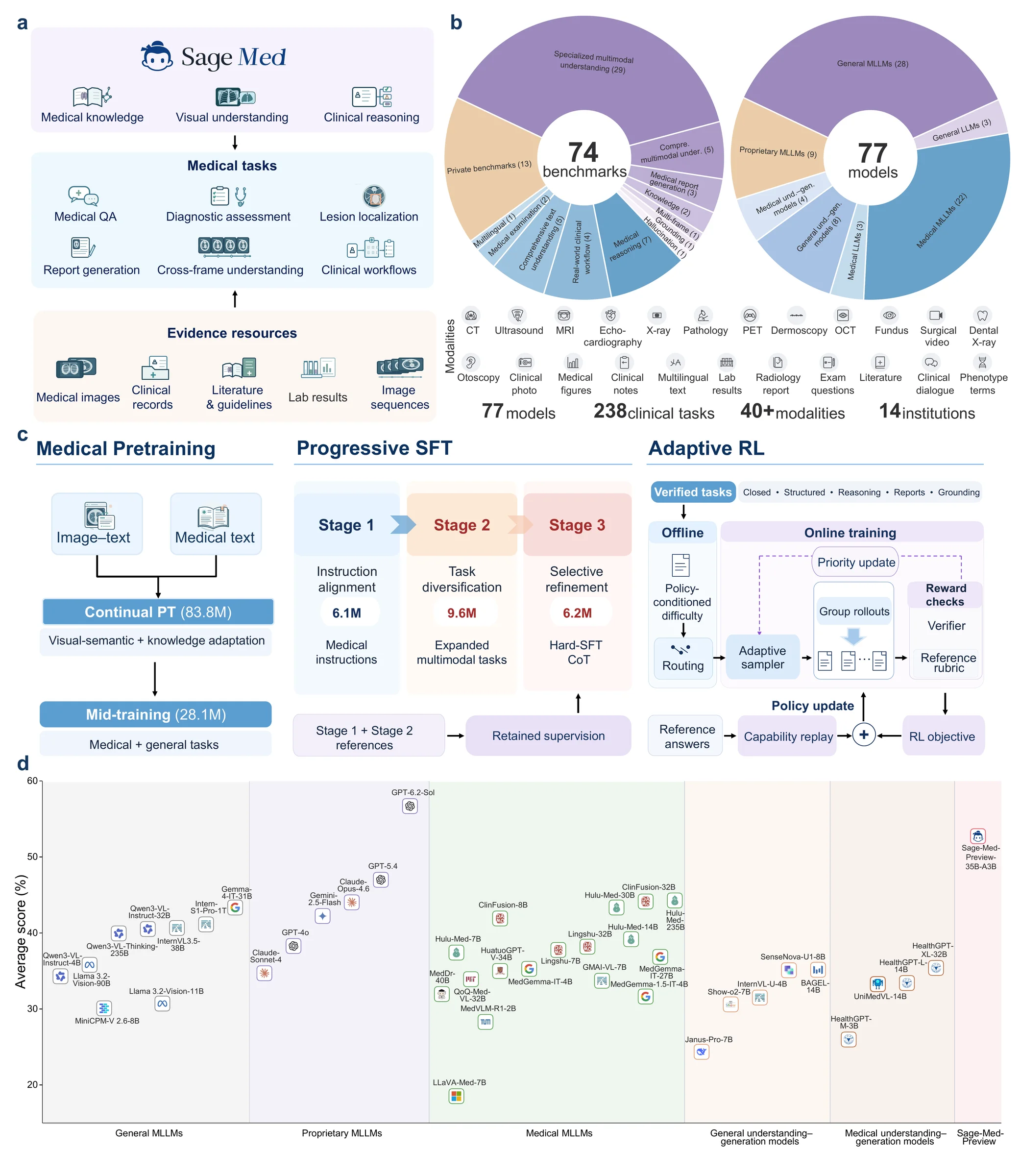
Shanghai Artificial Intelligence Laboratory released Sage-Med-Preview, an open-weight medical multimodal mixture-of-experts model with 35B total parameters and 3B active parameters per token, with weights on Hugging Face, vLLM serving instructions on GitHub, and a technical report (arXiv 2611.34575) surfaced on 26 November 2026. Built on Intern-S2-Preview, it joins November’s open medical model wave alongside inclusionAI’s LingSante-3.1 medical MoEs.
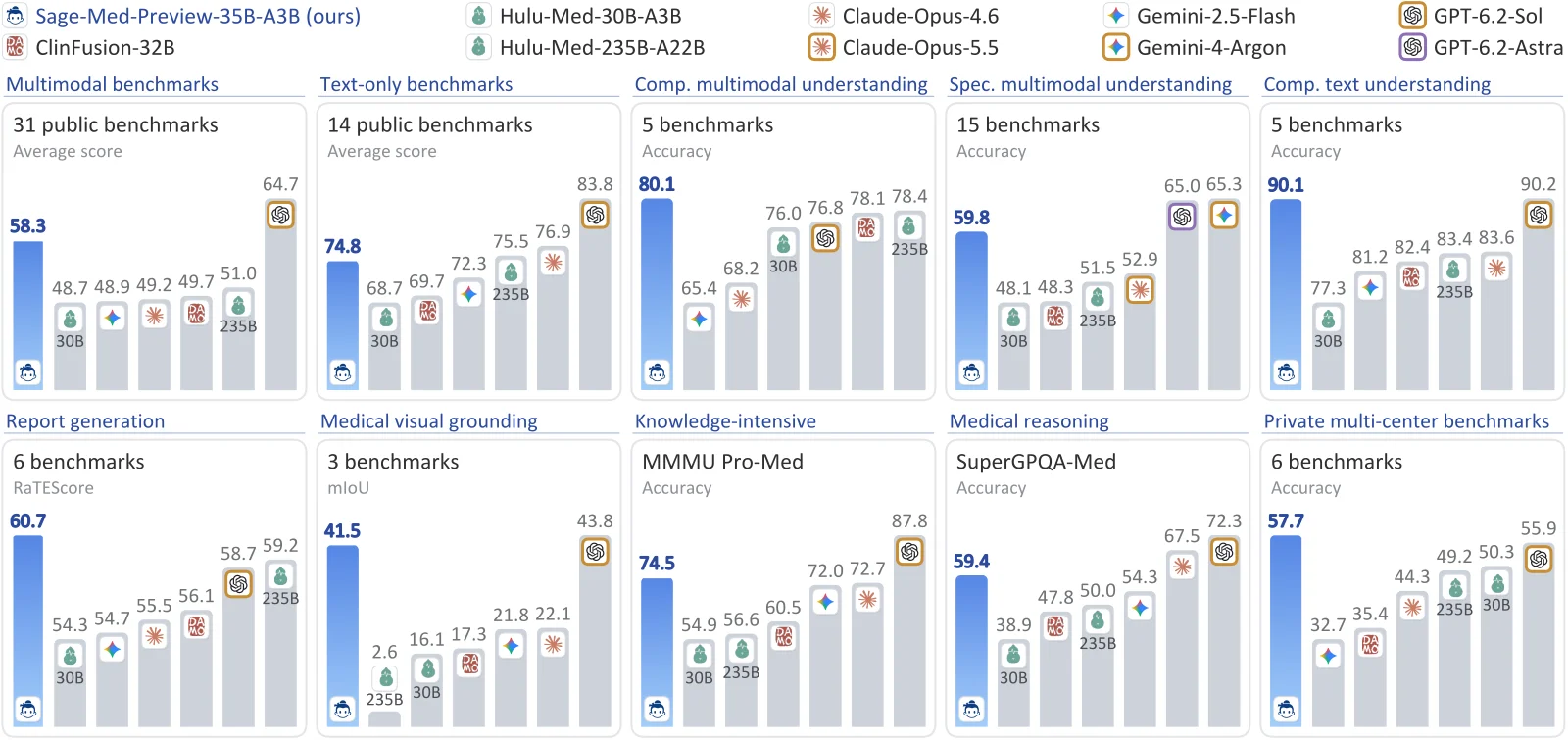
Sage-Med-Preview unifies clinical question answering, medical imaging analysis across 40+ modalities, radiology report generation, and visual grounding inside one checkpoint. Training drew on curated pools totalling roughly 164 million records and 226 billion tokens across continual pretraining, task-oriented mid-training, three-stage supervised fine-tuning, and difficulty-adaptive reinforcement learning with task-specific rewards and reference replay.
Across 31 public medical multimodal benchmarks, Sage-Med-Preview averages 58.26, exceeding Hulu-Med-235B-A22B (50.99), Intern-S2-Preview (52.24), GPT-5.4 (52.78), and Claude-Opus-4.6 (49.18). Head-to-head against GPT-6.2-Sol, it leads on multimodal understanding (80.05 vs 76.81), MIMIC-CXR report generation (33.37 vs 30.31 ROUGE-L), MedFrameQA (65.52 vs 62.78), and nine held-out tasks from 14 clinical institutions (57.72 vs 51.24).
07InfraOpenRouterConfirmed
Paid routing telemetry shows quarterly price elasticity dropping from 5.5 in Q2 to 1.2 in Q4 2026 as enterprises pocket falling closed-model API rates.
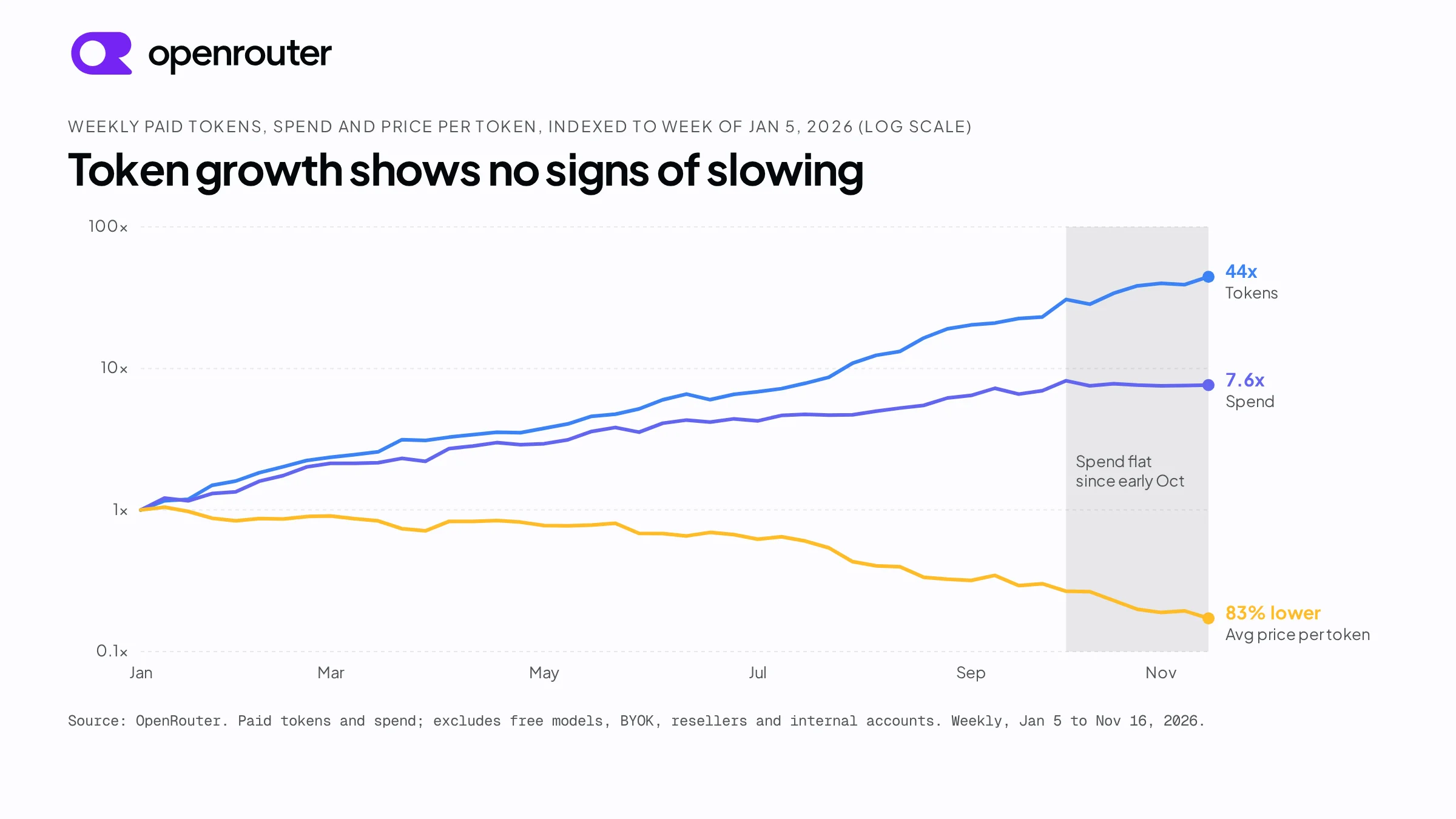
OpenRouter published an empirical breakdown of paid inference traffic on 26 November 2026 examining whether Jevons paradox, where falling unit costs lift total expenditure, still holds across production language models. Over 2026 to date, paid token volume across OpenRouter jumped 44 times while average price per token dropped 83%, expanding total customer spend 7.6 times overall. OpenRouter, which also launched its Extractions API alpha in November 2026, excluded free models, bring-your-own-key traffic, resellers, and internal accounts from the dataset.
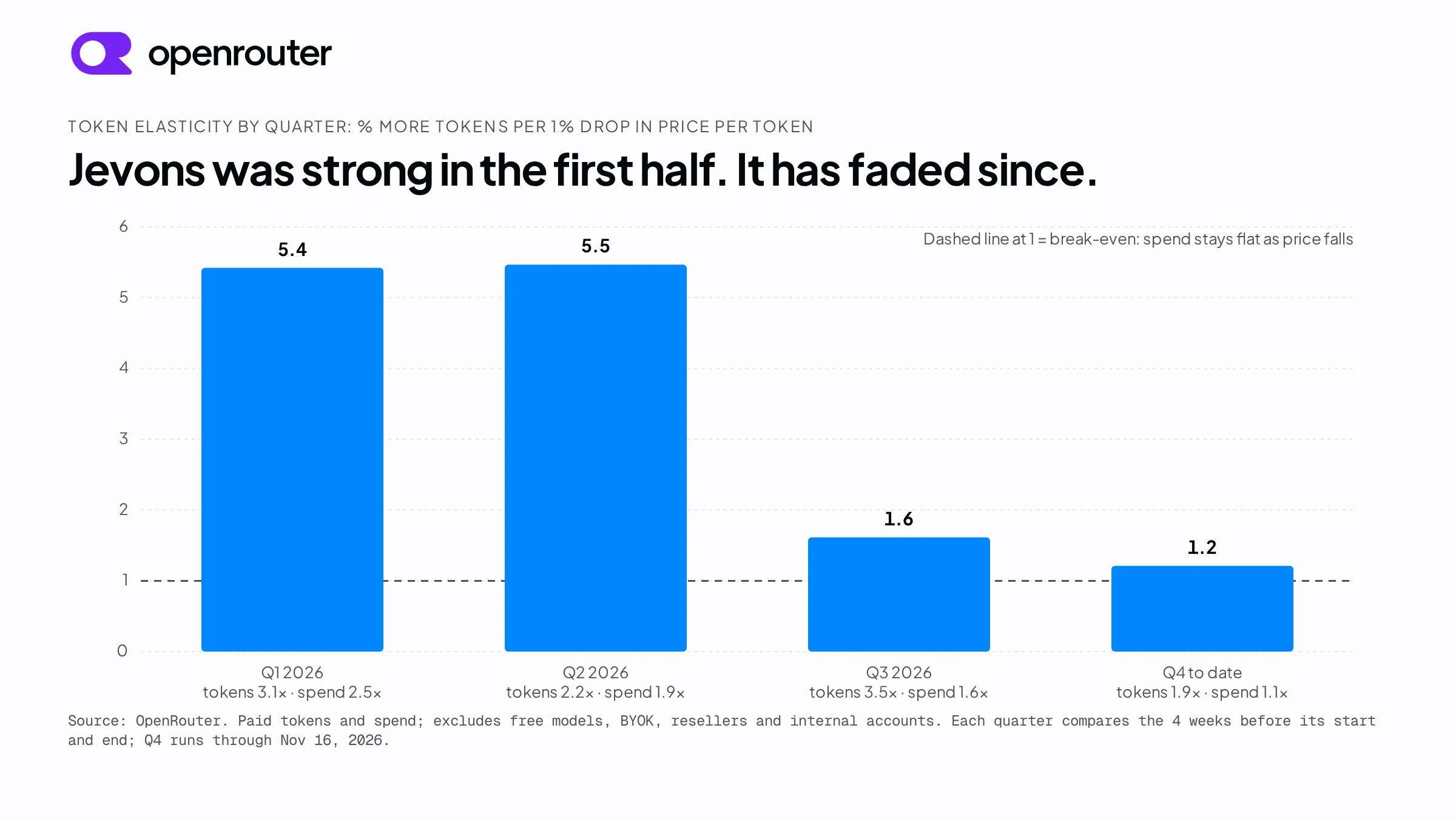
OpenRouter measures elasticity as the ratio of log changes in tokens to log changes in price per token, comparing the four weeks before each quarter’s start and end. Above 1, price drops raise total spend; at 1, buyers absorb savings as extra tokens on a flat budget. Elasticity stood at 5.4 in Q1 and 5.5 in Q2, when agentic coding drove rapid net-new spend, before sliding to 1.6 in Q3 and 1.2 so far in Q4 through 16 November 2026.
Since July 2026, monthly token demand has still compounded at roughly 39%, yet total spend has barely ticked upward since early October as closed families such as Claude and GPT cut per-token rates. OpenRouter observes enterprises acting more budget-consciously than AI-native scale-ups, though comparable dips near 1 in December 2024 and November 2025 rebounded after fresh capability waves.
08Infraggml-orgConfirmed
Weekly Hugging Face explorer tracks PP512 and TG128 throughput across Radeon 8060S and AI Pro R9700S builds with public raw JSONL logs.
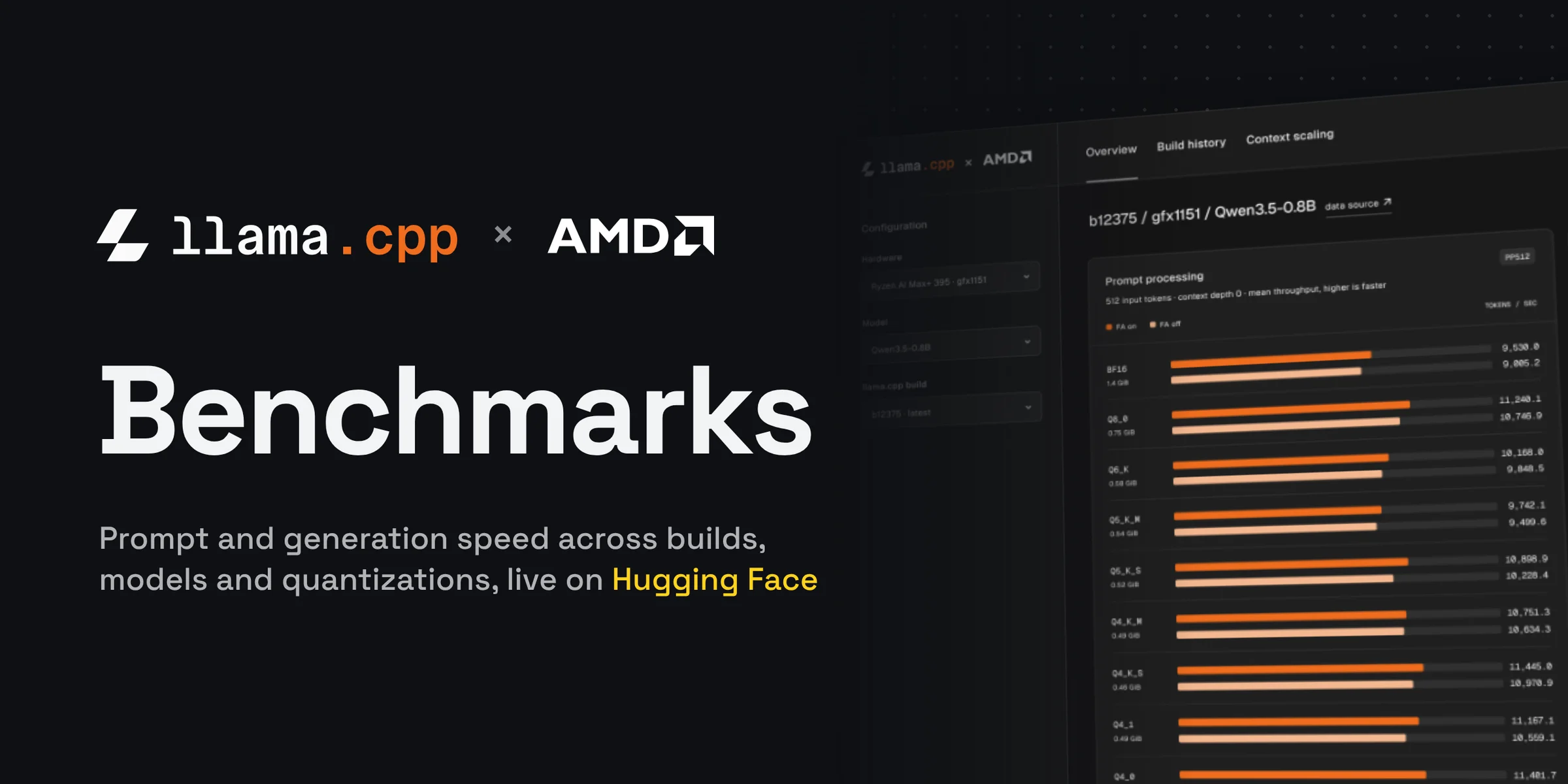
The llama.cpp maintainers at ggml-org, collaborating with AMD’s test infrastructure team, launched the public llama.cpp x AMD Benchmark dashboard on Hugging Face on 26 November 2026. The release follows ggml-org’s llama.cpp v1.0.0 stable C API and gives local-inference developers reproducible tracking across builds, models, and quantisation formats on AMD Ryzen and Radeon silicon.
Initial hardware targets cover the Radeon 8060S (gfx1151) and Radeon AI Pro R9700S (gfx1201). Public GitHub Actions workflows inside ggml-org/llama-install.sh benchmark prebuilt binaries distributed for llama.app every week using llama-bench with Flash Attention toggled both on and off across 10 repetitions per configuration.
The explorer splits telemetry into three tabs: Overview for comparing formats including Q4_K_M, Q8_0, F16, and BF16; Build history for catching kernel regressions across releases; and Context scaling for plotting generation speed as prompt depth grows. Both prompt processing (PP512) and text generation (TG128) report mean tokens per second across Inkling 2 Mini, Qwen, Gemma, gpt-oss, and LFM checkpoints, backed directly by raw JSONL files in the ggml-org/install.sh-benches-data Storage Bucket.
09Open sourceHugging FaceConfirmed
Reproducible cooperative RL guide on Hugging Face Jobs lifts four-agent Qwen3-0.6B success from 6.6% to 82.3% while cutting team tokens 37.4%.
Hugging Face launched a technical blog series and open TRL training recipe on 26 November 2026 explaining how to train and audit cooperative multi-agent reinforcement learning swarms using small open weights, building on its recent RL post-training guides including Qwen3.8-27B harness adapters. Part 1 reproduces the distributed information-aggregation task from Simple Scaling of Swarms, where four Qwen3-0.6B agents share one policy, hold private integers, and coordinate via message, read_messages, and check_notifications tools to output a sorted list.
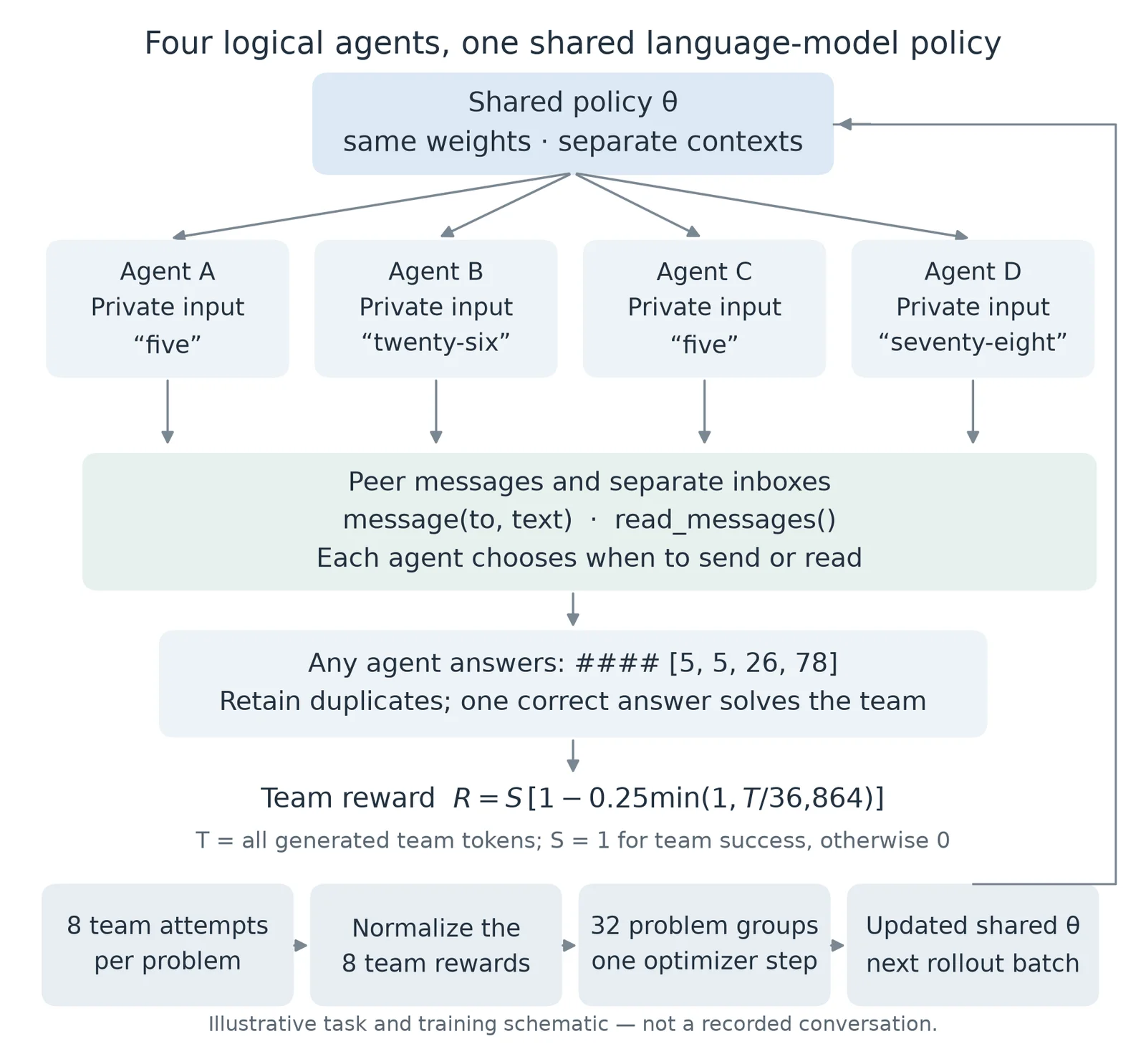
Using centralised GRPO-style group advantage across eight team attempts per problem, every agent in a team receives the identical token-penalised team advantage, incentivising useful communication without handcrafted per-message rewards. Across 75 updates (256 team attempts per update on one trainer H200 and seven vLLM rollout H200s), training success climbed from 6.6% to 82.3%, held-out accuracy hit 81.25% (26 of 32 problems), and generated tokens per team fell 37.4% from roughly 13k to 8k as broadcasts rose from 2.38 to 5.73.
For smaller budgets, Hugging Face published a two-GPU TRL script (async_grpo_s3_aggregation.py) for Hugging Face Jobs that runs 50 updates in 4.8 hours on two H100s (roughly $50 on two H200s), achieving 60.9% held-out success across 192 problems.
10RoboticsReal2SimHubConfirmed
Apache-2.0 platform from PKU-VaLuE-Lab standardises sandboxed offline physics evaluation and turns official scorers into leak-free RL rewards.
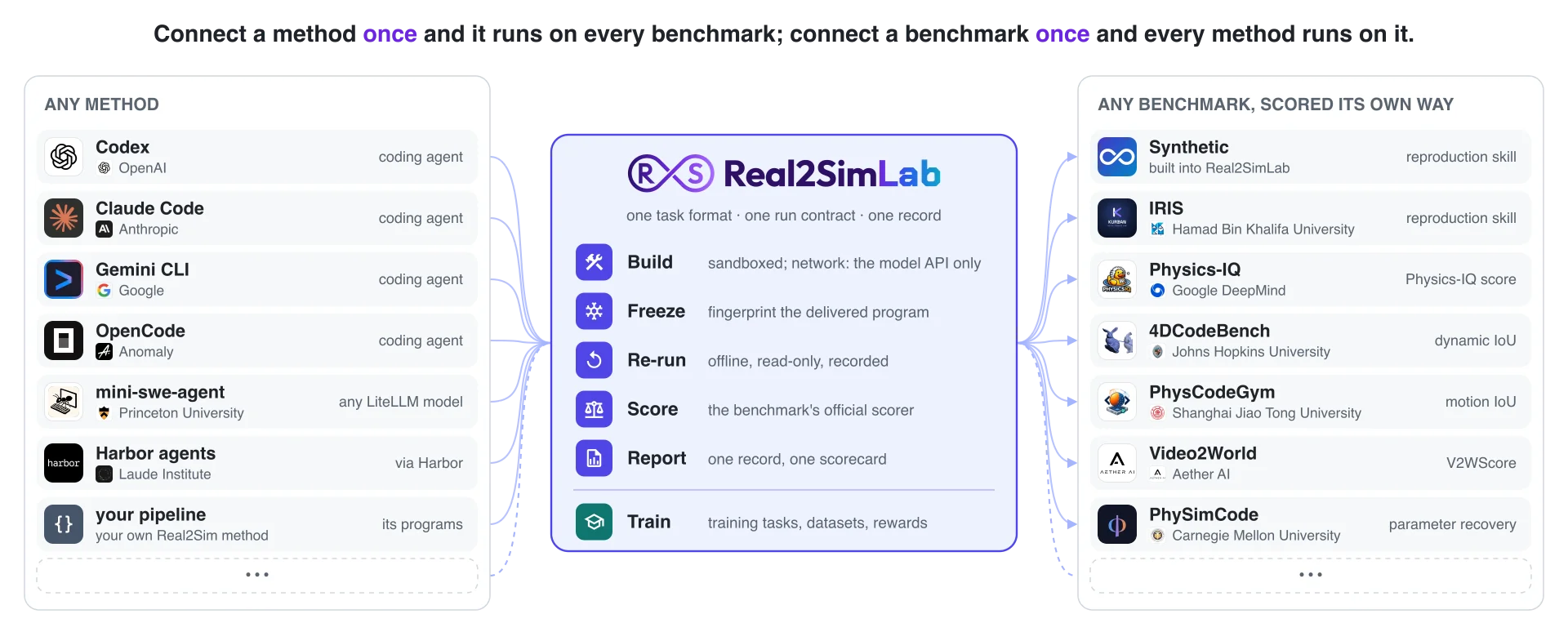
Researchers from PKU-VaLuE-Lab under Real2SimHub open-sourced Real2SimLab on GitHub under the Apache-2.0 licence alongside its arXiv preprint (arXiv 2611.34849), topping Hugging Face Daily Papers on 26 November 2026. The platform standardises evaluation and training for systems that translate recordings of physical scenes into executable simulation code.
Previously, real-to-simulation benchmarks including Physics-IQ, Video2World, 4DCodeBench, PhysCodeGym, and PhySimCode each demanded bespoke data layouts, execution harnesses, and scoring scripts. Real2SimLab connects six suites (adding the IRIS multi-recording dataset and a synthetic ground-truth benchmark) into one record schema and bootstrap-interval scorecard while running pinned official scorers verified against original pipelines.
The framework evaluates 47 coding agents through Harbor 0.27 alongside direct integrations for Codex, Claude Code, Gemini CLI, OpenCode, and mini-swe-agent inside Docker or rootless bubblewrap sandboxes limited strictly to model API calls. To prevent session leakage, Real2SimLab freezes each agent’s delivered code, re-runs it offline in read-only mode, and exposes the identical official verifier as a reward signal for training sets stripped of overlapping evaluation recordings.
11ModelMistral AIConfirmed
Mistral AI posted a visual grounding demonstration on 26 November 2026 showing Mistral Large 4 (nicknamed Le Chonk) locating exact matches and outlining targets on a map, stating the model beats closed frontier rivals on visual grounding tasks. Mistral AI, which recently shipped Mistral Vibe Desktop, did not publish model weights, benchmark numbers, or a companion blog post with the clip.
SourceMistral AI (@MistralAI): Mistral Large 4 visual grounding demo on X
12InfraCommand CodeConfirmed
Command Code launched MOAT on 26 November 2026, a pooled wholesale token-routing membership priced at $5 per month billed yearly ($60 per year) or $10 month-to-month with no spend cap. MOAT routes over 100 full-weight open models at single member rates 40% to 70% below list API pricing, including GLM-5.3 Flash ($0.045 input, $0.15 output), DeepSeek V4.1 Flash ($0.06, $0.24), and Kimi K3 ($1.80, $9).


12 launches from Thursday 26 November 2026, edited by . The next edition is out between 9:30 and 10:30 AM IST.
Spotted an error? Email aicompass@ashutoshai.com or tag @ai_for_success on X
Wednesday 25 November
Tuesday 24 November
Monday 23 November
Friday 20 November
Thursday 19 November