


RoboticsSenseTimeConfirmed
Story 4 of 7 in the Friday 27 November editionSenseTime open-sources SenseNova-RoboRSI-27B robotics model
Apache 2.0 weights shipped 23 to 27 November 2026 with RoboDojo scripts, scoring 34.7 and transferring zero-shot to physical Piper robots.

 Edited by Ashutosh Shrivastava
28 Nov 2026, 09:00 IST · 3 min read
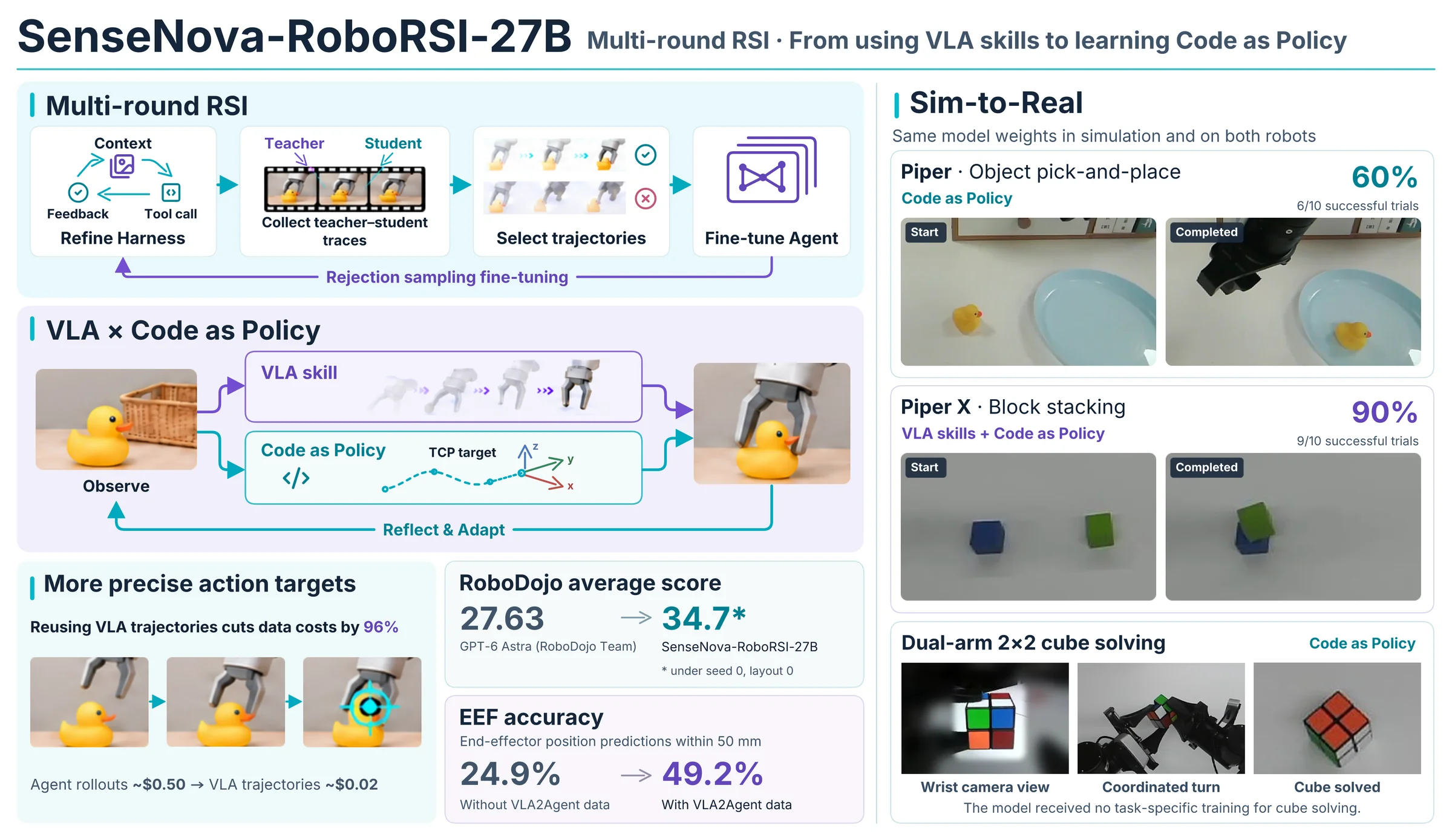
SenseTime completed its open-source release of sensenova/SenseNova-RoboRSI-27B under the Apache 2.0 licence across 23 to 27 November 2026, following model weights with a technical blog on 25 November, one-command RoboDojo reproduction scripts on 26 November, and canonical GGUF weights on 27 November. The 27B vision-language manipulation model follows SenseTime’s open-weight SenseNova-U1.6 release and pairs vision-language-action (VLA) skills with programmatic Code as Policy.
Model-harness co-evolution and RoboDojo benchmarks
Trained across three rounds of recursive self-improvement with GPT-6 Astra as teacher, SenseNova-RoboRSI-27B learns when to execute a VLA trajectory segment and when to write Python code for precise gripper offsets. Across recorded environment steps, VLA motions account for 41.9% and Code as Policy accounts for 58.1%.
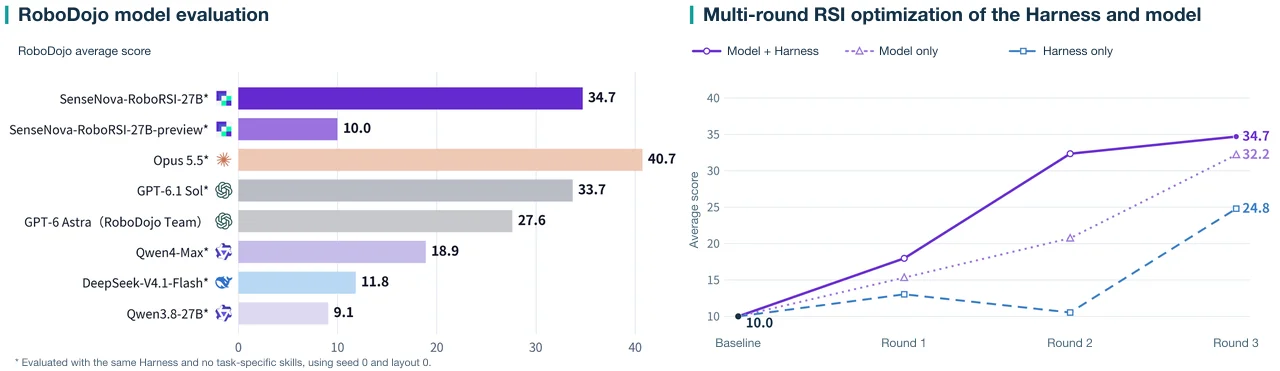
Under RoboDojo’s zero-skill Agent protocol (seed 0, layout 0), the checkpoint averages 34.7, up from 10.0 for Preview, outperforming GPT-6 Astra’s 27.6 leaderboard score and edging past GPT-6.1 Sol at 33.7 in shared-harness evaluations while trailing Opus 5.5 at 40.7.
Sim-to-real hardware transfer and VLA2Agent
SenseTime’s VLA2Agent pipeline converts open VLA demonstrations into single-turn target-pose examples, lifting 50 mm endpoint accuracy from 24.9% to 49.2% while cutting target-data cost by 96% ($0.02 versus $0.50). With simulation-only embodied post-training, the fixed 27B weights succeeded in 6 of 10 pick-and-place trials on Piper, 9 of 10 block-stacking trials on Piper X, and zero-shot dual-arm 2x2 cube solving.
Key details
- Weights and licence
- sensenova/SenseNova-RoboRSI-27B and GGUF quantisations under Apache 2.0
- RoboDojo Agent score
- 34.7 average progress (seed 0, layout 0), up from 10.0 Preview
- Serving requirements
- vLLM 0.21.0 (CUDA 12.9, 4 BF16 NVIDIA GPUs) or llama.cpp via GGUF
- Physical hardware trials
- Piper 6/10 pick-and-place (code only); Piper X 9/10 block stacking (VLA plus code)
Release details & context
Ablation paths, precision limits, and deployment tooling
SenseTime isolated each component of recursive self-improvement across three rounds starting from SenseNova-RoboRSI-27B-Preview. Refining the RoboRSI Harness alone lifted RoboDojo progress from 10.0 to 24.8, fine-tuning weights alone reached 32.2, and co-evolving both together delivered 34.7.
Open-loop gripper testing across 374 local RoboDojo actions (179 single-arm and 195 dual-arm) highlights remaining fine-manipulation limits: even with VLA2Agent supervision halving median XYZ error, only 15.5% of predictions landed within 5 mm tolerance, which matters for narrow insertions such as test tubes. The OpenSenseNova GitHub framework also supplies shared benchmark adapters for LIBERO-PRO, RoboLab, BEHAVIOR-1K, Bench2Dex, and DexJoCo.
Common questions
What hardware is required to self-host SenseNova-RoboRSI-27B?
SenseTime documents full BF16 serving across four NVIDIA GPUs using vLLM 0.21.0 on x86-64 Linux, alongside official GGUF quantisations for local llama.cpp inference.
Was SenseNova-RoboRSI-27B trained on real Piper robot trajectories?
No. Embodied post-training used simulation data only; SenseTime adapted camera, state, and controller interfaces while keeping the 27B weights fixed on physical Piper and Piper X arms.
Sources
- PrimaryHugging Face: sensenova/SenseNova-RoboRSI-27B Model Cardhuggingface.co/sensenova
- OfficialHugging Face Blog: SenseNova-RoboRSI Model-Harness Co-Evolutionhuggingface.co/blog
- OfficialGitHub: OpenSenseNova/SenseNova-RoboRSI Harness and Scriptsgithub.com/OpenSenseNova
SenseTime release timeline (2 launches tracked)
- SenseTime open-sources 8B SenseNova-U1.6 with native self-correction
SenseTime releases Apache 2.0 SenseNova-U1.6-8B-MoT, a unified multimodal image model that inspects and corrects its own dense poster text in one workflow.