


Open sourcev2.videoConfirmed
Story 6 of 7 in the Friday 27 November editionv2.video open-sources Git-style version control for AI video
MIT-licensed Go CLI and free web viewer save prompts, renders, and frame annotations for Claude Code, Codex, Antigravity, and Remotion.

 Edited by Ashutosh Shrivastava
28 Nov 2026, 09:00 IST · 2 min read
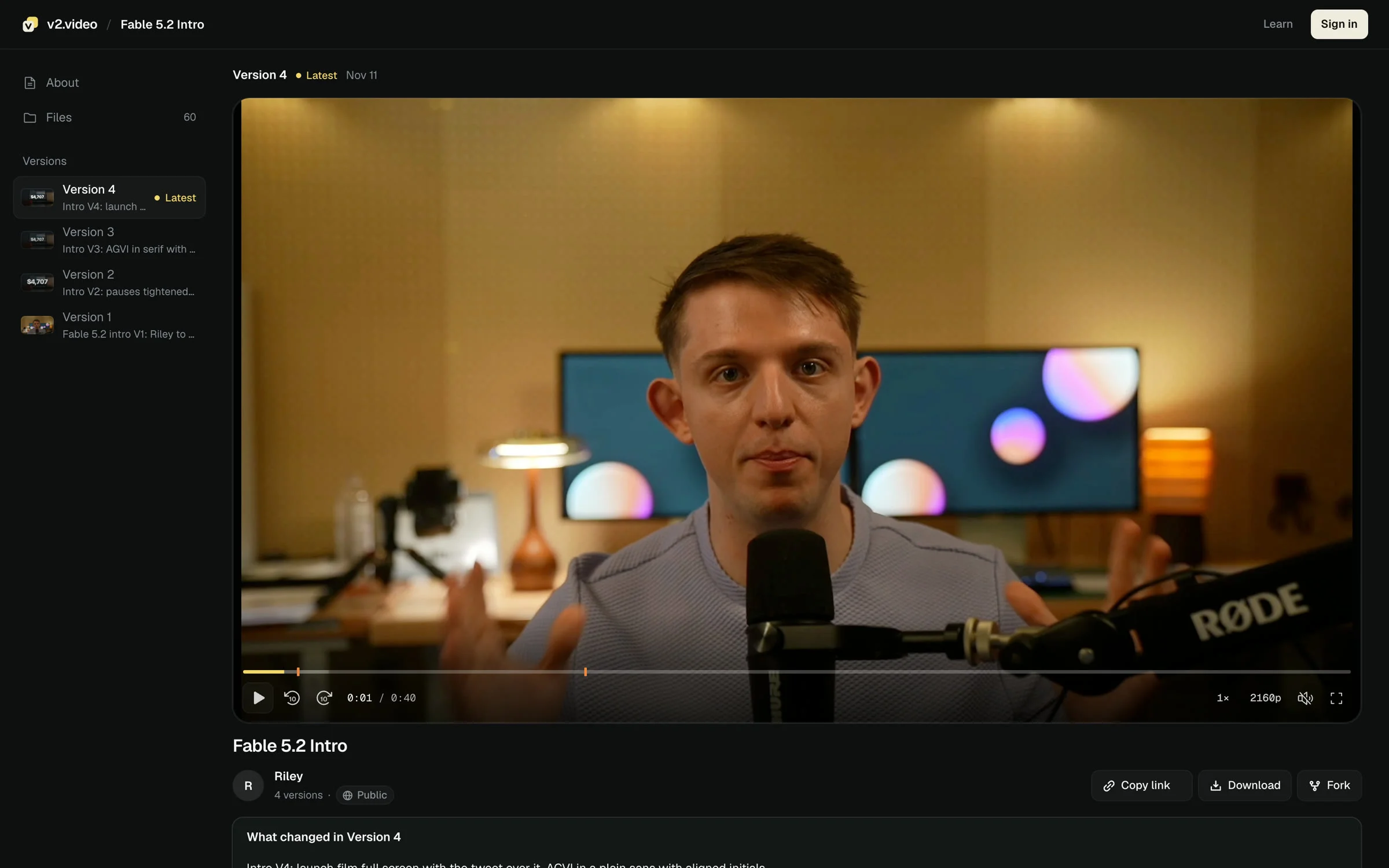
v2.video open-sourced its agentic video version-control CLI agentnativeinc/v2 under the MIT licence on 27 November 2026 (28 November 2026 at 03:11 IST), paired with free hosted sharing at v2.video. Built by Riley Brown and Shrey Gupta in Go with an embedded Node 24 web interface, v2 wraps programmatic video tools including Remotion, Hyperframes, and Tesseract rather than replacing them.
Prompt-linked snapshots and frame-level diffs
v2 requires git and ffmpeg, keeping project code and text inside Git while storing footage, audio, and rendered video cuts inside its own content store. Running v2 init configures coding agents such as Claude Code, Codex, Antigravity, Grok Bot, and dots to commit a restorable version alongside the prompt after every edit.
Creators review histories with v2 log, roll back exact builds via v2 restore, and launch v2 diff in a local browser to compare two cuts in synchronised side-by-side playback. Reviewers can circle visual defects on specific frames so the coding agent reads the timed comment, fixes the render, and marks the task complete.
Shareable and forkable video templates
Running v2 push uploads versioned cuts to v2.video as private review links or public templates that anyone can fork into their own coding agent with a single prompt. Signed binaries install on macOS and Linux via v2.video/install.sh; v2.video has not announced paid hosting tiers.
Technical details
- Repository and licence
- github.com/agentnativeinc/v2 under the MIT licence
- Runtime and dependencies
- Go binary with embedded Node 24 diff web app; requires git and ffmpeg (macOS and Linux)
- Supported agents and stacks
- Claude Code, Codex, Antigravity, Grok Bot, dots; Remotion, Hyperframes, Tesseract
- Core CLI commands
- v2 init, v2 log, v2 diff, v2 restore, v2 push, v2 update
Release details & context
Signed binary updates and source builds
v2 distributes signed macOS and Linux binaries through its install script, and v2 update verifies release signatures cryptographically before replacing the local executable. Developers building from source must compile the embedded React diff frontend inside web using Node 24 before running go build -o v2 ./cmd/v2 because standard go install omits the bundled web assets.
The workflow mirrors broader agent-native developer tooling trends alongside Google Antigravity’s native SSH desktop support, extending software version-control semantics to rendered multimedia pipelines.
Common questions
Does v2 replace Remotion or ffmpeg when editing videos?
No. v2 is a version-control wrapper around git and ffmpeg that works alongside programmatic rendering stacks such as Remotion, Hyperframes, and Tesseract.
How does v2 keep large video files out of Git?
Code and text stay tracked in Git while raw footage, music, and rendered video cuts are stored in v2’s separate object store, allowing exact rollbacks via v2 restore.
Sources
- Primaryv2.video Official Websitev2.video
- OfficialGitHub: agentnativeinc/v2 CLI Repositorygithub.com/agentnativeinc
- On XRiley Brown Launch Post on Xx.com
Related open source launches
- Prism ML open-sources 5.9 GB Ternary Bonsai 2.5 27B agent model
Prism ML releases Apache 2.0 Ternary Bonsai 2.5 27B in 5.93 GB, matching 77.2 vs 77.7 FP16 tool calling and 90% of FP16 agentic coding.
- SenseTime open-sources 8B SenseNova-U1.6 with native self-correction
SenseTime releases Apache 2.0 SenseNova-U1.6-8B-MoT, a unified multimodal image model that inspects and corrects its own dense poster text in one workflow.
- NVIDIA open-sources 18.88M Nemotron 3.5 Parse datasets and DFlash2
NVIDIA publishes 18.88 million CC-BY-4.0 document-parsing examples, a NeMo RLVR fine-tuning workflow, and the DFlash2 speculator for Nemotron 3.5 Parse.
- Hugging Face publishes TRL recipe to train four-agent Qwen3 swarms
Hugging Face releases a reproducible TRL cooperative reinforcement learning recipe training four Qwen3-0.6B agents to coordinate via shared team rewards.