Lead storyOpen sourceSberConfirmed
Sber open-sources 708B GigaChat 4 MoE under MIT licence
Ships a 1M context window, unified instant and reasoning modes, a 37B sibling, and 80.89 on SWE-bench Verified, released 26 November 2026.


 AI Compass
The day’s major AI releases, written up and sourced.
Friday 27 November 2026 · 7 launches · the whole day in 9 minutes
Lead storyOpen sourceSberConfirmed
Ships a 1M context window, unified instant and reasoning modes, a 37B sibling, and 80.89 on SWE-bench Verified, released 26 November 2026.
Sber published its open-weight GigaChat 4 family on Hugging Face and GitHub on 26 November 2026, updating the chat template on 27 November 2026. The flagship ai-sage/GigaChat4-708B-A41B ships under the MIT licence, while a smaller sibling ai-sage/GigaChat4-37B-A4B uses the Noncommercial License for Individuals 1.0. Both models ship in FP8, BF16, and GGUF instruction-tuned checkpoints alongside base weights and intermediate pretraining revisions.
Both checkpoints share a hybrid Mixture-of-Experts backbone that interleaves Gated DeltaNet linear-attention layers with DeepSeek Sparse Attention in multi-head latent attention layers at a 3:1 ratio. GigaChat4-708B-A41B activates 41B parameters per token across 64 decoder layers and routes eight of 256 experts plus one shared expert over a native 1,048,576-token context window.
Unlike GigaChat 3.5, one instruction-tuned checkpoint handles both instant and reasoning modes per request through chat_template_kwargs.reasoning. For faster autoregressive decoding, Sber pairs a recurrent Multi-Token Prediction layer with a five-layer BF16 DFlash2 drafter predicting eight-token blocks, echoing the speculative approach seen in NVIDIA’s Nemotron 3.5 Parse DFlash2 release.
In reasoning mode, Sber reports 88.82 on LiveCodeBench v6, 80.89 on SWE-bench Verified with a seven-hour timeout, 77.00 on SWE-bench Multilingual, and 95.00 mean@8 on AIME 2026. On terminal and tool evaluations, the 708B release scores 71.26 on Terminal-Bench 2.0 and 79.55% on Function Calling Benchmark FCLv4.
SGLang and vLLM serving recipes are live for two eight-GPU H100 80GB nodes at TP16, with shell tool calling verified on Pi 1.6.0, Codex CLI 0.171.0, and DeepSeek Harness 0.2.2-rc.5. Sber published the 708B technical report PDF on GitHub and has not yet released the separate 37B technical report or hosted API pricing.
02Coding agentGoogleConfirmed
Published under Apache 2.0 in google-gemini/demolab, the markdown workflow wins over 90% of blind Gemini 4 evaluations across coding agents.
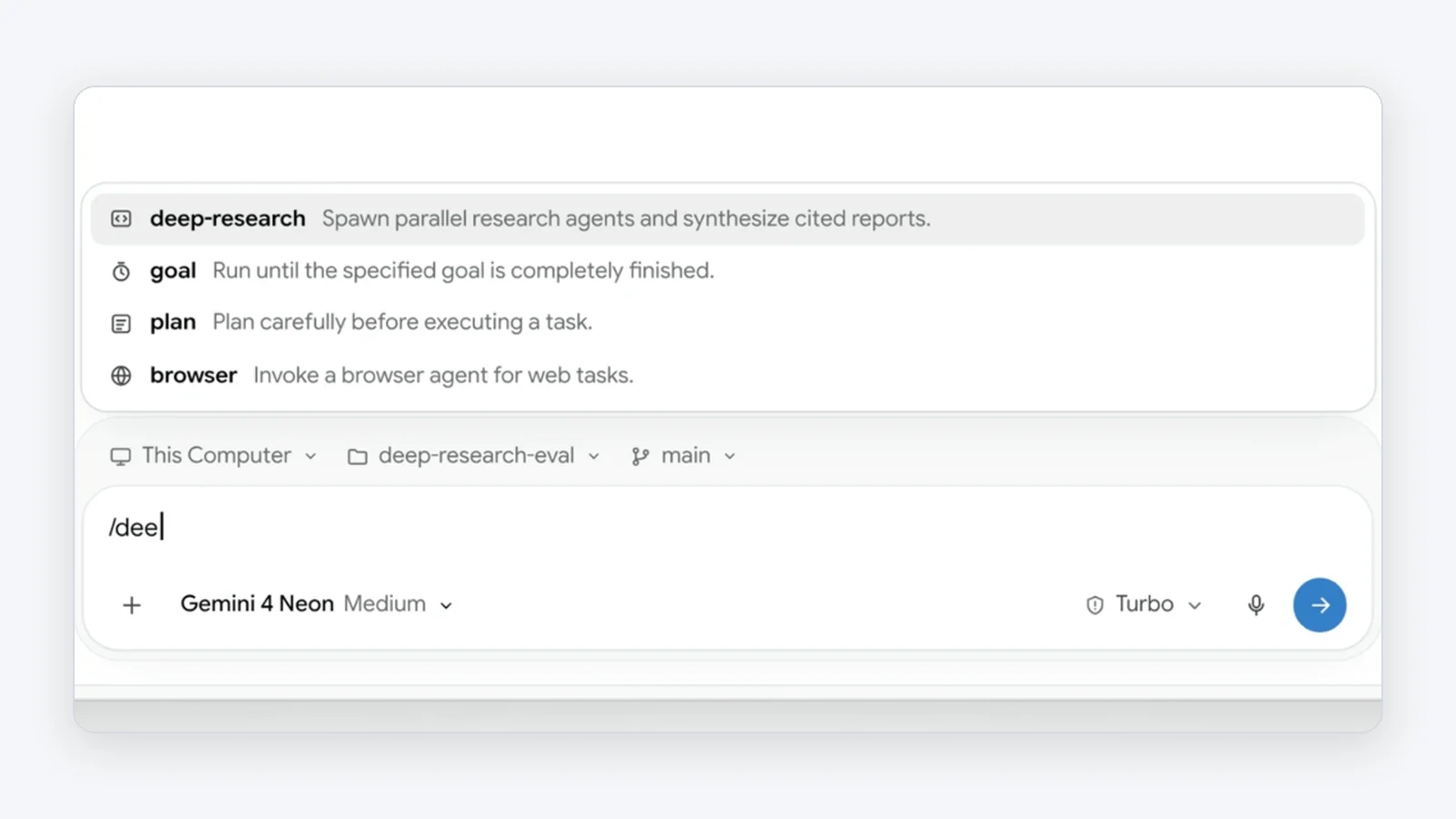
Google’s Gemini developer team added an experimental deep-research skill to its Apache 2.0 GitHub repository google-gemini/demolab on 27 November 2026, turning coding agents powered by Gemini 4 Neon into parallel multi-agent researchers. Announced by Google’s Phil Schmid alongside pull request number two, the 16-line skills/deep-research/SKILL.md file follows the open Agent Skills specification.
Across hundreds of blind evaluations on Gemini 4 models, judges preferred reports generated with the deep-research skill more than 90% of the time compared with running no skill. The instruction set first scopes queries: narrow lookups answer directly with at most two subagents, while broad questions split into three to five non-overlapping parallel tracks capped at two to three on slower high-thinking models.
Each research or browser subagent gets a strict budget of eight to twelve search or tool steps and must verify claims on primary filings and PDFs rather than search snippets. To prevent slow stragglers, the lead agent cancels stalled workers once most tracks finish, caps follow-ups at one targeted pass, and outputs a two-sentence summary with inline links plus an Unresolved section noting conflicts or missing data.
Developers can install deep-research or the companion gemini-frontend-design skill through Vercel’s skills CLI (npx skills add google-gemini/demolab --skill deep-research), Context7 CLI, Antigravity (agy plugin install), Claude Code, Cursor, or OpenAI Codex. Google’s disclaimer notes that google-gemini/demolab is an experimental demo library rather than an officially supported product.
03ModelLiquid AIConfirmed
Live in Liquid Console at $0.042 per million input tokens with zero output fees, tying Bison 31B for first on Decision Index v2.1 across 64k context.
Liquid AI released d1.3-ultra on 27 November 2026, updating its d1.2-ultra flagship decision model through recursive self-improvement across an internal suite of more than 100 benchmarks. The release goes live in Liquid AI’s first-party API console (console.liquid.ai) with a 64k context window priced at $0.042 per one million input tokens and no charge for output tokens.
Liquid AI reports a top score of 76.4 on the Artificial Analysis Decision Index v2.1. Independent testing published by Artificial Analysis on the same day records a rounded score of 76, tying Bison 31B for first place and gaining one point over d1.2-ultra while cutting cost per one million tasks by 60% to $133.
On Artificial Analysis’s private AA-Paperclip extraction and decision benchmark, d1.3-ultra leads with 77 (up one point over d1.2-ultra). It also rises five points to 66 on AA-Omniscience-Decision, tying Gemini Decision 1 for first place on the capability-versus-cost Pareto frontier.
New capabilities include ordering option sets or returning top-k rankings, extracting numbers and dates directly from scanned receipts, tables, and audio clips, and returning start-and-end timestamps for spoken spans. Liquid AI also strengthened refusal behaviour on uncertain questions and trained the model to treat planted input instructions as untrusted data. OpenRouter and Vercel availability are listed as coming soon; Liquid AI has not announced open weights.
04RoboticsSenseTimeConfirmed
Apache 2.0 weights shipped 23 to 27 November 2026 with RoboDojo scripts, scoring 34.7 and transferring zero-shot to physical Piper robots.
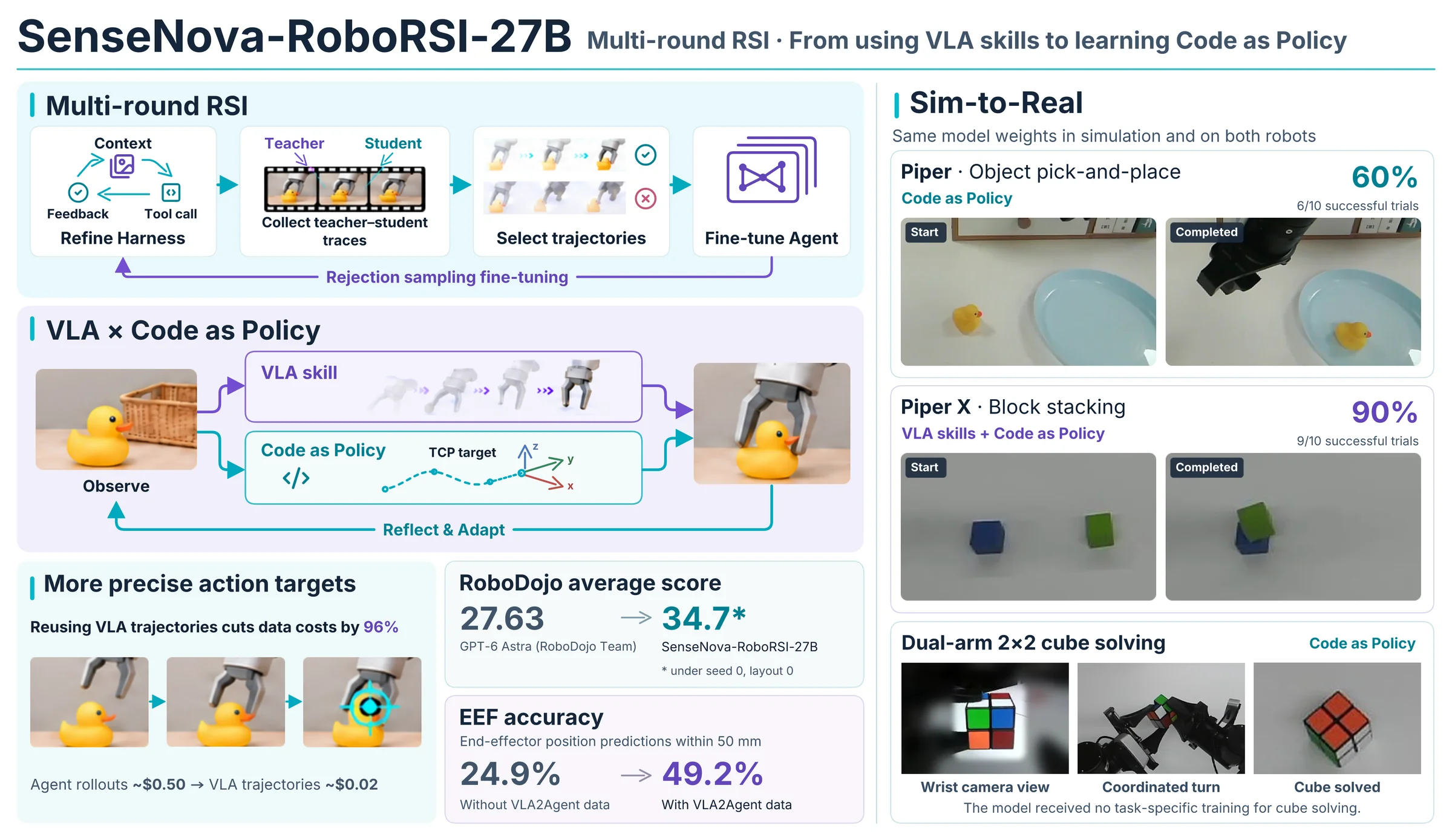
SenseTime completed its open-source release of sensenova/SenseNova-RoboRSI-27B under the Apache 2.0 licence across 23 to 27 November 2026, following model weights with a technical blog on 25 November, one-command RoboDojo reproduction scripts on 26 November, and canonical GGUF weights on 27 November. The 27B vision-language manipulation model follows SenseTime’s open-weight SenseNova-U1.6 release and pairs vision-language-action (VLA) skills with programmatic Code as Policy.
Trained across three rounds of recursive self-improvement with GPT-6 Astra as teacher, SenseNova-RoboRSI-27B learns when to execute a VLA trajectory segment and when to write Python code for precise gripper offsets. Across recorded environment steps, VLA motions account for 41.9% and Code as Policy accounts for 58.1%.
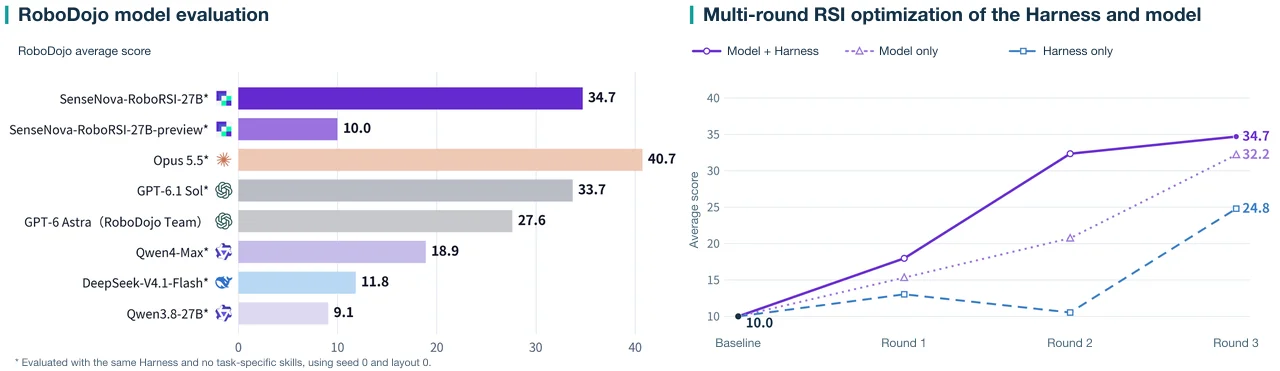
Under RoboDojo’s zero-skill Agent protocol (seed 0, layout 0), the checkpoint averages 34.7, up from 10.0 for Preview, outperforming GPT-6 Astra’s 27.6 leaderboard score and edging past GPT-6.1 Sol at 33.7 in shared-harness evaluations while trailing Opus 5.5 at 40.7.
SenseTime’s VLA2Agent pipeline converts open VLA demonstrations into single-turn target-pose examples, lifting 50 mm endpoint accuracy from 24.9% to 49.2% while cutting target-data cost by 96% ($0.02 versus $0.50). With simulation-only embodied post-training, the fixed 27B weights succeeded in 6 of 10 pick-and-place trials on Piper, 9 of 10 block-stacking trials on Piper X, and zero-shot dual-arm 2x2 cube solving.
05ProductMoonshot AIConfirmed
Global natural-science and engineering teams can apply through 8 December 2026 for roughly seven billion tokens plus early model access.

Moonshot AI (Kimi) launched the Kimi for Science grant programme on 27 November 2026 via kimi.ai/news/kimi-for-science-program, offering free Kimi API credits to scientific and engineering teams worldwide. Selected applicants receive up to $20,000 in API credits, estimated by Moonshot AI at roughly seven billion tokens, with exact allocations determined by project needs and review outcomes.
The programme is open to both theoretical and experimental projects across the natural sciences, engineering, and interdisciplinary fields, explicitly highlighting life sciences, health, energy, materials, and underfunded fundamental science. Teams can apply at any research stage, whether automating literature review and data analysis or testing new AI-driven methodologies.
Beyond compute credits, accepted groups receive early access to upcoming Kimi models, dedicated technical support from Moonshot AI engineers, and curated research community resources. Outstanding teams are eligible for longer-term technical and resource partnerships.
Applications for the opening cohort close on 8 December 2026, and teams may submit revised proposals before the deadline with only the latest entry evaluated. Moonshot AI says further cohorts will open later, and has not announced total programme funding caps or acceptance quotas.
06Open sourcev2.videoConfirmed
MIT-licensed Go CLI and free web viewer save prompts, renders, and frame annotations for Claude Code, Codex, Antigravity, and Remotion.
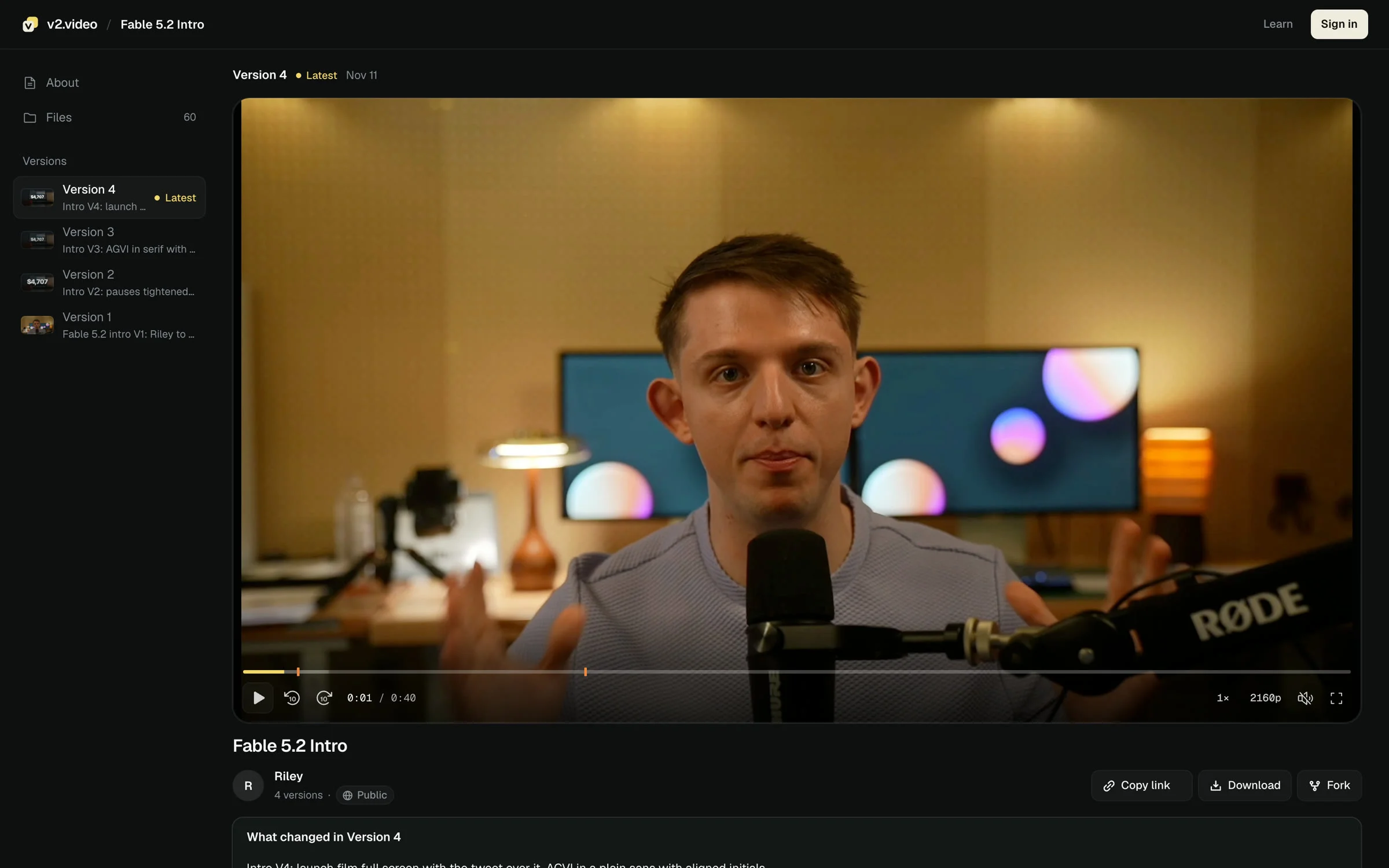
v2.video open-sourced its agentic video version-control CLI agentnativeinc/v2 under the MIT licence on 27 November 2026 (28 November 2026 at 03:11 IST), paired with free hosted sharing at v2.video. Built by Riley Brown and Shrey Gupta in Go with an embedded Node 24 web interface, v2 wraps programmatic video tools including Remotion, Hyperframes, and Tesseract rather than replacing them.
v2 requires git and ffmpeg, keeping project code and text inside Git while storing footage, audio, and rendered video cuts inside its own content store. Running v2 init configures coding agents such as Claude Code, Codex, Antigravity, Grok Bot, and dots to commit a restorable version alongside the prompt after every edit.
Creators review histories with v2 log, roll back exact builds via v2 restore, and launch v2 diff in a local browser to compare two cuts in synchronised side-by-side playback. Reviewers can circle visual defects on specific frames so the coding agent reads the timed comment, fixes the render, and marks the task complete.
Running v2 push uploads versioned cuts to v2.video as private review links or public templates that anyone can fork into their own coding agent with a single prompt. Signed binaries install on macOS and Linux via v2.video/install.sh; v2.video has not announced paid hosting tiers.
07Open sourceSberConfirmed
Sber open-sourced GigaEdge Enhance on 27 November 2026 under the MIT licence at github.com/salute-developers/giga-edge-enhance, offering a shared C++ streaming speech-enhancement SDK with ONNX Runtime and TensorFlow Lite backends for CPU servers, Android, iOS, and WebAssembly. The release bundles three models (8 kHz INT8 plus 48 kHz discriminative and hybrid FP32 denoisers), configurable normalisation chains, and SpeexDSP acoustic echo cancellation benchmarked on EARS-WHAM v2.
SourcesGigaChat Blog: GigaEdge Enhance Streaming Speech Enhancement SDK · GitHub: salute-developers/giga-edge-enhance


7 launches from Friday 27 November 2026, edited by . The next edition is out between 9:30 and 10:30 AM IST.
Spotted an error? Email aicompass@ashutoshai.com or tag @ai_for_success on X
Thursday 26 November
Wednesday 25 November
Tuesday 24 November
Monday 23 November
Friday 20 November