Google DeepMind’s next frontier model after Gemini 4 Argon reaches #1 on the Artificial Analysis Intelligence Index v5.0 and begins rolling out to trusted cyber defenders through the Fairwind Program ahead of general availability.
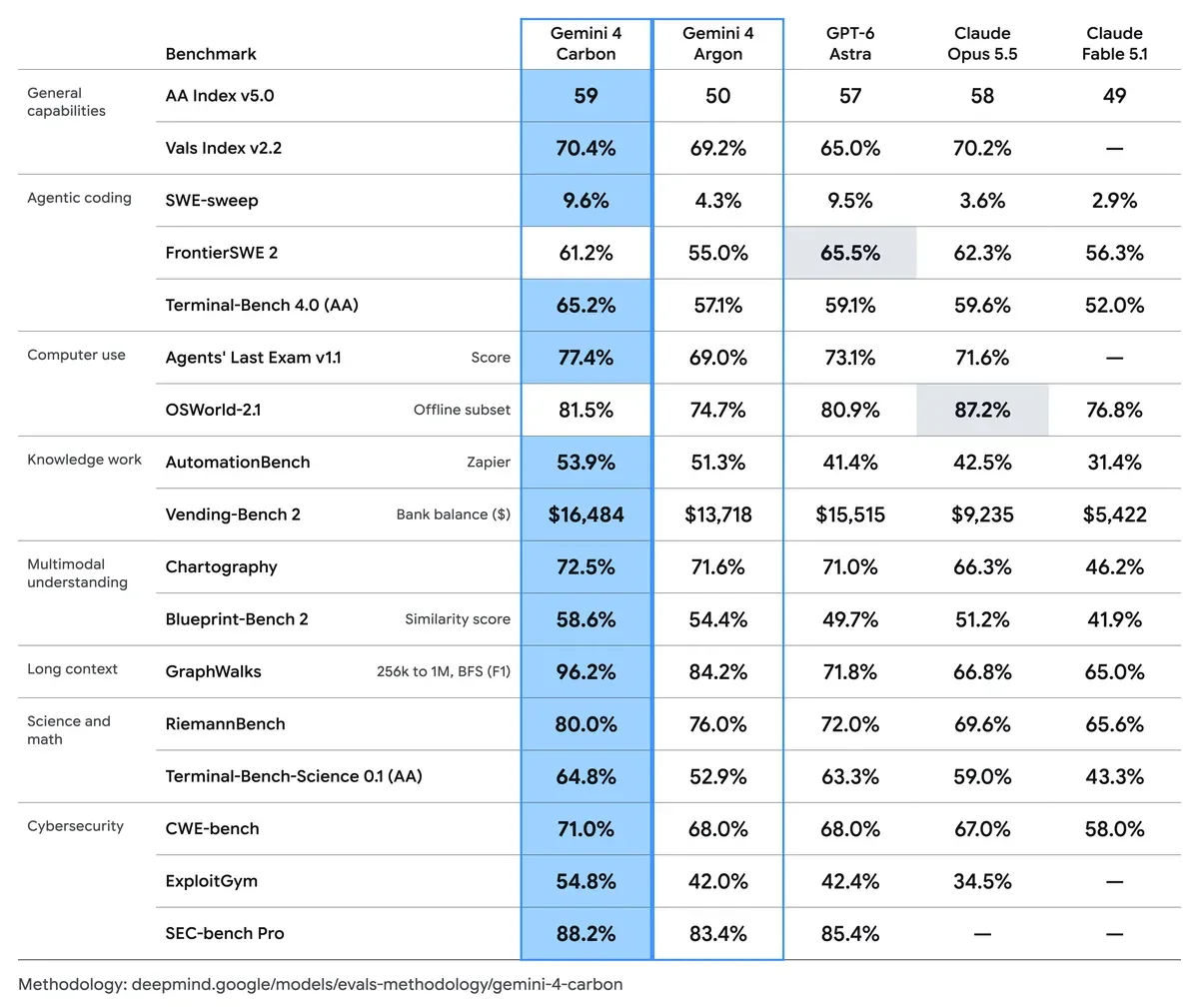
Google DeepMind introduced Gemini 4 Carbon on 28 October 2026, two weeks after releasing Gemini 4 Argon. Carbon is trained to handle multi-step software engineering, defensive cybersecurity, and long-horizon agent workflows while keeping Argon’s inference footprint and token pricing. On the independent Artificial Analysis Intelligence Index v5.0, Carbon ranks first overall with a score of 59, alongside an 89-point Elo gain over Argon on WebDev Arena to reach fourth place at 1,768.
Gemini 4 Carbon benchmark scores compared with frontier peers across reasoning, coding, and cybersecurity suites.Image: Google DeepMind
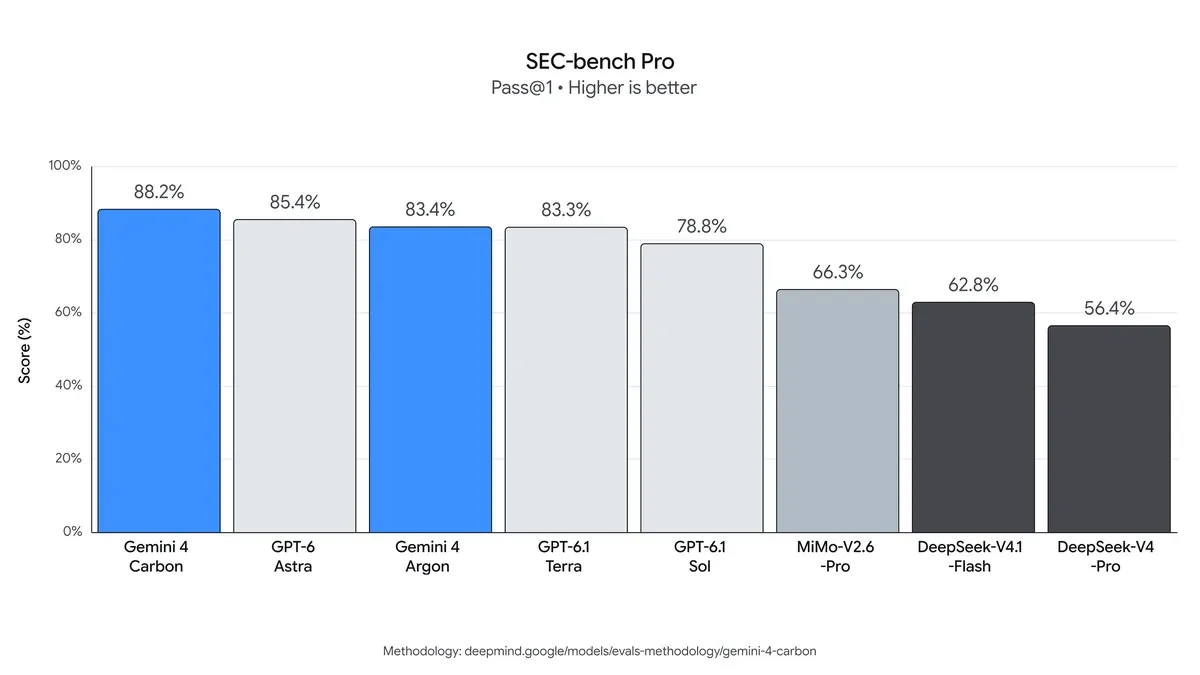
Evaluated without defensive guardrails, Gemini 4 Carbon reaches 88.2% on SEC-bench Pro, 54.8% on ExploitGym, and 71.0% on CWE-bench.Image: Google DeepMind
Cybersecurity and defensive code generation
To test dual-use security capabilities before broad release, Google DeepMind evaluated an unguarded research checkpoint across three offensive and defensive benchmarks: SEC-bench Pro for vulnerability detection, ExploitGym for end-to-end exploit construction, and Collinear’s CWE-bench for root-cause patching. Carbon also more than doubled Argon’s score on Google DeepMind’s internal secure code generation suite, which tests whether a model introduces exploitable flaws when writing production patches.
Rollout and pricing
Because of its exploit-generation scores, Google DeepMind is staging deployment through the Fairwind Program, giving vetted security teams, critical-infrastructure maintainers, and trusted enterprise partners early access for defensive red-teaming and automated vulnerability remediation before general availability on Vertex AI and Google AI Studio.
Key numbers
59: Rank #1 score on the Artificial Analysis Intelligence Index v5.0.
88.2% / 54.8% / 71.0%: Scores on SEC-bench Pro, ExploitGym, and CWE-bench when tested without guardrails.
$2 / $10 per million tokens: Introductory input and output API pricing, matching Gemini 4 Argon, with a 95% discount on cached input tokens.
Unveiled at GitHub Universe on 28 October 2026, Copilot Fusion routes prompts across frontier models using single-pass, cascade, and parallel critique patterns across all GitHub Copilot plans.
GitHub launched Copilot Fusion at GitHub Universe on 28 October 2026, replacing static model pickers with a runtime orchestrator across all Copilot plans. For every prompt, Copilot Fusion inspects task signals across reasoning depth, code generation, debugging, and tool calls, then selects both the model family and one of three execution patterns:
Single: Routes straightforward edits or explanations to one matched model.
Cascade: Drafts a response with a lower-latency model, runs an automated judge pass, and escalates to a heavier reasoning model only when checks fail.
Critique: Generates a candidate patch with a primary model while multiple models inspect the diff in parallel for bugs, edge cases, and regressions before synthesising the final revision.
Developers can choose four effort modes: Fusion Standard (which can also dispatch tasks to local models such as MAI Code 1.1 Flash or Qwen3.8 Flash Next in preview), Fusion High, Fusion Max, and Fusion Fast for inline chat in VS Code. On the Artificial Analysis Coding Agent Index, Copilot Fusion Max scored within two points of Claude Code running Opus 5.5 Max while cutting API spend by roughly half and wall-clock task time by 40%. GitHub is offering a 30% promotional discount on Fusion usage through 30 November 2026.
Announced on 28 October 2026, the GitHub-built Copilot harness is now available as a downloadable SDK and a managed cloud service in Microsoft Foundry supporting more than 20 frontier models.
Microsoft announced on 28 October 2026 that the Copilot harness, the core agent execution engine developed with GitHub that powers Copilot Code, Copilot Studio, the GitHub Copilot app, CLI, and VS Code, is now available directly to enterprise developers through Microsoft Foundry. Teams can embed the harness as a downloadable SDK inside their own infrastructure or run it as a managed cloud service inside Foundry.
To reduce cold-start overhead and improve streaming responsiveness during long tool-use loops, Microsoft and GitHub recently ported the harness runtime to Rust, lowering memory use and time-to-first-token across multi-step agent sessions. The harness coordinates more than 20 frontier models alongside custom enterprise checkpoints and bring-your-own-key (BYOK) endpoints, so a single workflow can pair fast drafting models with deeper reasoning or code-review models in the same session.
Out of the box, the harness includes native support for the Model Context Protocol (MCP), reusable agent skills, and third-party plugins, while inheriting Microsoft Foundry’s enterprise identity, role-based access controls, audit logging, and policy guardrails. Microsoft has not published separate per-hour hosting fees beyond standard Foundry model and compute consumption.
Starting 28 October 2026, eligible ChatGPT Pro and ChatGPT Business subscribers can claim up to $500 per month in OpenAI API credits from their billing settings to build external apps and agents.
OpenAI announced on 28 October 2026 that eligible ChatGPT Pro and ChatGPT Business subscribers can claim up to $500 per month in OpenAI API credits at no extra subscription charge. Users activate the benefit from their account billing page at chatgpt.com/settings/billing, which links the monthly credit grant to their OpenAI developer platform organisation.
Once claimed, the credits apply toward standard OpenAI API token and tool usage, allowing subscribers to prototype and run custom applications, background automations, and autonomous coding or research agents outside the ChatGPT web and desktop interface. Previously, ChatGPT seat subscriptions and OpenAI API billing were strictly separate, requiring developers and small teams on $200-per-month Pro plans or Business seats to fund a separate prepaid API balance before testing API-driven tools.
OpenAI noted that credit eligibility and monthly caps depend on active subscription standing in the billing portal, and unused monthly promotional credits do not replace enterprise volume commitments.
Published on Hugging Face on 28 October 2026, NVIDIA-Nemotron-3.5-Transcribe-30B-A4B is a 34-billion-parameter hybrid mixture-of-experts speech model that processes up to one hour of audio in a single 65,536-token context window.
NVIDIA released NVIDIA-Nemotron-3.5-Transcribe-30B-A4B on Hugging Face on 28 October 2026 under the permissive OpenMDW-1.1 licence, alongside its Granary v2 data curation pipeline and NeMo fine-tuning recipes. Built as an offline Speech-Augmented Language Model, the checkpoint pairs a speech encoder with a 34-billion-parameter hybrid mixture-of-experts decoder that activates roughly 4.3 billion parameters per token and ships in BF16, FP8, and NVFP4 quantised weights.
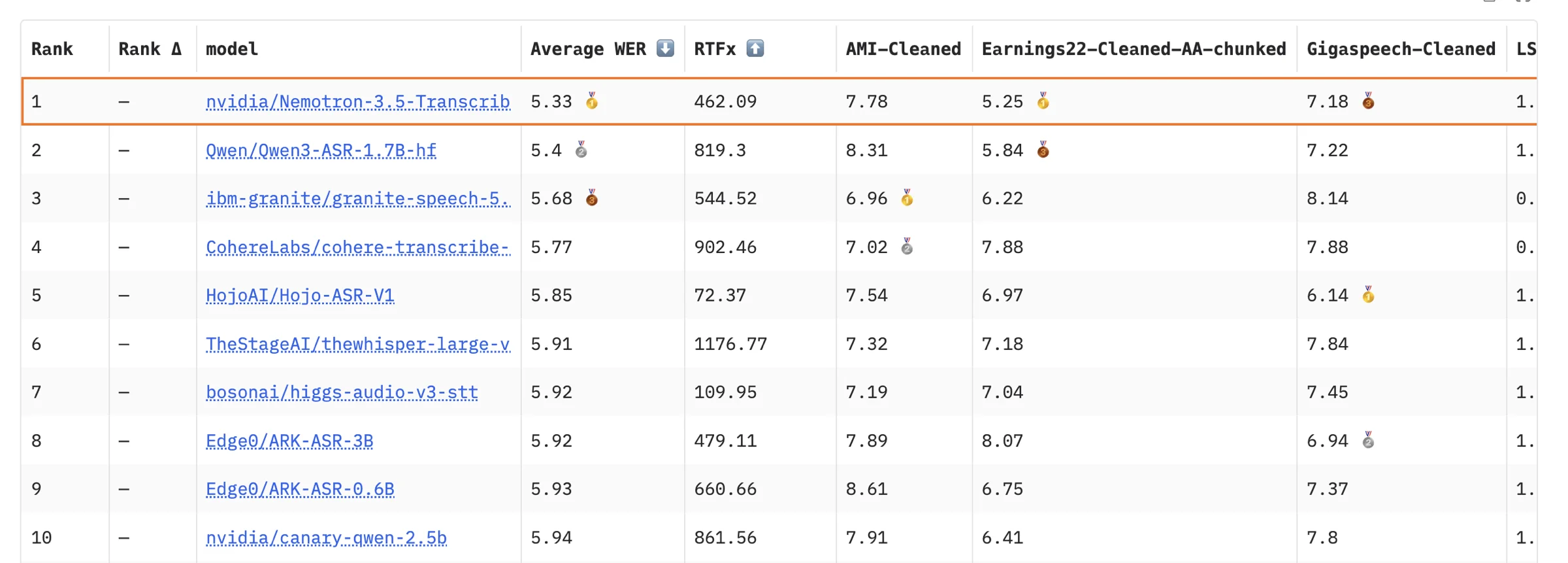
Nemotron 3.5 Transcribe ranks first among open-weight models on the Hugging Face Open ASR English Leaderboard with a 5.33% average WER.Image: NVIDIA
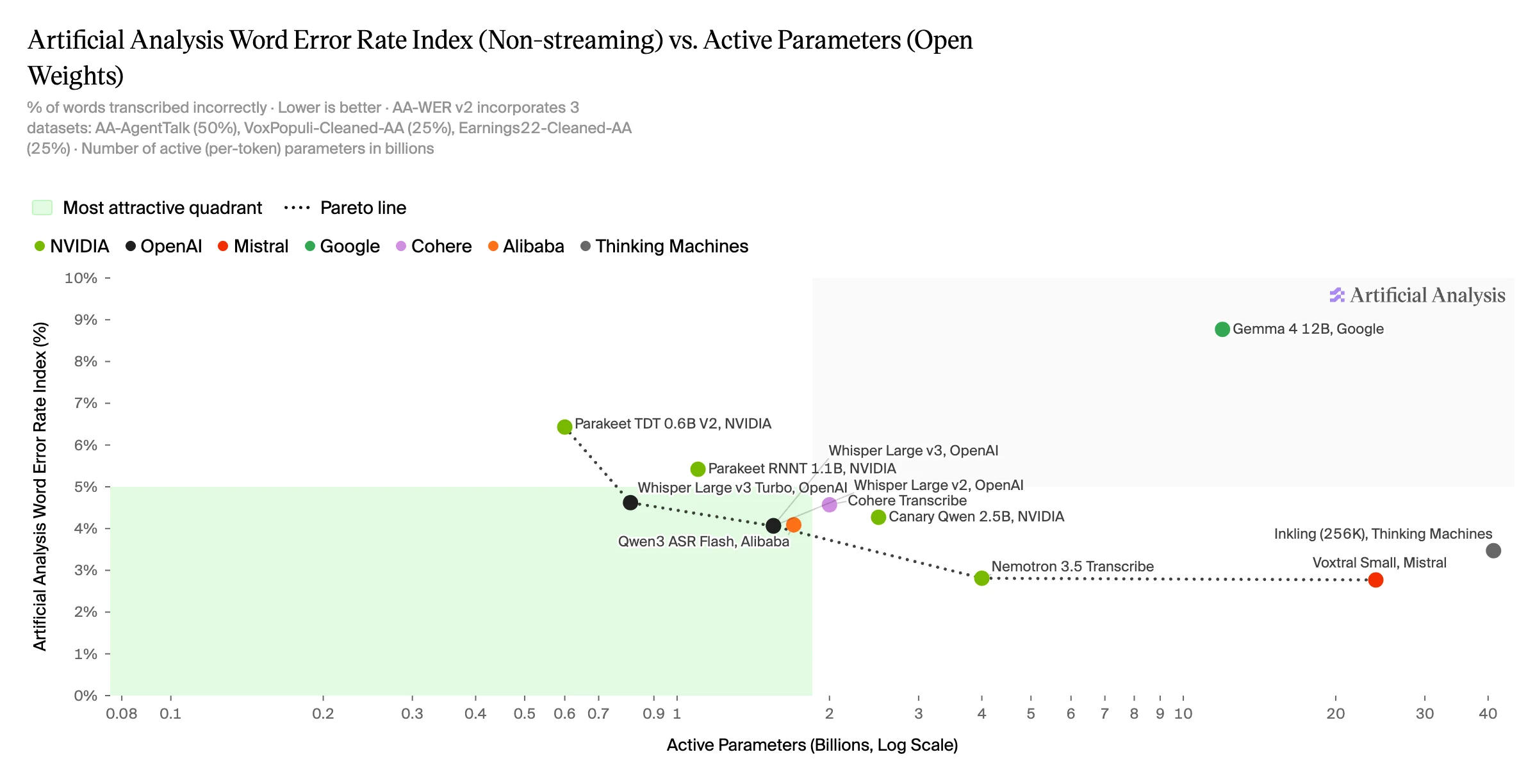
Nemotron 3.5 Transcribe ties for first among open-weight models on Artificial Analysis Speech-to-Text at 2.8% AA-WER.Image: NVIDIA
Within a 65,536-token context window, the model ingests continuous recordings up to one hour long without external chunking. A single unified checkpoint handles automatic speech recognition across 40 languages, bidirectional speech-to-text translation between English and 31 languages, speaker diarisation across 13 languages, and direct question answering over raw audio.
Key numbers
5.33% WER: #1 open-weight score on the Hugging Face Open ASR English Leaderboard.
Announced on 28 October 2026, Claude for Legal now includes a library of interactive, customisable artifact templates for contract review, regulatory horizon scanning, and citation verification.
Anthropic rolled out a ready-made artifact gallery inside Claude for Legal on 28 October 2026, giving in-house counsel and law firm practitioners interactive starting templates for recurring legal workflows. Instead of building structured prompts from scratch, users can browse pre-configured artifacts designed for commercial contract review, regulatory horizon scans, and case-law or statutory citation verification.
Each artifact renders as a dedicated interactive workspace side by side with the conversation. Legal teams can customise the underlying review criteria, attach their own redline playbooks or fallback clause libraries, and wire the artifact to connected enterprise document repositories and compliance data sources. Once adapted to a firm’s standards, the customised artifact can be published internally so colleagues run identical issue-spotting checklists and export uniform review tables across matters.
The artifact gallery is included for existing Claude for Legal customers; Anthropic did not announce changes to seat pricing alongside the update.
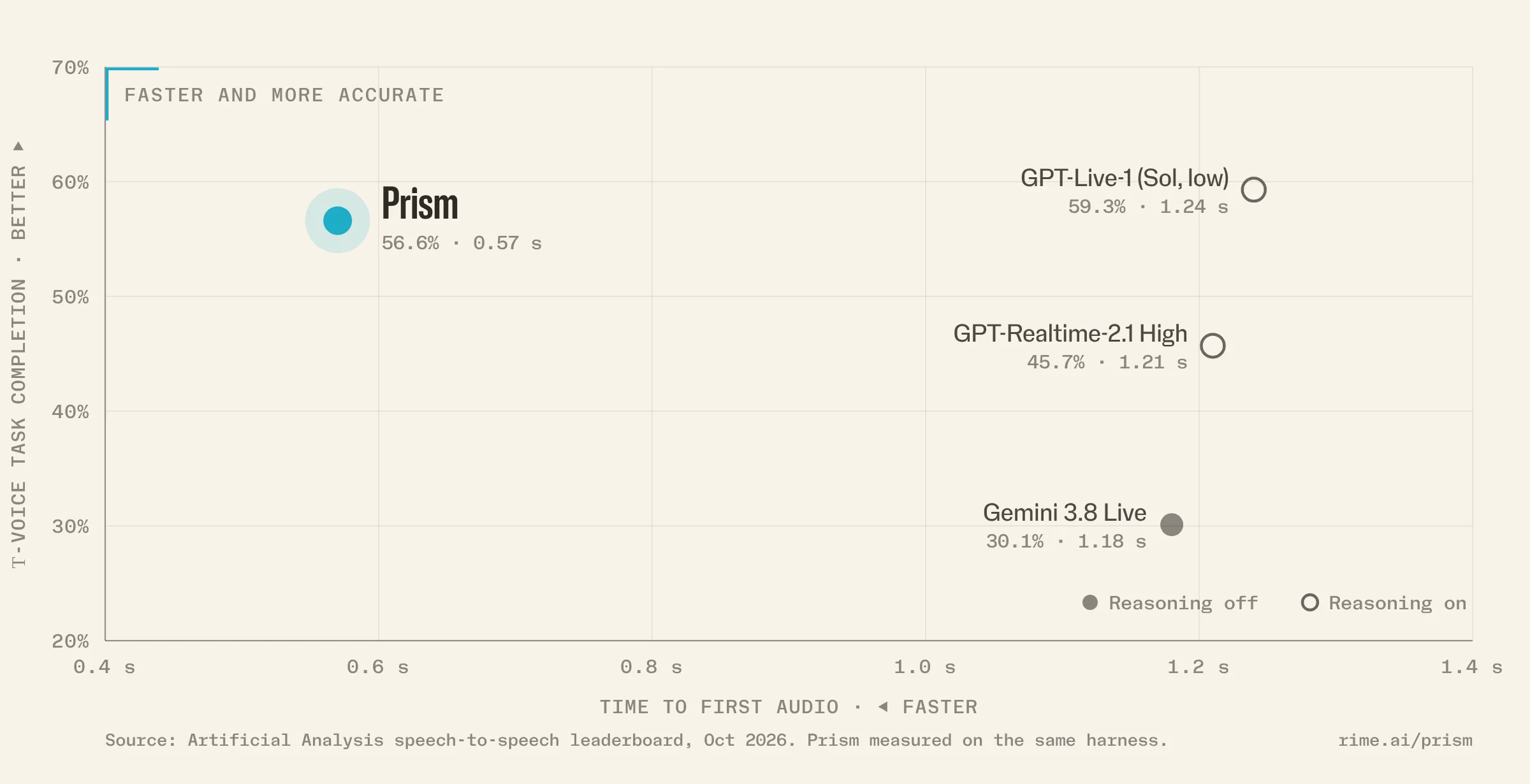
Released on 28 October 2026, Rime’s Prism speech-to-speech architecture inserts an inspectable text checkpoint milliseconds before audio synthesis, reaching 0.57-secondtime-to-first-audio and topping Artificial Analysis τ-Voice at 56.6.
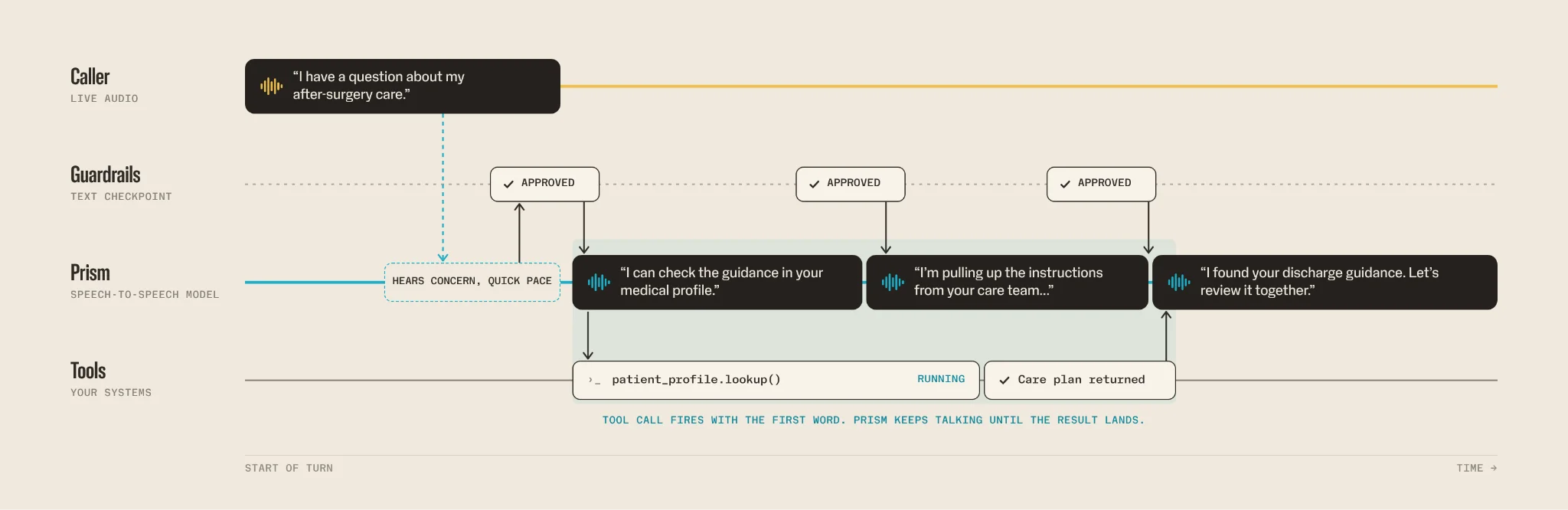
Voice AI company Rime launched Prism on 28 October 2026, an end-to-endspeech-to-speech model built for regulated customer-service and enterprise phone agents. Traditional speech-to-speech models map audio directly to audio as a black box, preventing compliance teams from intercepting forbidden phrases or enforcing exact pronunciation of account numbers and drug names. Prism solves this by emitting an inspectable text checkpoint a few milliseconds before synthesising audio, allowing policy guardrails, phonemic conditioning, and parallel tool calls to execute mid-turn without cascading STT-to-LLM-to-TTS latency.
Prism processes native audio end to end while emitting a live text checkpoint milliseconds before speech synthesis for guardrails.Image: Rime
Prism leads Artificial Analysis tau-Voice at 56.6 (and 82.5 in telecom) while cutting time-to-first-audio to 0.57 seconds.Image: Rime
On the Artificial Analysis τ-Voice benchmark, Prism ranks first overall at 56.6 and reaches 82.5 on telecom customer-support workflows, compared with 45.6 for OpenAI’s GPT-Live-1. Model response latency averages roughly 300ms, yielding a 0.57-secondtime-to-first-audio that is about half the wait of GPT-Live-1, GPT-Realtime-2.1, and Gemini 3.8 Live.
Enterprise teams can fine-tune Prism with supervised fine-tuning (SFT) and reinforcement learning (RL) on their own historical call logs, and deploy via Rime’s WebSocket API, SDKs, or self-hosted private cloud containers.
Launched in public preview on 28 October 2026, Mistral AI’s Responses API returns model answers, reasoning steps, and tool calls as separate structured items in a single response payload.
Mistral AI launched the Responses API in public preview on 28 October 2026, introducing a dedicated endpoint designed for multi-step AI agents and tool-using applications. Until now, developers building agents on Mistral models had to manage conversation history, tool execution loops, and intermediate chain-of-thought traces inside the older Chat Completions format, often parsing reasoning text and function arguments out of combined message blocks.
The Responses API restructures every turn into discrete, typed output items: the model’s intermediate reasoning steps, structured tool or function calls, and the final user-facing answer are returned as separate array elements in the response object. That separation lets application code log or hide internal reasoning traces, validate tool inputs before execution, and resume multi-turn agent state without re-serialising the entire prompt history on every step.
The endpoint is available immediately in public preview across Mistral AI’s developer platform and works with all chat models hosted by Mistral, including Large 4.
Announced on 28 October 2026 as part of Shopify’s Fall ’26 Edition, Shop Pay checkout and Shop MCP let AI assistants search over one billion products and complete purchases across more than 400 million Shop Pay accounts.
Shopify released its Fall ’26 Edition on 28 October 2026, opening its merchant catalogue and payment rails directly to third-party AI agents. Through new native integrations, shoppers using Muse, Claude Duet, Grok Bot, and Instinct can browse over one billion products from Shopify merchants and complete purchases in chat using saved credentials from more than 400 million Shop Pay accounts.
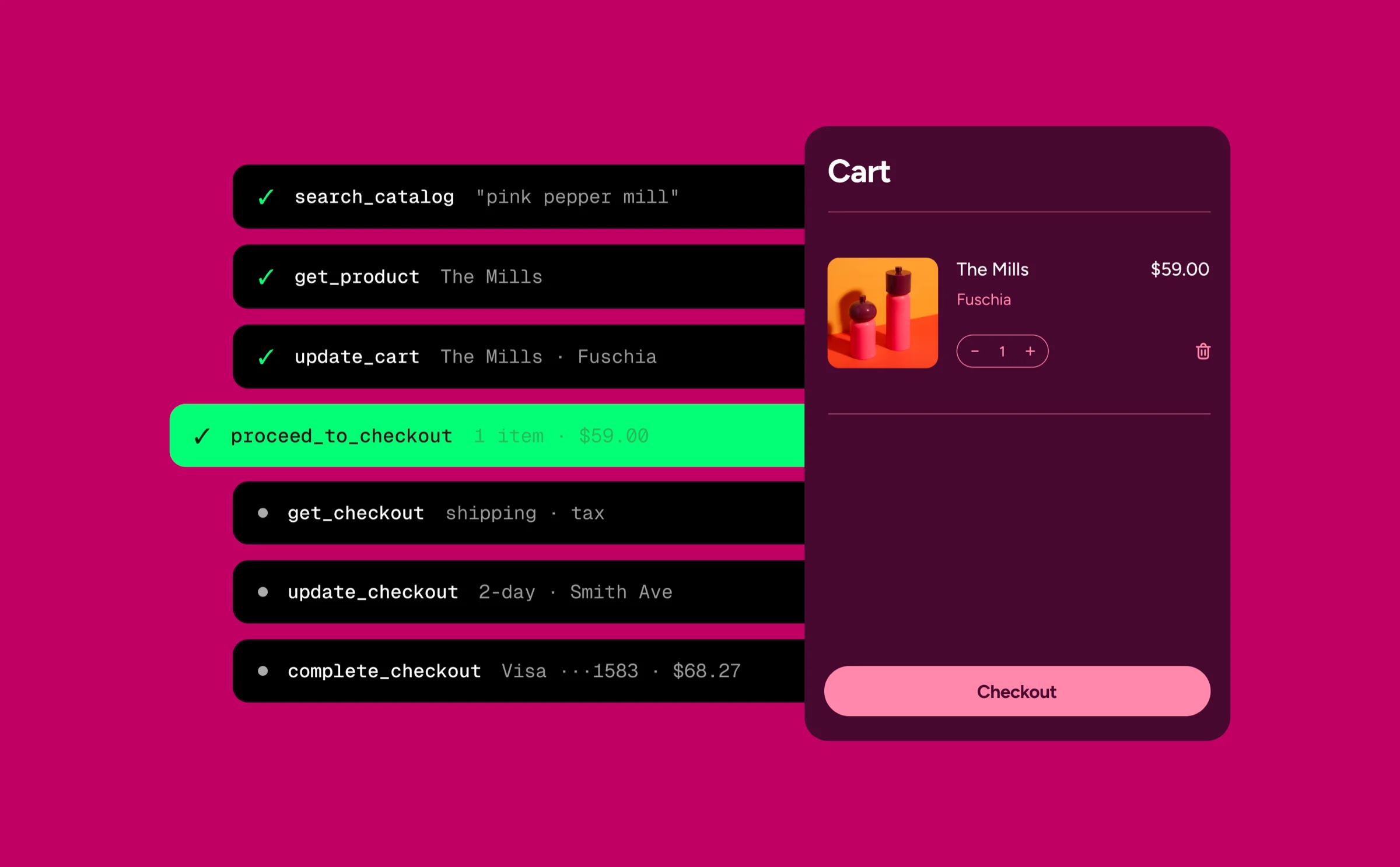
Every Liquid and Hydrogen storefront now exposes default WebMCP tools for product search, cart management, and Universal Checkout.Image: Shopify
For developers building custom shopping or procurement agents, Shopify launched Shop MCP at mcp.shop.com, paired with a machine-readable skill.md specification and the @shopify/shop CLI. Any agent connected to Shop MCP can query live inventory, variants, and pricing across merchants and trigger a unified Universal Checkout session that bundles items from multiple stores into a single Shop Pay transaction.
In addition, all Liquid and Hydrogen storefronts now expose default WebMCP tools out of the box, letting browser-based agents inspect product schemas and build carts without brittle DOM scraping.
Orders opened on 28 October 2026 at $1,099 for XREAL AURA, the first wired optical see-through Android XR glasses powered by a Snapdragon Reality Elite compute puck and multimodal Gemini.
Google and XREAL opened orders on 28 October 2026 for XREAL AURA, the first wired optical see-through XR glasses built on Google’s Android XR platform. Weighing under 95 grams, the frames house Sony Micro-OLED displays with a 70-degree diagonal field of view, five-level electrochromic dimming lenses, Bose-tunedopen-ear spatial audio, and XREAL’s in-frame X1S Spatial Coprocessor, which maintains a 3ms motion-to-photon tracking latency.
To keep battery weight off the face, the glasses tether over USB-C to a pocketable compute puck that doubles as a physical trackpad and debuts Qualcomm’s Snapdragon Reality Elite platform. Users can pin multiple virtual monitors in 3D space, mirror a laptop or phone via Wired Mirroring over USB-C, and invoke Gemini for real-time multimodal assistance that sees the user’s physical surroundings and on-screen workspace simultaneously.
Key numbers
$1,099: Retail price with orders live on 28 October 2026 in the US, Canada, and South Korea (2 November 2026 in Japan) ahead of mid-November shipping.
Under 95g / 70° FOV: Frame weight and diagonal field of view using Sony Micro-OLED optics and 3ms X1S spatial tracking.
Particle released Particle-1 on 28 October 2026, a software engineering model post-trained on DeepSeek V4.1 Flash using Cascade RL and GSPO with a rank-64 LoRA adapter. Across DeepSWE 1.1, Terminal-Bench 2.1, ReactBench, and ADE Bench, Particle-1 matches base pass@1 accuracy while reducing output tokens by 28.4% to 52.2% and cutting task cost by up to 51.6%, priced at $0.25 per million input tokens and $1 per million output tokens on the Particle API and OpenRouter.
AssemblyAI launched AssemblyAI-TTS-1 on 28 October 2026, expanding beyond speech recognition into real-time speech synthesis for voice agents. Operating on continuous audio representations rather than discrete audio tokens, the model achieves a 90ms streaming latency (47ms median first byte) and 99.0% word accuracy across six languages, with over 4,000 voices and instant cloning priced at $15 per million characters with unlimited concurrency.
Perplexity rolled out an updated conversational voice mode on 28 October 2026 for all Perplexity Pro and Max subscribers across its web interface and macOS application. Powered by OpenAI’s gpt-live-1 speech model, the update lets subscribers work across multiple Perplexity Computer sessions simultaneously, launch new tasks, and create or manage Projects inside a single continuous voice session.
Meta announced research partnerships on 28 October 2026 with the California Institute of Technology (Caltech), The Ohio State University College of Medicine, Louisiana State University, Indiana University, and UTHealth Houston. Depending on the institution, support combines research funding, direct collaboration with Meta scientists, and access to Muse Wonder, Muse Spark, Muse Spark Open, the 30B single-GPU Muse Glimmer, SAM, V-JEPA, DINO, and SeamlessM4T, with healthcare centres running models inside their own environments to keep clinical data private.