Available in ChatGPT Work, Codex and the API as gpt-6.1-terra, the visual-reasoning and computer-use model cuts standard token prices in half compared with GPT-5.6 Terra and GPT-6.1 Sol.
OpenAI has released GPT-6.1 Terra, a multimodal model built for visual reasoning, desktop computer use and writing. On 26 October 2026, the model rolled out to Plus, Pro, Enterprise and Edu subscribers in ChatGPT Work and Codex, and to developers in the OpenAI API as gpt-6.1-terra. It supports a 1,050,000-token context window, up to 128,000 output tokens, a 1 June 2026 knowledge cutoff and six reasoning effort levels from none to max through the Responses API.
Standard API pricing is $1 per million input tokens, $0.05 per million cached input tokens and $5 per million output tokens, which is 50% lower than both GPT-5.6 Terra and GPT-6.1 Sol. Standard cache writes cost $1.25 per million tokens for 30-minute retention and $2.50 for 12-hour retention, while prompts exceeding 272k input tokens are billed at twice the input and cache rate and 1.5 times the output rate. Batch and Flex processing cut standard prices by 50%, whereas Fast mode doubles them.
Interactive benchmark charts on the launch page cannot be saved as static images, but across all evaluations GPT-6.1 Terra outperforms GPT-5.6 Terra while running more than three times faster than GPT-6 Astra and GPT-6.1 Sol. On Agents’ Last Exam, medium-effortGPT-6.1 Terra scores 15 percentage points above GPT-5.6 Terra at roughly one-third the cost and matches GPT-6 Astra at one-tenth the price per token; at max effort, it uses less than one-third the tokens of Claude Opus 5.5 at one-fourth the per-token price for roughly nine times lower cost per task. Under OpenAI’s Preparedness Framework, the model meets the Critical cybersecurity threshold.
Key numbers
Context and output: 1,050,000 input tokens and 128,000 max output tokens
Standard API price: $1 input, $0.05 cached input and $5 output per million tokens
Terminal-Bench 4.0: 50.3% at maximum reasoning effort, up from 21.5% on GPT-5.6 Terra
Internal factuality error rate: 16.7% at low effort (down from 53.6%) and 4.3% at max effort
The public-benefit corporation filed a registration statement with the U.S. Securities and Exchange Commission to list its Class A common stock on the Nasdaq Global Select Market under the ticker symbol ANT.
Anthropic, PBC announced on 26 October 2026 that it has filed a Form S-1 registration statement with the U.S. Securities and Exchange Commission (SEC) relating to a proposed initial public offering of its Class A common stock. Anthropic has applied to list its Class A common stock on the Nasdaq Global Select Market under the ticker symbol ANT.
In its filing announcement, the company stated that the number of shares to be offered and the price range for the proposed offering have not yet been determined. The offering is subject to market and other conditions, and the Form S-1 registration statement relating to the securities has been filed with the SEC but has not yet become effective.
Under SEC rules, the shares may not be sold, nor may offers to buy be accepted, prior to the time the registration statement becomes effective. Anthropic did not name lead underwriting banks, a target valuation or an expected trading date in the notice.
Pretrained from scratch on the 0.1T to 0.5T parameter Mirendil-Base model, Fern 0.1 holds up to 23 MB of source code in active context for repository-scale coding and training-log analysis.
AI lab Mirendil has introduced Fern 0.1, the first post-trained release of its in-houseMirendil-Base foundation model (0.1T to 0.5T parameters). Rather than scaling static parameter count alone, Mirendil engineered Fern’s architecture, training and serving stack around a 10M-token context window capable of holding roughly 23 MB or 500,000 lines of code at once. That capacity fits a library on the scale of Megatron-LM, dozens of complete agent execution traces or an entire pretraining data shard audited for benchmark contamination and duplicates. Two larger models, Mirendil-Base-Large (0.5T to 2T parameters, over 80% through pretraining) and Mirendil-Base-XL (2T to 10T parameters, over 20% through pretraining), are in development.
Interactive charts on the launch page are rendered in browser canvas and cannot be saved as static images, but they show cross-entropy loss on a 42.9 MB concatenated repository stream dropping steadily from 0.2456 bits per byte at 32k bytes of context to 0.1552 bits per byte at 23 MiB (10.2M tokens), where rival models stop near 1M tokens. On the RULER long-context benchmark at 10M tokens, Mirendil-Base reaches 100% on single-needle retrieval, all-needlesmulti-key retrieval and variable-tracking recall, 90% on multi-key retrieval and 45% on HotpotQA multi-hop question answering. Mirendil has opened an early-access waitlist and has not announced API pricing.
Key numbers
Context window: up to 10M tokens (about 23 MB or 500k lines of code) on a 0.1T to 0.5T parameter base
SWE-Bench Pro v2 Hard & Verified: 76.5% on Pro v2 Hard and 73.4% on Verified (OpenCode harness, 1 attempt)
SWE Atlas Codebase QnA: 53.2%, ahead of Beam (31.8%) and Nemotron 3.5 (24.2%)
DeepSWE v1.1 & Terminal-Bench 4.0: 44.2% on DeepSWE v1.1 and 6.1% on Terminal-Bench 4.0
Internal reasoning models generated Lean-verified proofs resolving the local smoothing and Kakeya conjectures in all dimensions, refuting the Exponential Time Hypothesis and establishing 4D Yang-Mills and QCD existence.
OpenAI has announced three mathematical, computer science and theoretical physics breakthroughs generated by its internal reasoning models, paired with three different models for academic review across the scientific community.
In harmonic analysis, an OpenAI model produced a proof on 18 October 2026 of Sogge’s 1991 local smoothing conjecture for the Euclidean wave equation in every spatial dimension, using a new auxiliary partial differential equation. Formalised in the Lean theorem prover on 19 October 2026 and published directly to OpenAI’s openai/math GitHub repository, the result implies both the Kakeya conjecture and Stein’s restriction conjecture in all dimensions, generalising the 2025 three-dimensional Kakeya proof by Wang and Zahl.
In computational complexity, OpenAI’s models disproved the Exponential Time Hypothesis (ETH), a foundational conjecture regarding Boolean satisfiability (SAT) hardness, with the refutation verified in Lean on 17 October 2026. OpenAI published the natural-language writeup and Lean proof (lean/docs/378.md), formed a working group led by Russell Impagliazzo, Ramamohan Paturi and Ryan Williams, and committed to funding an open academic conference. In constructive quantum field theory, the models produced existence proofs in four dimensions for pure Yang-Mills theory (part of the Clay Millennium Prize problem) on 9 September 2026 and for interacting quantum chromodynamics (QCD) and a grand unified completion of the Standard Model on 18 September 2026, building on Balaban’s renormalisation approach. A physics working group led by Nobel laureate David Gross alongside Michael Douglas, Arthur Jaffe, Igor Klebanov and Nikita Nekrasov is writing up those results before public release.
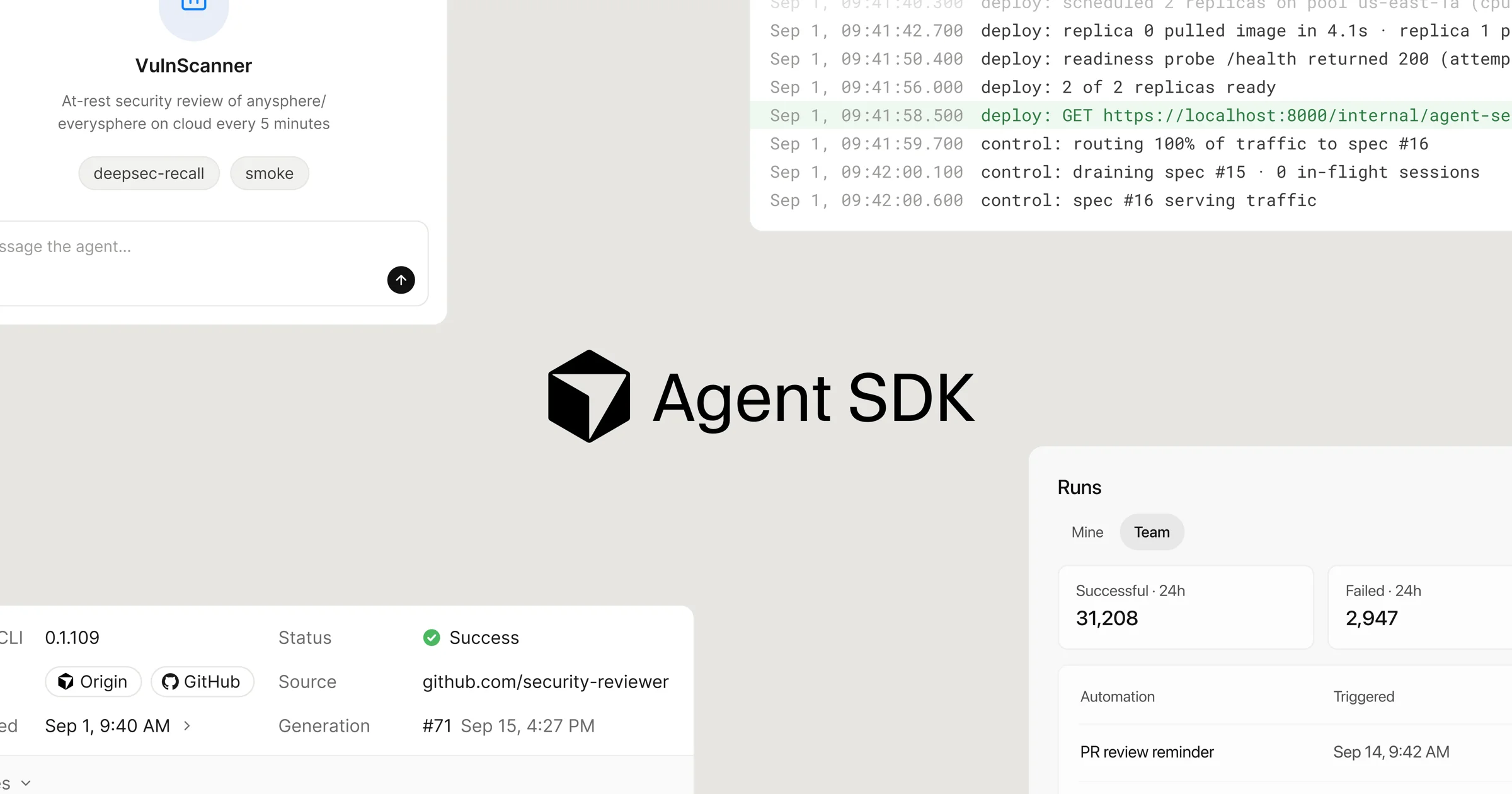
Announced in a 20 October 2026 blog post and marked generally available in v0.3.0 on 23 October 2026, the TypeScript and Markdown framework exposes the harness behind Bugbot and Security Review.
Cursor has released the Agent SDK, the internal framework that powers its own managed agents including Bugbot, Security Review, Approval Bot and Rollouts. Announced on the Cursor blog on 20 October 2026 and promoted to v0.3.0 general availability in the SDK changelog on 23 October 2026, the kit lets engineering teams build, test and version custom workflow agents inside standard source repositories.
Each Agent SDK project combines Markdown instruction files with deterministic TypeScript tool definitions, model routing rules and subagent handoffs. Agents subscribe to events across GitHub, GitLab, Bitbucket, Slack, Linear and Jira to automate tasks such as checking pull requests against an internal engineering knowledge base, routing high-risk diffs to owners or investigating production incidents. Built-in evaluation suites and event replay let developers test prompt or tool changes locally in a playground before shipping.
Once validated, teams can deploy an agent to Cursor-managed cloud infrastructure with a single agent-sdk deploy command, managing secrets, logs and MCP connections from the Deployed Agents dashboard, or package it as a single Node.js process (Node 22.13 or newer) inside their own container infrastructure. The launch blog imports defineAgent from @cursor/agent-sdk, whereas the official documentation instructs installing @grok/agent-sdk globally and notes the package was previously named @cursor/bdk.
Licensed under Apache 2.0 with up to 131,072 tokens of context per question, the model reads text, images and video once per request to answer up to 255 structured questions without generating text.
The vLLM Semantic Router team has open-sourcedd3-turbo under the Apache 2.0 licence on Hugging Face and ModelScope, alongside a free hosted System One API at decision.vllm-sr.ai and ROCm support in the vLLM SR Engine. Built as the 26.09B-parameter flagship of the Decision 3.0 family (including a 0.46B vision encoder), the model supports 32,768 tokens per question by default and 131,072 tokens when long_context=True is enabled.
Unlike generative language models that emit text token by token, d3-turbo encodes a text, JSON, image or video state once per request and evaluates up to 255 structured questions against that shared representation in a single pass, returning calibrated probabilities with zero output tokens. It supports five decision types: multiple choice (including images embedded inside individual questions or options), binary yes/no (noul), scalar scoring, single-object bounding boxes (box) and whole-video object tracking (track at 1 or 2 updates per second).
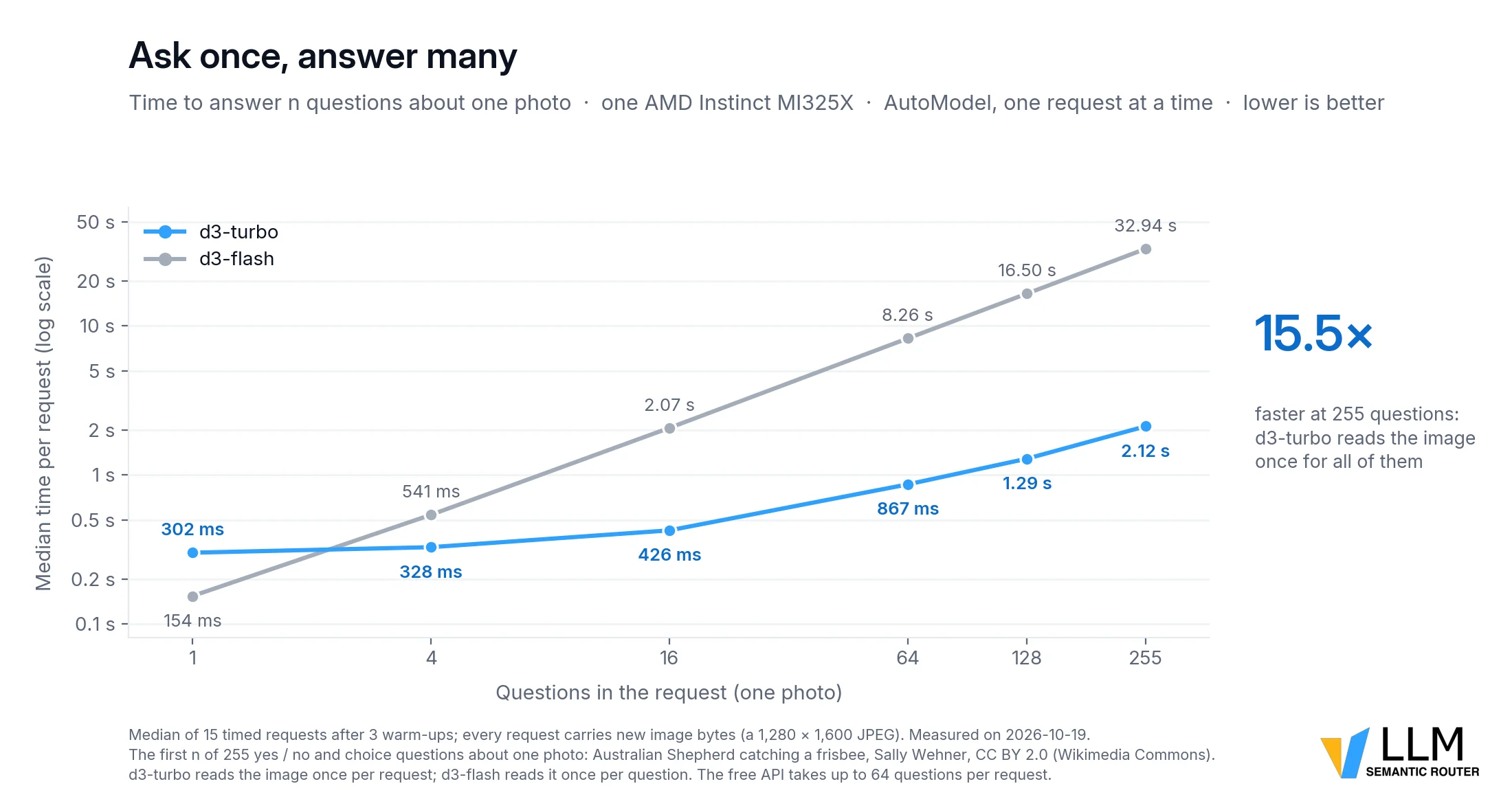
Encoding the input once per request lets d3-turbo answer 255 questions in 2.12 seconds on an MI325X GPU versus 32.94 seconds for d3-flash.Image: vLLM
While the smaller d3-flash is faster for a single question on one AMD Instinct MI325X GPU (154 ms vs 302 ms), d3-turbo pulls ahead from four questions onward (328 ms vs 541 ms) and is 9.5 times faster at 64 questions (867 ms vs 8.26 s). On visual localisation and tracking evaluations, d3-turbo reaches 0.90 bounding-box accuracy at IoU 0.5 (0.96 confidence AUROC), 0.96 accuracy when images sit inside question options (+0.31 over d3) and 0.80 success AUC (0.97 presence F1) when tracking targets at 2 frames per second.
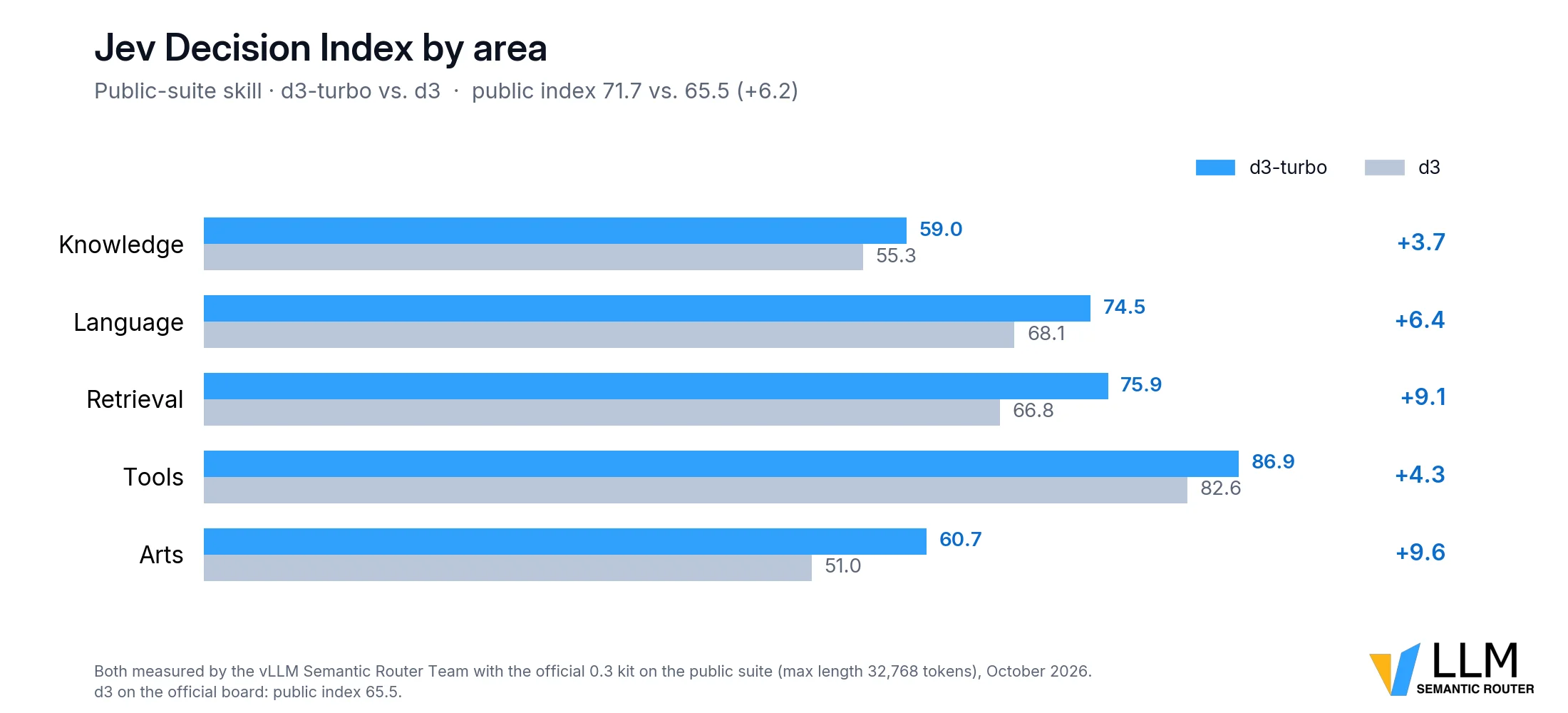
Across the five areas of the public Jev Decision Index 0.3.2 suite, d3-turbo beats d3 by 6.2 points overall (71.7 vs 65.5).Image: vLLM
Enterprise teams can run model-neutral vulnerability scans powered by Anthropic’s Claude Mythos and other frontier cyber models inside Devin, backed by hundreds of millions of dollars in compute credits.
Cognition has upgraded Devin Security with deep vulnerability scans powered by Anthropic’s Claude Mythos alongside other frontier cyber-capable models, giving enterprise customers managed access to those models inside Devin without separate lab contracts or infrastructure setup.
Rather than scoring alerts in isolation, Devin Security collaborates with engineering and security teams to maintain a living threat model that maps services, hosts, deployment paths, unused code, network policies and business impact. Guided by that threat model, Devin runs deep scans to uncover multi-step chained exploits across large repositories while also ingesting, deduplicating and re-verifying alerts from third-party scanners, bug bounties and security advisories.
To resolve verified findings at scale, Devin supports three workflows: proposing evidence-backed risk adjustments or false-positive records for human sign-off (while keeping original CVSS scores and never relabelling CISA Known Exploited Vulnerabilities), applying interim infrastructure mitigations such as WAF rules or security-group changes, and launching thousands of parallel isolated virtual machines that reproduce each vulnerability, write a patch and verify the fix against the reproduction test. Cognition is committing hundreds of millions of dollars in Devin credits to provide free frontier-model scans and remediation support for current and new enterprise customers.
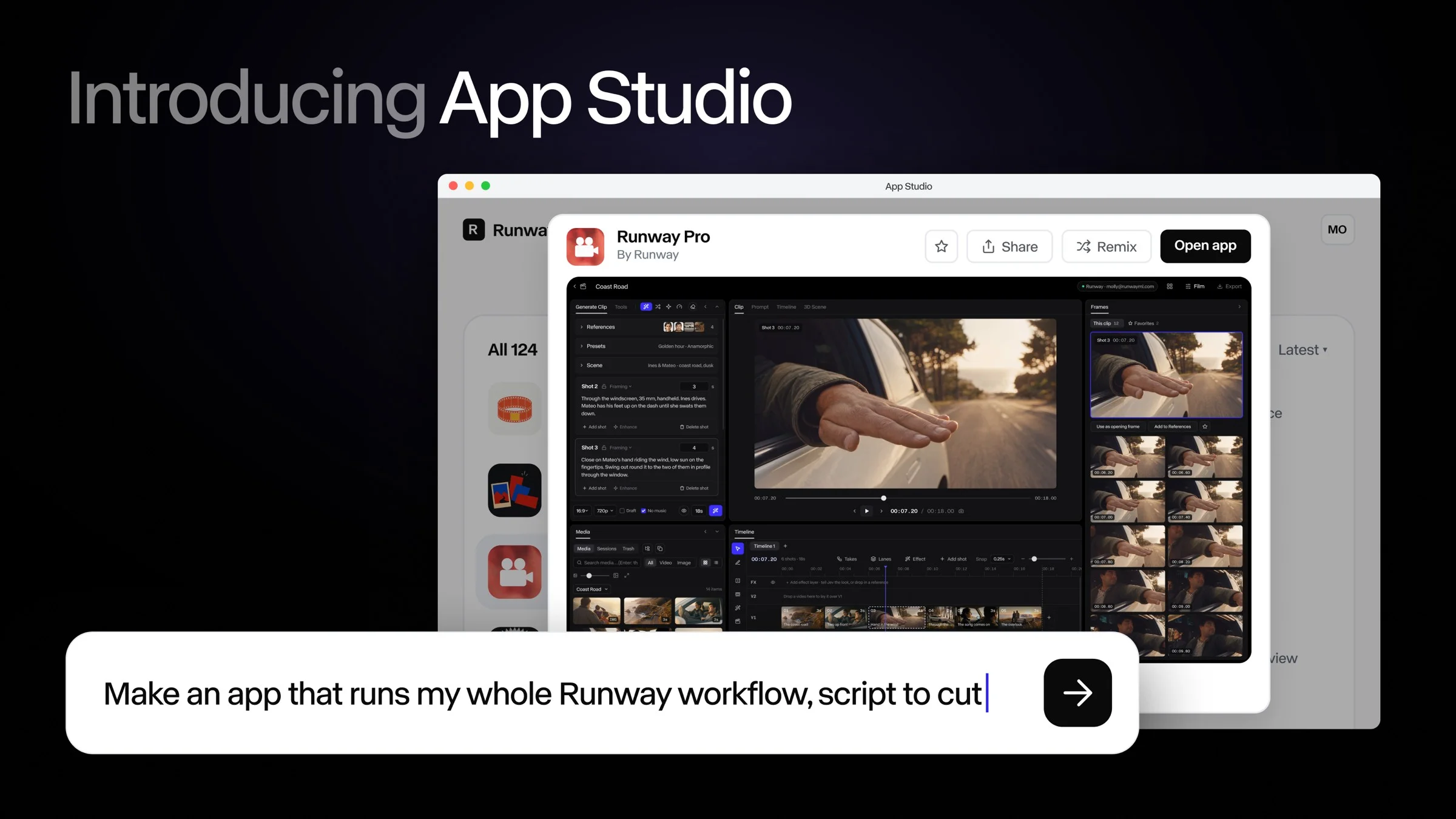
Included across all paid plans, App Studio turns plain-language prompts or existing Runway Workflows into shareable video, image and audio apps built on a team’s Brand Kits.
Runway has launched App Studio, an environment inside Runway that builds custom creative applications from plain-language descriptions or converts an existing Runway Agent session or Workflow into a dedicated app in one click. App Studio writes, tests and deploys the application interface, connecting Runway’s generative image, video and audio models with a workspace’s Brand Kits, Assets and References while keeping the underlying code inspectable and versioned for rollbacks.
At launch on 26 October 2026, Runway shipped six built-in apps that teams can run directly or remix: Character Swap for recasting talent across regional spots, AutoComp for swapping products into footage with accurate labels, Product Portfolio for turning a single product photo into catalogue visuals, 3D Camera Control for staging shots in 3D space, Precise Edit for localized image retouching and Runway Pro for custom production pipelines. During early access, architecture firm KPF built an app that turns still design renderings and drawn camera paths into directed video.
App Studio is included on every paid Runway plan with no separate add-on fee. Building, hosting and running apps draw from existing workspace credit balances, while free-tier users can run built-in or shared apps on their own credits. Enterprise administrators can restrict model availability, disable public links and audit usage per app.
Cursor has added DeepSeek V4.1 Flash to its model selector under Cursor Settings > Models, reporting that every reasoning effort level of the open-weight model sits on the CursorBench cost-efficiency frontier with task costs ranging from $0.60 at low effort to $0.98 at high effort.
Y Combinator startup Pomerado has launched an open-source core and hosted platform that converts any website into a typed REST API or Model Context Protocol (MCP) server (mint, get_job, provide_input and cancel_job), replacing live headless-browser steps on repeat agent workflows with authenticated HTTP calls and automatic self-healing when site layouts change.