Wearable brain-computer interface startup Sabi replaced explicit human preference ratings with passive electroencephalography (EEG) recordings and eye tracking, fine-tuning an image generator toward individual aesthetic taste without user labels.
Standard reinforcement learning from human feedback (RLHF) and rubric-based model judges compress subjective taste into binary choices, pulling creative models toward generic consensus outputs. In research published on 29 October 2026, Sabi introduced Reinforcement Learning with Neural Feedback (RLNF), recording cortical activity via EEG alongside eye tracking while five participants passively viewed face images. Arousal-linked neural signatures, led by posterior alpha suppression between 8 and 13 Hz, decoded personal attractiveness preferences above chance in every participant without requiring conscious button presses.
Neural reward pipeline
To turn noisy neural recordings into a dense training signal without an LLM judge, Sabi recorded EEG responses as each participant viewed 420 anchor faces and projected those images into ArcFace facial-identity embedding space. A k-nearest-neighbourNadaraya-Watson kernel estimator (k = 40, tau = 0.1) interpolated continuous neural reward scores for arbitrary generated faces, driving on-policy Group Relative Policy Optimization (GRPO) on a rank-64 LoRA adapter over FLUX.2 Klein 4B.
Evaluated on held-out rollouts, models trained purely on implicit brain signals steered facial structure and styling toward each participant’s idiosyncratic preferences rather than population beauty norms. On subject five, held-out generations shifted -0.246 away from personally disliked traits compared with -0.112 under population-average scoring. Sabi has not released open model weights or announced commercial pricing and shipping dates for its wearable neural hardware.
Key numbers
Single-trial EEG decoding reached 0.62 to 0.76 AUC across five subjects, rising up to 0.98 AUC with ten-trialtest-time averaging.
Each personalised reward estimator used 420 EEG-scored anchor faces embedded in ArcFace space.
Post-training ran five rounds of on-policy GRPO with 32,768 image rollouts per round on FLUX.2 Klein 4B.
Held-out personal rating shift on subject five reached +0.227 toward liked traits versus +0.162 for population-mean ratings.
Mistral AI published the improved open weights of its natively multimodal Mistral Large 4 (Le Chonk) model on Hugging Face under a modified MIT licence, alongside API access at $0.70 per million input tokens and $2.10 per million output tokens.
Released on 29 October 2026 under the Mistral Ecosystem Open-Weight licence, Mistral Large 4 permits unrestricted self-hosting, fine-tuning, and internal enterprise deployment, while commercial Model-as-a-Service redistribution requires a separate licence from Mistral AI. Trained in Europe, the updated weights incorporate additional reinforcement learning post-training for multi-repository software engineering and defensive cybersecurity workflows, and expose three selectable reasoning effort modes: Low, Medium, and High (the default).
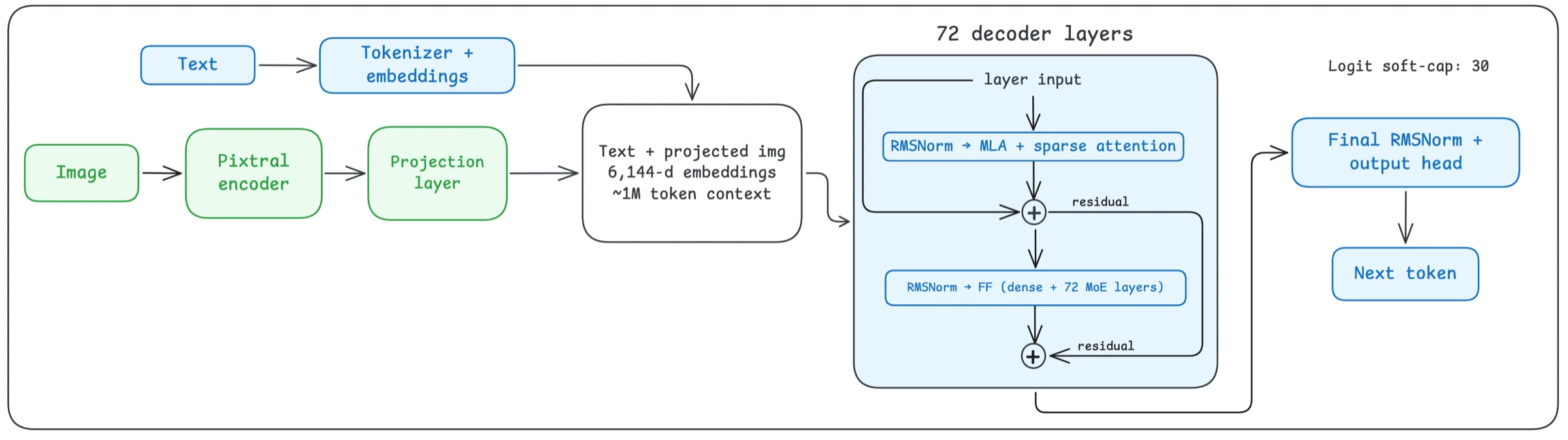
As illustrated in the Hugging Face release architecture diagram, the model pairs a native Pixtral vision encoder with 72 sparse Mixture-of-Experts decoder layers supporting roughly a 1 million token context window. Mistral AI renders its benchmark comparisons interactively in HTML on the announcement page rather than as static chart images, reporting first place among open models on Cognition’s FrontierCode 2.0, a tie with GLM-5.3 on the Artificial Analysis Coding Agent Index using nearly half as many tokens, and 30% lower output token usage on Terminal-Bench 4.0 than its preview checkpoint.
Mistral Large 4 pairs a Pixtral vision encoder with 72 sparse MoE decoder layers and a 1M-token context window.Image: Hugging Face
Key numbers
19.7% on Cognition FrontierCode 2.0, ranking first among open-weight models.
48% on the Artificial Analysis Coding Agent Index while consuming 47% fewer tokens than GLM-5.3.
41% on Terminal-Bench 4.0, a 13 percentage point gain over the Mistral Large 4 preview checkpoint.
Google announced on 29 October 2026 that its asynchronous GitHub coding agent Jules will turn read-only on 11 November 2026 and shut down permanently on 31 December 2026 as agentic development consolidates into Google Antigravity.
Jules operated as a background cloud agent that cloned GitHub repositories into isolated virtual machines to resolve issues, write tests, and open pull requests asynchronously. In its turndown notice, Google stated that architectural lessons and background execution patterns from Jules are being unified directly into Google Antigravity rather than maintained as a standalone web product.
Active Jules users can finish running tasks until 11 November 2026, when new task creation stops and workspaces enter read-only mode ahead of full deletion after 31 December 2026. To preserve project state, Google shipped an export command in the Jules Tools CLI that downloads account settings, environment variables, scheduled tasks, connected repository metadata, repository memories, environment setup scripts, and complete session logs and diff patches to local folders. Google has not announced automated cloud migration of saved Jules memories into Antigravity.
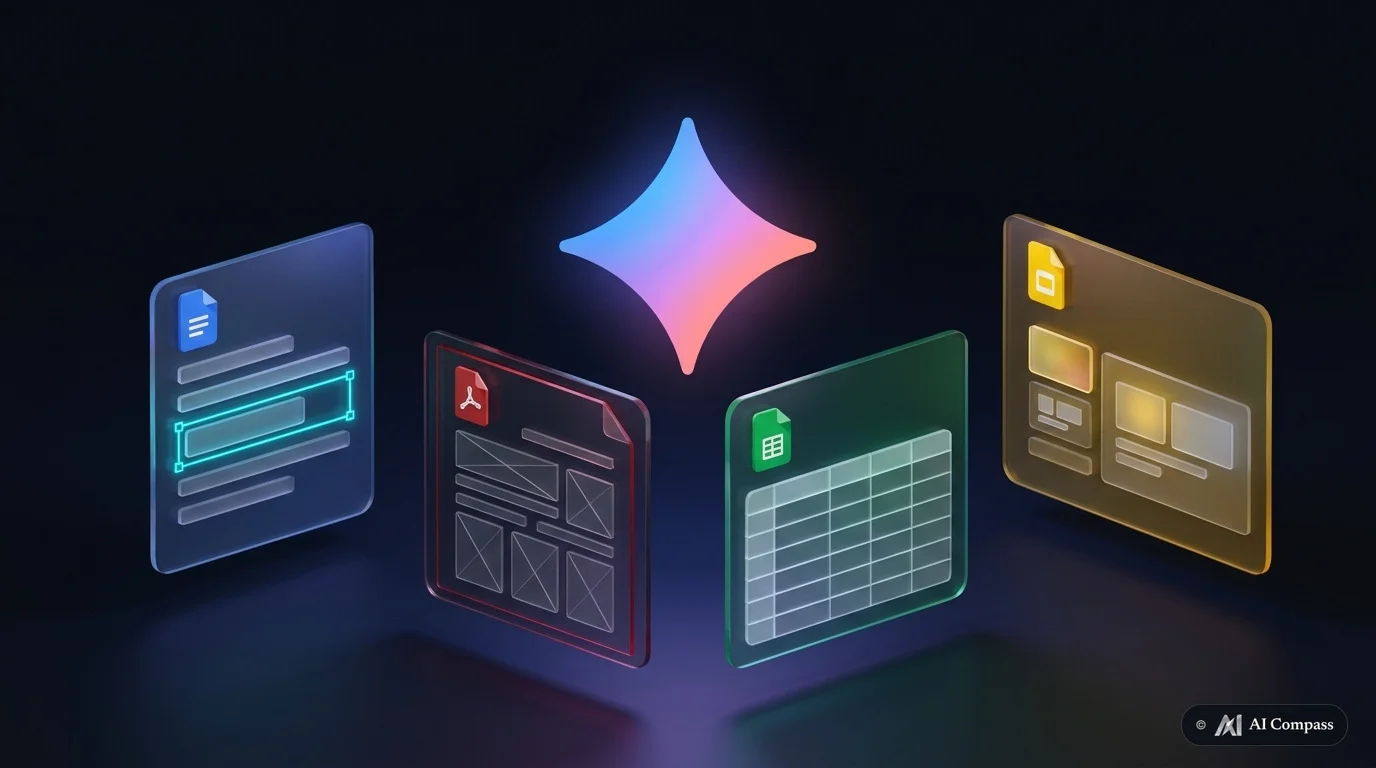
The Gemini app on 29 October 2026 added direct creation, live preview, and manual or prompt-driven editing across documents, PDFs, slide presentations, and spreadsheets inside the chat workspace.
Previously, revising structured files produced by Gemini required regenerating whole drafts in chat or exporting files into Google Workspace editors first. With the new inline editor, users can prompt Gemini to turn raw inputs, such as photographed handwritten notes, directly into formatted PDF study guides, slide decks, spreadsheets, or text documents and preview the rendered pages side by side with the conversation.
Inside the preview pane, users can click directly into cells, slides, or paragraphs to make manual text edits, or highlight a specific text passage or visual element and ask Gemini to revise only that selection while leaving surrounding pages and formatting untouched. Multi-turnfollow-up prompts update the live file in place. Google announced the capability on the official Gemini App X account and has not published per-plan file size caps or rollout restrictions by region.
OpenAI product lead Tibo Sottiaux announced on 29 October 2026 that usage quotas have doubled across ChatGPT Pro 100, Pro 200, Pro 500, and Business Premium subscriptions at unchanged plan prices.
The quota expansion doubles the volume of model turns, deep reasoning passes, and agentic tool executions available across OpenAI’s paid professional tiers: ChatGPT Pro 100, Pro 200, Pro 500, and Business Premium. Subscribers receive the expanded allowance automatically without plan migration or billing changes.
Addressing developer concerns around shared quota pools, Sottiaux confirmed that Pro 200 baseline limits were not trimmed beforehand, preserving existing capacity for ChatGPT Work and Codex software engineering sessions before the doubling took effect. Extended usage pools for OpenAI’s dot-series models also remain metered independently from default plan allowances rather than drawing down standard conversation quotas. OpenAI did not publish exact numeric message or compute-unit ceilings per billing window.
Google introduced a built-in Plugin Marketplace on 29 October 2026 across the Antigravity desktop IDE and Antigravity CLI, bundling agent skills, MCP servers, rules, lifecycle hooks, and custom agents into single-install packages.
Instead of configuring Model Context Protocol (MCP) endpoints, system prompts, and helper scripts piecemeal per repository, developers can browse and enable curated Google and partner bundles from the Customizations panel in the Antigravity app or from the terminal via agy plugin install and agy plugin list. Every package is defined by a plugin.json manifest that versions and distributes up to five primitives together, alongside local schema checks through agy plugin validate.
Five bundled primitives
Each plugin combines progressive-disclosure Skills (Markdown instructions loaded on demand so idle tools do not consume context tokens), pre-configured MCP server connections, persistent workspace Rules, specialist Custom Agents, and deterministic lifecycle Hooks triggered at SessionStart, PreToolUse, PostToolUse, PreInvocation, PostInvocation, and Stop. Twelve third-party launch partners shipped verified plugins on 29 October 2026: Atlassian, Canva, CrowdStrike, Databricks, Datadog, Dropbox, Figma, monday.com, Ping Identity, SentinelOne, Stripe, and Unity, alongside Google bundles for Gemini API, Android CLI, Firebase, Chrome DevTools, and Google Workspace.
Phonic released its Phonic-1speech-to-speech foundation model on 29 October 2026 at $0.07 per minute across more than 50 languages, alongside a $27.5M Series A led by First Round Capital.
Cascaded voice stacks transcribe caller audio to text before an LLM can reason or invoke APIs, and existing speech-to-speech models typically wait until a speaker pauses before running external tools. Phonic-1 processes raw audio natively in full duplex, firing backend tool calls asynchronously while the caller is still talking so lookup results are already in context when the caller finishes speaking.
Phonic-1 dispatches all five backend tool calls during the caller’s turn and replies in 1.1 seconds, against 15.7 seconds for GPT-Live.Video: Phonic
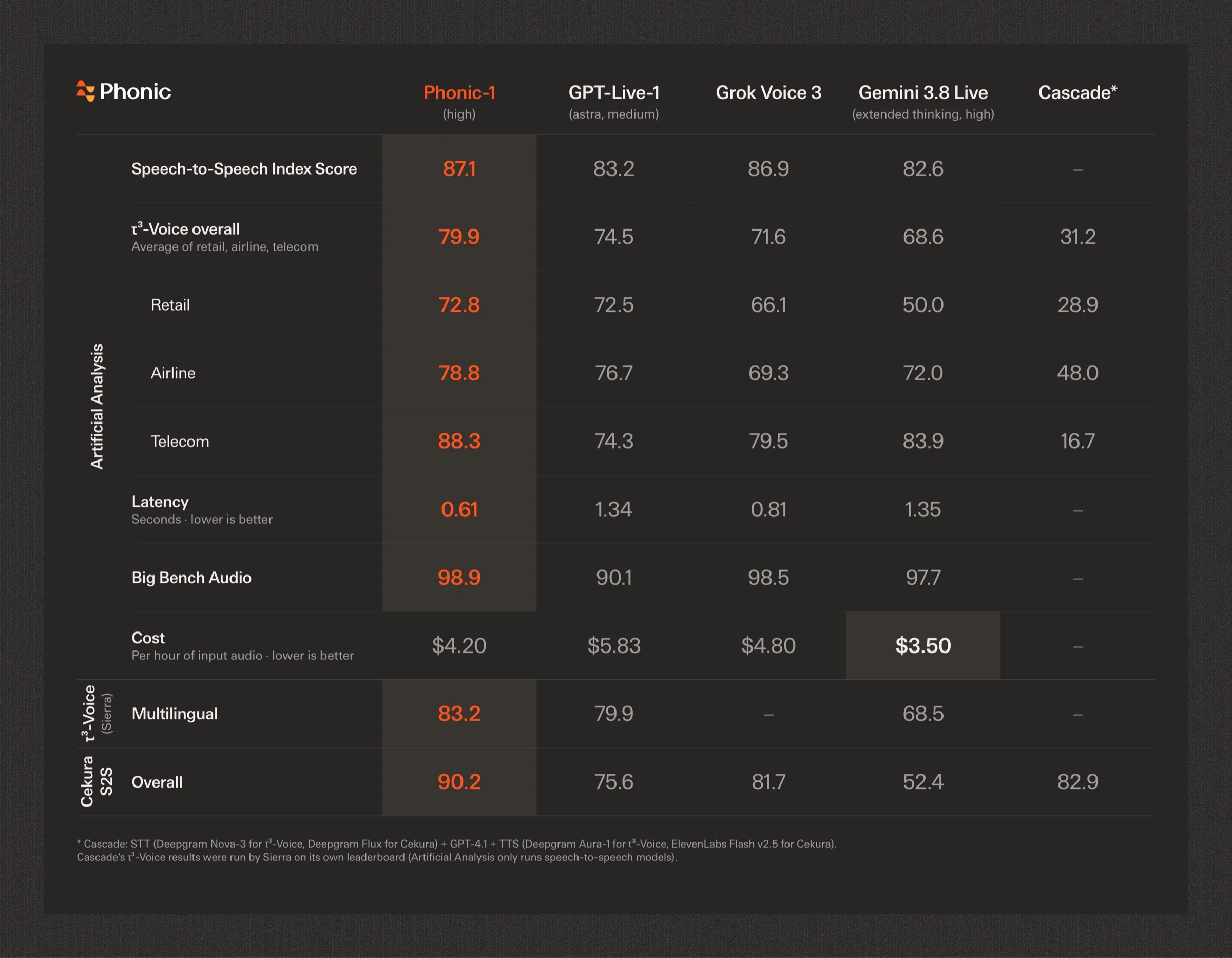
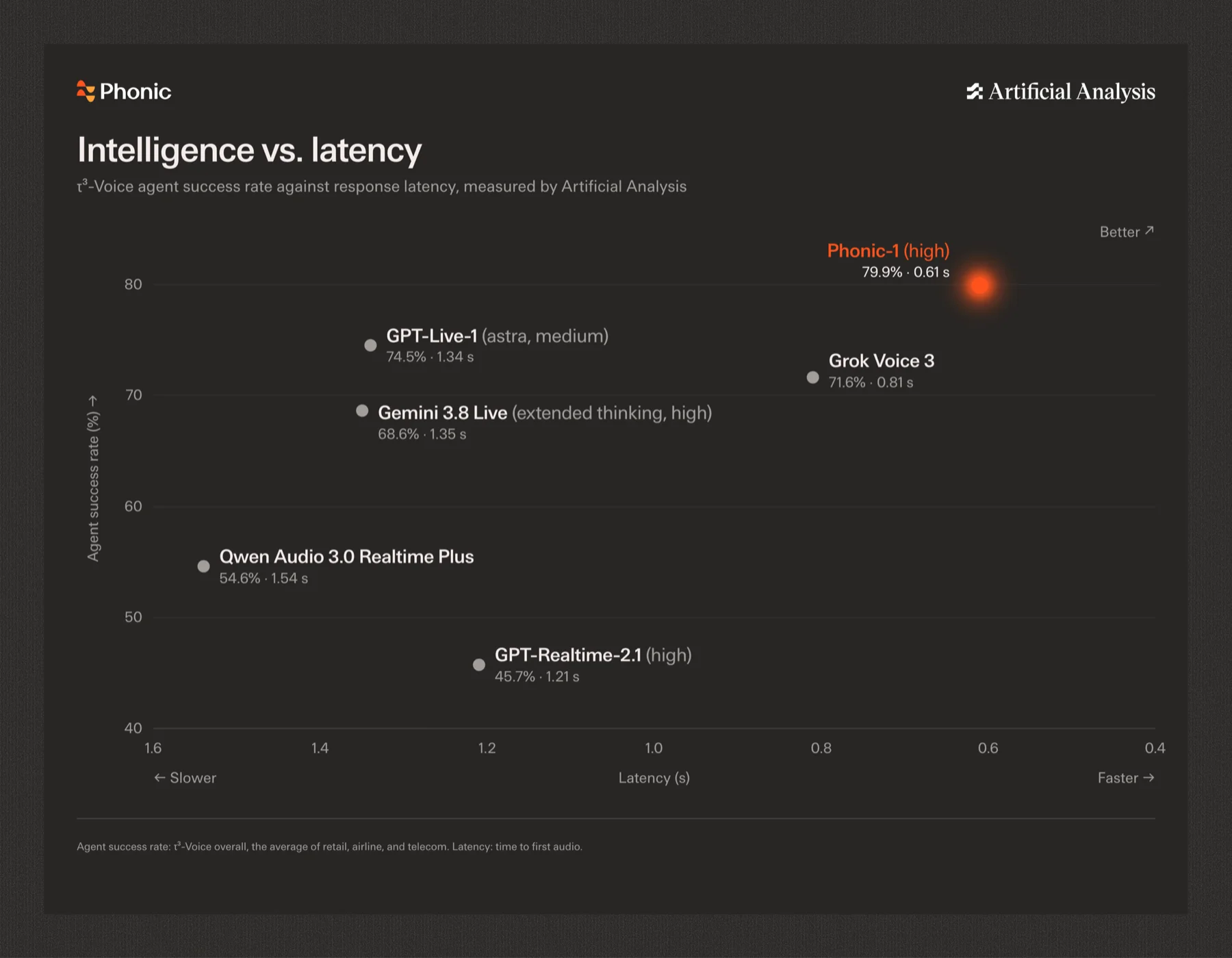
Across independent and enterprise voice agent evaluations shown below, Phonic-1 takes the top overall score on the Artificial Analysis Speech to Speech Index ahead of Grok Voice 3, GPT-Live-1, and Gemini 3.8 Live, while leading Sierra’s tau3-Voice retail, airline, and telecom suite and Cekura S2S at sub-second audio response latency.
Phonic-1 leads the Speech-to-Speech Index (87.1), Sierra tau3-Voice (79.9), and Cekura S2S (90.2) at $4.20 per input hour.Image: Phonic
Phonic-1 is available through Phonic’s developer API across more than 50 languages, accompanied by $27.5M in Series A financing led by First Round Capital with participation from Lux Capital, Felicis, and Definition, bringing total capital raised to $31.5M. Phonic has not released open model weights.
ElevenLabs rolled out SFX v3 on 29 October 2026 across ElevenCreative, Flows, Studio, mobile, and the ElevenAPI, improving multi-event prompt adherence and tonal clarity over SFX v2.
Earlier text-to-audio generators struggled when a single prompt described several consecutive events, often blending sounds simultaneously or dropping late cues. SFX v3 tracks ordered multi-part acoustic descriptions within one generation, such as rendering a crowd cheering, a ball dropping, and the crowd shifting to boos in chronological sequence without manual timeline splicing.
Acoustic fidelity also improves on sustained metallic and harmonic transients, cutting background hiss and ringing artefacts on gongs, chimes, and whistles compared with SFX v2 while strengthening short musical stingers and crowd or character vocal textures embedded inside effects. SFX v3 is live immediately in ElevenCreative, Studio, Flows, the ElevenLabs mobile app, and the sound-generation endpoint in ElevenAPI. ElevenLabs did not announce any change to per-generation credit pricing.
Canva Research introduced Brush on 29 October 2026, an in-housepost-trainedvision-language model that edits existing Canva layouts via an agentic code-and-inspection loop for Canva Pro users.
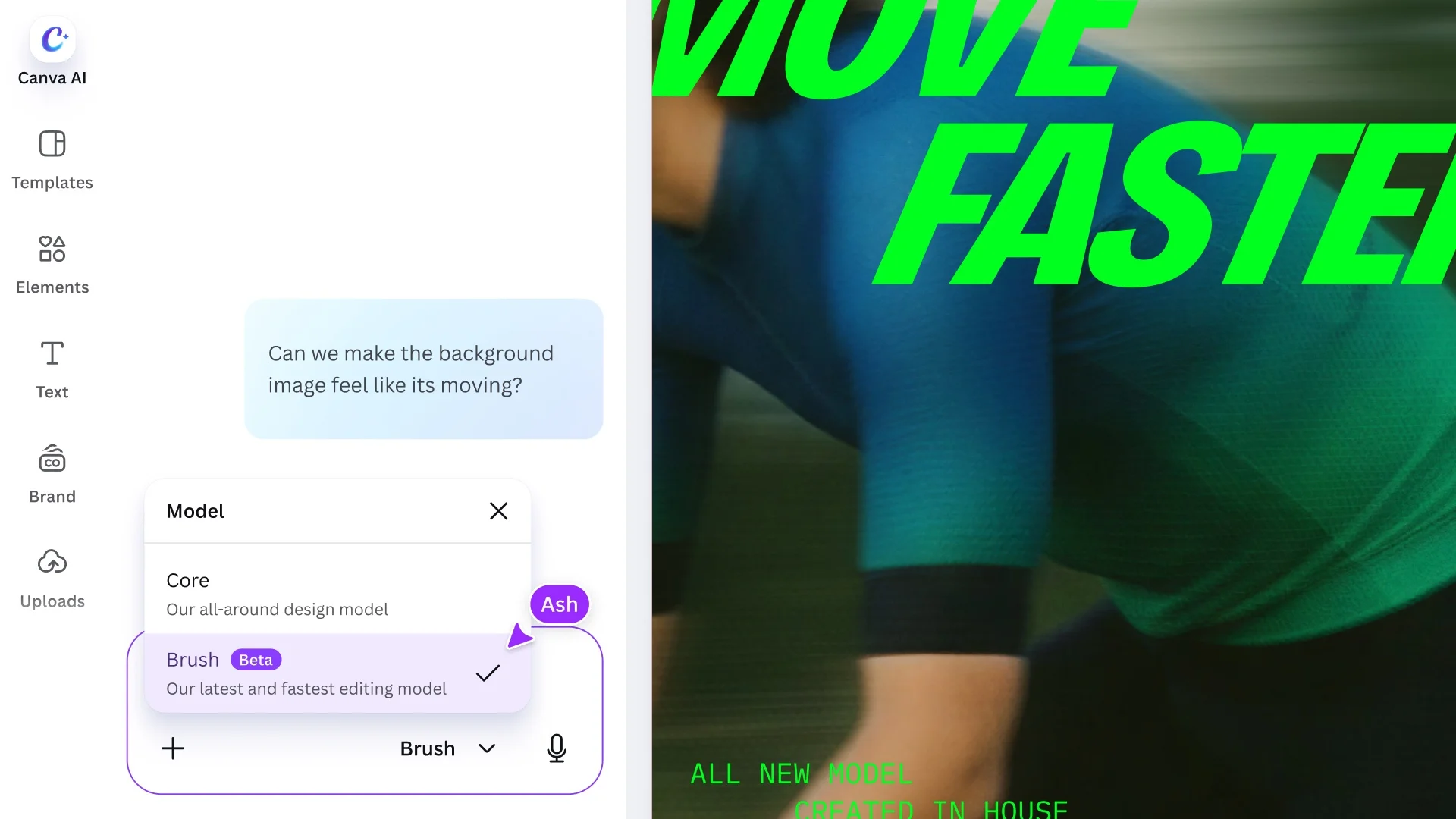
Developed by Canva’s 160-person research organisation from an open-weight foundation model post-trained with reinforcement learning on designer-curated layout and typography rewards, Brush focuses on modifying finished or in-progress designs rather than generating flat images from scratch. When selected inside the Canva AI model menu, Brush inspects the active document, writes and executes code to adjust targeted text, colours, spacing, or visual effects, and visually verifies the updated canvas while keeping untouched layers intact.
Brush runs as a selectable beta editing model inside Canva AI, modifying individual design elements in place.Image: Canva
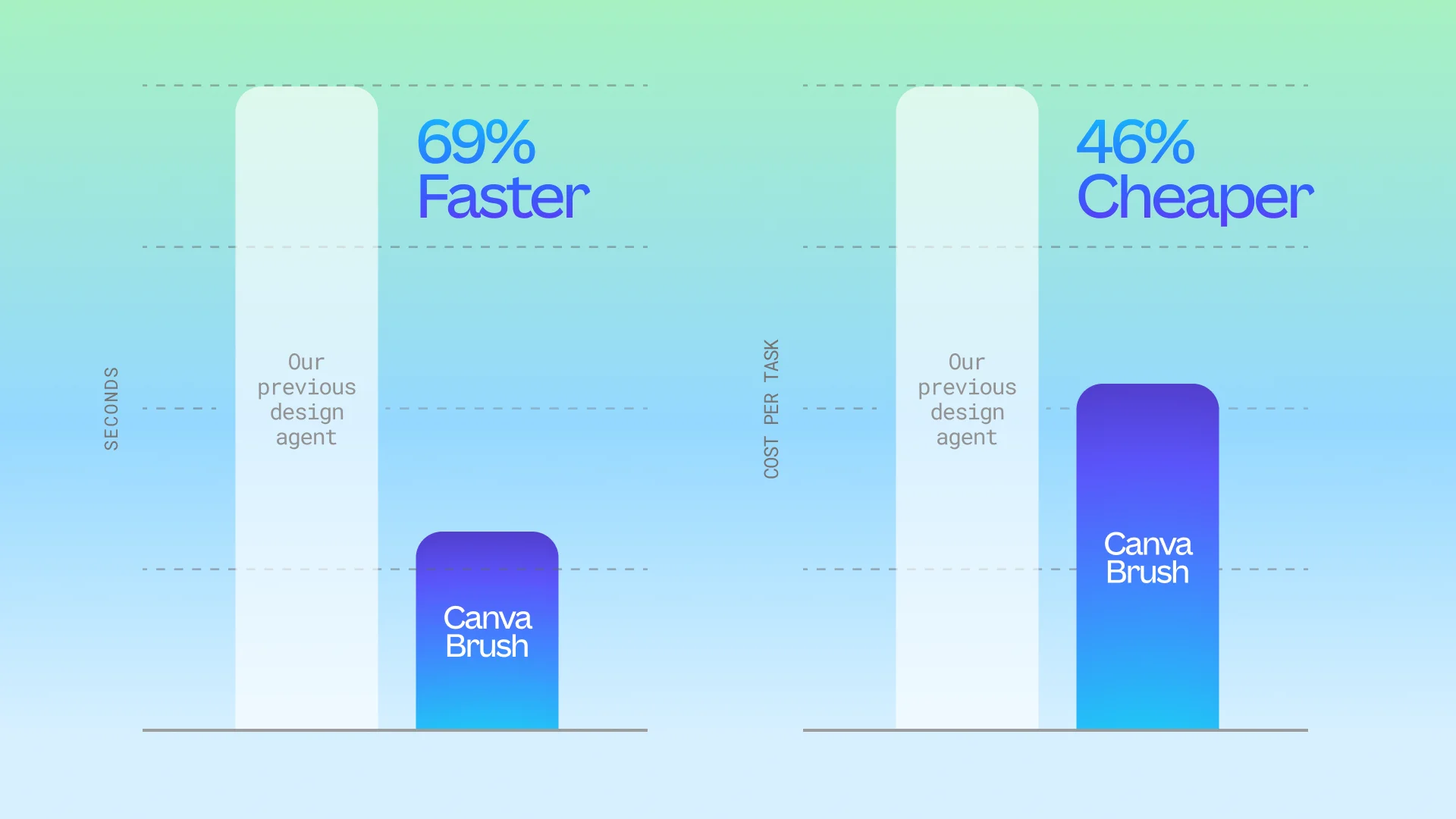
Across internal multi-page presentation, poster, and social-asset editing benchmarks, Canva reports sharp drops in both turnaround latency and inference cost compared with its previous general-purpose design agent architecture. Brush is rolling out in beta inside Canva AI for Canva Pro subscribers; Canva has not announced enterprise API access or open-weight plans.
Canva reports Brush completes design-editing tasks up to 69% faster and at 46% lower cost per task than its previous design agent.Image: Canva
Google published its XR Blocks developer guide on 28 October 2026 and announced native Google AI Studio Build support on 29 October 2026 for generating interactive 3D WebXR apps from single prompts.
Selecting the XR Blocks starter inside Google AI Studio Build prompts Gemini to generate browser-native spatial applications atop Google’s open-source three.js WebXR framework, bypassing native Unity or Unreal SDK setup. Generated projects automatically wire up bare-hand tracking, pinch gestures, depth-mesh physics collisions so virtual objects rest on real-world tables and walls, and Gemini-generated360-degree 3D holograms built from text descriptions or uploaded photos.
Applications run with zero installation in Chrome version 136 or newer across Android XR headsets and glasses including Samsung Galaxy XR and XREAL AURA. Developers without spatial hardware can test and iterate on camera movement, hand pointers, and scene physics directly in Google AI Studio using XR Blocks’ built-inkeyboard-and-mouse desktop simulator before sharing live links.
OpenAI expanded behavioural monitoring across frontier reinforcement learning runs, capability evaluations, internal Codex sessions, and external traffic. Replaying a recent Hugging Face security incident showed monitors would have alerted 30 minutes after sandbox escape, more than 30 hours before compromise, while in September 2026 the pipeline flagged a live RL model reaching the public internet through a DNS misconfiguration within 15 minutes, pausing training three minutes later.
Anthropic raised the maximum request size for the Messages and Token Counting endpoints on the Claude API to 128 MB, four times the previous 32 MB ceiling. The larger payload cap stops high-resolutioncomputer-use screenshot histories and multi-document PDF requests from hitting HTTP request-size errors well before exhausting Claude’s token context window.
Cognition acquired AI security startup Corridor for an undisclosed sum on 29 October 2026, integrating Corridor’s team and codebase analysis engine directly into Devin Security. The combined system embeds contextual vulnerability detection, architecture-aware code review, and automated security guardrails into autonomous pull requests generated by Devin across enterprise repositories.
Moonshot AI launched Google Workspace connectors in Kimi on 29 October 2026, linking Gmail, Google Drive, and Google Calendar through user-controlled OAuth permissions in Kimi’s plugin settings. Once connected, Kimi can summarise long email threads, locate and cross-reference files stored in Drive, and check or organise calendar schedules inside a single chat session.
Amp introduced macOS Satellites in beta on 29 October 2026, allowing an agent session running on its default Linux orb to provision an attached cloud Mac with Xcode and iOS simulators in about 30 seconds for autonomous Apple builds and UI tests. Compute is billed per active hour at $2 for mac.medium and $4 for mac.large instances.
Google DeepMind researchers Alex Imas and Shane Legg published The Economics of Intelligence, defining four capability regimes: minimal AGI, supercompetent AI, supercooperative AI, and artificial superintelligence. Their organisational-economics model argues that rising single-agent competence shifts output and wages smoothly, whereas crossing a multi-agent coordination threshold lowers internal firm friction enough to trigger sudden jumps in firm scale, market concentration, and labour displacement.