


ResearchGoogle DeepMindConfirmed
Story 2 of 13 in the Tuesday 10 November editionGoogle DeepMind uses AlphaProof Code and Gemini 4 Carbon to formally verify Signal
Built on the Lean theorem prover and Gemini 4 Carbon agents, AlphaProof Code proved forward secrecy and post-compromise security on Signal’s live Rust implementation down to compiled machine instructions in four weeks.

 Edited by Ashutosh Shrivastava
11 Nov 2026, 09:20 IST · 3 min read

Google DeepMind introduced AlphaProof Code on 10 November 2026, open-sourcing formal verification artefacts and a technical paper detailing end-to-end verification of the Signal cryptographic protocol. Rather than stopping at abstract protocol diagrams or source-level checks that assume bug-free compilers, the framework verifies Signal’s live Rust implementation down to compiled machine code executing on a formal Lean model of the target processor.
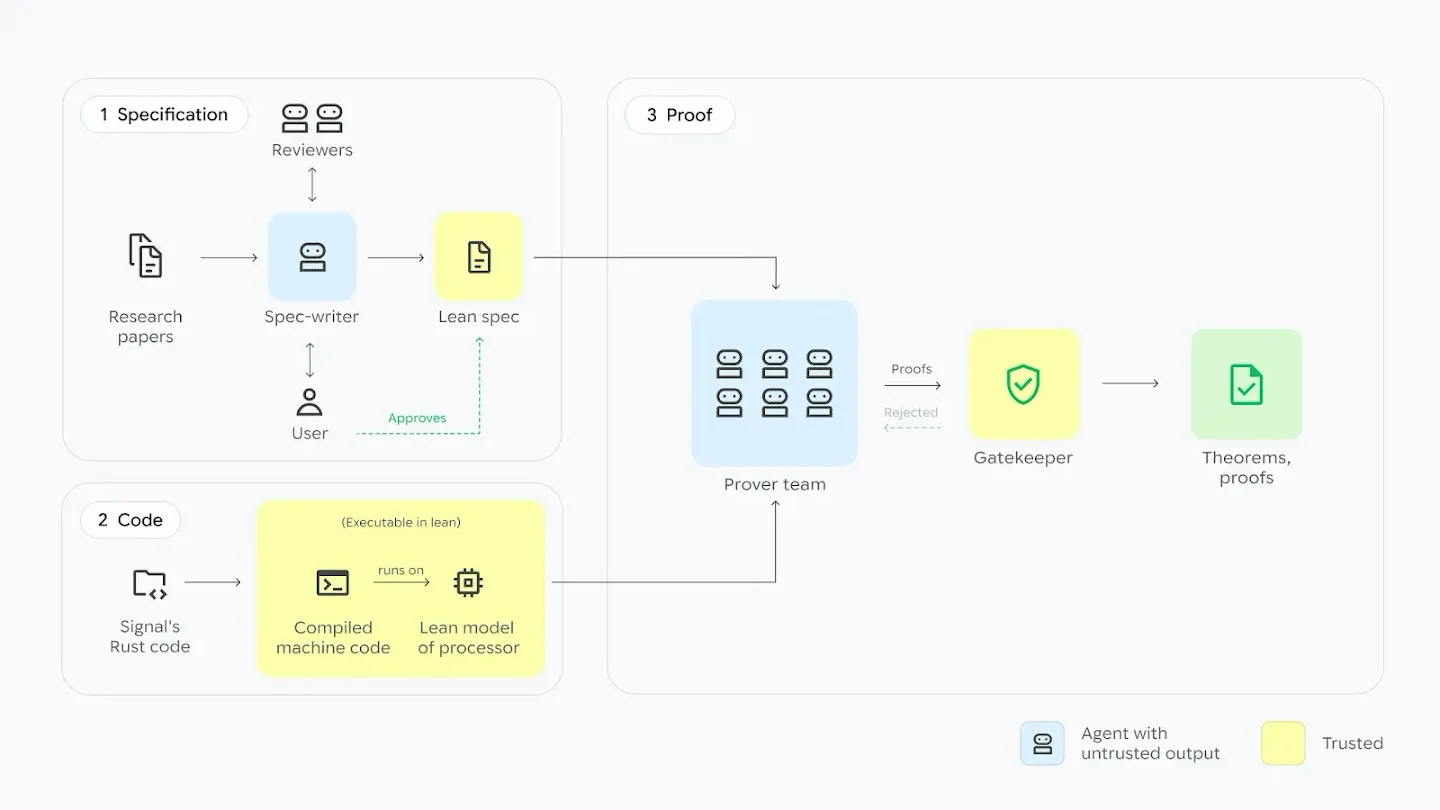
Multi-agent Lean proof pipeline
AlphaProof Code splits formal verification across specialised Gemini 4 Carbon roles. Spec-writer agents collaborate with human security engineers to translate cryptographic research papers into concise, human-approved Lean specifications covering properties such as forward secrecy and post-compromise security. Prover agents then decompose the compiled binary and construct mathematical proofs, while automated gatekeeper agents audit intermediate steps so humans only review roughly 1% of the codebase and Lean’s kernel machine-checks the remainder.
To test sensitivity to real bugs, researchers reintroduced two previously patched vulnerabilities into an isolated copy of Signal’s code; AlphaProof Code rejected both builds and produced machine-checked proofs of insecurity.
Key numbers
- Over 6 million lines of machine-checked Lean proofs generated in 4 weeks of autonomous prover runs
- 1% of the codebase requiring human specification audit after automated gatekeeper and Lean kernel verification
- 2 historical, previously patched Signal vulnerabilities caught with formal proofs of insecurity in isolated testing
Study details
- Verification stack
- Lean theorem prover paired with Gemini 4 Carbon spec-writer, prover and gatekeeper agents
- Target codebase
- Signal cryptographic protocol live Rust implementation down to compiled processor machine code
- Proof scale and duration
- Over 6 million lines of machine-checked Lean proofs produced in 4 weeks
- Human audit scope
- Roughly 1% of the codebase reviewed for specification fidelity; remainder checked by Lean’s kernel
- Released materials
- Open-source formal verification artefacts and technical research paper
Release details & context
Processor-level proof scope, Signal collaboration and critical infrastructure
In Google DeepMind’s AlphaProof Code post, researchers note that the Signal protocol secures messaging across both Signal and Google Messages, and credit methodology feedback from Signal’s Rolfe Schmidt, Michael Rosenberg and CTO Ehren Kret. According to DeepMind, the four-week run marks the first time any widely deployed cryptographic protocol implementation has been formally verified end to end, with or without AI, all the way down to compiled device instructions rather than idealised source models.
Powered by Gemini 4 Carbon following its Fairwind cyber-defence preview, DeepMind positions AlphaProof Code alongside automated remediation systems such as CodeMender to verify high-assurance targets including medical-device firmware and power-grid control software.
Common questions
Why does AlphaProof Code verify compiled machine instructions instead of Rust source code alone?
Source-only verification assumes compilers introduce zero subtle translation bugs, whereas proving properties against a formal Lean processor model guarantees the actual binary running on user devices preserves forward secrecy and post-compromise security.
Sources
Google DeepMind release timeline (8 launches tracked)
- Google DeepMind unveils Genie 4 real-time interactive world model
Google DeepMind released Genie 4 as a preview to trusted testers, bringing interactive world generation to the Gemini API and Project Genie.
- Google DeepMind unveils Gemini 4 Carbon frontier model
Google DeepMind’s Gemini 4 Carbon scores 59 on Artificial Analysis v5.0 and 88.2% on SEC-bench Pro at Argon’s $2/$10 per million token API price.
- Google DeepMind publishes economic framework for multi-agent AGI regimes
Google DeepMind modelled four AI capability regimes, finding that multi-agent coordination thresholds trigger abrupt jumps in firm concentration and wages.
- Google DeepMind releases AlphaGenome 2 API for single-cell DNA variant prediction
Google DeepMind launches AlphaGenome 2 with custom scRNA-seq conditioning, imputed tracks and CpG methylation scoring across 1 Mb DNA windows.