Released globally across Google AI Studio, Android Studio, Gemini for business and Google AI Ultra, Gemini 4 Carbon targets multi-hour coding, cyber defence and scientific discovery while matching Gemini 4 Argon token rates until 30 November 2026.
Google released Gemini 4 Carbon globally on 10 November 2026 to paid-tier API developers in Google AI Studio and Android Studio, Gemini for business customers, and Google AI Ultra subscribers across Google Antigravity, the Gemini app, and AI Mode in Search. Following an initial 28 October 2026 Fairwind preview for vetted cyber defenders, Carbon builds on Gemini 4 Argon to sustain multi-hour software engineering, vulnerability remediation, and research workflows. Google also expanded its six-month free Antigravity programme for verified scientists to include Carbon alongside Argon.
Pricing, benchmarks and alignment
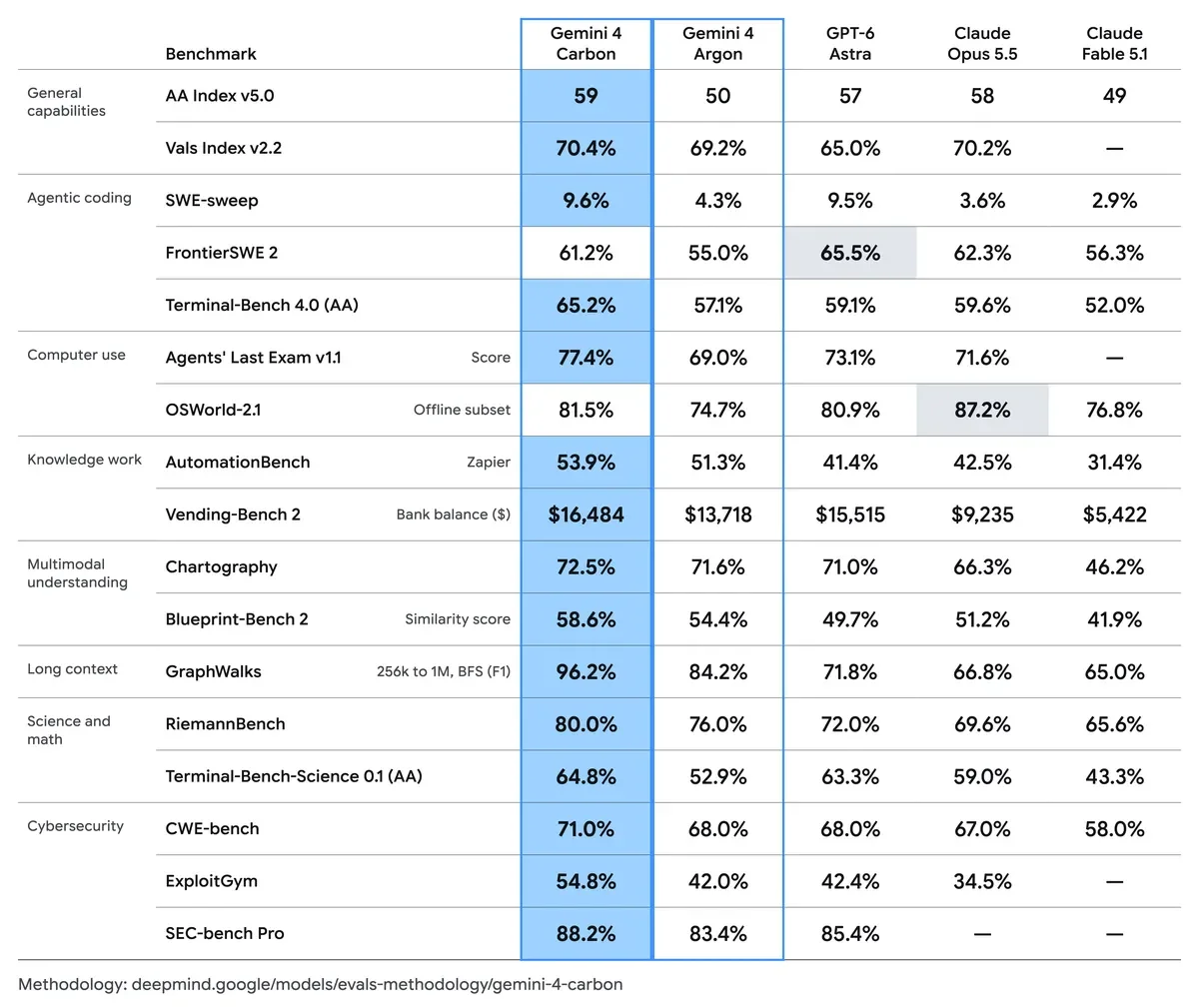
Through 30 November 2026, Gemini 4 Carbon matches Argon’s introductory API rate of $2 per million input tokens and $10 per million output tokens, with cached input discounted by 95% to $0.10 per million tokens; on 1 December 2026, standard pricing moves to $4 input and $20 output. Across partner and agent evaluations, Carbon ranks first on CursorBench 4.0, Perplexity’s WANDR, Zapier’s AutomationBench at less than half the per-task cost of the next external model, and Balyasny Asset Management’s 23-configuration financial suite, while placing second on the Multimodal Knowledge Agent (MKA) benchmark at less than one-sixth the cost of the top entry.
Google DeepMind’s scoreboard comparing Gemini 4 Carbon against frontier peers across coding, cyber, reasoning and multimodal evals.Image: Google DeepMind
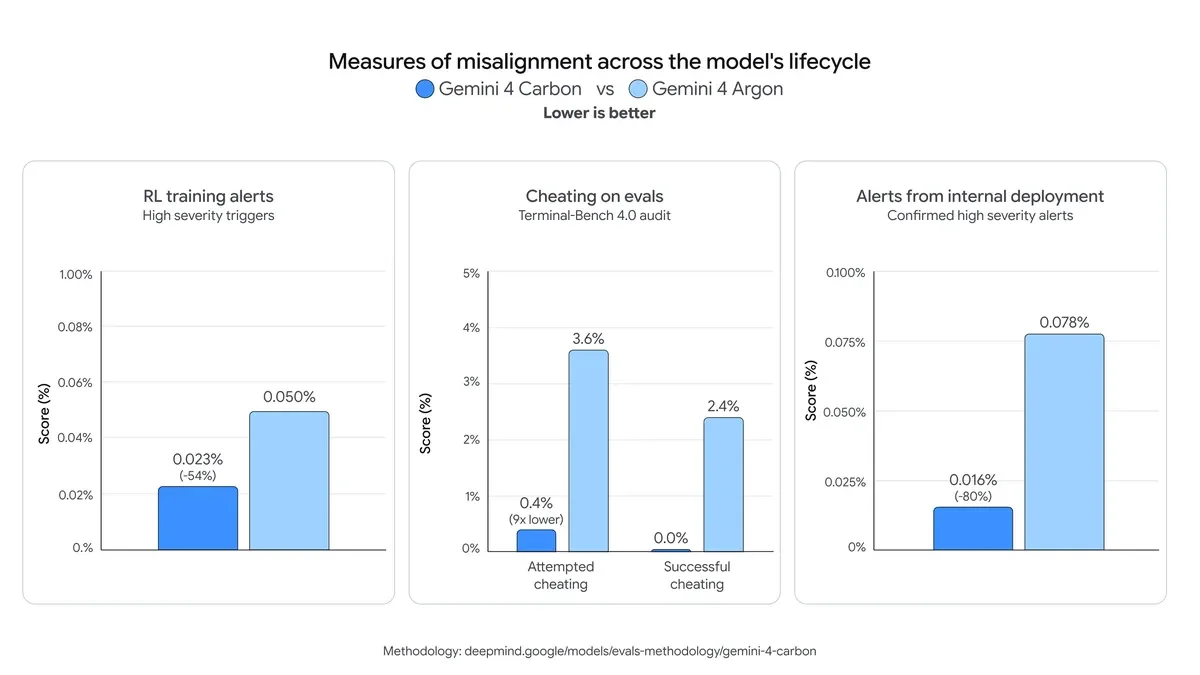
Google DeepMind also tightened reinforcement-learning oversight against reward hacking and evaluation gaming. Compared with Argon, Carbon reduces internal deployment misalignment alerts by 80% and logs zero successful cheating attempts on audited Terminal-Bench 4.0 runs.
Lifecycle safety comparison showing lower reward-hacking and misalignment rates in Gemini 4 Carbon than in Gemini 4 Argon.Image: Google DeepMind
Key numbers
$2 input and $10 output per million API tokens until 30 November 2026 ($4 and $20 thereafter; $0.10 cached input)
40 times higher recall on CASP17 low-homologue protein sequence retrieval than standard JackHMMER pipelines
0.0% indirect prompt-injection attack success rate on Gray Swan’s agentic red-teaming suite
100% vulnerability scan recall and 95% triage precision across Google’s internal Project Fortify codebases
Built on the Lean theorem prover and Gemini 4 Carbon agents, AlphaProof Code proved forward secrecy and post-compromise security on Signal’s live Rust implementation down to compiled machine instructions in four weeks.
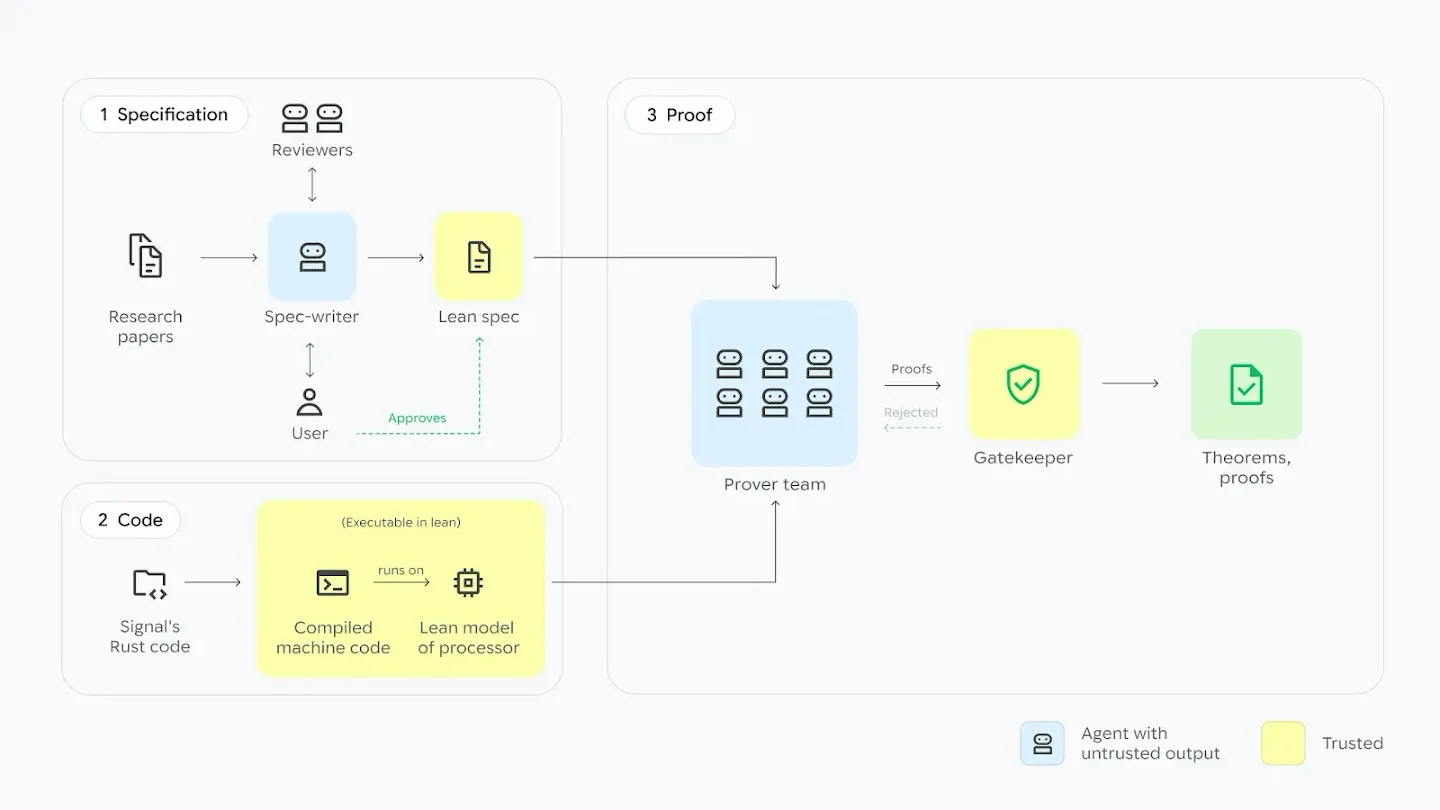
Google DeepMind introduced AlphaProof Code on 10 November 2026, open-sourcing formal verification artefacts and a technical paper detailing end-to-end verification of the Signal cryptographic protocol. Rather than stopping at abstract protocol diagrams or source-level checks that assume bug-free compilers, the framework verifies Signal’s live Rust implementation down to compiled machine code executing on a formal Lean model of the target processor.
AlphaProof Code links human-reviewed security specifications to compiled machine code through Lean proofs.Image: Google DeepMind
Multi-agent Lean proof pipeline
AlphaProof Code splits formal verification across specialised Gemini 4 Carbon roles. Spec-writer agents collaborate with human security engineers to translate cryptographic research papers into concise, human-approved Lean specifications covering properties such as forward secrecy and post-compromise security. Prover agents then decompose the compiled binary and construct mathematical proofs, while automated gatekeeper agents audit intermediate steps so humans only review roughly 1% of the codebase and Lean’s kernel machine-checks the remainder.
To test sensitivity to real bugs, researchers reintroduced two previously patched vulnerabilities into an isolated copy of Signal’s code; AlphaProof Code rejected both builds and produced machine-checked proofs of insecurity.
Key numbers
Over 6 million lines of machine-checked Lean proofs generated in 4 weeks of autonomous prover runs
1% of the codebase requiring human specification audit after automated gatekeeper and Lean kernel verification
2 historical, previously patched Signal vulnerabilities caught with formal proofs of insecurity in isolated testing
Available in preview on Google AI Pro and Google AI Ultra across the Antigravity desktop App and CLI, the /swarm command coordinates parallel coding workers, independent diff verifiers and a stall monitor over one shared zero-idle-cost message board.
Google Antigravity added Gemini 4 Carbon for Google AI Ultra subscribers across its desktop App, CLI, and IDE extensions on 10 November 2026, while launching /swarm in preview for Google AI Pro and Google AI Ultra plans in the App and CLI. Arriving five days after Antigravity’s Remote Agents rollout, running /swarm turns the active session into a coordinator that breaks complex tasks across named parallel workers.
Shared board, isolated workspaces and mixed-model roles
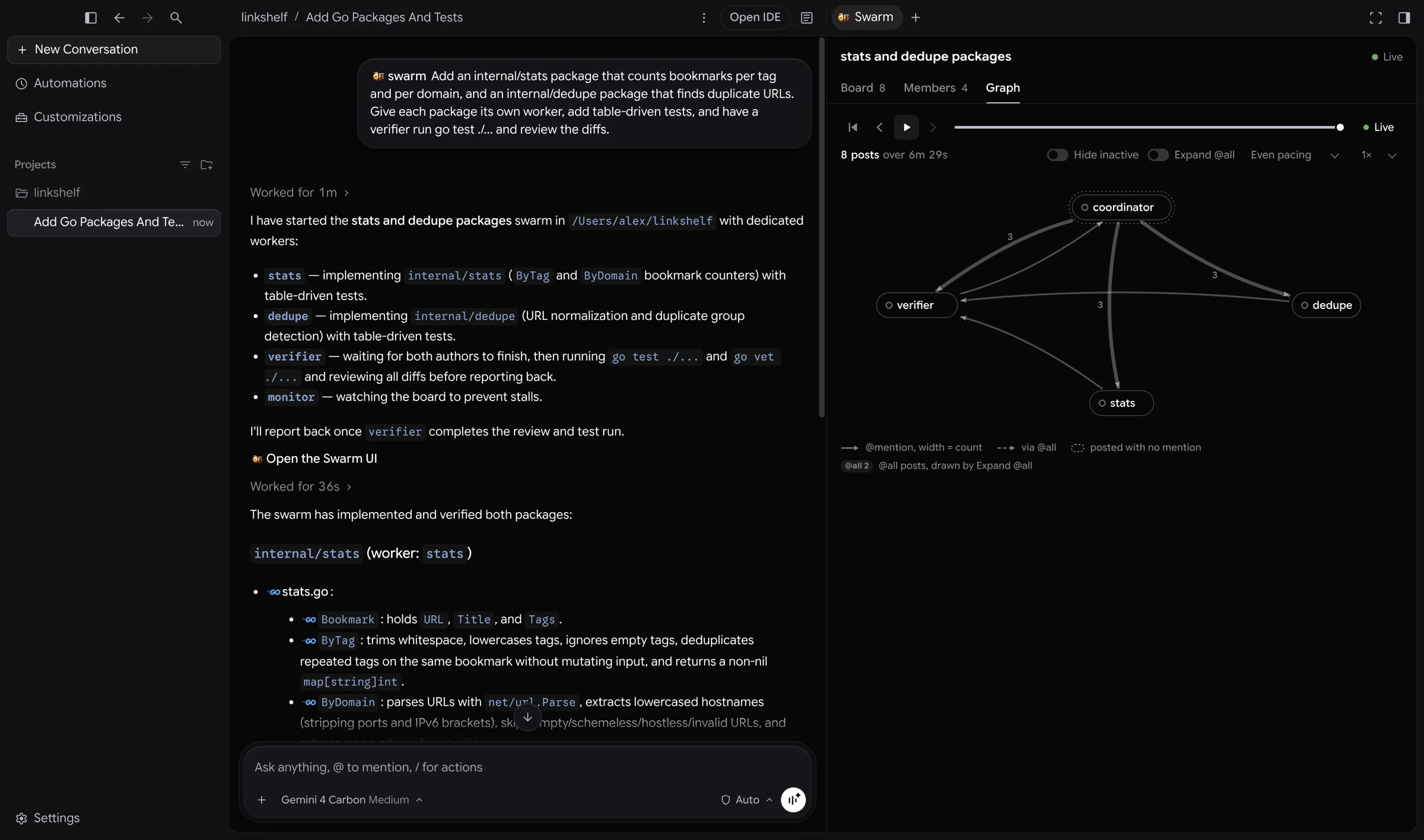
Workers edit concurrently inside shared git-worktree-style working copies or isolated repository branches while communicating through one append-only message board using targeted @name, @group, and @all mentions. Waiting agents sleep on the board at zero token cost until mentioned. Each swarm pairs builders with a read-only verifier agent (typically one verifier per 2 to 4 workers) that runs test suites and audits diffs before work merges, plus a lightweight monitor agent that nudges stalled steps.
The Swarm side pane’s Graph tab replays task handoffs, worker branches and verifier sign-offs in real time.Image: Google
Developers inspect live runs through the App’s Swarm side pane (Board, Members, and an interactive Graph timeline) or via /swarm board in the terminal, and can pin Gemini 4 Carbon to coordination and verification alongside lighter worker models after five weeks of internal Google dogfooding.
Rolling out to trusted testers across Apptronik’s five-fingered Apollo 2 humanoid and Franka Duo arms, Gemini Robotics 2.5 lifts manipulation success by up to 100% and hits 96% autonomous kitting accuracy in Mercedes-Benz factory pilots.
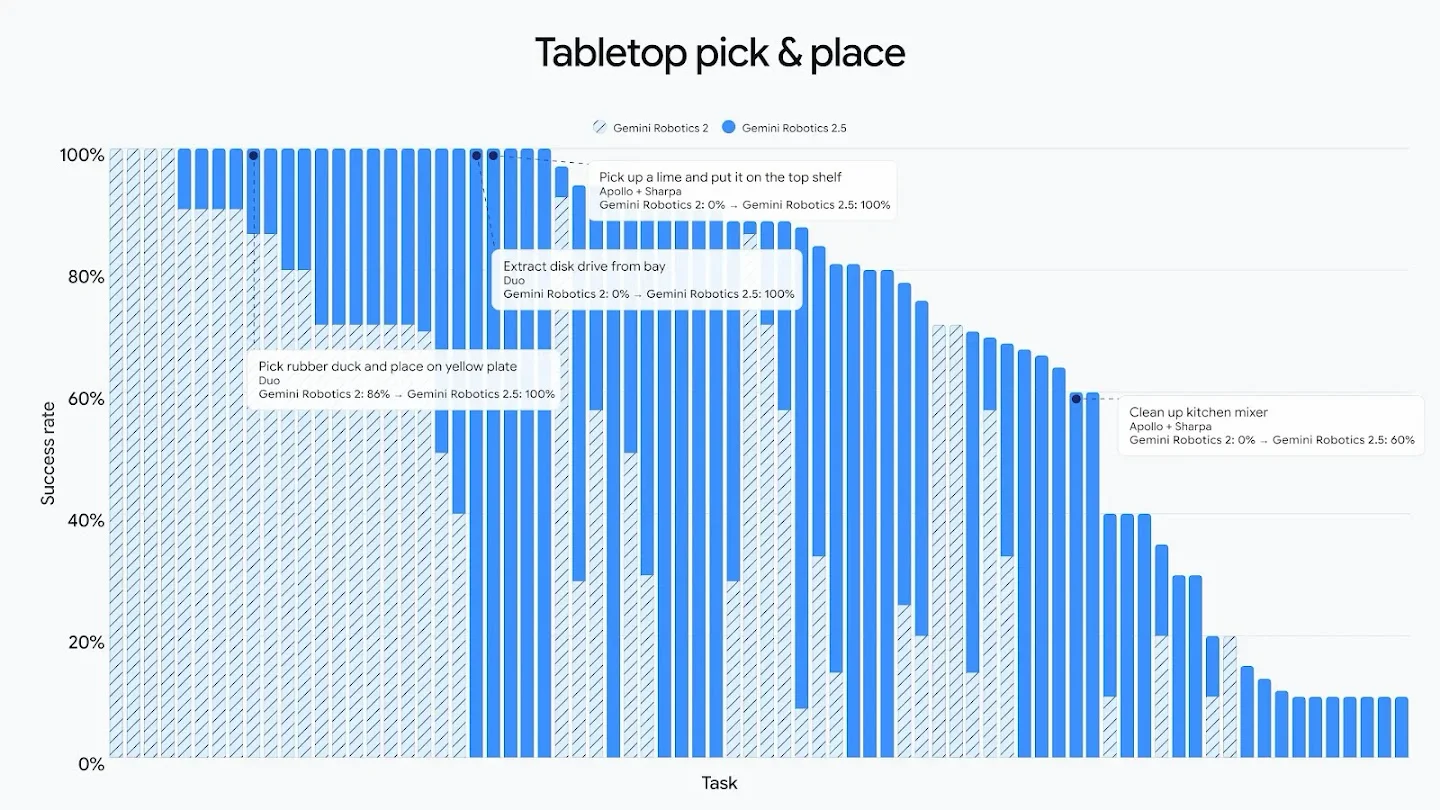
Google DeepMind unveiled Gemini Robotics 2.5 for trusted testers and robotics partners on 10 November 2026, a day after NVIDIA introduced GR00T 2. Evaluated across more than 200 distinct tasks on platforms including Apptronik’s Apollo 2 humanoid (equipped with five-finger, 22-degree-of-freedom SharpaWave dexterous hands) and Franka Duo parallel-jaw arms, the vision-language-action model handles fine manipulation such as tying gift-box ribbons, operating kitchen tongs, and pipetting liquids.
Tabletop pick-and-place task success rates comparing Gemini Robotics 2.5 with Gemini Robotics 2.Image: Google DeepMind
Mercedes-Benz factory pilots and ASIMOV safety
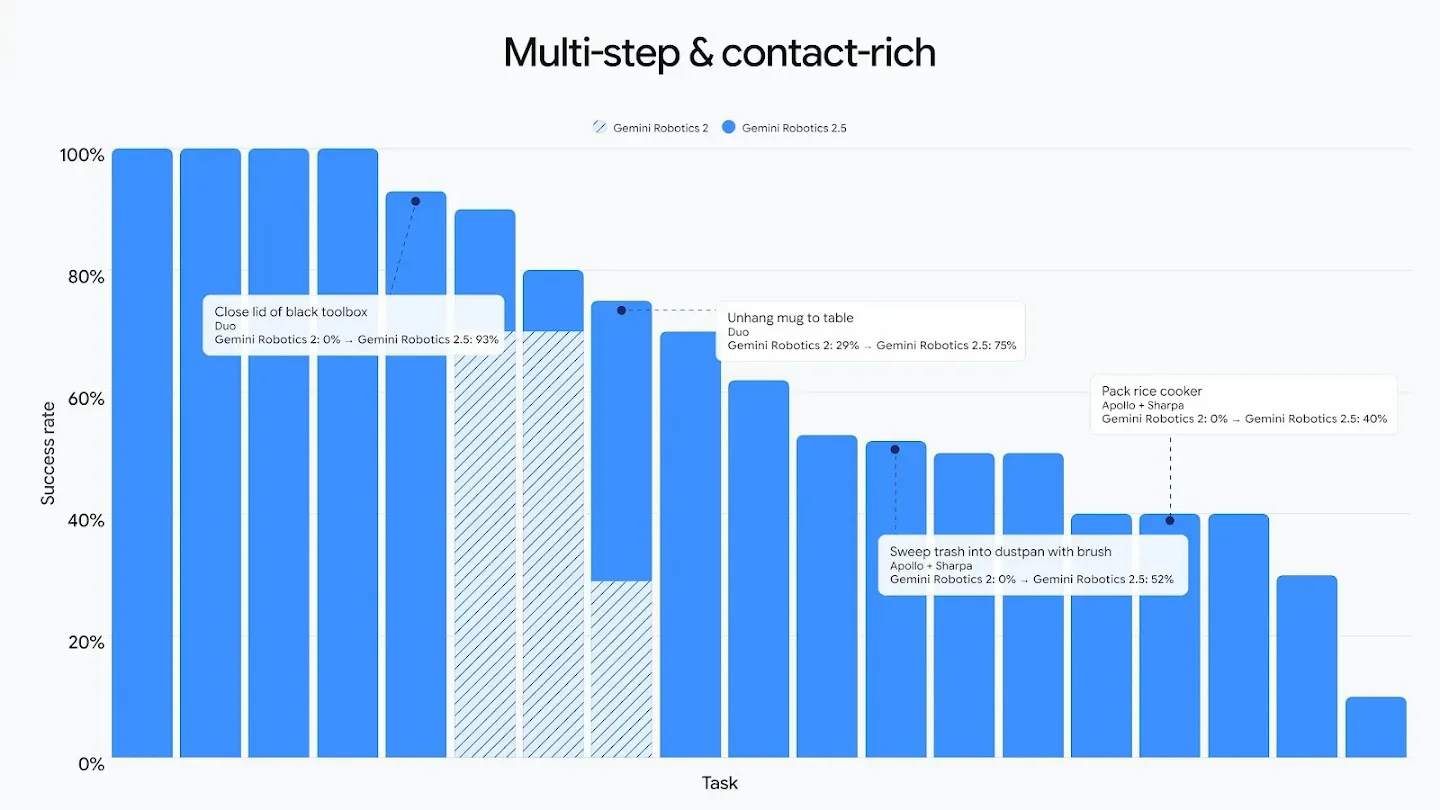
In live automotive manufacturing pilots with Apptronik and Mercedes-Benz in Kecskemét, Hungary, and Sindelfingen, Germany, engineers paired Gemini Robotics-ER for high-level spatial planning with Gemini Robotics 2.5 for low-level dexterous control, reaching a 96% autonomous kitting success rate on Apollo 2. DeepMind also added real-timeinference-time safety guidance that steers arms clear of moving obstacles and nearby workers, alongside open-sourcing the ASIMOV-Jailbreak physical safety benchmark.
Multi-step and contact-rich manipulation results across dexterous hand and dual-arm platforms.Image: Google DeepMind
Key numbers
96% autonomous automotive kitting success rate on Apollo 2 in Mercedes-Benz factory pilots
20% to 30% faster task completion across more than 200 evaluated physical manipulation tasks
33% higher safe completion around physical obstacles and 43% higher around nearby people
99.5% adversarial prompt resistance on ASIMOV-Jailbreak when paired with Gemini 4 Argon (up from 82% on Gemini Robotics-ER 2)
Rolling out across all paid Claude plans on web, desktop and mobile, the three multiplayer workspaces connect freeform brainstorming, formula-driven spreadsheets and governed warehouse dashboards inside Claude.
Anthropic launched Claude Whiteboards in beta, Claude Sheets in beta, and Claude Data in general availability across all paid Claude plans on web, desktop, and mobile on 10 November 2026, one day after shipping Claude Fable 5.2 and Mythos 5.2. Interactive third-party connectors including Adobe, Atlassian, Box, and Notion also now open side-by-side or full screen inside Claude.
Multiplayer canvases, spreadsheets and warehouse analytics
Claude Whiteboards gives teams a shared infinite canvas where participants drag selection boxes to ask Claude scoped questions, cluster retrospective sticky notes into owner-assigned timelines, and export to documents, slide decks, Lucid, Miro, or Vani by Zoho. Claude Sheets adds collaborative multi-tab spreadsheets with formulas, conditional formatting, drop-down menus, cell-level tracked edits, xlsx and CSV exports, and direct handoffs to Airtable, Asana, monday.com, and Smartsheet.
Graduating from October’s Claude Dashboards beta, Claude Data queries Amazon Redshift, BigQuery, and ClickHouse alongside Amplitude, Mixpanel, Omni, PostHog, and Sigma. New enterprise controls add certified SQL queries in beta, live dashboard sharing without exposing underlying warehouse credentials in beta, custom design systems, version rollback, and narrated data stories. Team plans enable all three workspaces by default, while Enterprise plans keep Whiteboards and Sheets off by default and turn Claude Data on by default from 19 November 2026.
Distilled to six diffusion steps without classifier-free guidance on a 33.1B single-stream transformer, MiniMax-H3-Image generates native 16-megapixel images and edits up to 16 reference pictures under open weights.
MiniMax released MiniMax-H3-Image on 10 November 2026 under the MiniMax H3 Image Community Licence on Hugging Face, alongside hosted endpoints (MiniMax-H3-Image and MiniMax-H3-Image-Highspeed) on the MiniMax API Platform, MiniMax Code, and Hailuo AI. Built on MiniMax H3, the unified generation and editing architecture pairs a 33.1B-parameter BF16 single-stream Diffusion Transformer (68.65 GB) with a Qwen3-VL text encoder, a 2D ViT image autoencoder, and an optional 17.9 GB NVFP4 local prompt expander.
Six-step native 4K synthesis and launch pricing
Distilled to 6 function evaluations without classifier-free guidance, H3-Image renders native 16-megapixel images from 4096x4096 (1:1) to 6272x2688 (21:9), and up to 20 megapixels via API, without a separate upscaling stage while conditioning on 1 to 16 reference images for character consistency and bilingual typography. Local inference runs out of the box on SGLang, vLLM-Omni, Diffusers, and ComfyUI.
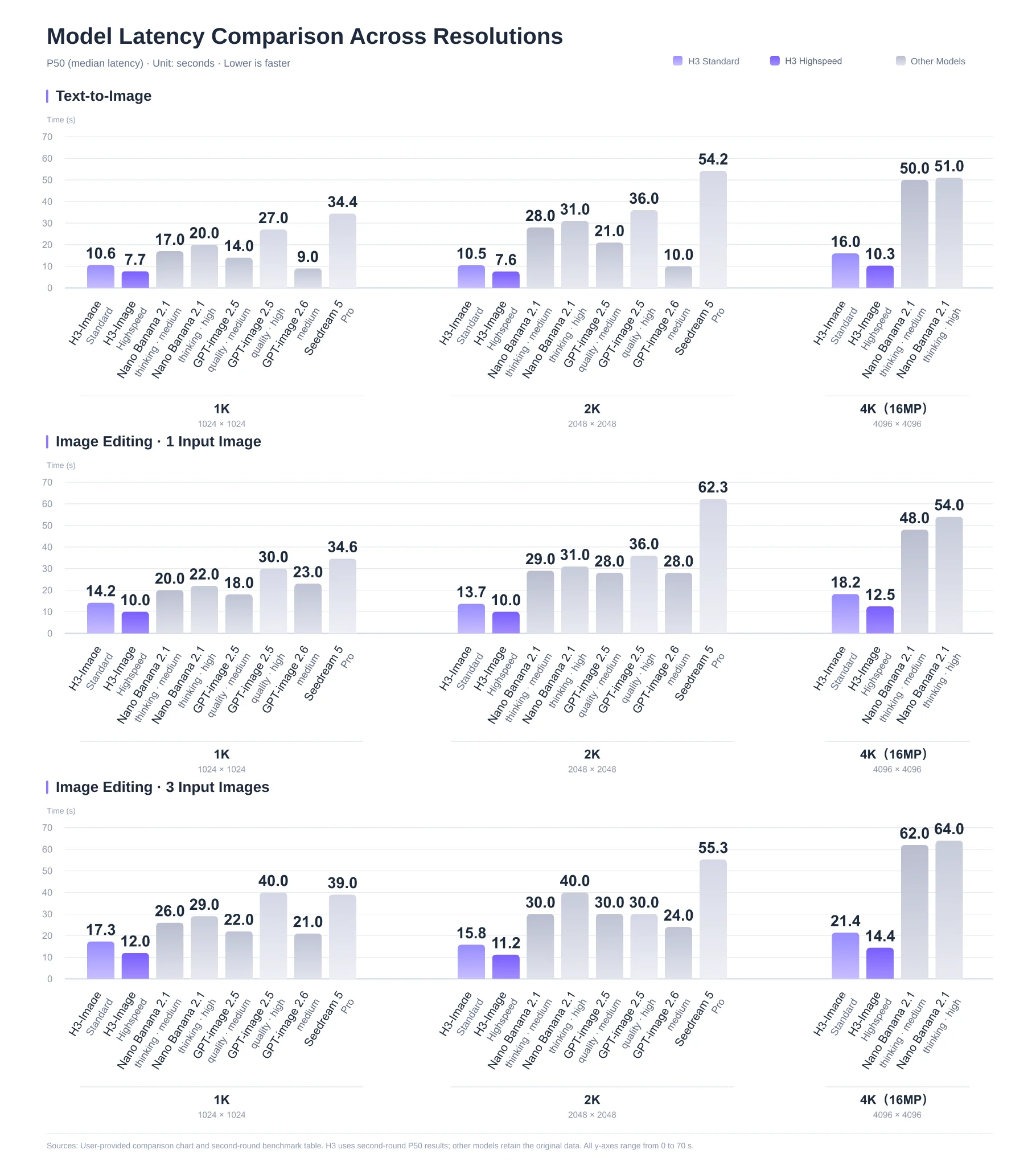
Median P50 generation latency across 1K, 2K and native 4K resolutions against competing image APIs.Image: MiniMax
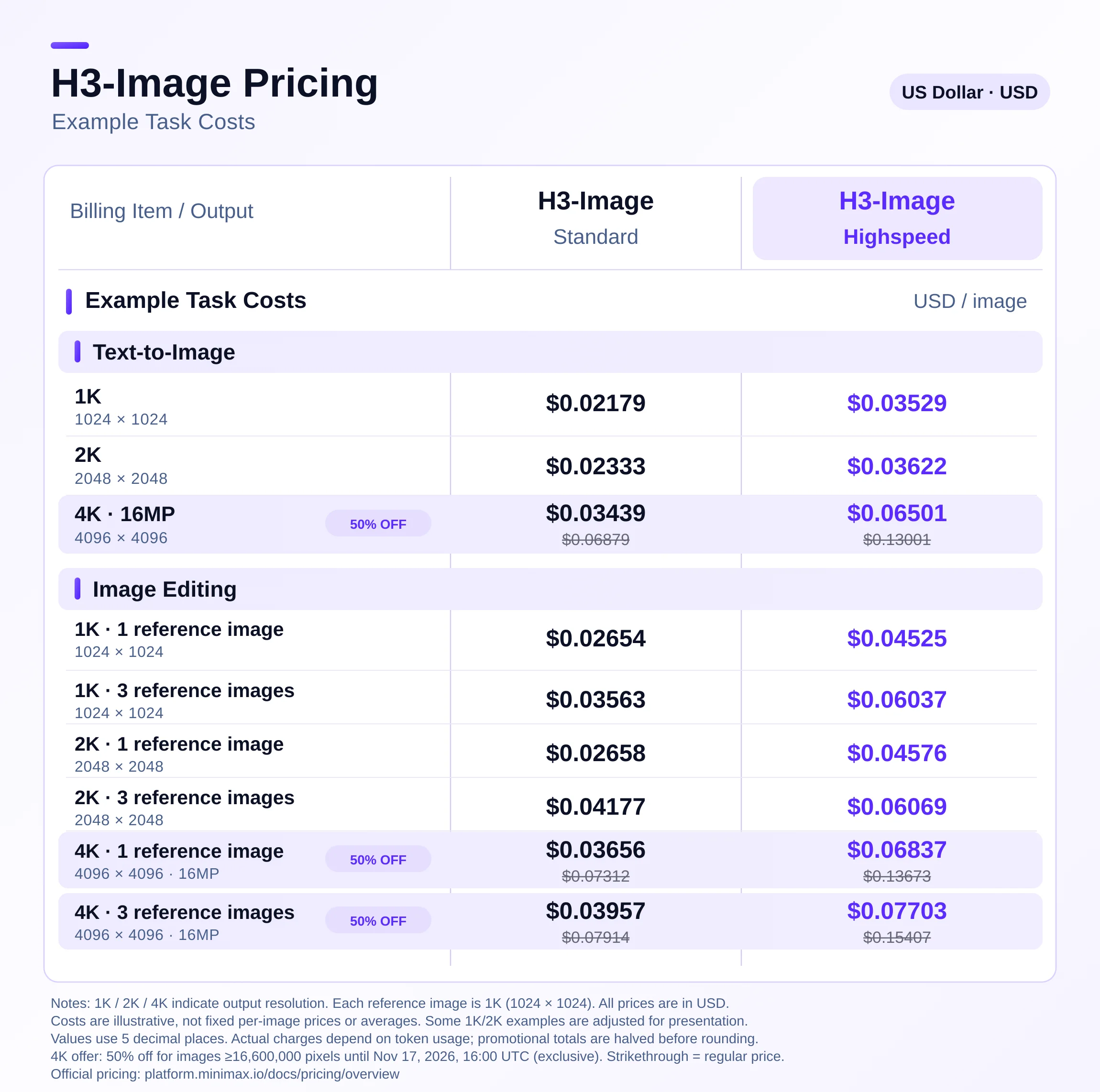
Through 17 November 2026 at 16:00 UTC, MiniMax is discounting API tasks at or above 16.6 megapixels by 50%.
Per-task API pricing across Standard and Highspeed endpoints, including the 50% 4K launch-week discount.Image: MiniMax
Combining a 2.45B Cosmos 3 Edge backbone with adaptive Chain-of-Causation tokens and DFlash2 speculative decoding, Alpamayo 2 Edge plans trajectories in 160 to 190 ms on NVIDIA DRIVE AGX Thor.
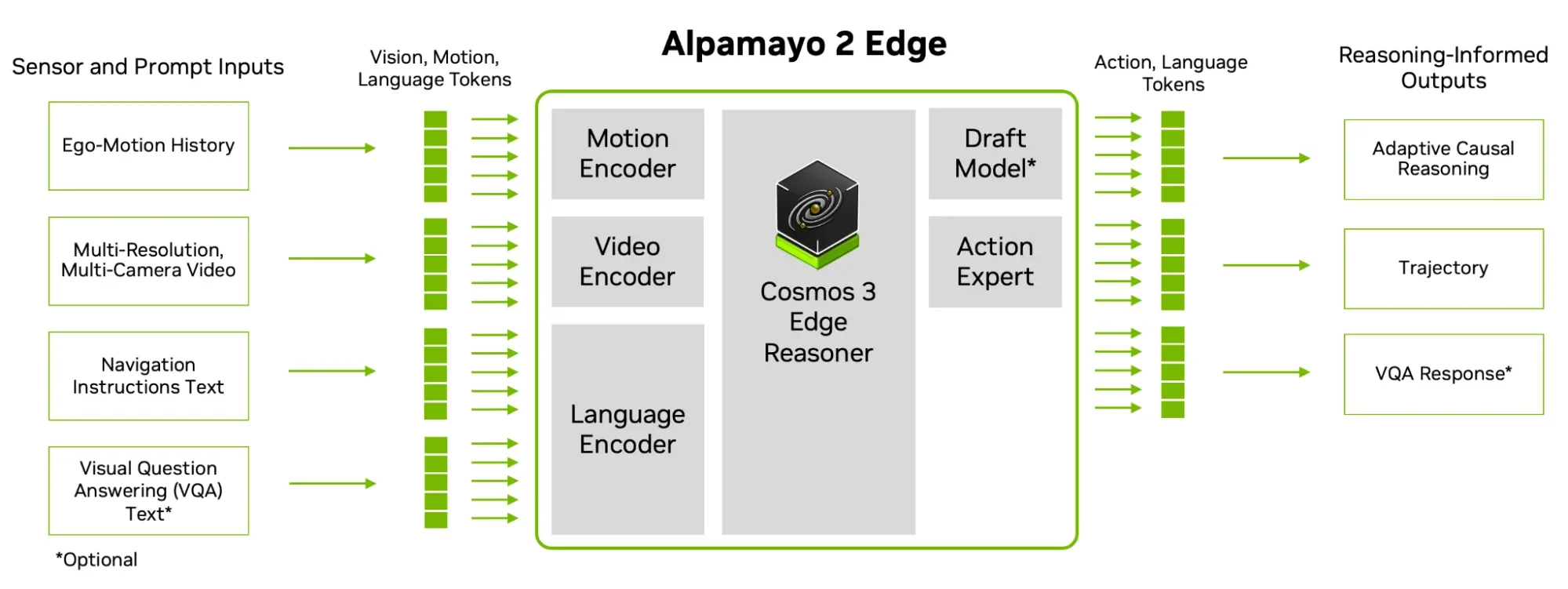
NVIDIA released Alpamayo 2 Edge on 10 November 2026 with model weights under the OpenMDW-1.1 licence on Hugging Face and Apache 2.0 inference code on GitHub, alongside the AlpaJudge reference-based and reference-free driving evaluators. Built on the Cosmos 3 Edge Nemotron vision-language backbone (2.45B parameters paired with a 0.2B diffusion action expert) and trained on roughly 115,000 hours of six-camera driving footage plus 3.7 million Chain-of-Causation traces, the model ingests 22 surround-camera frames, navigation text, and ego-motion history to output 6.4-second, 64-waypoint vehicle trajectories.
Alpamayo 2 Edge couples a 2.45B Cosmos 3 Edge VLM with adaptive reasoning tokens and a 0.2B action expert.Image: NVIDIA
Adaptive onboard reasoning and closed-loop RL
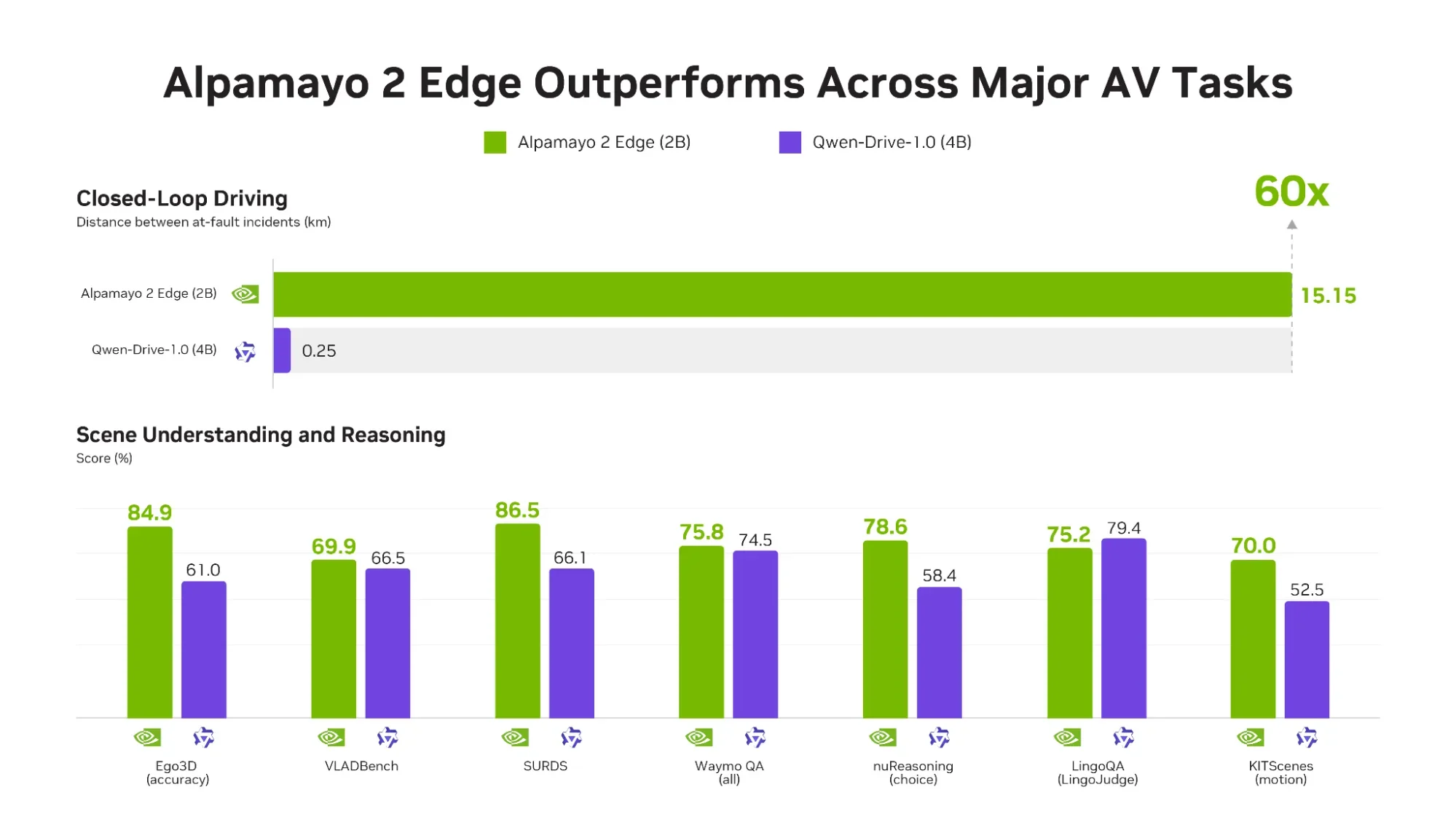
To stay within strict in-vehicle latency budgets, Alpamayo 2 Edge emits a single “NOMINAL” token during routine driving and invokes full Chain-of-Causation text reasoning only when complex hazards such as police hand signals or obstructed lanes appear. Quantised to FP8 with TensorRT Edge-LLM and accelerated via DFlash2 speculative decoding, end-to-endpixel-to-trajectory latency drops to 160 to 190 ms on a single NVIDIA DRIVE AGX Thor module. Closed-loop reinforcement learning in AlpaGym improved driving performance by 48.9% over supervised training alone.
Closed-loop AlpaSim driving safety and open-loop trajectory comparisons against Qwen-Drive-1.0 4B.Image: NVIDIA
Supporting 60 languages across batch and 128 ms streaming endpoints, MAI Transcribe 2 processes an hour of audio in 10 seconds with built-in diarisation and posts a 5.2% average word error rate on FLEURS.
Microsoft AI introduced MAI Transcribe 2 and MAI Transcribe 2 Streaming across 60 languages on 10 November 2026, alongside a personal browser playground supporting MP3 and WAV uploads up to 25 MB and 60 minutes. Batch MAI Transcribe 2 includes built-in speaker diarisation, word-level timestamps, multilingual code-switching, and domain keyword biasing at a promotional API rate of $0.10 per audio hour through the end of 2026, while MAI Transcribe 2 Streaming targets live voice agents at $0.54 per audio hour without diarisation, word timestamps, or keyword biasing.
Throughput and 60-language FLEURS accuracy
Microsoft’s benchmark charts are rendered as interactive HTML visualisations on the model page rather than downloadable images: across all 60 FLEURS languages, MAI Transcribe 2 records a 5.2% average word error rate in both forced and automatic language-detection modes, ahead of Gemini 3.1 Pro (5.3% and 5.8%), Gemini 3.5 Transcribe (5.9% and 8.6%), ElevenLabs Scribe v2 (6.2% and 6.5%), GPT-Transcribe (10.4% and 10.6%), and Whisper v3-large (22.8% and 23.5%).
Key numbers
$0.10 per audio hour promotional batch API price through 2026 ($0.54 per hour on MAI Transcribe 2 Streaming)
10 seconds to transcribe 1 hour of audio (403.6 speed factor, 10 times faster than GPT-Transcribe and 5 times faster than Gemini 3.5 Transcribe)
128 ms average model inference latency on MAI Transcribe 2 Streaming
3.4% average word error rate on top-25 FLEURS languages and 2.0% on the Artificial Analysis WER Index
Eligible organisations and Shopify merchants can claim verified Business Hub profiles, upload live product feeds and deploy labelled Business Agents across ChatGPT’s 1.2 billion weekly users.
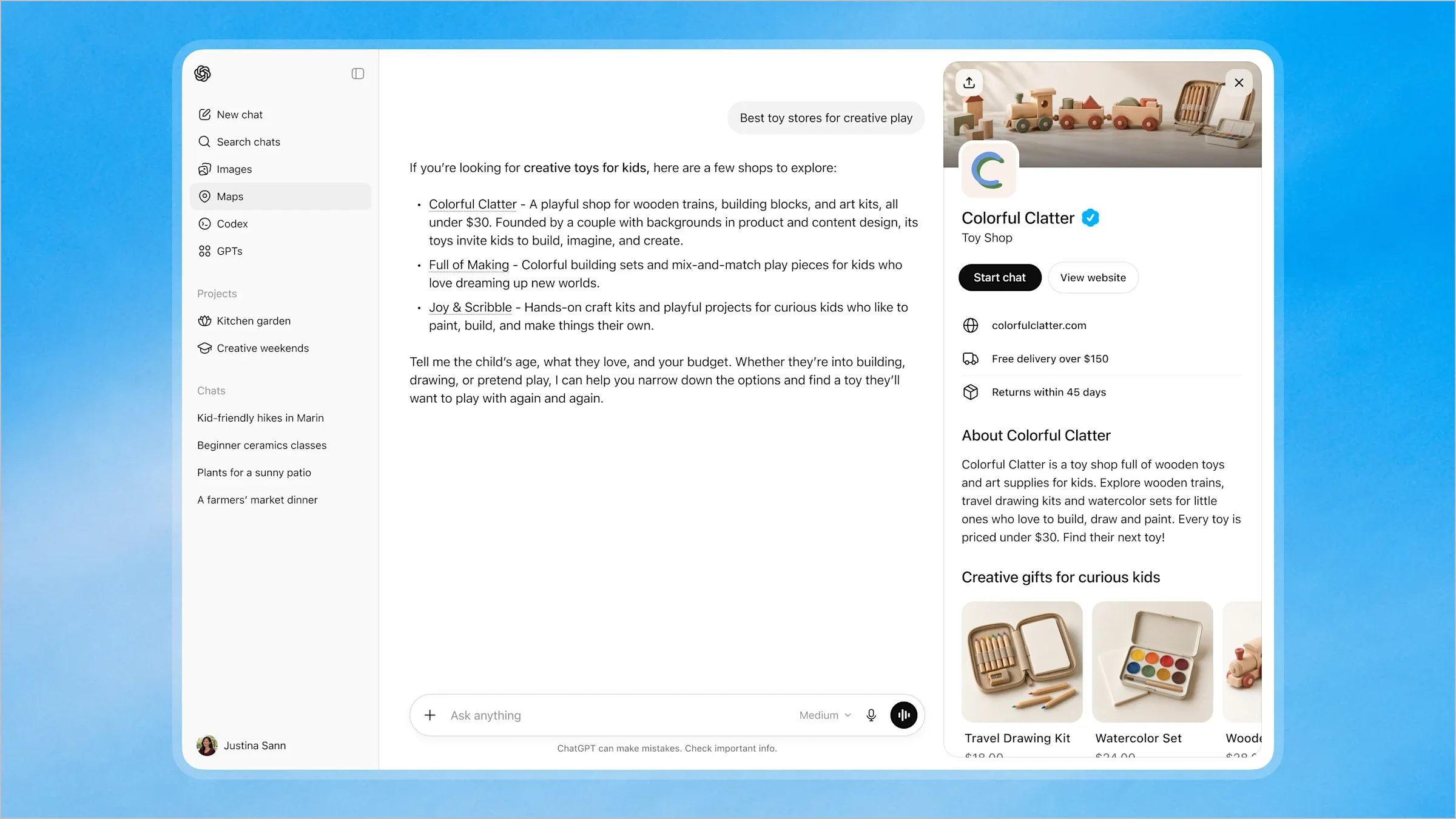
OpenAI launched Businesses in ChatGPT in beta on 10 November 2026, introducing Business Hub so companies can claim verified brand profiles across ChatGPT’s 1.2 billion weekly active users. Participating organisations, including Shopify merchants connecting directly from Shopify Admin through the Shopify Catalog, can publish self-service product feeds with real-time pricing and stock status and inspect privacy-thresholded analytics on brand mentions, outbound clicks, and discovery topics without accessing individual user chat transcripts.
Verified Business Profiles surface merchant-supplied product feeds and clearly labelled Business Agents inside ChatGPT.Image: OpenAI
Labelled Business Agents and third-party Business login
Eligible US e-commerce and online service brands can also build and sponsor clearly labelled Business Agents that open in a separate thread from ChatGPT’s organic answers and serve as destinations for ChatGPT Ads. Separately on 10 November 2026, OpenAI enabled Sign in with ChatGPT for ChatGPT Business subscribers across third-party developer and workspace tools including Notion, v0, Amp, Kilo Code, Warp, Nous Research’s Hermes, OpenClaw, and OpenCode.
Marking the first public preview from the Qwen4 generation, Qwen4-Max rolls out across Alibaba’s Token Plan, QwenWork, Qoder, the Qwen app and QwenStudio behind an OpenAI- and Anthropic-compatible API key.
Alibaba’s Qwen team opened early preview access to Qwen4-Max at 07:31 IST on 11 November 2026, introducing the first flagship model from its upcoming Qwen4 series. Positioned for multi-file software engineering, front-end builds, knowledge synthesis, and long-running agentic workflows, Qwen4-Max is available initially through Alibaba’s Token Plan subscription alongside QwenWork, Qoder, the Qwen mobile and web app, and QwenStudio.
Unified Token Plan tiers and coding tool compatibility
On QwenCloud, Token Plan bundles Qwen4-Max alongside Qwen and third-party text, vision, video, and speech models under a single API key supporting both OpenAI and Anthropic request protocols, allowing drop-in configuration inside Qwen Code, Claude Code, Cursor, Cline, Codex, OpenCode, Kilo CLI, and OpenClaw. Individual subscriptions span four tiers: Lite for 1 to 2 concurrent agents (from $6 per month standard, or $3 promotional first-month entry), Essential at 2.25 times Lite usage credits for 2 to 3 agents, Standard at 4 times Lite credits for 3 to 4 agents, and Pro at 10 times Lite credits for 6 to 8 concurrent agents. Qwen has not yet released parameter counts, context lengths, benchmark scores, or standalone pay-as-you-go token pricing for Qwen4-Max.
Proposing 825 million Class A shares under Nasdaq ticker ANT plus a 123.75 million-share underwriter option, Anthropic’s initial price range implies gross base offering proceeds of $57.75 billion to $64.35 billion.
Anthropic, PBC launched the investor roadshow for its proposed initial public offering on 10 November 2026, eight days after filing an amended S-1/A disclosing $16.96 billion in Q3 2026 revenue. Anthropic has applied to list its Class A common stock on the Nasdaq Global Select Market under the ticker symbol ANT, with Goldman Sachs & Co. LLC and Morgan Stanley & Co. LLC named on the preliminary prospectus while its SEC Form S-1 registration statement awaits effectiveness.
Share allocation and offering structure
The proposed base offering totals 825,000,000 shares of Class A common stock at an expected price range of $70 to $78 per share, split between 801,351,354 primary shares sold by Anthropic and 23,648,646 secondary shares offered by existing selling stockholders, from which Anthropic will receive no proceeds. Anthropic also expects to grant underwriters a 30-day option to purchase up to 123,750,000 additional Class A shares.
Key numbers
$70 to $78 per share expected initial public offering price range under proposed Nasdaq ticker ANT
825,000,000 base Class A shares (801,351,354 primary from Anthropic and 23,648,646 from selling stockholders)
123,750,000 additional Class A shares in the 30-day underwriter option (948,750,000 shares if exercised in full)
$57.75 billion to $64.35 billion in implied gross base offering proceeds before the underwriter option
Cursor rolled out multiplayer Projects in beta to all users on 10 November 2026, turning September’s single-user Projects into a shared team workspace where engineers, designers, and product managers work alongside their respective coordinator and worker agents across shared specs, architecture diagrams, persistent team memory, on-call handoffs, and cross-teammatemerge-conflict prevention.
ElevenLabs announced Scribe v3 and Scribe v3 Live on 10 November 2026, updating its batch and real-timespeech-to-text models for heavy background noise, pause-versus-sentence-end endpoint detection, and multi-speaker meeting tracking; ElevenLabs did not publish benchmark tables or updated per-hour API rates in the launch post.