


RoboticsNVIDIAConfirmed
Story 7 of 13 in the Tuesday 10 November editionNVIDIA open-sources Alpamayo 2 Edge reasoning model for onboard autonomous driving
Combining a 2.45B Cosmos 3 Edge backbone with adaptive Chain-of-Causation tokens and DFlash2 speculative decoding, Alpamayo 2 Edge plans trajectories in 160 to 190 ms on NVIDIA DRIVE AGX Thor.

 Edited by Ashutosh Shrivastava
11 Nov 2026, 09:20 IST · 3 min read
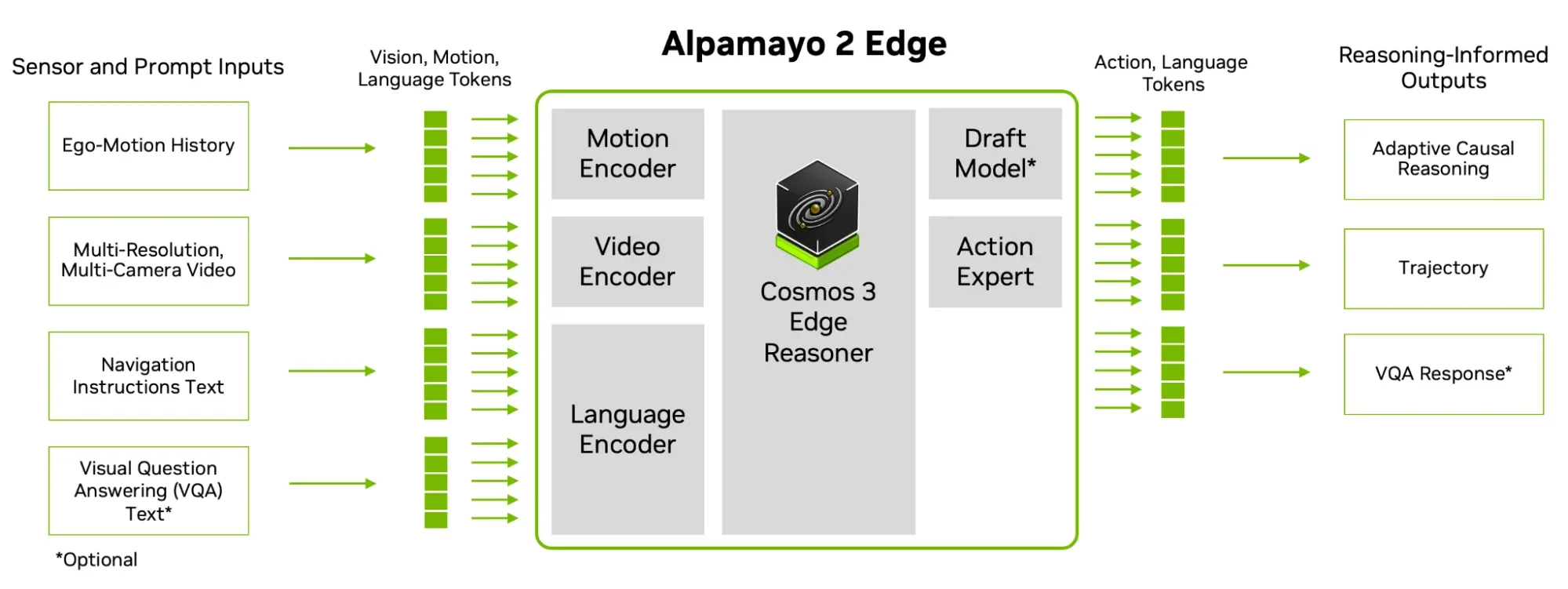
NVIDIA released Alpamayo 2 Edge on 10 November 2026 with model weights under the OpenMDW-1.1 licence on Hugging Face and Apache 2.0 inference code on GitHub, alongside the AlpaJudge reference-based and reference-free driving evaluators. Built on the Cosmos 3 Edge Nemotron vision-language backbone (2.45B parameters paired with a 0.2B diffusion action expert) and trained on roughly 115,000 hours of six-camera driving footage plus 3.7 million Chain-of-Causation traces, the model ingests 22 surround-camera frames, navigation text, and ego-motion history to output 6.4-second, 64-waypoint vehicle trajectories.
Adaptive onboard reasoning and closed-loop RL
To stay within strict in-vehicle latency budgets, Alpamayo 2 Edge emits a single “NOMINAL” token during routine driving and invokes full Chain-of-Causation text reasoning only when complex hazards such as police hand signals or obstructed lanes appear. Quantised to FP8 with TensorRT Edge-LLM and accelerated via DFlash2 speculative decoding, end-to-end pixel-to-trajectory latency drops to 160 to 190 ms on a single NVIDIA DRIVE AGX Thor module. Closed-loop reinforcement learning in AlpaGym improved driving performance by 48.9% over supervised training alone.
Key details
- Parameter split
- 2.45B Cosmos 3 Edge VLM (1.96B LLM, 0.41B SigLIP2, 0.08B projector) plus 0.2B action expert (5.3 GB BF16)
- Sensor and output horizon
- 22 six-camera frames plus 20 ego poses (0.1 s steps) generating 6.4-second, 64-waypoint trajectories
- DRIVE AGX Thor latency
- 160 to 190 ms end-to-end with FP8 TensorRT Edge-LLM quantisation and DFlash2 speculative decoding
- Closed- and open-loop scores
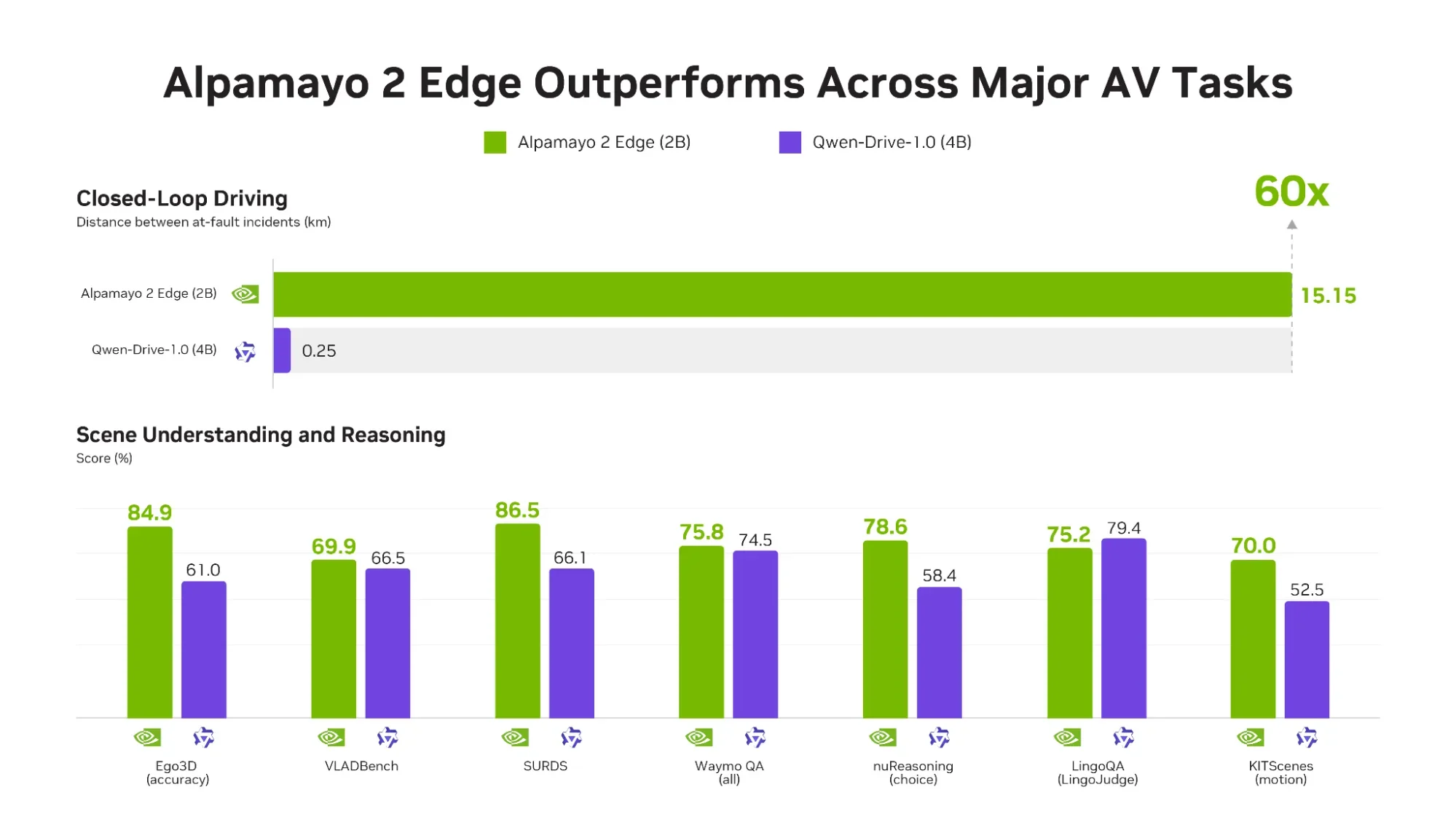
- 15.15 km per at-fault incident in AlpaSim (875 NuRec scenarios) and 0.52m minADE_6 at 5s on PhysicalAI-AV
- Licences and evaluators
- OpenMDW-1.1 weights on Hugging Face, Apache 2.0 code on GitHub and AlpaJudge driving evaluators
Release details & context
Camera frame scheduling, VQA benchmarks and early AV partner integrations
In NVIDIA’s Alpamayo 2 Edge engineering blog, nvidia/Alpamayo2-Edge model card and NVlabs/alpamayo2-edge repository, each planning cycle reads 5 historical frames from the front wide and telephoto cameras plus 3 frames each from four cross and rear cameras (or up to 24 frames in freeform VQA mode) and integrates unicycle kinematics across 10 diffusion steps, extending NVIDIA’s compact edge lineup alongside Nemotron 3.5 Bolt E4B and GR00T 2.
Across driving comprehension benchmarks, Alpamayo 2 Edge scores 75.2 on LingoQA, 84.94 on Ego3D, 69.94 on VLADBench, 86.50 on SURDS and 75.77 on WaymoQA (71.09 on safety-critical subsets). Early partners include PORT (running 2 times faster than Alpamayo 1.5), Niulinx (cutting minADE by 44.2% after fine-tuning) and Embedl (deploying at 10 Hz on DRIVE AGX Thor in under 48 hours), while local testing targets Python 3.12, PyTorch 2.8.0 and 16 GB+ GPUs.
Common questions
How does Alpamayo 2 Edge keep onboard latency below 200 ms on NVIDIA DRIVE AGX Thor?
During routine driving it emits a single NOMINAL token instead of full causal text traces, pairs FP8 TensorRT Edge-LLM quantisation with DFlash2 speculative decoding, and triggers Chain-of-Causation text only on ambiguous road hazards.
Under which licences are Alpamayo 2 Edge weights and inference code distributed?
Model weights ship on Hugging Face under the OpenMDW-1.1 licence while inference code on GitHub is licensed under Apache 2.0.
Sources
- PrimaryRunning AV Reasoning Models Within Onboard Compute and Latency Limitsdeveloper.nvidia.com
- Officialnvidia/Alpamayo2-Edge on Hugging Facehuggingface.co/nvidia
- OfficialNVlabs/alpamayo2-edge on GitHubgithub.com/NVlabs
- On XNVIDIA (@nvidia) launch announcement on Xx.com
NVIDIA release timeline (10 launches tracked)
- NVIDIA releases Nemotron 3.5 Bolt E4B, a 4GB open model for edge agents
NVIDIA released Nemotron 3.5 Bolt E4B 4GB, ranking first among small models on Scale AI’s MultiChallenge at 56.03% with up to 80% fewer reasoning tokens.
- NVIDIA launches SimReady Central Library with over 2,000 OpenUSD 3D assets on Hugging Face
NVIDIA launched SimReady Central Library on Hugging Face with more than 2,000 physics-ready OpenUSD 3D assets from robotics and industrial equipment makers.
- NVIDIA releases open-weight Nemotron 3.5 Transcribe speech model and Granary v2 pipeline
NVIDIA’s open-weight Nemotron 3.5 Transcribe tops the Hugging Face Open ASR English Leaderboard at 5.33% WER with 4.3B active parameters per token.
- NVIDIA introduces GR00T 2 world-action robotics model and releases 100k hours of human video
NVIDIA unveils the GR00T 2 world-action model trained on 402,730 hours of human video and open-sources the 100,000-hour Human-1M-100K dataset on Hugging Face.