


Open sourceMiniMaxConfirmed
Story 6 of 13 in the Tuesday 10 November editionMiniMax releases open-weight H3-Image for 10-second native 4K generation
Distilled to six diffusion steps without classifier-free guidance on a 33.1B single-stream transformer, MiniMax-H3-Image generates native 16-megapixel images and edits up to 16 reference pictures under open weights.

 Edited by Ashutosh Shrivastava
11 Nov 2026, 09:20 IST · 3 min read
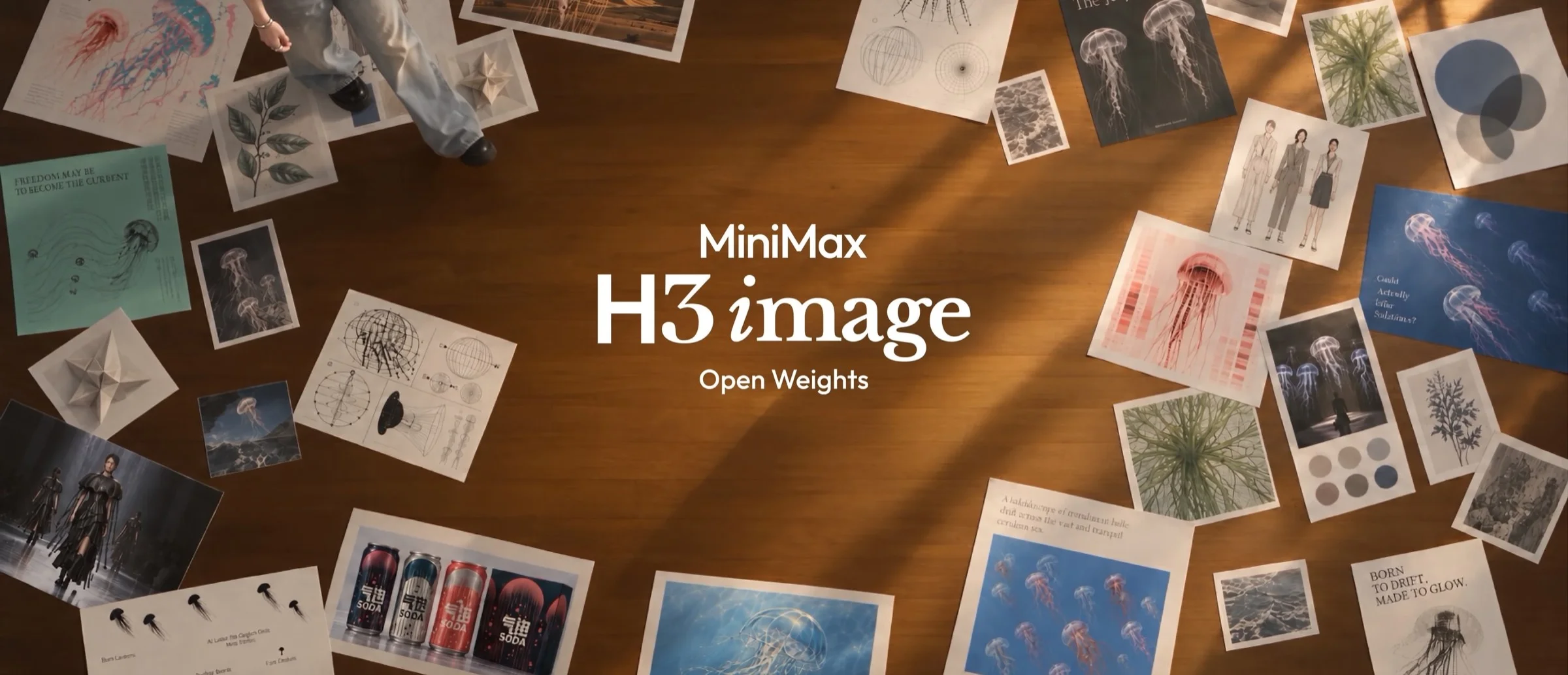
MiniMax released MiniMax-H3-Image on 10 November 2026 under the MiniMax H3 Image Community Licence on Hugging Face, alongside hosted endpoints (MiniMax-H3-Image and MiniMax-H3-Image-Highspeed) on the MiniMax API Platform, MiniMax Code, and Hailuo AI. Built on MiniMax H3, the unified generation and editing architecture pairs a 33.1B-parameter BF16 single-stream Diffusion Transformer (68.65 GB) with a Qwen3-VL text encoder, a 2D ViT image autoencoder, and an optional 17.9 GB NVFP4 local prompt expander.
Six-step native 4K synthesis and launch pricing
Distilled to 6 function evaluations without classifier-free guidance, H3-Image renders native 16-megapixel images from 4096x4096 (1:1) to 6272x2688 (21:9), and up to 20 megapixels via API, without a separate upscaling stage while conditioning on 1 to 16 reference images for character consistency and bilingual typography. Local inference runs out of the box on SGLang, vLLM-Omni, Diffusers, and ComfyUI.
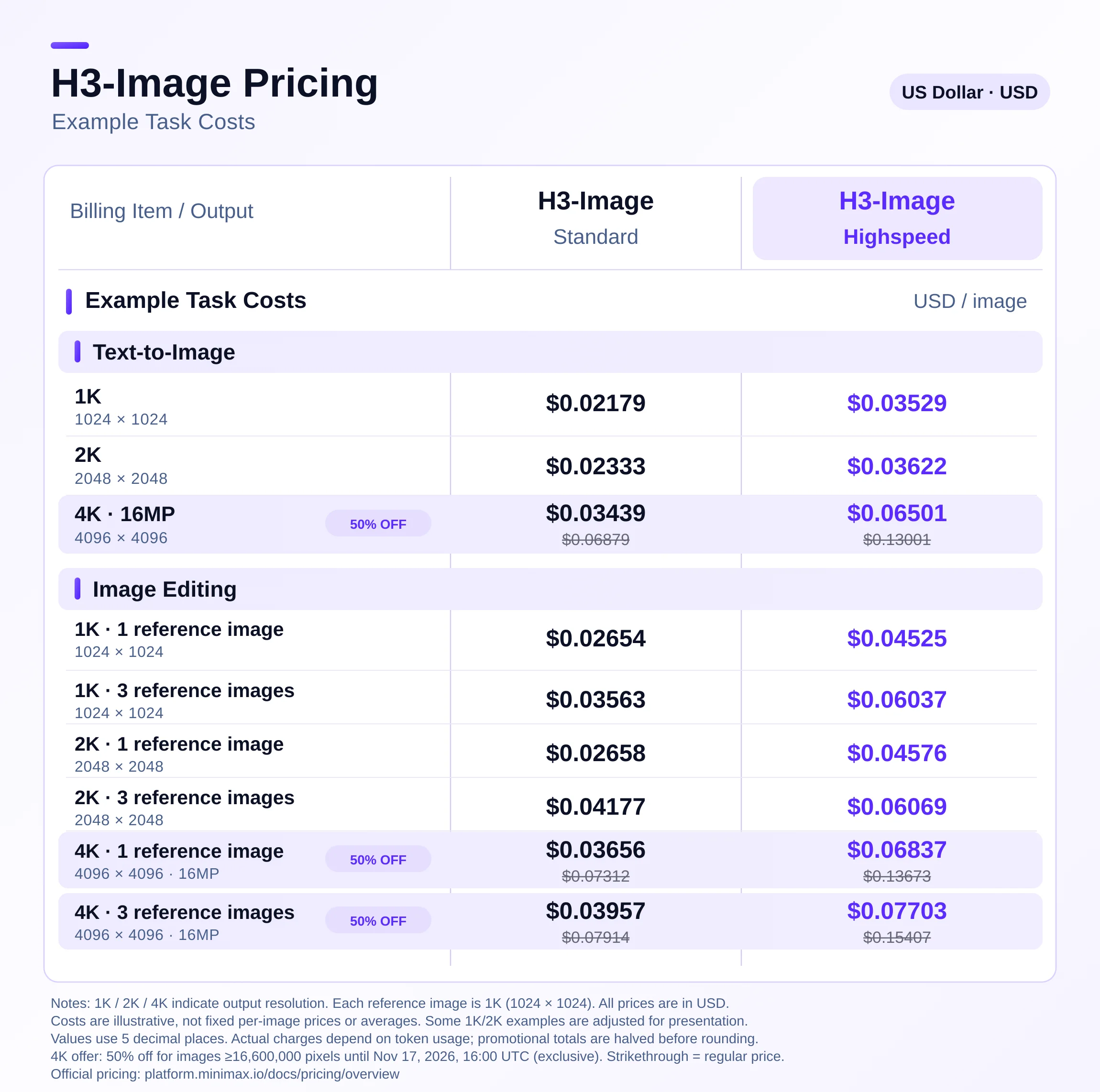
Through 17 November 2026 at 16:00 UTC, MiniMax is discounting API tasks at or above 16.6 megapixels by 50%.
Technical details
- Backbone and encoders
- 33.1B single-stream DiT (50 layers, 66.28 GB BF16) with Qwen3-VL encoder (layer 50) and 2D ViT VAE (24 layers)
- Sampling and resolutions
- 6 CFG-free steps across 655,360 to 20,000,000 pixels (1:3 to 3:1 aspect ratio, up to 7104x2368 via API)
- Reference image limits
- 1 to 16 input images (128 to 8192 px, up to 64 MiB in JPG, PNG, WEBP, HEIC or HEIF); 1 to 10 outputs per call
- 4K latency and promo rates
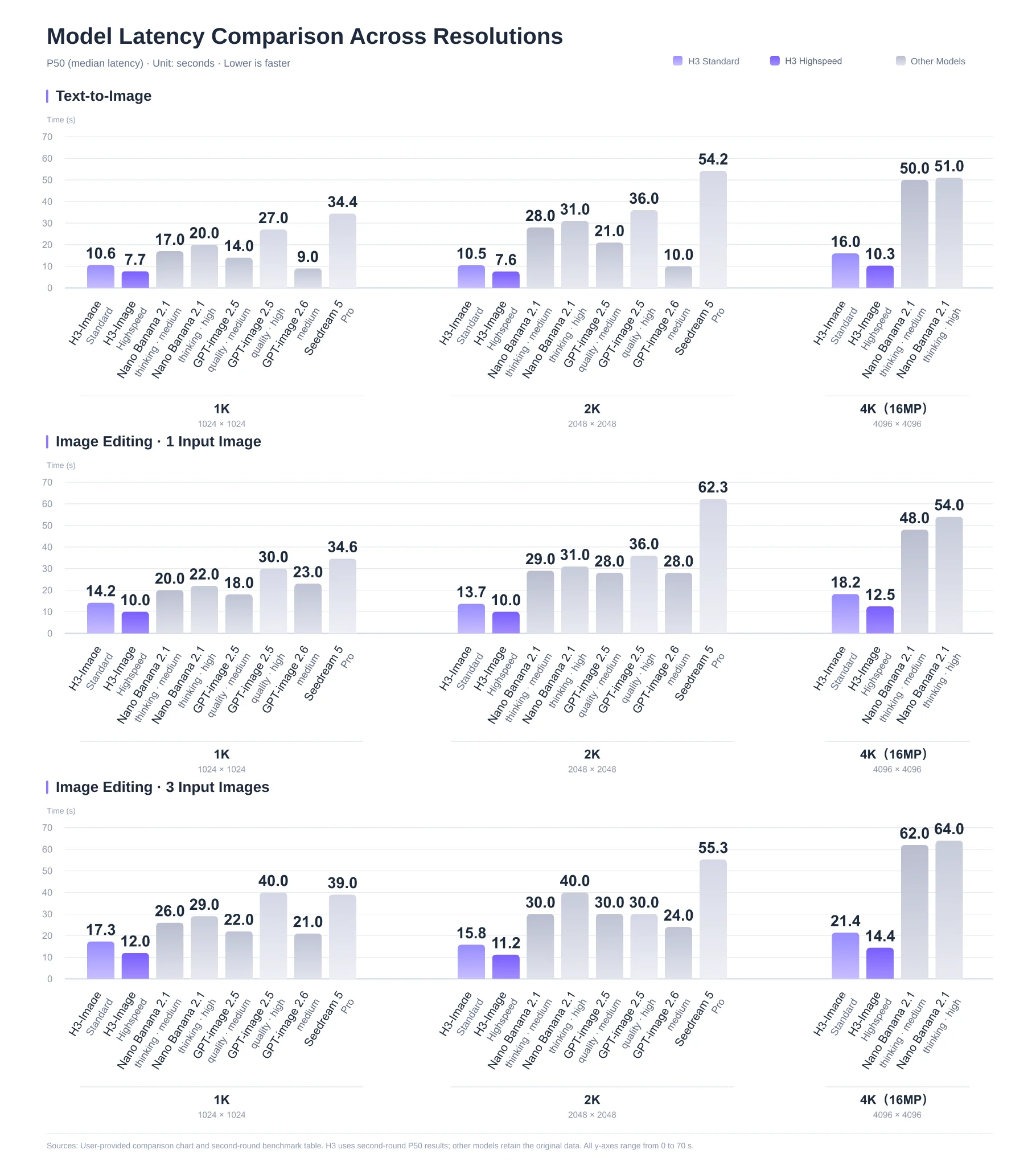
- 16.0s P50 ($0.03439) on Standard and 10.3s P50 ($0.06501) on Highspeed with 50% discount until 17 November 2026
- Licence and local engines
- MiniMax H3 Image Community Licence on Hugging Face for SGLang, vLLM-Omni, Diffusers and ComfyUI
Release details & context
Single-stream DiT geometry, API endpoints and current feature boundaries
Detailed on the MiniMaxAI/MiniMax-H3-Image model card and MiniMax API image generation docs, H3-Image adapts the H3-Base transformer (hidden size 5376, 56 attention heads, FFN size 14336 and 3D multimodal RoPE) paired with a 2.34 GB FP32 2D ViT VAE (16 times spatial compression, 32x32 pixels per token) and layer 50 of the 66.7 GB Qwen3-VL encoder, expanding MiniMax’s multimodal stack after MiniMax M3.1 Flash.
Developers call POST /v1/images/generations, POST /v1/images/edits and the H3-Image-Context-IR prompt expander (accepting prompts up to 32000 characters, or 4096 tokens when enhancement is disabled) for jpeg, png or webp outputs. Unlike ByteDance Seed’s Seedream 5.5, H3-Image does not yet support transparent alpha backgrounds, masked region edits or intermediate preview frames.
Common questions
Does MiniMax-H3-Image support transparent RGBA backgrounds or masked inpainting?
No, the MiniMax API documentation notes that transparent background generation, masked region editing and intermediate preview frames are unsupported in the 10 November 2026 release.
How fast are the Standard and Highspeed MiniMax-H3-Image endpoints at native 4K?
At native 4K resolution, MiniMax-H3-Image-Highspeed posts a 10.3s median P50 latency ($0.06501 promotional price) while Standard posts 16.0s P50 ($0.03439 promotional price through 17 November 2026 at 16:00 UTC).
Sources
- PrimaryMiniMax H3-Image official release postminimax.io
- OfficialMiniMaxAI/MiniMax-H3-Image on Hugging Facehuggingface.co/MiniMaxAI
- OfficialMiniMax API image generation guideplatform.minimax.io
- On XMiniMax (@MiniMax_AI) launch post on Xx.com
MiniMax release timeline (2 launches tracked)
- MiniMax releases MiniMax-M3.1-Flash with a 1M-token context window
MiniMax’s MiniMax-M3.1-Flash offers a 1M-token context at $0.15 per million input tokens.