


ResearchOpenAIConfirmed
Story 4 of 13 in the Friday 20 November editionOpenAI details GPT-6.2 Astra anti-distillation reasoning defences
Conversation-bound encrypted reasoning, streaming tool-call leak classifiers and automated red-teaming cut adaptive extraction to 0.2% across GPT-6.2 Astra and Sol.

 Edited by Ashutosh Shrivastava
21 Nov 2026, 08:30 IST · 3 min read
OpenAI published safety and security research on 20 November 2026 detailing how it detects and disrupts unauthorised adversarial distillation across GPT-6.2 Astra and GPT-6.2 Sol. In controlled teacher-student experiments trained on benign coding and defensive cybersecurity trajectories, student models fine-tuned on exact Astra-level chain-of-thought traces outperformed students trained only on user-visible reasoning summaries at the highest evaluation compute budgets after reinforcement learning, showing that raw reasoning traces transfer dual-use cyber skills.
Request-level classifiers, conversation-bound reasoning and campaign enforcement
OpenAI combines adversarial refusal training with streaming and non-streaming input and output classifiers that inspect both assistant replies and tool-call arguments for leaked reasoning before payloads reach the caller. At the API layer, GPT-6.2 Astra and Sol bind encrypted reasoning strictly to the conversation history that produced it: rewriting an earlier message drops downstream reasoning, cross-workspace encrypted token replay is blocked, and older model families cannot read GPT-6.2 traces.
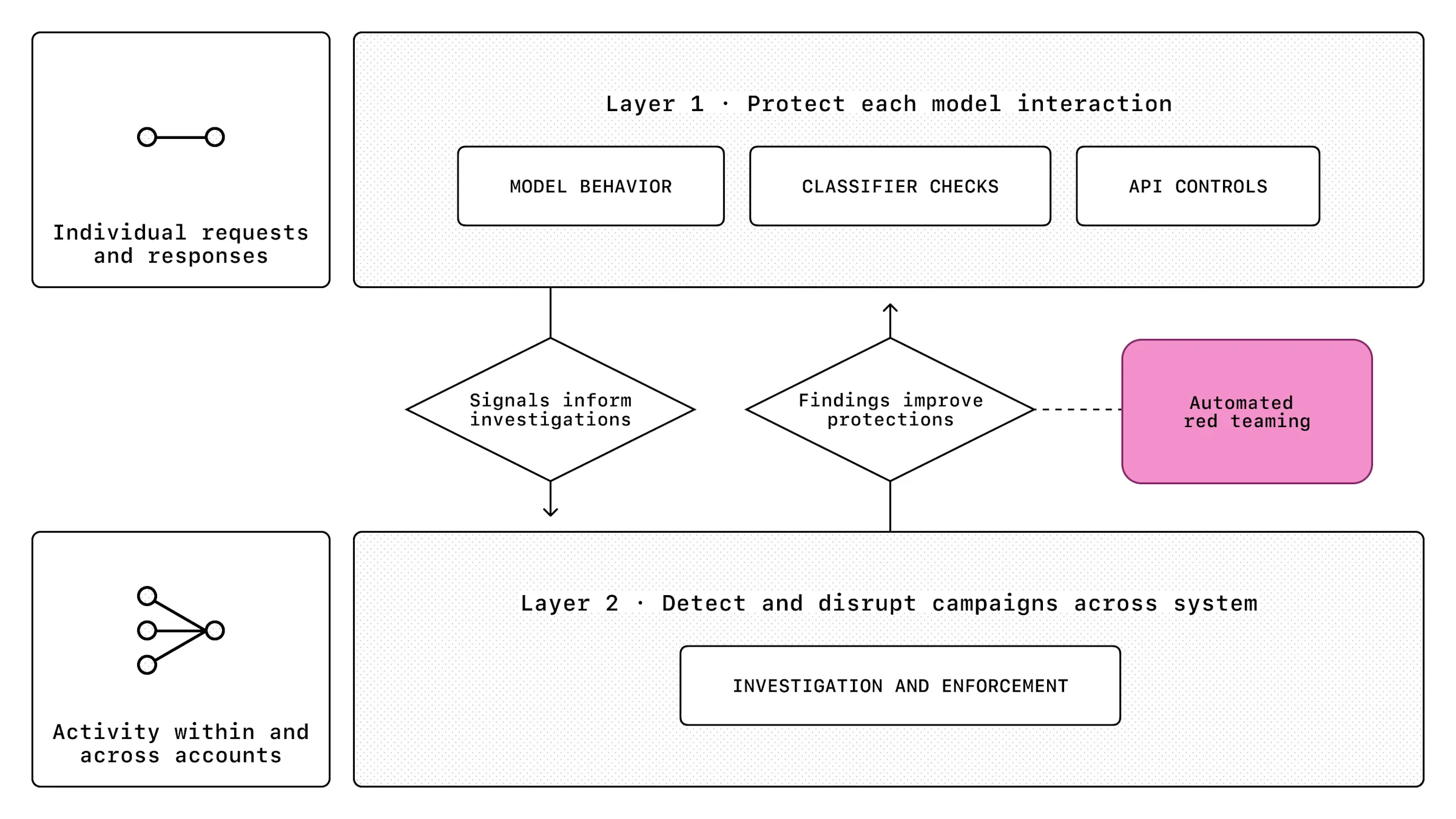
Across six automated attacker models in adaptive black-box red-teaming, average protected-reasoning extraction success dropped from 54.0% on GPT-6 Astra with original safeguards to 0.2% on GPT-6.2 Astra (and below 1% on both earlier-turn and current-turn extraction), with selected upgrades backported to GPT-6 Astra. OpenAI reported weekly enforcement actions spanning thousands to tens of thousands of accounts, cited prior DeepSeek and Moonshot AI attributions, and endorsed the US Chip Security, AI OVERWATCH and MATCH Acts.
Study details
- Adaptive black-box extraction ASR
- 0.2% on GPT-6.2 Astra with updated safeguards, down from 54.0% on GPT-6 Astra original safeguards
- Request-level safeguard stack
- Adversarial refusal training, streaming input/output and tool-argument classifiers, history-bound reasoning
- API reasoning isolation rules
- Rewriting prior turns drops subsequent reasoning; cross-user replay and older-model reads blocked
- Weekly enforcement scale
- Thousands to tens of thousands of accounts disrupted per week, plus Frontier Model Forum IOC sharing
Release details & context
September encrypted-reasoning replay vector and compute-budget crossover
OpenAI noted that its API boundary hardening closes an attack class disclosed in September 2026 in which adversaries copied encrypted reasoning objects from one conversation into another session and prompted the model to decode them into plaintext, complementing OpenAI’s prefix-tied GPT-6.2 Responses API reasoning controls.
In the cyber distillation study, student models trained only on user-visible summaries actually scored higher at low evaluation token budgets after reinforcement learning, whereas students trained on exact teacher chain-of-thought transcripts pulled ahead at the largest inference compute budgets on both cybersecurity benchmarks.
Common questions
Why does OpenAI run output classifiers on tool-call arguments as well as assistant text?
A model can leak protected chain-of-thought steps inside structured tool-call parameters without printing them in its final user-visible reply, so output classifiers inspect both streams before returning data.
What happens in the OpenAI API if a developer edits an earlier message in a GPT-6.2 Astra thread?
Because protected reasoning is cryptographically tied to the exact message history that generated it, editing an earlier turn automatically drops all reasoning states that followed that message.
Editor’s weekly perspective
Benchmarks, science, defences and legal oversight: Cuts adaptive chain-of-thought extraction success from 54.0% on GPT-6 Astra to 0.2% via conversation-bound encryption.
Sources
- PrimaryOpenAI: Combatting adversarial distillationopenai.com
- On XOpenAI (@OpenAI) anti-distillation research announcement on Xx.com
OpenAI release timeline (59 launches tracked)
- OpenAI details Codex Performance Factory keeping ChatGPT fast
OpenAI details Performance Factory, its cloud Codex system running 17 automated ChatGPT regression investigations per day.
- OpenAI ties GPT-6.2 Responses API reasoning to prompt prefix
OpenAI binds GPT-6.2 Responses API reasoning items to preceding conversation prefixes for higher cache hit rates and lower token use.
- OpenAI brings ChatGPT dots to Business Standard and Plus test
OpenAI rolls out proactive ChatGPT dots agents to all Business Standard workspaces and starts testing with a small cohort of Plus users.
- OpenAI expands ChatGPT Health to desktop, Android and Sites
OpenAI expands ChatGPT Health in the US to desktop, Android Health Connect, ChatGPT Sites and proactive Pro dots suggestions.