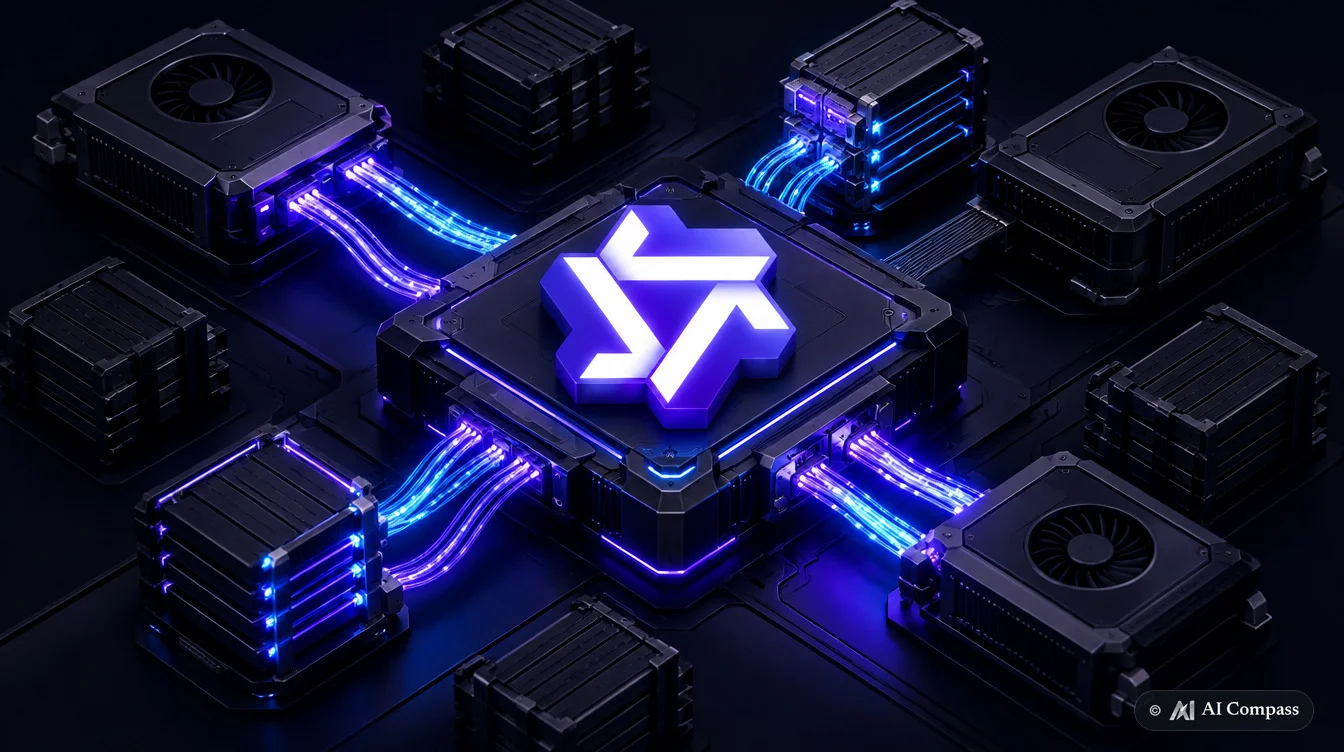
Thinking Machines Lab released Inkling 2 Mini (thinkingmachines/Inkling-2-Mini) on 20 November 2026 under an Apache 2.0 licence on Hugging Face alongside hosted inference and fine-tuning on Tinker, following Thinking Machines Lab’s 594B Inkling 2 Small release. Designed as a 24-layer multimodal Mixture-of-Experts looped transformer accepting text and images across a 1M-token context window, the model holds 26.4B total parameters and routes each token to 8 of 128 experts for 3.4B unique active weights. Running its two middle six-layer blocks three times with gated attention residuals yields 48 layer applications and 5.4B effective active parameters per token.
Native NVFP4 laptop deployment, agentic benchmarks and loop monitorability
Trained natively in 4-bit NVFP4 across 20 expert layers and 8-bit MXFP8 on the final four layers, the single 20GB checkpoint runs without post-training quantisation loss on Apple Silicon Macs with 32GB memory, NVIDIA DGX Spark systems or 32GB GPUs via NVIDIA Dynamo, llama.cpp, Unsloth, Ollama and Exo Labs. Mid-training pruned two-thirds of the initial 384 experts before healing on 1T distilled tokens and running 2.2T tokens of reinforcement learning.
All 20 autonomous residents in Thinkyville run simultaneously offline on one MacBook powered by Inkling 2 Mini via Ollama.Video: Thinking Machines Lab
Inkling 2 Mini scores 20.1 on Artificial Analysis Index v5.0 and leads open-weight models below 100B parameters on DeepSWE v1.1 (48.2%), Vals Index v2.2 (46.5%), SWE-bench Pro v2 Hard (77.9%) and SWE-bench Verified bash-only (79.2%). Alongside the main checkpoint, Thinking Machines Lab released TML-d24-varloop-research on Hugging Face to test chain-of-thought monitorability across one to five loop passes. Thinking Machines Lab has not announced per-token Tinker API pricing.
Live on Hugging Face, ModelScope and GitCode on 20 November 2026 alongside pre-trainedHy4-base, a 3.3B DFly2 drafter and 1M context under the Tencent Hy License.
Tencent’s Hy Team published open weights for its flagship Hy4 instruct model (tencent/Hy4), FP8-quantisedHy4-FP8, pre-trainedHy4-base and an end-to-end test GGUF build on 20 November 2026 across Hugging Face, ModelScope and GitCode. The release fulfils the open-weight pledge from Tencent’s 4 November Hy4 API launch and follows 220B open-weightHy4-flash. Its 78-layer language backbone pairs one dense layer with 77 Mixture-of-Experts layers totalling 770B parameters, activating top-8 of 256 routed experts plus one shared expert for 49B active text parameters and 1.23B vision parameters per token across a 1,048,576-token context window.
Gated DeepSeek Sparse Attention, DFly2 zero-KV drafting and serving images
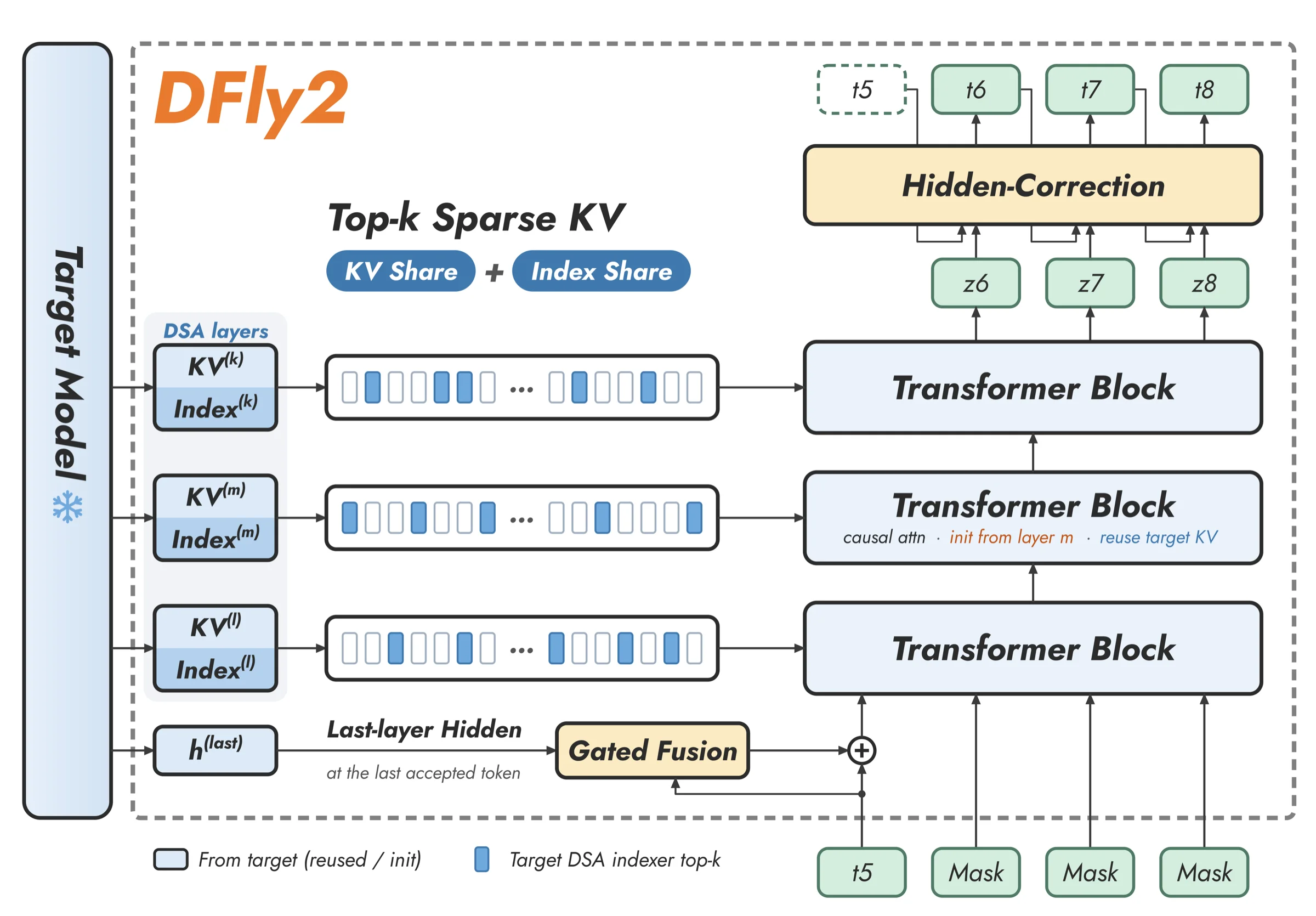
Hy4 combines Multi-head Latent Attention with Gated DeepSeek Sparse Attention, selecting the top 2,048 tokens per step and reusing sparse indices across layers via IndexCache alongside four-stream identity Hyper-Connections. Built directly onto the backbone is DFly2, a five-layer, 3.3B-parameter speculative-decoding drafter trained with AngelSpec that shares Hy4’s KV cache and top-2,048 sparse positions so each draft token attends to roughly 2,000 keys with zero extra KV memory.
DFly2 reuses Hy4’s top-2,048 sparse KV cache and indexer positions across draft layers at constant compute and zero extra KV memory.Image: Tencent
Tencent ships prebuilt multi-arch Docker containers (vllm/vllm-openai:hy4 and lmsysorg/sglang:hy4), its AngelSlim compression suite and the Hy4 System Card under the Tencent Hy License, which requires separate commercial licensing above $50 million in annual MaaS revenue or 100 million monthly active users.
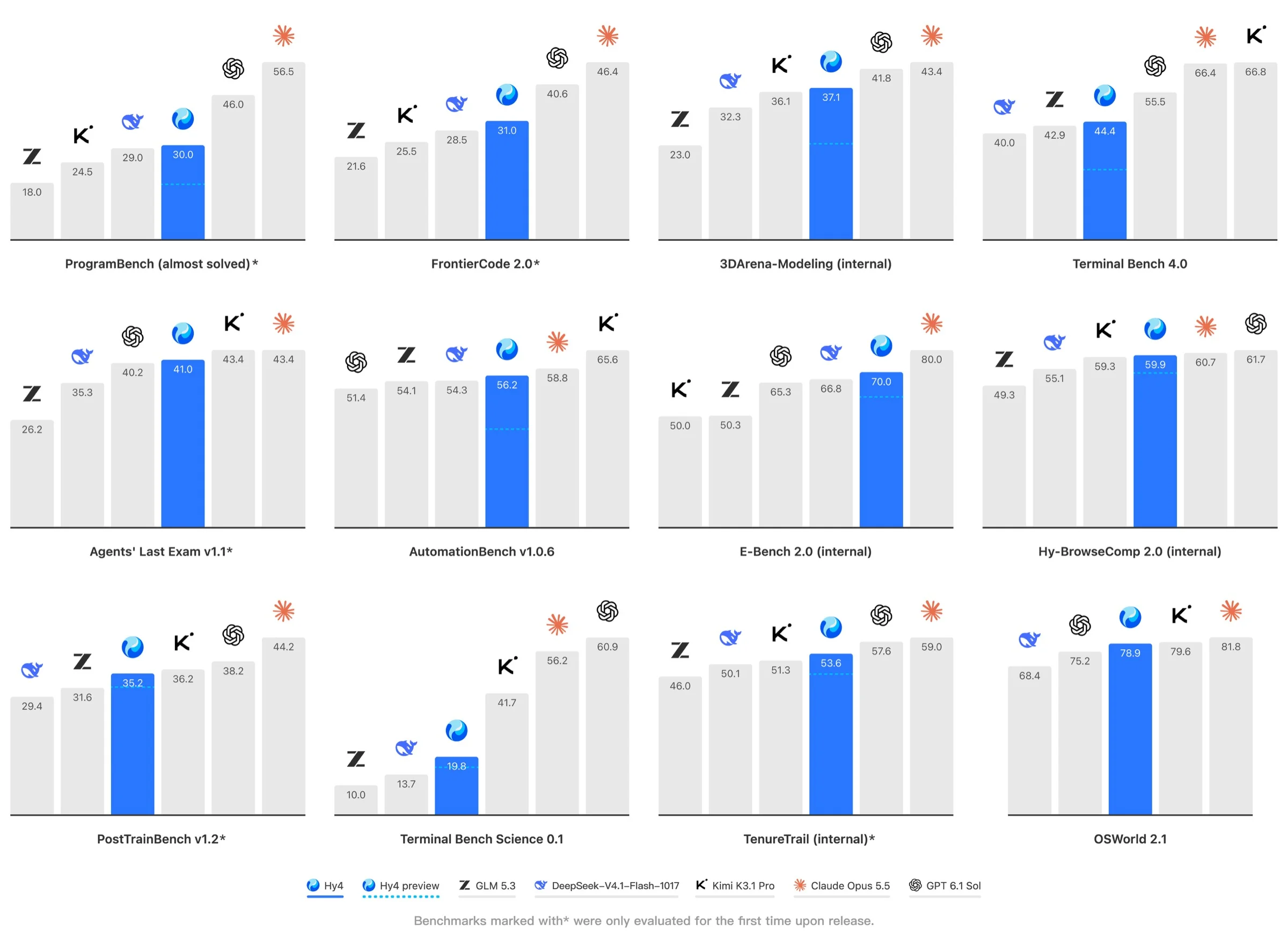
Hy4 scores 78.9 on OSWorld 2.1, 70.0 on E-Bench 2.0 and 44.4 on Terminal Bench 4.0 against open-weight and proprietary peers.Image: Tencent
Live on 20 November 2026 across macOS, Linux and Windows CLI sessions with Nano and Pro 3D tiers bundled into Muse Code plans starting at $5 per month.
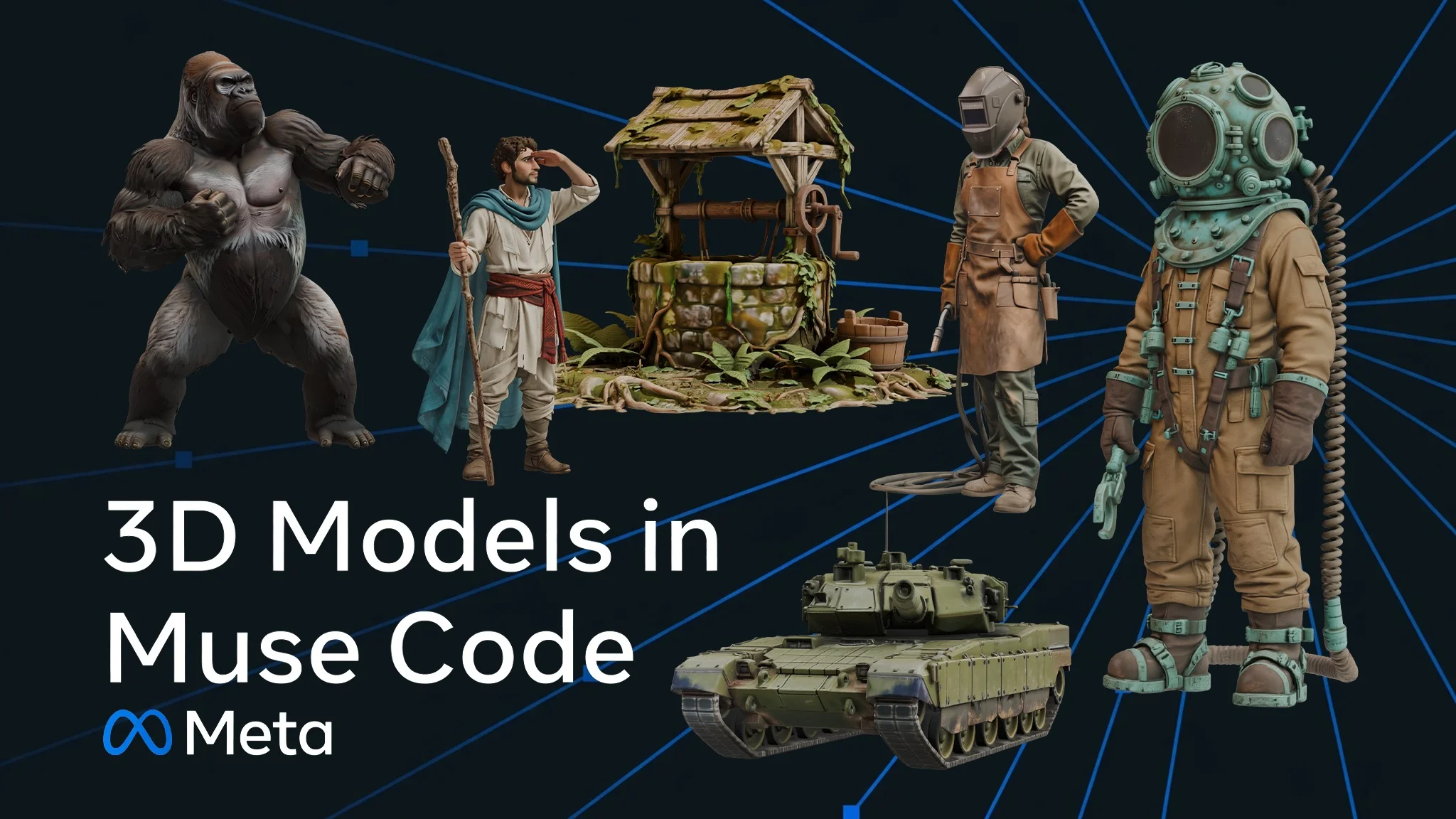
Meta launched native 3D modelling capabilities inside its Muse Code CLI coding agent on 20 November 2026 across macOS, Linux and Windows (installed via dev.meta.ai/install.sh). Muse Wonder, Muse Spark and Muse Ember can invoke built-in 3D tool calls alongside Muse Image inside an active coding session, turning text descriptions or single reference images into textured GLB meshes saved straight into the developer’s repository for games, 3D printing or web visualisations.
Nano and Pro 3D quality tiers, five-hour plan allowances and character rigging
3D asset generation draws from existing Muse Code subscription quotas without external 3D plugins or separate third-party subscriptions. Subscribers on the $5-per-month Everyday Usage plan generate roughly 30 textured 3D models per five-hour window using the faster Nano 3D model, while High Usage ($15, 5 times Everyday capacity), Power Usage ($50, 20 times capacity plus Muse Wonder Full) and Maximum Usage ($200, 80 times capacity) plans raise 3D volume limits and add the higher-resolution Pro 3D setting.
Meta noted that Muse Code does not include a built-in tool call for skeletal rigging or character animation, publishing a prompt workflow that pairs Muse Wonder Full with Mesh2Motion human skeletons and Blender automatic weights alongside downloadable Dungeon Crawler and 3D web viewer sample projects.
Conversation-bound encrypted reasoning, streaming tool-call leak classifiers and automated red-teaming cut adaptive extraction to 0.2% across GPT-6.2 Astra and Sol.
OpenAI published safety and security research on 20 November 2026 detailing how it detects and disrupts unauthorised adversarial distillation across GPT-6.2 Astra and GPT-6.2 Sol. In controlled teacher-student experiments trained on benign coding and defensive cybersecurity trajectories, student models fine-tuned on exact Astra-levelchain-of-thought traces outperformed students trained only on user-visible reasoning summaries at the highest evaluation compute budgets after reinforcement learning, showing that raw reasoning traces transfer dual-use cyber skills.
Request-level classifiers, conversation-bound reasoning and campaign enforcement
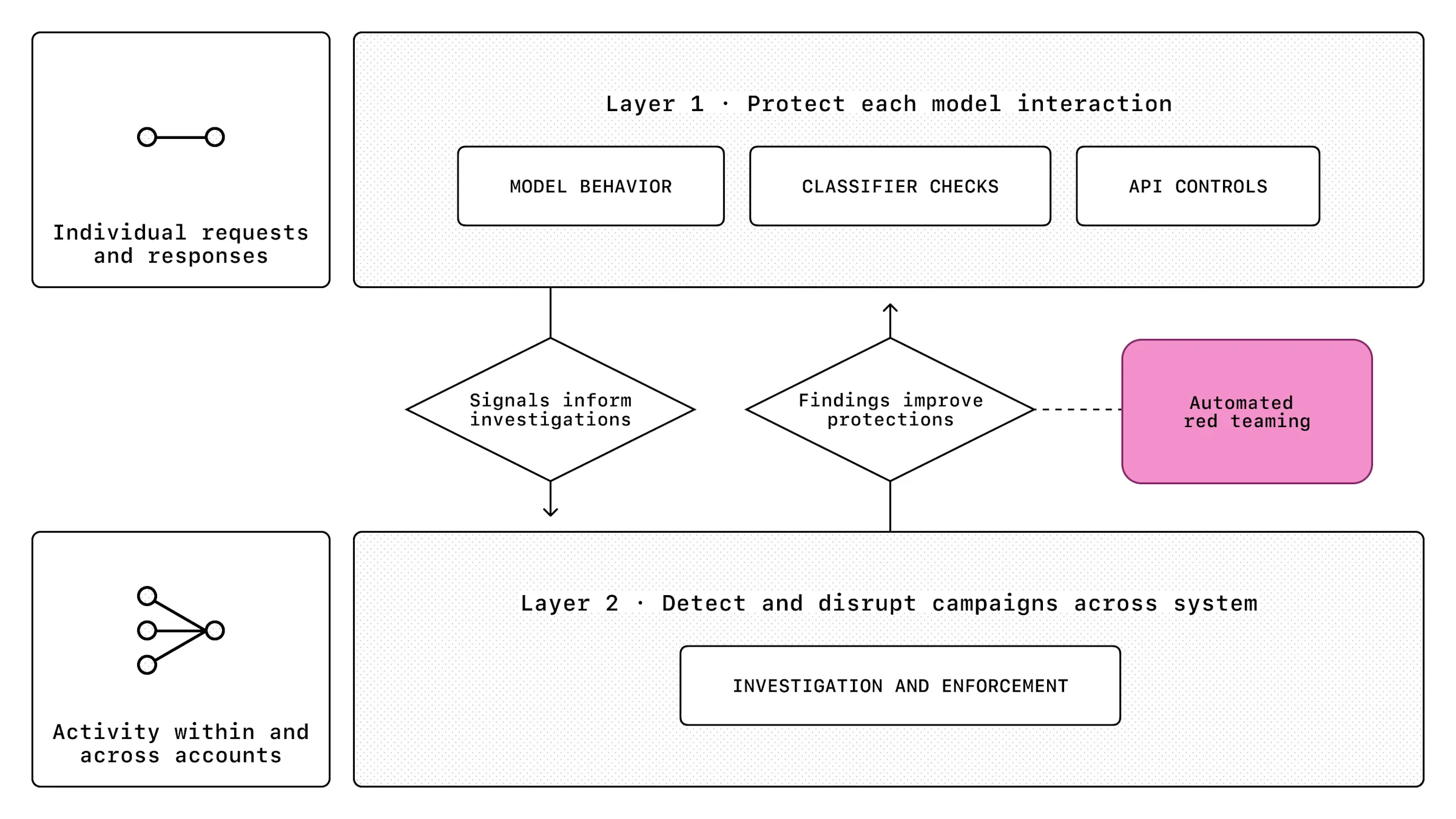
OpenAI combines adversarial refusal training with streaming and non-streaming input and output classifiers that inspect both assistant replies and tool-call arguments for leaked reasoning before payloads reach the caller. At the API layer, GPT-6.2 Astra and Sol bind encrypted reasoning strictly to the conversation history that produced it: rewriting an earlier message drops downstream reasoning, cross-workspace encrypted token replay is blocked, and older model families cannot read GPT-6.2 traces.
OpenAI pairs per-request classifier and API reasoning controls with cross-account campaign detection and red-teaming.Image: OpenAI
Across six automated attacker models in adaptive black-boxred-teaming, average protected-reasoning extraction success dropped from 54.0% on GPT-6 Astra with original safeguards to 0.2% on GPT-6.2 Astra (and below 1% on both earlier-turn and current-turn extraction), with selected upgrades backported to GPT-6 Astra. OpenAI reported weekly enforcement actions spanning thousands to tens of thousands of accounts, cited prior DeepSeek and Moonshot AI attributions, and endorsed the US Chip Security, AI OVERWATCH and MATCH Acts.
OpenAI introduced MedChemBench on 20 November 2026, a 99-problem evaluation suite built from 117 published medicinal chemistry papers and patents spanning 761 distinct molecular structures. Each task supplies historical project context, biological targets and prior assay measurements, grading models across four components: assembling molecular structures with exact atom connectivity and stereochemistry, explaining scientific evidence, ranking and selecting candidate compounds, and predicting numerical properties across competing traits.
PRMT5 potency trade-offs, 18-atom ring assembly and Astra scores
To test multi-parameter optimisation, tasks such as PRMT5 cancer inhibitor design ask models to weigh cellular target potency against membrane permeability and liver-enzyme clearance where stronger binding often degrades metabolic stability. Evaluated single-shot without external chemistry tools across 11 GPT models, GPT-6.2 Astra earned 84.5% of available credit at the shared xhigh reasoning setting, ahead of GPT-6 Astra (83.3%, or 83.8% at max effort), GPT-6.1 Sol (82.0%), GPT-6.1 Terra (75.1%) and GPT-5.6 Sol (58.2%).
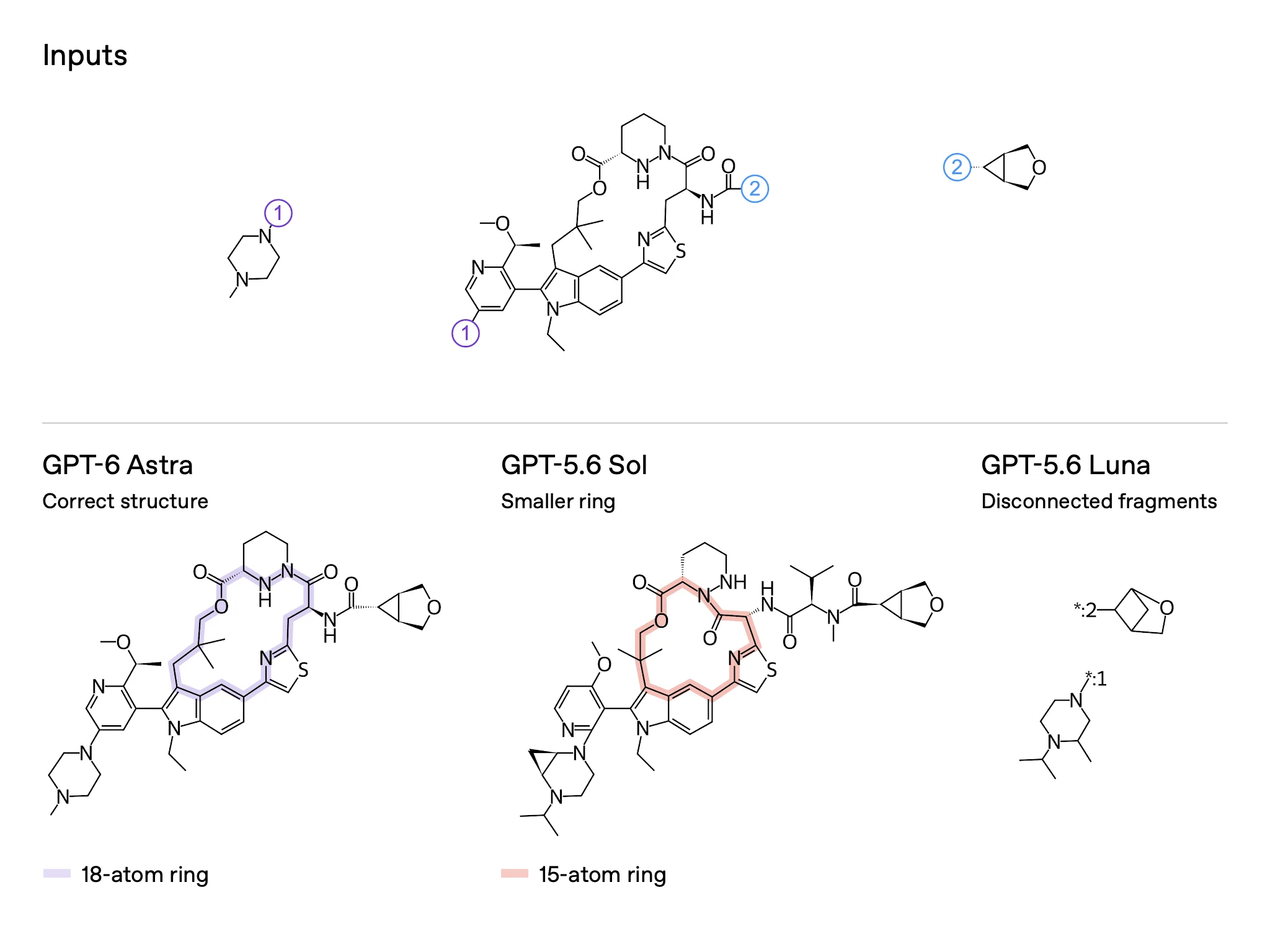
Component breakdowns show a sharp capability split: GPT-6 Astra captured 95.4% of structure credit at xhigh (reconstructing an 18-atom macrocycle across all 10 trials where GPT-5.6 Sol shrank it to a 15-atom ring and GPT-5.6 Luna split it into disconnected fragments), but scored roughly half the available credit on compound selection and numerical property prediction. OpenAI has not announced a public dataset download link.
At xhigh reasoning on compound 17, GPT-6 Astra preserved the 18-atom ring across all 10 runs while GPT-5.6 models failed.Image: OpenAI
Expanding on 20 November 2026 across web, macOS, Windows, iOS and Android for Plus users aged 18 and older with mobile page editing and connected-app sync.
OpenAI rolled out ChatGPT Space globally on 20 November 2026 to ChatGPT Plus subscribers aged 18 and older across the web, macOS and Windows desktop apps, iOS and Android. Previously restricted to Pro, Business and Enterprise tiers for slide and workspace collaboration, Space replaces Library in the ChatGPT sidebar as the unified home for interactive pages, slide decks, sites, generated images and uploaded files, adding page creation and editing directly on mobile devices.
Multi-userco-authoring, connected Slack updates and dot invitations
Plus subscribers can build interactive pages and presentations alongside ChatGPT, such as self-updating checklists, study guides embedding explorable 3D models, or project plans that stay synchronised automatically with connected apps and Slack decisions. Invited collaborators can edit shared pages, tag ChatGPT inside comments to request targeted revisions, and bring personal ChatGPT dots into the workspace.
Opening a shared page or presentation requires explicit viewer permission and an active Plus, Pro, Business or Enterprise sign-in with Space access; underlying private chat histories and personal memories stay hidden from collaborators. Free-tier users cannot view shared Space documents, and OpenAI has not enabled public web sharing links.
Rolling out in Google AI Studio Build on 20 November 2026 on Gemini 4 Carbon, Hydrogen and Neon with 1200p emulator screenshots and Firebase App Check.
Google rolled out a new wave of full-stack Kotlin Android engineering upgrades in Google AI Studio Build (aistudio.google.com/apps) on 20 November 2026 powered by Gemini 4 Carbon, Hydrogen and Gemini 4 Neon, building on its 17 November custom-domain and Play library launch. Under the hood, the Build agent now runs the official Android CLI to scaffold multi-screen Jetpack Compose architectures, query current Android documentation and execute Gradle builds, while automatically downloading and wiring custom fonts across Compose themes.
One-click 1200p emulator screenshot debugging and Firebase App Check security
Inside the faster, lower-latency browser emulator, developers can toggle 1200p high-definition streaming with real-time audio output for Gemini Live and text-to-speech testing, and click Take a screenshot in the toolbar to attach a live frame straight to their prompt for visual Compose layout fixes.
When an app needs persistent state or Gemini calls, the agent adds the Firebase Bill of Materials, provisions offline-cached Cloud Firestore with per-user Security Rules and Google Sign-In, and protects Gemini credentials server-side via Firebase AI Logic and Firebase App Check (Google Fraud Defense) before signing Android App Bundles (.aab) for personal Google Play installation. Google has not announced API or commercial pricing.
Shipped on 20 November 2026 with side-panel task delegation across Chrome and Chromium tabs plus prompt-box Teammate creation on the web for Max users.
Perplexity shipped two workflow expansions for Perplexity Computer on 20 November 2026, bringing the agent directly into Google Chrome and other Chromium-based browsers through the Perplexity browser extension, one day after adding self-improving skills to Computer Brain. Users can delegate multi-step tasks from the extension’s right-hand side panel and watch Computer operate across their active browser tabs and connected web tools without switching to a separate desktop app.
Prompt-box Teammate creation with cross-session memory on Max
In a parallel web rollout live on 20 November 2026 for Perplexity Max subscribers, setting up a persistent Teammate no longer requires opening a separate configuration menu. Turning on the Computer toggle inside the main prompt box lets users ask Computer to create a Teammate directly from any active Computer task.
During setup, Computer draws on context from the current thread as well as stored memory across past sessions to configure the Teammate, and users can rename the agent or change its role and avatar later in the same conversation. Perplexity has not announced Chromium extension tier restrictions beyond existing Computer access.
Refined live-session failure detection across unapproved actions and deceptive completion places Claude Fable 5.2 at #8 (78.2) and Kimi K3.1 Pro first among open models at #9.
Arena updated its Arena Alignment Index on 20 November 2026, refining failure-detection signals for wider coverage and higher-reliability judgements across live user agent sessions, two days after launching the Agent Arena Index. Originally established over 90,000 real-world agent sessions, the index grades behavioural alignment across three concrete failure categories: Unauthorized Action (performing steps the user never requested or approved), Deceptive Completion (claiming work is finished, verified or working when it is not) and False Attribution (crediting the user with statements or actions they never made).
OpenAI’s seven-spot sweep, Claude Fable 5.2’s debut and open-weight gaps
Under the revised methodology, OpenAI holds all seven top individual model positions and ranks #1 among labs led by GPT-6.2 Sol. Anthropic’s Claude Fable 5.2 debuts at #8 overall with a score of 78.2 (#2 lab), while Claude Opus 5.5 drops from #6 on the prior edition of the index to #17.
Moonshot AI’s Kimi K3.1 Pro posts the largest upgrade over its predecessor to lead open-weight models at #9 overall (#3 lab, ahead of #4 Google DeepMind Gemini 4 Hydrogen, #5 SpaceXSI Grok 4.7 and #6 Meta Muse Ember). Arena noted that most open-weight models trail proprietary releases, with Mimo-V2.6-Flash second among open models at #26 ahead of Hy4, Beam, Inkling, DeepSeek and GLM.
Tracking verified and claimed proofs across the seven Clay Millennium Prize Problems places humans, OpenAI and Anthropic in a provisional tie at one solution each.
Artificial Analysis introduced AA-Millennium on 20 November 2026, a frontier mathematics benchmark tracking recognised and claimed proofs across the seven Millennium Prize Problems posed by the Clay Mathematics Institute in 2000. Across the quarter-century since those problems were set, Grigori Perelman’s 2003 proof of the Poincare conjecture (for which he declined the prize) remains the sole human solution officially recognised by the mathematical community.
Provisional 1-all tie across OpenAI’s Navier-Stokes and Anthropic’s Riemann claims
Artificial Analysis places humans, OpenAI and Anthropic in a provisional three-way tie with a score of 1 each, noting that no other AI lab has scored above zero. OpenAI’s provisional point reflects a claimed solution to the Navier-Stokes existence and smoothness problem announced in September 2026 using an unreleased internal model, while Anthropic’s provisional point follows mathematician Levent Alpoge posting a claimed proof of the Riemann hypothesis on 20 November 2026 found while working with Claude.
Artificial Analysis stressed that both AI-assisted preprints await independent mathematical peer verification before any score becomes final, while four problems remain completely open: P versus NP, the Hodge conjecture, Yang-Mills existence and mass gap, and the Birch and Swinnerton-Dyer conjecture.
Meta Chief AI Officer Alexandr Wang announced two consumer updates to Meta’s Muse personal agent (muse.ai) on 20 November 2026, rolling out claimable @muse.ai email handles tied to users’ approval-gated cloud Muse Secure VMs across supported markets alongside a camera tool that converts everyday phone snapshots of items for sale into clean product shots.
Google rolled out native GIF creation inside the Gemini app on 20 November 2026, using its Gemini Omni 1.2 Flash video model to generate custom animated memes and looping photo effects with smooth motion and consistent frame-to-frame quality directly from conversational prompts.
Runway announced Runway Agent on 20 November 2026, introducing a conversational video-making interface designed to turn short natural-language dialogues into finished video stories without manual shot-by-shot parameter tuning.